


Estoc (Harnischkampfschwert)
The estoc (Polish estok, English and French estoc) is a sword with a very narrow and rigid blade, designed to penetrate a gap in plate armour and subsequently through the mail armour beneath. It differs from the similar koncerz (Polish koncerz) primarily in its two-handed grip although both types of swords are often confused in the literature. In German, both the koncerz and the estoc fall into the category of Panzerbrecher (armour piercer) swords, but for the variant of the estoc used in Harnischfechten (fencing in armour), the Germans have the term Harnischkampfschwert. To make matters even more confusing, the term Harnischkampfschwert is used for all swords intended for Harnischfechten, including practice swords with a recessed blade for the grip called Halbschwert, which however do not have as narrow a blade as estocs. This article, however, will deal with a special category of estocs (harnischkampfschwerts) that are modified in some way for delivering strikes, especially the well-known Mortschlag. Such estocs, on the borderline between a sword and a war hammer, have survived — probably three.
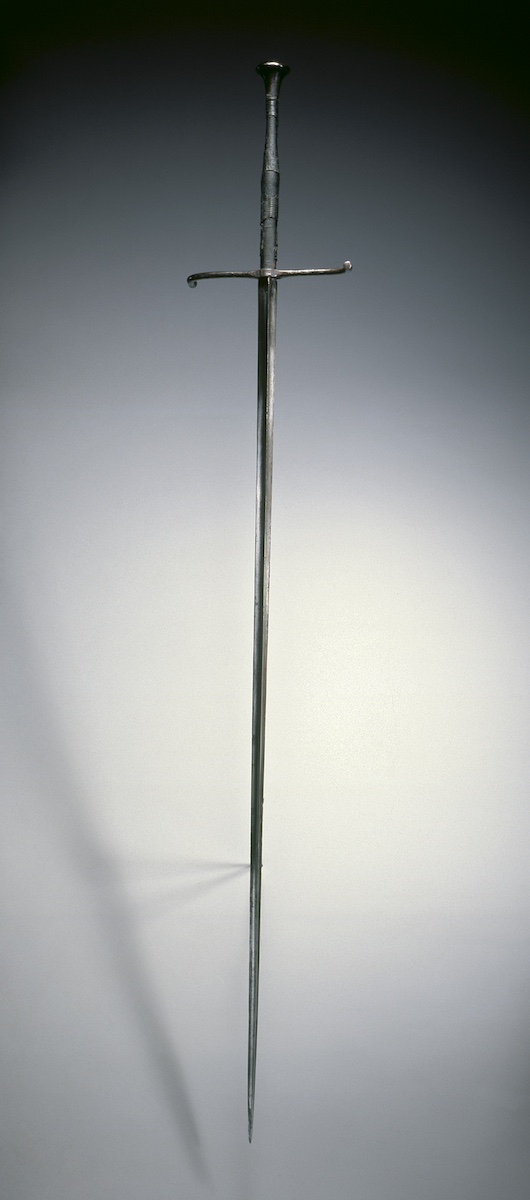
A classic estoc with a two-handed grip from the early 16th century.
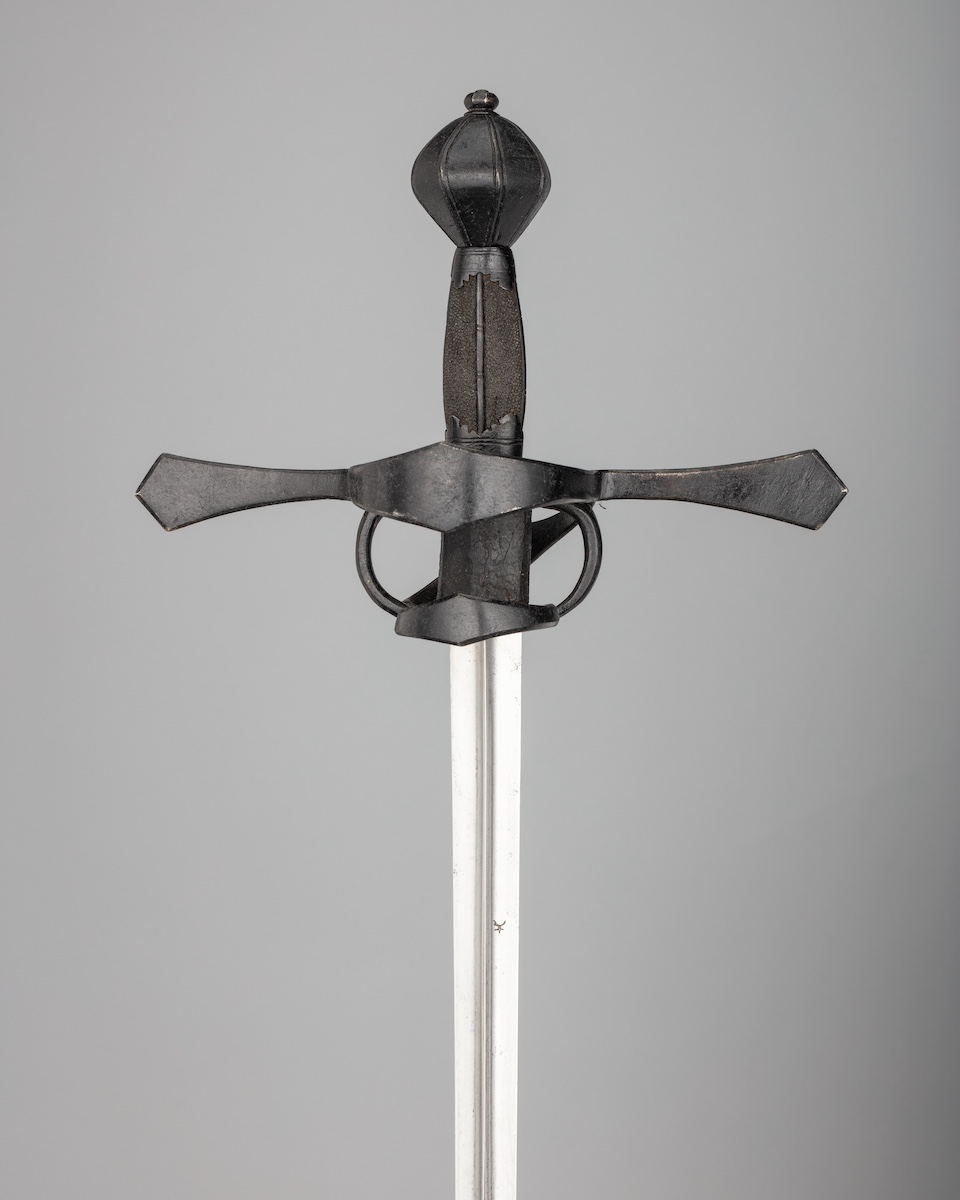
A koncerz with a one-handed grip from the Metropolitan Museum of Art in New York, late 16th century.
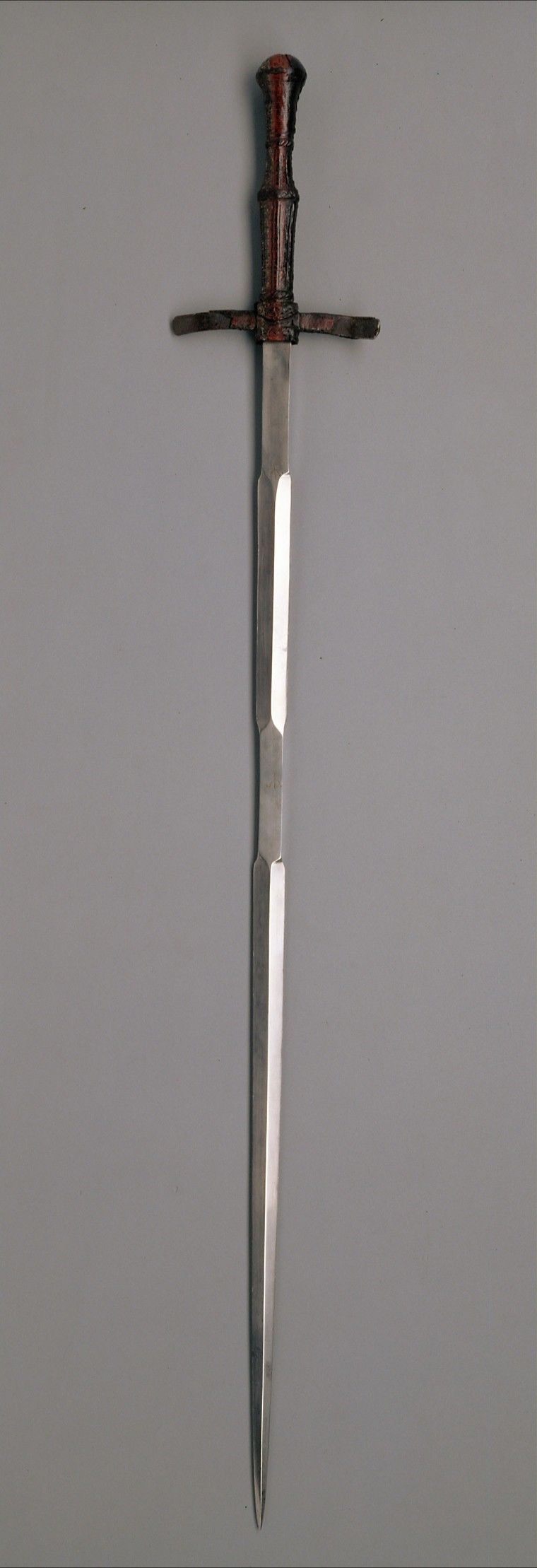
A practice Harnischkampfschwert from the Kunsthistorisches Museum in Vienna, which is not an estoc.
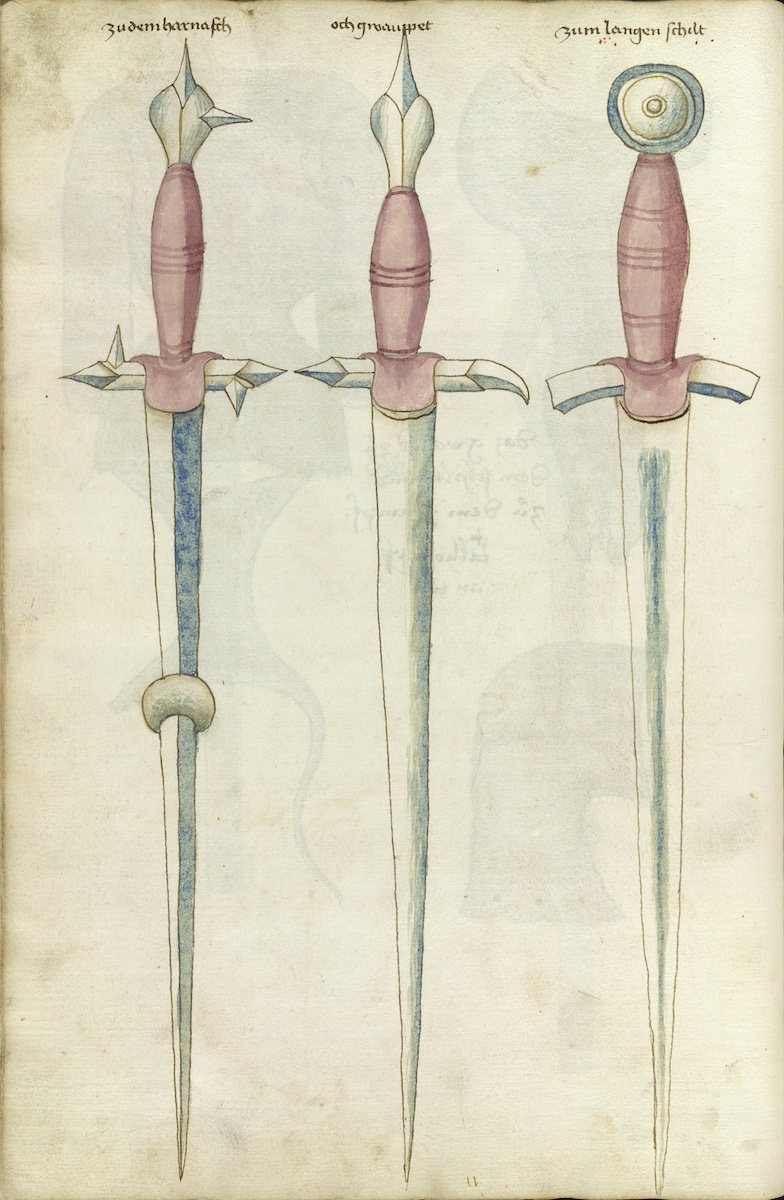
Harnischkampfschwerts (the first two; the third is intended for combat with a shield) in an illumination from the manuscript of Hans Talhoffer, 1459.
The so-called “Teutonic estoc”


Fig. 1
This estoc is part of the deposit of the Czartoryski Princes Museum, now kept in the armoury of the Royal Wawel Castle in Kraków, under inventory number MNK XIV-49. It is dated approximately to the 14th or 15th century. It has a completely preserved thick steel blade of rectangular, almost square cross-section, which tapers to a slightly rounded tip. Neither the edges nor the tip show any signs of sharpening. The guard has the shape of a simple cross made of thick steel rods that taper to rounded points and are also of an almost square cross-section (fig. 3 and 4). The tang is thick and of square cross-section (fig. 3), flattened in the plane of the guard. There is enough room on the grip for approximately one and a half average male hands. A provisional wooden covering has been placed on the tang. It is slightly wider in the middle (fig. 1). However, it covers only one side and is probably much younger than the artefact itself, on which it is held only by a silver plaque bearing the inscription “Teutonic from the royal treasury”, affixed in the mid-19th century. The pommel is large and massive, shaped as an irregular tetrakaidecahedron with four concave sides (fig. 5). The entire weapon is 1586 mm long and weighs 4050 g. Its centre of gravity is on the blade, 230 mm from the lower edge of the guard.
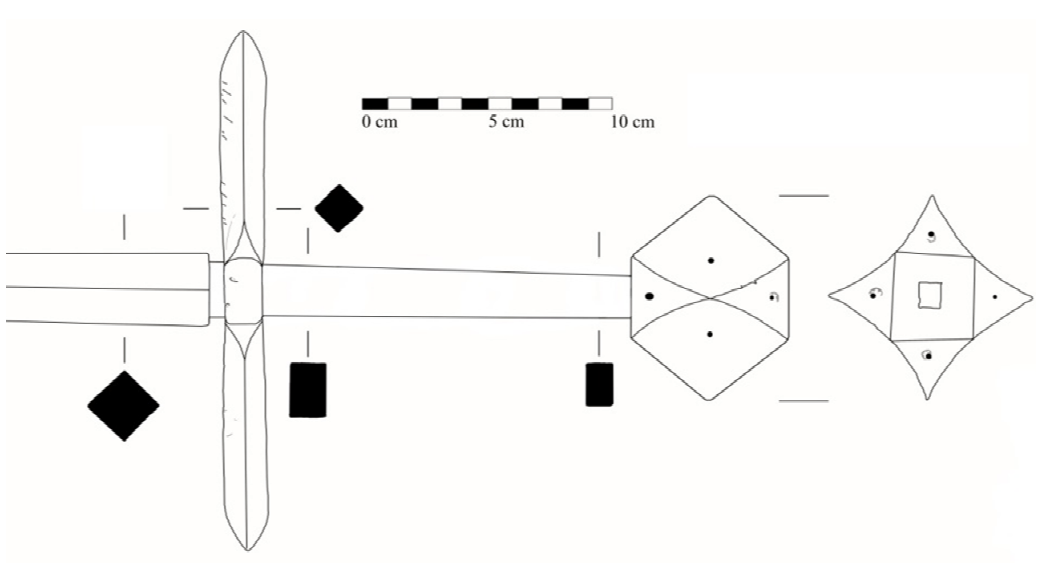
Fig. 3
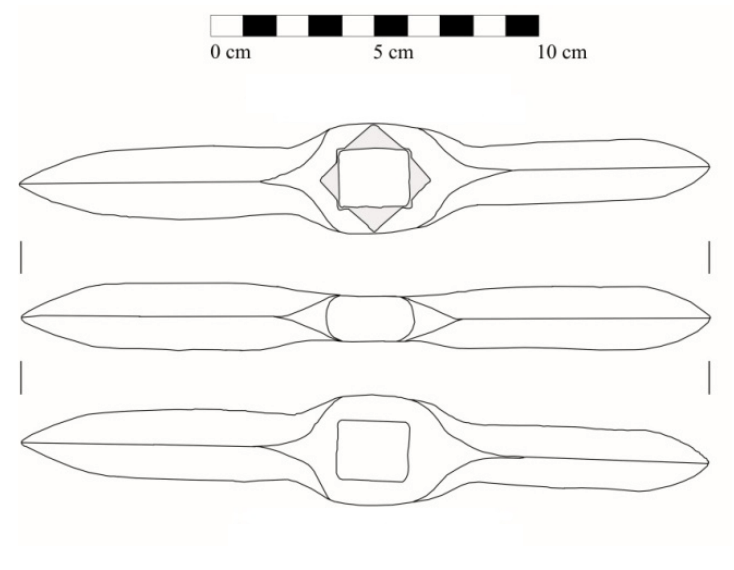
Fig. 4

Fig. 5
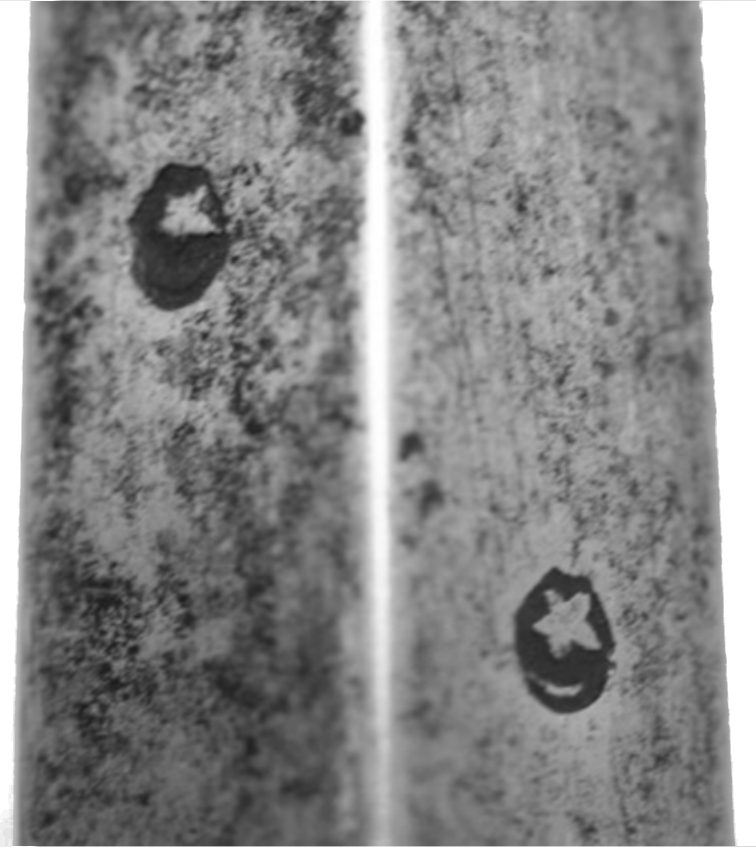
Fig. 8
Blade
The blade is made of steel and is well preserved (fig. 1). The edges and the tip of the blade are slightly rounded. The blade is slightly bent in the plane perpendicular to the plane of the guard. The bend is visible at about three quarters of the blade length, closer to the tip, and does not exceed 1 mm from the long axis of the blade. We are not yet able to determine when or under what circumstances this deformation occurred. On all four surfaces of the blade there are swordsmith's marks in the form of a five-pointed star and a crescent, each with a diameter of 5 to 6 mm (fig. 8). Two marks on opposite sides of the blade are placed 45 mm from the lower edge of the guard, while the other two are 53 mm away. The blade is 1346 mm long. At the guard, its width is 29.5 mm and its thickness is 25.5 mm.
Guard, Hilt and Pommel
The pommel is large and massive (fig. 5, 6 and 7). On its twelve faces there are circular dimples with a diameter of 2 to 4 mm and a depth of up to 2 mm (fig. 5 and 6). In addition, three swordsmith's marks were engraved on it, analogous to those on the blade, of which one is completely preserved. The complete mark has a circular shape and its diameter is 4 mm. The diameters of the remaining marks are smaller, approximately 3 mm. The tang is thick and robust, corresponding to the size of the pommel and the blade (fig. 3). But one unusual detail draws attention. The tip of the tang does not protrude above the upper part of the pommel in the slightest and shows no signs of peening (fig. 3 and 7). Moreover, it is surrounded by a dark distinctive stain, which perhaps indicates a missing rivet (fig. 7). The guard is robust (fig. 3 and 4). Its arms have rounded tips and, like the blade, have an almost square cross-section with a diagonal of 13 mm. The guard is 208 mm long. On both sides there are some minor scratches and abrasions or dents, but generally no traces of use or wear are visible to the naked eye. The hilt is well preserved. All elements are made of steel, but since no chemical analysis has been performed, its quality remains unknown. The dimensions of the pommel are: height 63 mm, width 84 mm, thickness 85 mm.
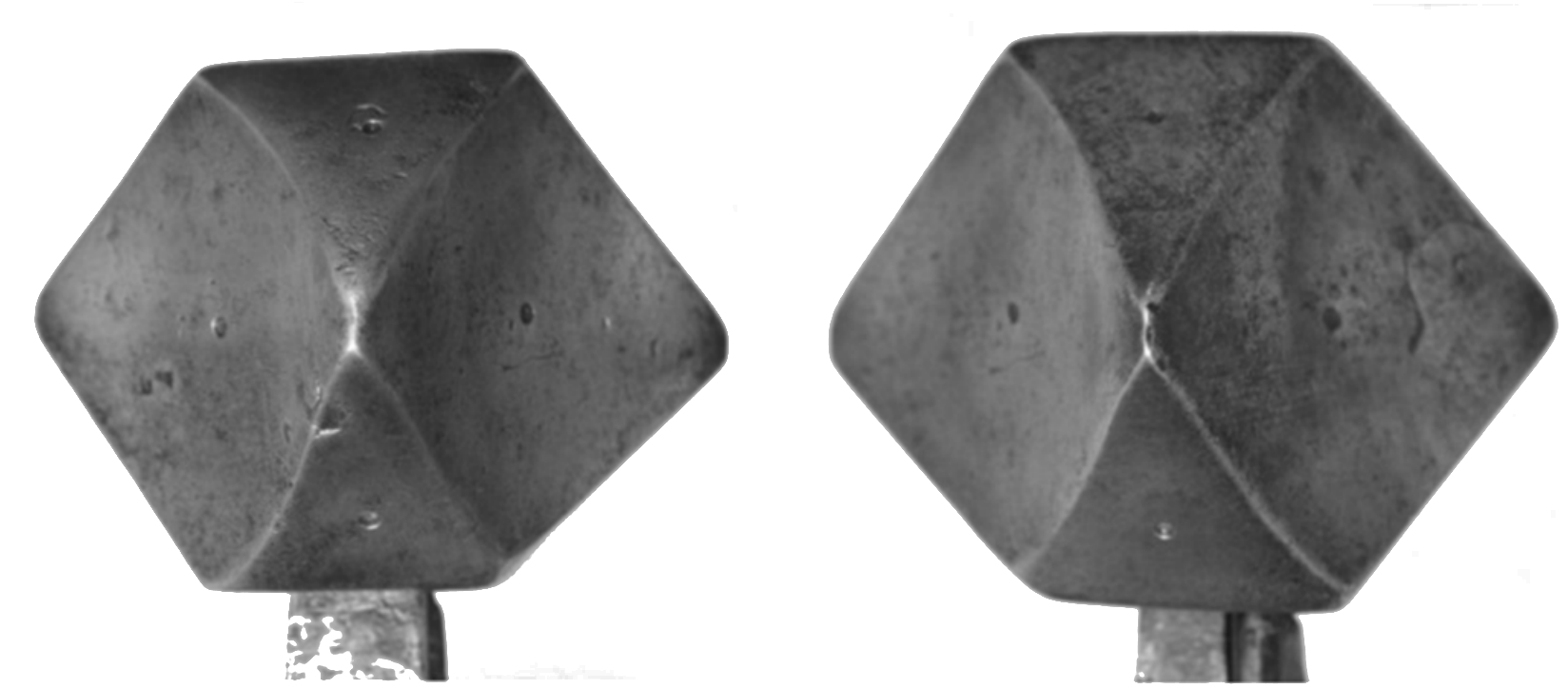
Fig. 6
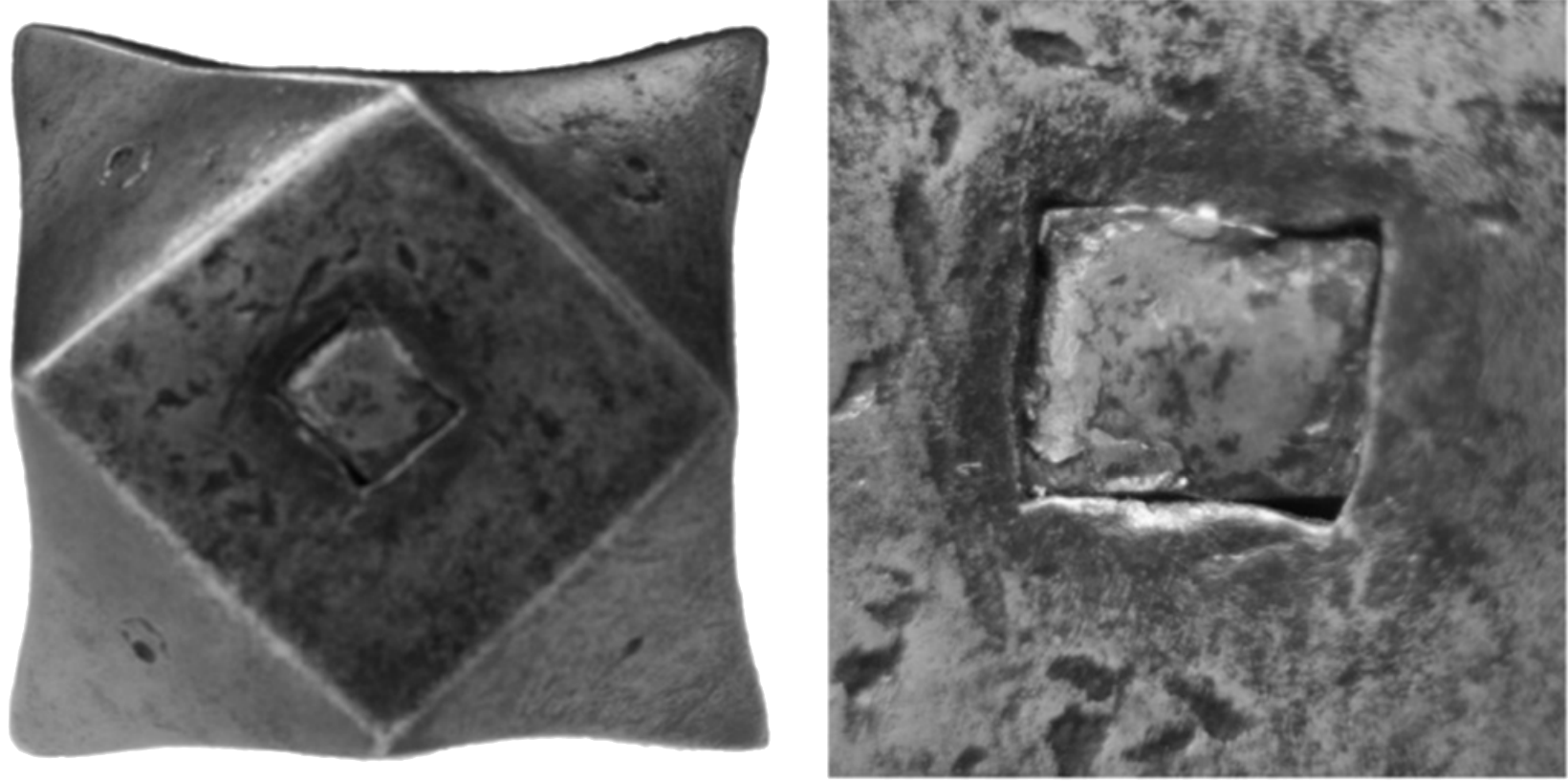
Fig. 7
Estoc from Vilnius
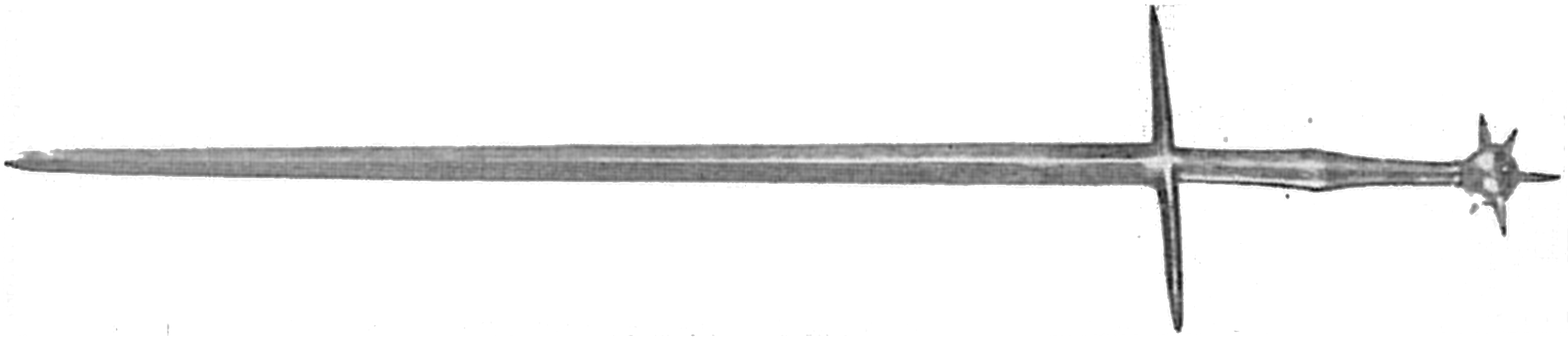
This estoc is kept in the Lithuanian National Museum in Vilnius (registered as a 'two-handed sword', inventory number IM-839). Unfortunately, the only available photographs come from the museum's collection catalogue published in 1979. They show a weapon resembling an estoc with a blade of rectangular cross-section, a two-handed grip, sharp guard tips and a round, pointed pommel. Its written description is consistent with these observations. The known dimensions of the artefact are: total weapon length 135 cm and blade length 99 cm. It is dated between the 14th and 16th centuries and provides the closest known analogy to the above-mentioned Kraków estoc. Unfortunately, the museum staff in Vilnius consider it a 19th-century forgery, which was not recorded in the aforementioned catalogue. However, it seems that there is currently no decisive evidence for this notion. Moreover, the weapon is very similar to swords depicted in the compendium of Paulus Hector Mair.
Estoc Combined with a Handgun
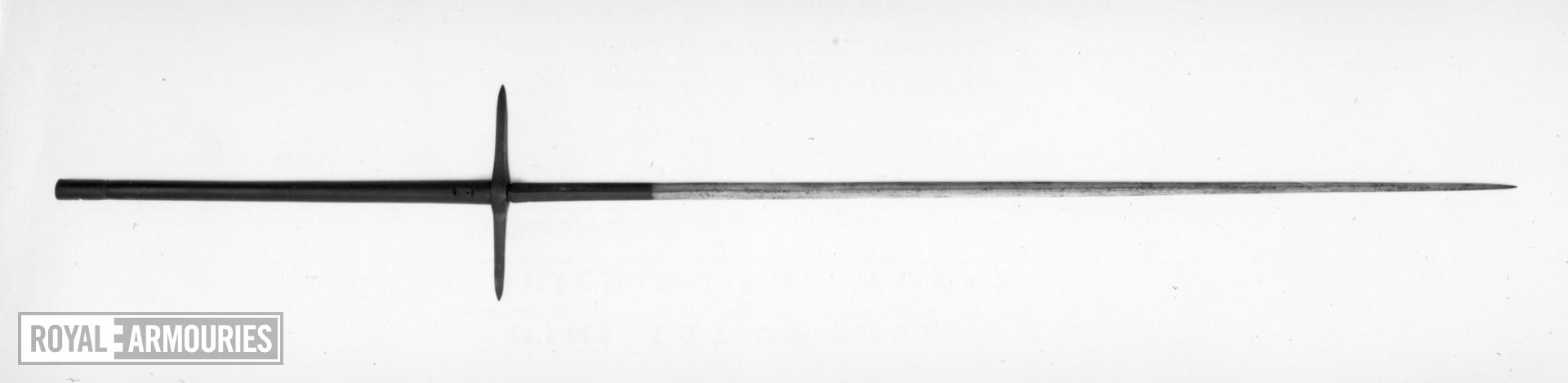
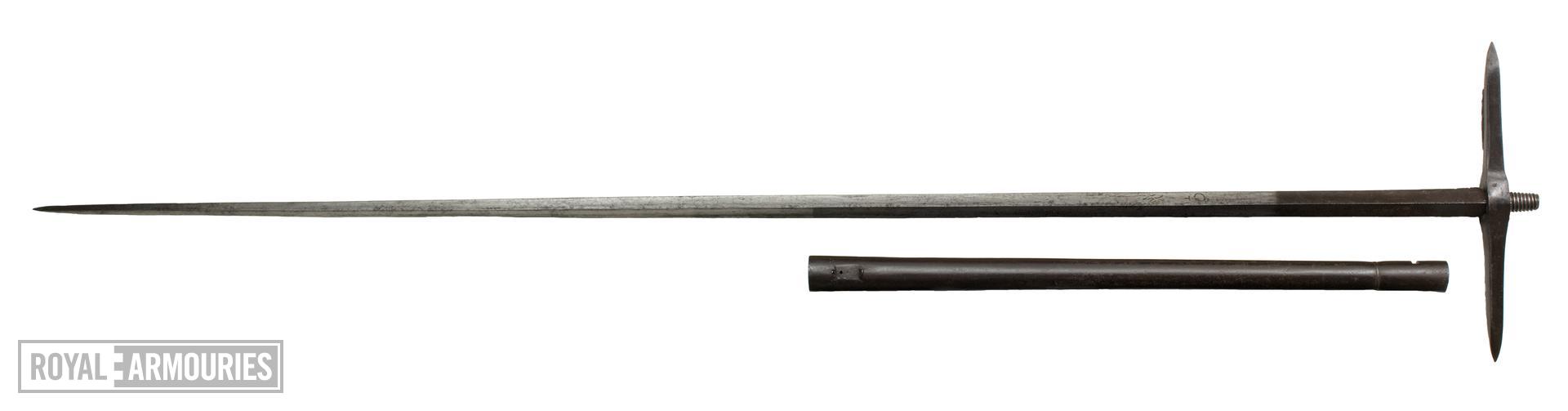
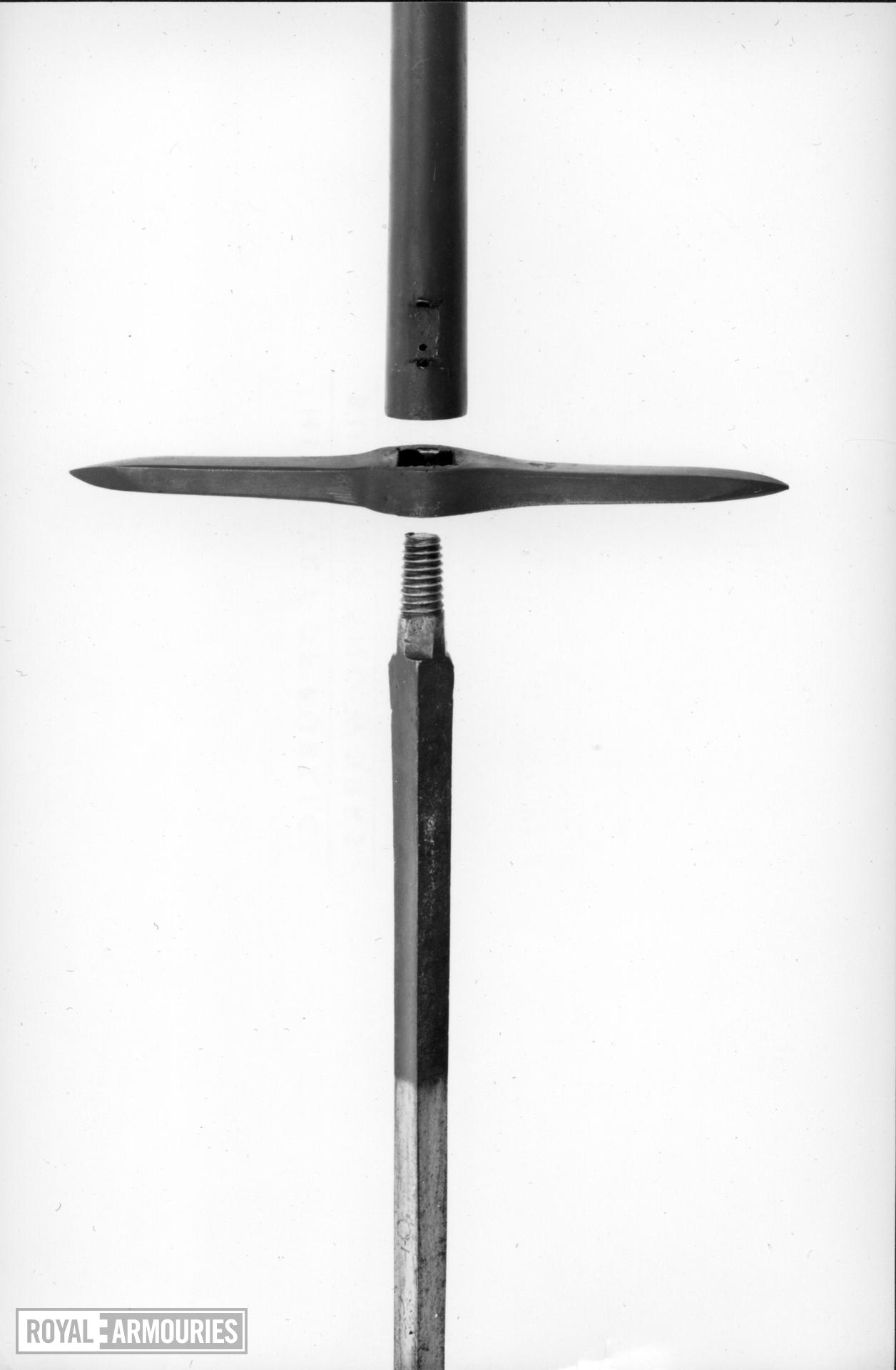
This weapon is in the collections of the Royal Armouries in Great Britain under inventory number XIV.10. It combines an estoc with a handgun. It is dated to around 1520 and is believed to have once belonged to the notorious King Henry VIII. It has an estoc blade and a robust, pointed guard, while instead of a hilt and pommel it has a handgun barrel, which is attached to the tang terminating in a screw. The weapon is 195 cm long. Unfortunately, nothing more detailed about it has been published so far.
Sources:
If you enjoyed this article, please consider making a small financial contribution. Writing articles is very time consuming and we do it in our free time.
IBAN: CZ39 2010 0000 0028 0346 2929
BIC/SWIFT: FIOBCZPPXXX