


Cloak
The cloak was a very popular type of men's and women's outer garment. Its cut varied greatly and the names of individual types of cuts considerably overlapped, making it quite difficult today to distinguish which specific type of garment was meant. We can encounter terms such as plášček, pláščík; in the Luxembourg period it began to be called klok, kloček, from the French form cloque, Latin clanis, further Latin pelicio, German tasselmantel, mantl and mantlík. Most commonly, we encounter cloaks of a semi-circular cut, but a three-quarter circle cut was also worn. The length of the cloak varied and it could come in a whole palette of colours, but blue, green, pink and grey clearly predominated.
The cloak was most often fastened at the chest under the chin. An ornamental brooch called an agrafa could serve this purpose; its shape, colour and decoration had religious significance, which is why we often encounter a lozenge-shaped agrafa decorated with precious stones arranged in the shape of a cross, or its vertices could be finished with pearls resembling a lily. A semi-circular cloak fastened with an agrafa is most frequently found in depictions of the Virgin Mary. Furthermore, cloaks were fastened with a cord or strap, or with a decorative band placed across, or also, especially for shorter cloaks, with three buttons under the chin or more often on the shoulder.
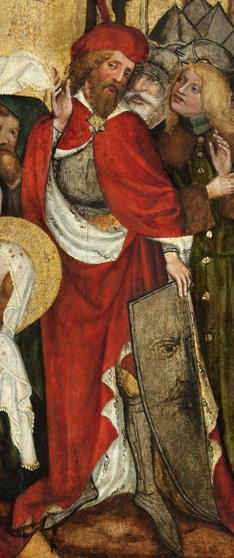
A long cloak fastened with an agrafa in an excerpt from the Crucifixion from Nové Sady, 1440.
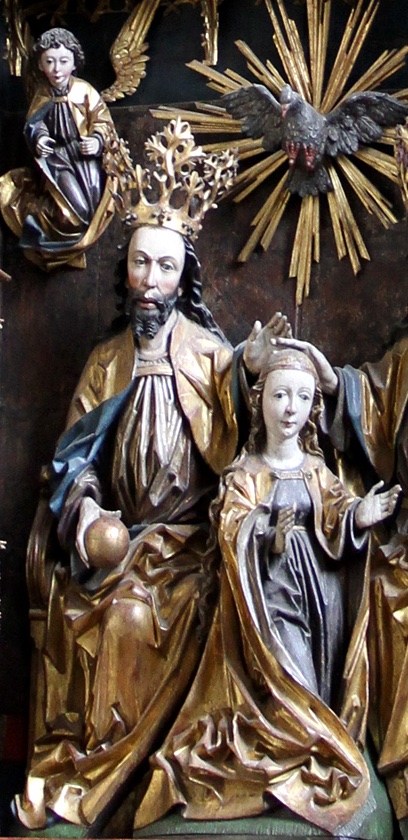
Long cloaks fastened with a band of fabric, Křivoklát Altarpiece, probably 1483.
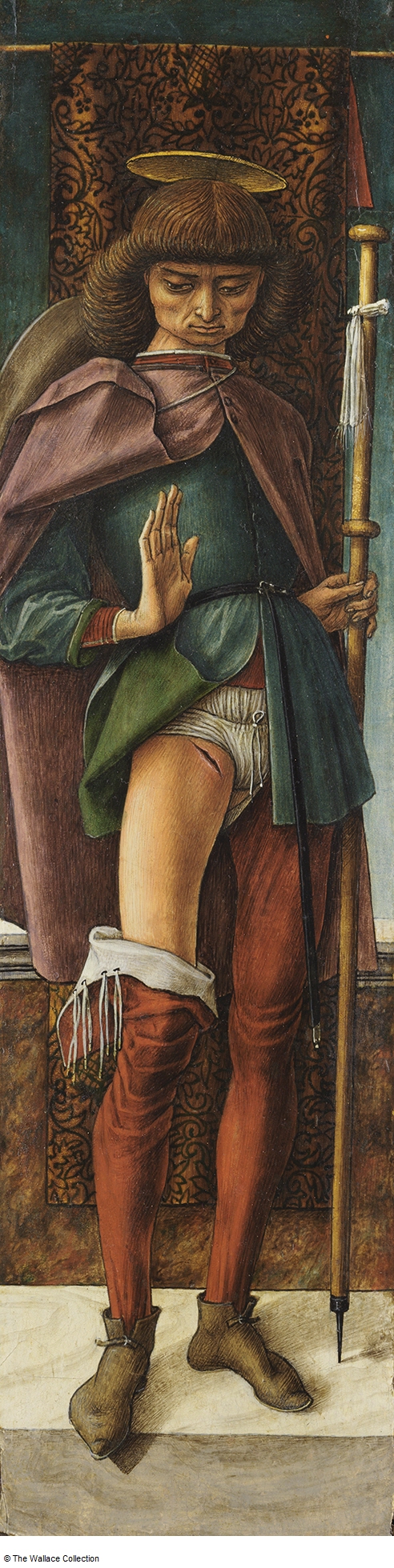
A shorter cloak fastened with three buttons at the front on the painting of St. Roch of Italian provenance, 1480.
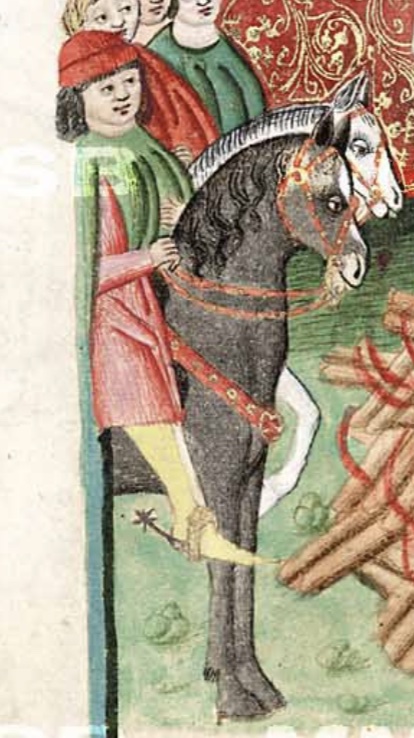
A shorter cloak fastened at the shoulder, excerpt from the Codex of Jena (1490-1510).
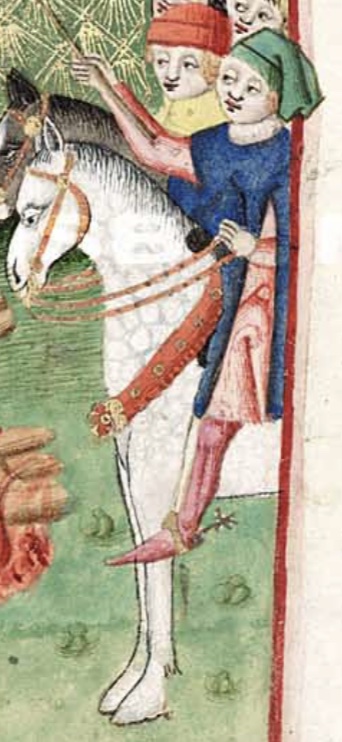
A shorter cloak fastened at the shoulder, excerpt from the Codex of Jena (1490-1510).
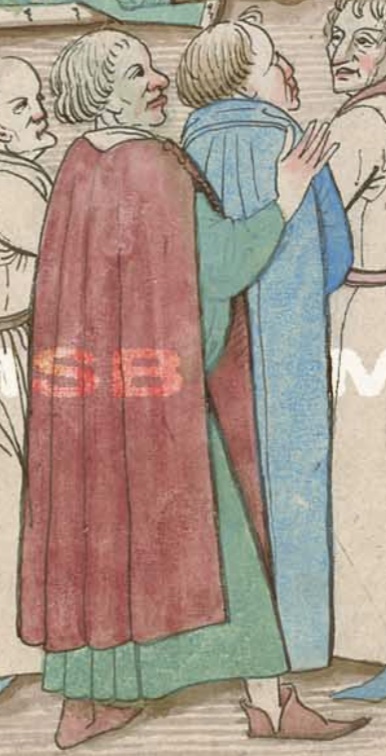
A cloak fastened with buttons at the shoulder, excerpt from the Richental Chronicle (1470-1480).
Another group of cloaks comprises cloaks that some scholars today refer to by the artificial term cloak-tunic. Two types of cloaks fall into this category: the first, called a huque, and the second, which has slits for the hands and is closer to a gown or the Western European houppelande.
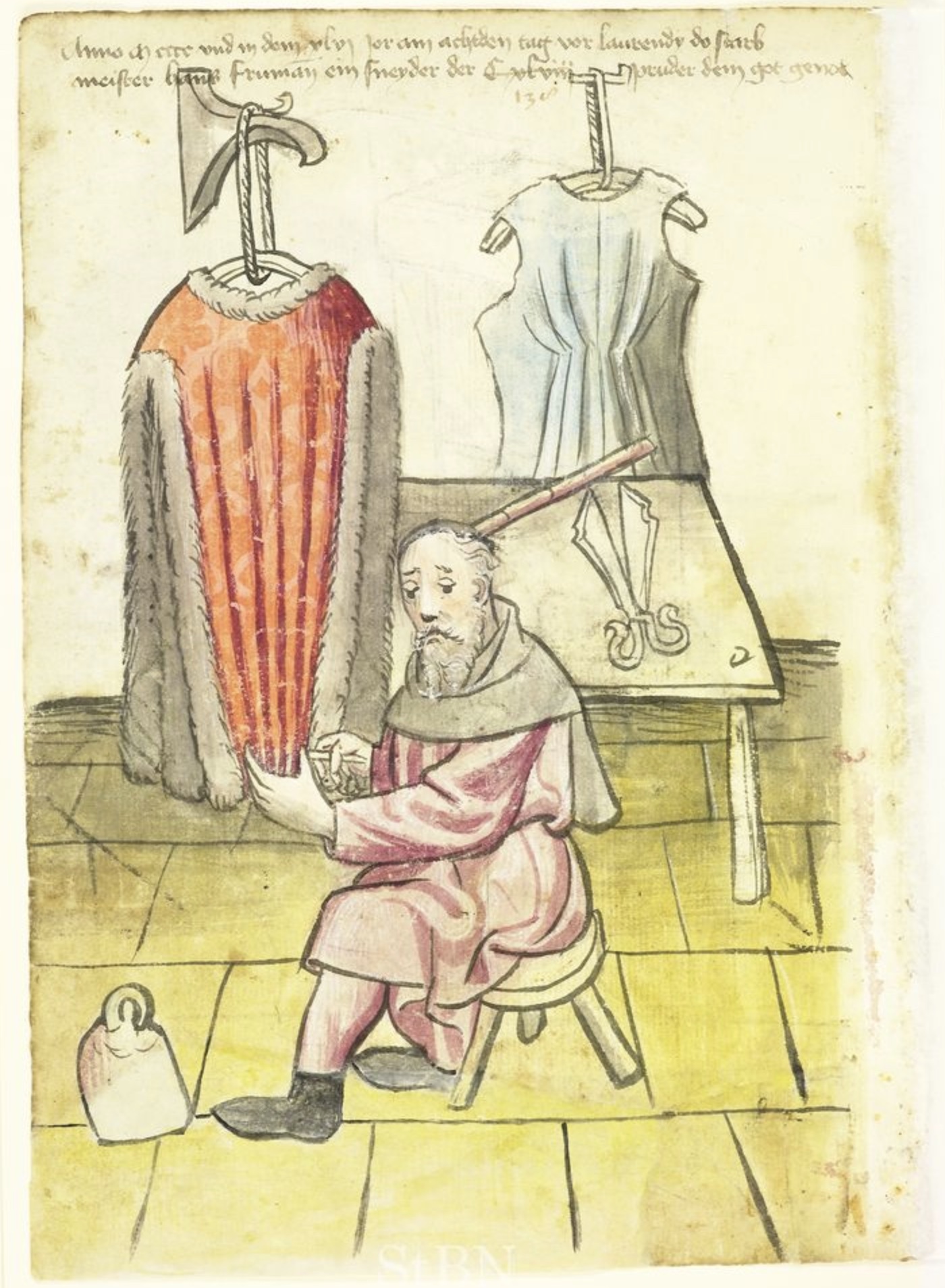
Nuremberg tailor Hans Frumann creates pleats on a cloak-tunic, a page from the House Book of the Nuremberg Twelve Brothers Foundation, 1446.
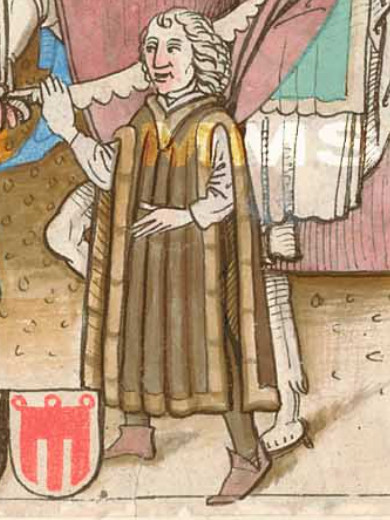
A cloak of the huque type, excerpt from the Richental Chronicle (1470-1480).
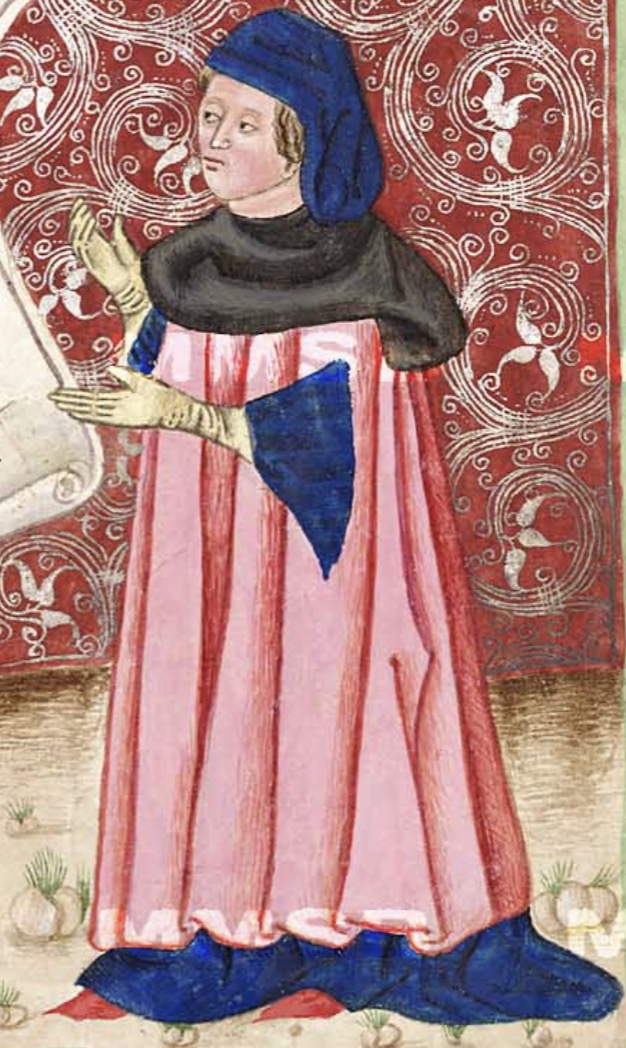
A cloak with slits for the hands, excerpt from the Codex of Jena (1490-1510).
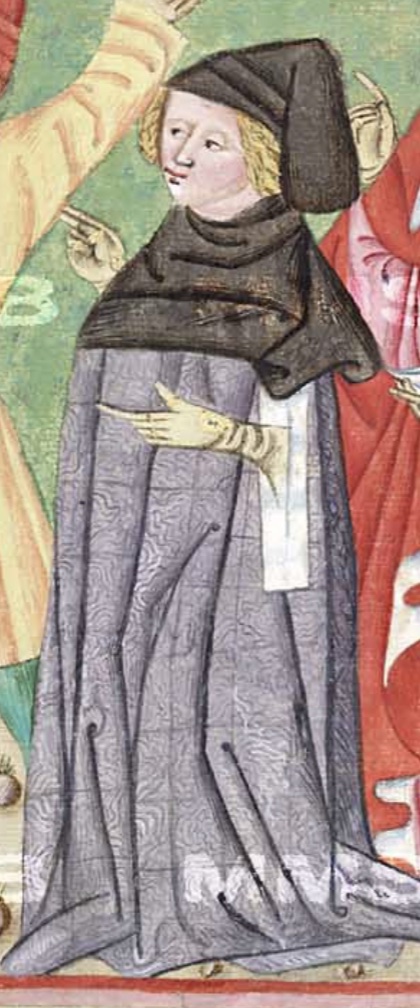
A cloak with slits for the hands, excerpt from the Codex of Jena (1490-1510).
Sources:
If you enjoyed this article, please consider making a small financial contribution. Writing articles is very time consuming and we do it in our free time.
IBAN: CZ39 2010 0000 0028 0346 2929
BIC/SWIFT: FIOBCZPPXXX