


The Waldshut War
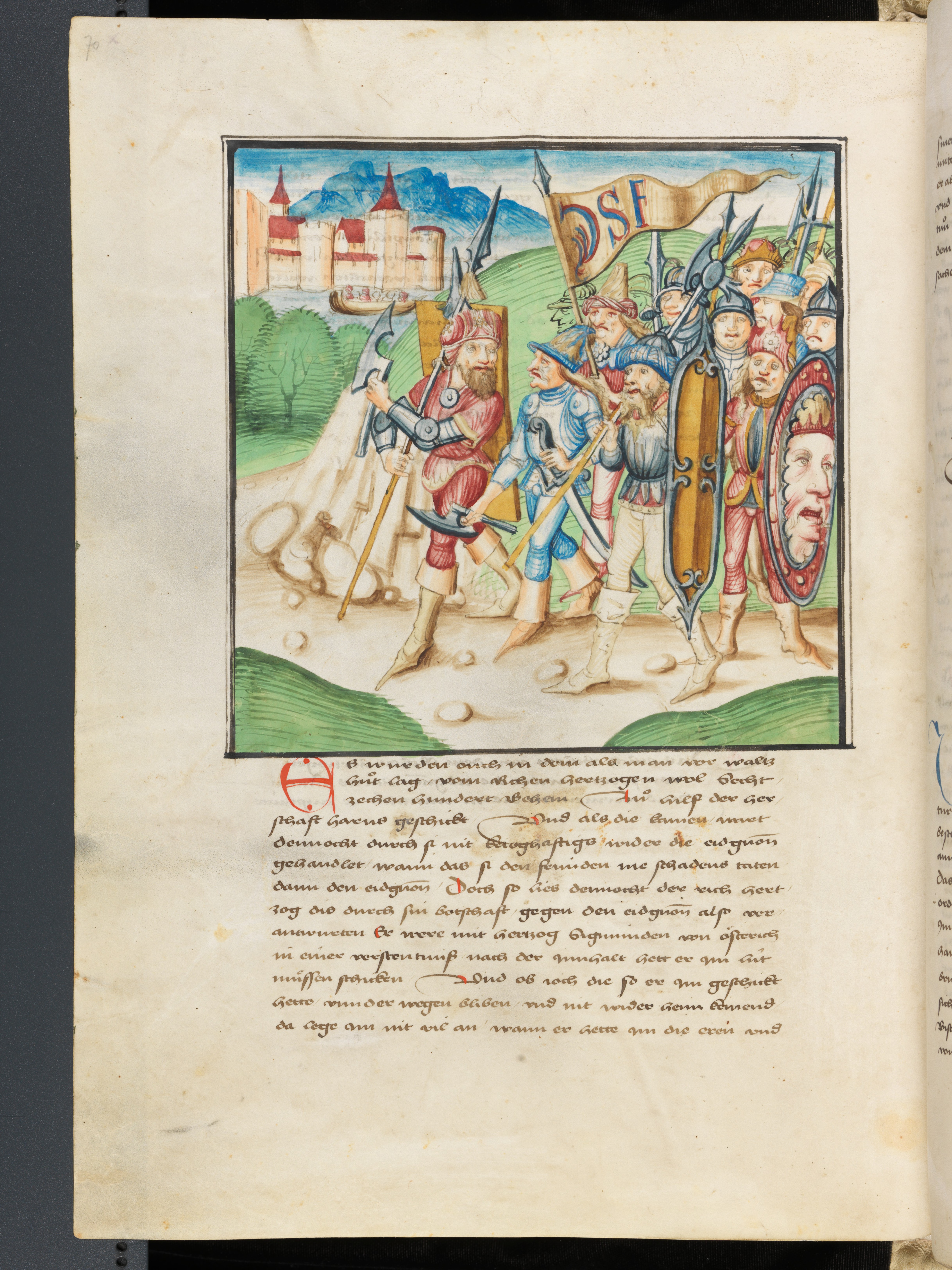
Bohemian troops arriving in 1468 to relieve the besieged Waldshut, Amtliche Berner Chronik (1478–1483)
The Waldshut War (also known as the Schaffhausen War) was part of the military conflicts in 1468 between the nobility in the Sundgau, Breisgau, Klettgau and Hegau regions and Further Austria under the leadership of Habsburg Duke Sigismund the Rich on one side, and eight cantons of the Old Swiss Confederacy together with several allied cities on the other. The main focus of the fighting was Waldshut, which was besieged and partially destroyed.
In the second half of the 15th century, clashes between the aristocratic supporters of the Habsburgs and cities in the southern German region became increasingly frequent. Nobles often descended to the level of robber knights, raiding urban merchants with growing frequency. The Swiss Confederates sought to exploit these disputes to expand their influence north of the Rhine. They concluded defensive alliances with the cities of Schaffhausen (1454), Rottweil (1463) and Mulhouse (1466). Two events led to the escalation of the conflict:
- The city of Schaffhausen concluded an alliance on 1 June 1454 for 25 years with the Confederate cantons of Zurich, Bern, Lucerne, Schwyz, Zug and Glarus after Bilgeri von Heudorf attempted to re-subject Schaffhausen to the Habsburgs. Bilgeri von Heudorf continued his hostility towards the city, and in 1467 the situation escalated when he captured the Schaffhausen mayor Hans Amstad near Anselfingen and released him only after payment of a ransom of 1,800 guilders. The Confederates sent troops to reinforce the city, and a detachment of men from Unterwalden under the command of Captain Kaspar Koller undertook a plundering raid into the Klettgau region.
- The city of Mulhouse concluded an alliance on 17 June 1466 for 25 years with Bern and Solothurn. Mulhouse, which was heavily oppressed by the nobility in an undeclared petty war, sought a military solution and, trusting in its alliance treaty, went on the offensive. In April 1468, Mulhouse units raided the villages of Rixheim and Sausheim, which belonged to the nobility. The estates of Further Austria wanted to punish this attack, and on 15 May 1468 they marched with 4,000 men before Mulhouse and devastated its surroundings. On 18 June 1468, Bern, Solothurn and Fribourg declared war on Duke Sigismund – and soon the other Confederate cities followed suit.
The Sundgau Campaign
On 25 June 1468, the Bernese and Solothurn forces invaded the Sundgau region from the direction of Basel, advancing through Blotzheim, Bartenheim and Habsheim towards Mulhouse, leaving devastation in their wake. This first echelon was followed by soldiers from Zurich and Schwyz. Units from the inner Swiss cantons then marched through villages on the left bank of the Rhine towards Mulhouse.
On 6 July 1468, the three Swiss echelons met between Thann and Mulhouse on the plain known as Ochsenfeld and expected the forces of Further Austria to engage them in open battle, which however did not occur.
After the Habsburgs and their allies refused to fight at Ochsenfeld, the Confederates attempted to take the town of Thann. At the same time, a detachment of 1,000 men was sent via Wehr and Tiengen to Schaffhausen.
On 16 July 1468, the Confederates withdrew from the Sundgau back through Basel, thus ending the so-called Sundgau campaign or Mulhouse War, and the theatre of war shifted further east.
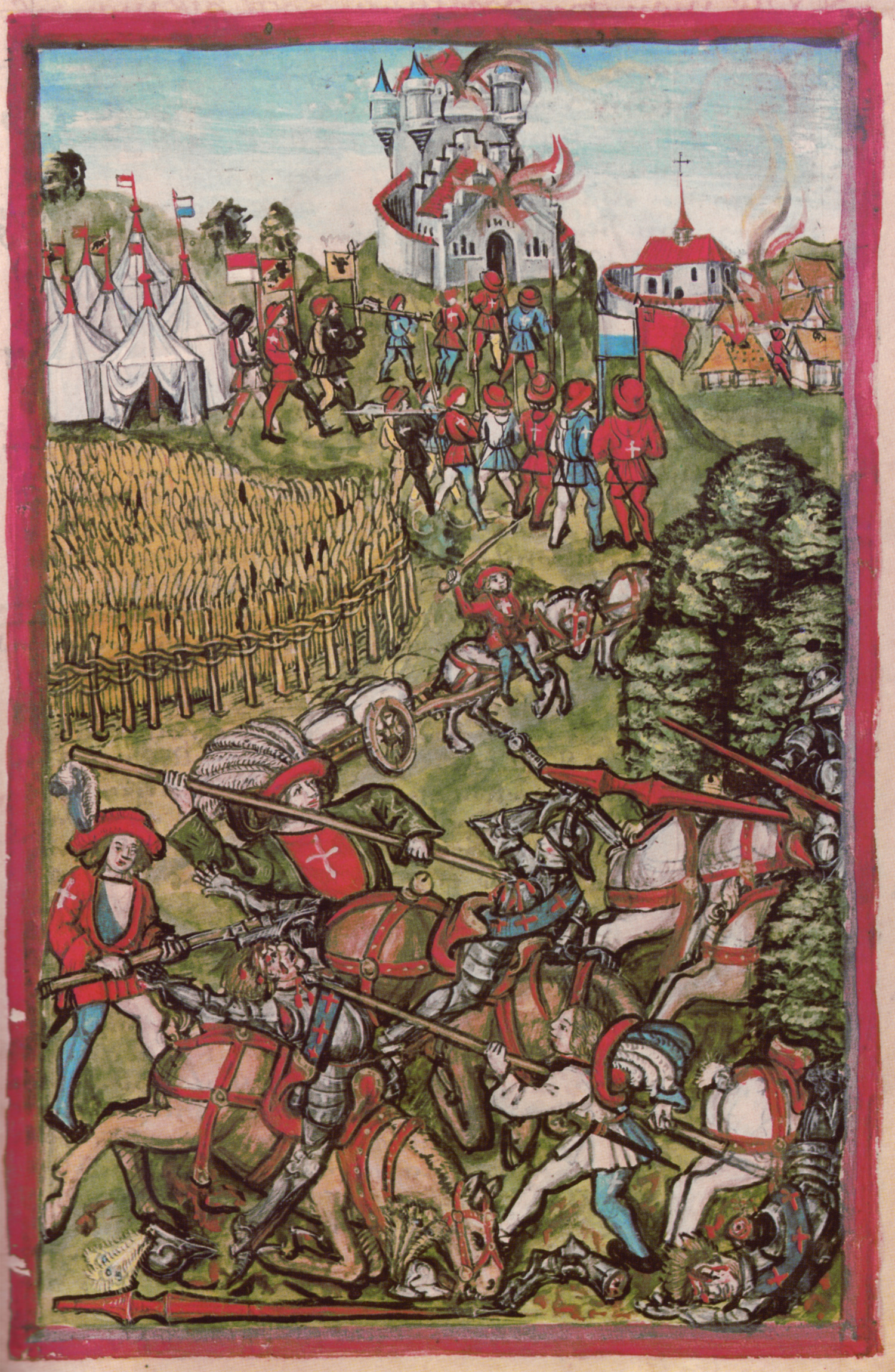
A Swiss (Eidgenossen) supply wagon is attacked by knights of Further Austria. Depiction, Luzerner Chronik (1513)
The Habsburgs, the Nobility and the Imperial Estates
Approximately 800 men were available for the defence of Waldshut. The command was held by Werner von Schienen (1410–1496). Among the defenders were also Wilhelm Herter von Hertneck and Bilgeri von Heudorf. The local nobility had already retreated into Waldshut during the first Confederate incursion into the Klettgau region. The Further Austrian cities of Breisach, Neuenburg am Rhein and Freiburg im Breisgau sent auxiliary detachments.
Waldshut was protected by a circular wall with five towers, fronted by a deep moat and in places also by the River Rhine.
The Breisgau knighthood occupied the section of the Upper Rhine between Rheinfelden and Laufenburg, and conscripts from Further Austrian Breisgau occupied the Black Forest to prevent its inhabitants from joining the Swiss. In this area, Duke Sigismund also deployed Bohemian troops. The exact number of forces that Sigismund deployed during the Waldshut War is not reliably known, but it considerably exceeded the number of the defenders inside Waldshut itself.
Margrave Charles I of Baden feared that the Confederates might attack the Margraviate of Baden-Hachberg from the Mulhouse area – it had returned to the main line of the House of Baden in 1415 – and therefore also sent troops to occupy the other so-called forest towns (Waldstädte). Count Ulrich V of Württemberg likewise began preparations after reports spread that the Confederates intended to besiege the city of Villingen. Duke Ludwig the Rich of Bavaria offered Duke Sigismund assistance and mediation.
A larger Confederate incursion and occupation of the Black Forest would probably have prompted the southern German princes to intervene, but in the case of the threatened border town of Waldshut, they showed little willingness to provide decisive help.
The Confederacy
Although the alliance treaties with Mulhouse and Schaffhausen had been concluded by only a few cantons of the old eight-member Swiss Confederacy (VIII Orte), all eight joined the war against Duke Sigismund, along with several so-called associated cantons (zugewandte Orte), and even the Abbot of the Monastery of St. Gall sent soldiers.
The Confederates had no supreme commander; decisions were made by a council of chief captains. These were also in written communication with their home cantons and often had to seek retroactive approval for further steps. The commander of the Zurich contingent was considered the first captain, who convened the councils.
The Zurich forces were commanded by Eberhard Ottikon. One of the chief commanders of the Zurich detachment was also the later mayor and military leader Hans Waldmann. Among the Lucerne units was the chronicler Petermann Etterlin. The Bernese were led by Petermann von Wabern, Niklaus von Scharnachthal and Niklaus von Diesbach.
The total size of the besieging army reached 16,000 men towards the end of the siege, when additional reinforcements arrived from the home cantons. Part of the forces was simultaneously tied up in plundering expeditions into the Black Forest and in securing the siege against a possible relief of the city.
On the River Rhine before Waldshut, the Bernese forces had two boats and Lucerne one, from which the city fortifications were bombarded.
Course of Events
While the main Confederate forces were still in the Sundgau region, they also sent 2,000 men as reinforcements to Schaffhausen. From there, from 27 June 1468, they marched under the command of Zurich captain Felix Keller on a devastating campaign through the Klettgau region and on 29 June captured the small town of Erzingen.
Incursion into the Black Forest
On 6 July 1468, the Confederates undertook another plundering campaign into the Black Forest, targeting the Monastery of St. Blasien, known for its loyalty to the Habsburgs. In the villages of Bürglen and Indlekofen, properties belonging to this monastery were looted. Near Remetschwiel, they encountered a fortification (Letze) defended by peasants from the Hauenstein area.
After overcoming this defensive line on 7 July 1468 with the help of two detachments, one from Schaffhausen and the other from Sundgau, the Confederates had a clear path to the Monastery of St. Blasien. Near the village of Häusern, Abbot Christoph von Greuth came to meet them and managed to persuade them to withdraw in exchange for a payment of 1,500 guilders.
On their return, the Confederates burned the town of Waldkirch, occupied Tiengen – a fief of the Bishopric of Constance that had been pledged to Bilgeri von Heudorf – and left 600 men there. The Austrian court marshal Jakob Trapp requested additional reinforcements from the city of Freiburg from the Monastery of St. Blasien and expressed his fear that the entire Black Forest wanted to become Swiss.
The Siege of Waldshut
On 19 July 1468, the main Confederate detachments that had participated in the Sundgau campaign assembled at the Rafzerfeld. On 20 July 1468, the Confederates at the diet in Lucerne – by the votes of the cantons of Uri, Schwyz, Unterwalden, Zug, Glarus and Schaffhausen – decided on a military campaign against Waldshut.
The first to arrive on 22 July 1468 were the Lucerne forces together with units from Glarus, Schwyz and Zug at the southern bank of the Rhine before Waldshut. The Zurich and Schaffhausen forces, who had been in Tiengen since 20 July 1468, set out towards the city. The remaining units – primarily the heavy bombards from Zurich and Bern intended for bombarding the city walls – arrived gradually, so the first cannonade on the city is estimated to have taken place on 29 July 1468.
During the siege, approximately 280 heavy stone balls and another 248 smaller mortar projectiles were reportedly fired at the city and its fortifications. The bombardment, among other things, destroyed the city mills, which the inhabitants replaced by building and using treadwheels. Since the besiegers also diverted the water supply to the city and drawing water from the Rhine was dangerous due to enemy fire, the defenders dug a well near the Rhine Gate.
The ducal court marshal Jakob Trapp organised two attempts to supply the city with ammunition and provisions:
- On the night of 3–4 August, a detachment of 1,200 men was assembled in Laufenburg and advanced along the left bank of the Rhine to the village of Full, from where they attempted to cross the river into the city. Although the Confederate siege ring was only weakly manned in this section, the attempt was largely unsuccessful – only about 200 men with a small quantity of supplies managed to get into the city.
- The second attempt, carried out on the night of 8–9 August, failed completely because the Swiss had meanwhile reinforced the defence of this area to 400 men.
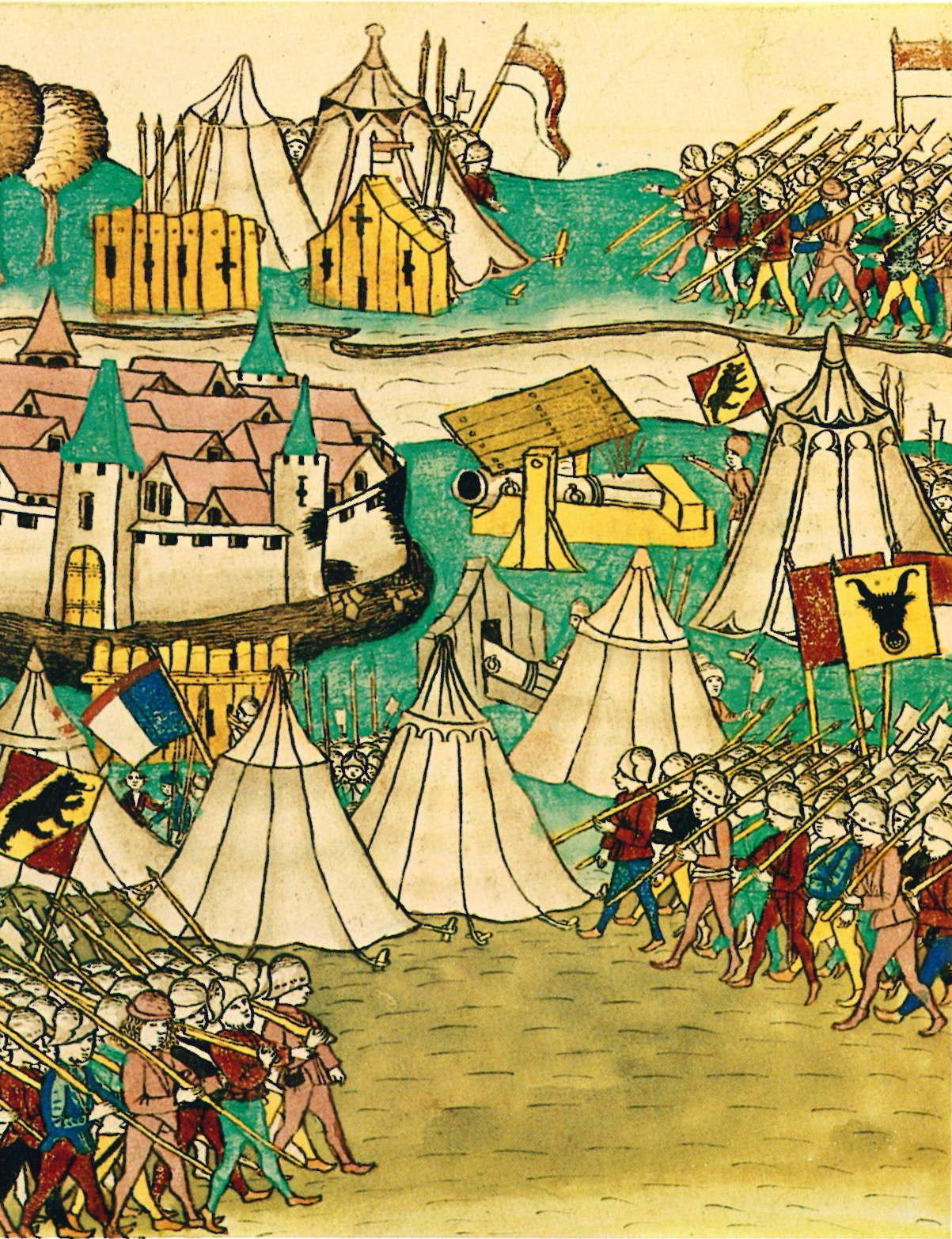
Arrival of reinforced Bernese units before the besieged city of Waldshut, Amtliche Berner Chronik (1478–1483)
The defenders of the city themselves did not remain passive either – they launched several sorties, inflicting losses on the besiegers.
The Landvogt Thüring III von Hallwyl established his headquarters in Laufenburg, and a fortified position with 1,300 men was set up between Albbruck and Dogern. In the St. Blasien area, Duke Sigismund assembled about 1,600 Bohemian mercenaries, who however never effectively engaged in the fighting.
Due to reports of Further Austrian units and rumours of impending reinforcements under the leadership of Duke Sigismund, the Confederates on 10 August 1468 requested additional soldiers from their home cantons. These indeed arrived and the total number of besiegers grew to 16,000 men.
The situation inside the city continued to deteriorate – supplies were collapsing, the city walls were severely damaged by constant bombardment, and the Habsburgs and the nobility were neither willing nor able to undertake a decisive attempt to relieve the city.
On 17 August 1468, the Confederates planned a direct assault on the city, to take place two days later. At the same time, however, peace negotiations were already underway, and the assault was therefore postponed. Moreover, serious disputes broke out in the Confederate camp between the cantons of Zurich and Bern.
On 21 August 1468, the Lucerne forces, supported by the cantons of Schwyz, Glarus and Appenzell, undertook a plundering raid on Bonndorf in the Black Forest, which was burned in the process. During the retreat, this detachment was attacked by Sigismund's units and managed to bring its spoils (including 400 head of cattle) to the camp only with the help of troops from Zurich and Zug. On 24 August, further fighting took place at the fortification near Albbruck.
The interests of Zurich merchants extended as far as Waldshut, and there were also family ties. Formally, the Zurich side argued that an assault on the city would only be possible at the cost of high casualties on their own side. Politically, however, Zurich had no interest in Bern securing influence in this area through a conquered Waldshut.
Zurich was supported by the eastern and inner Swiss cantons, while Bern had Solothurn and Lucerne on its side. These rivalries within the Confederate camp ultimately led to the end of the siege.
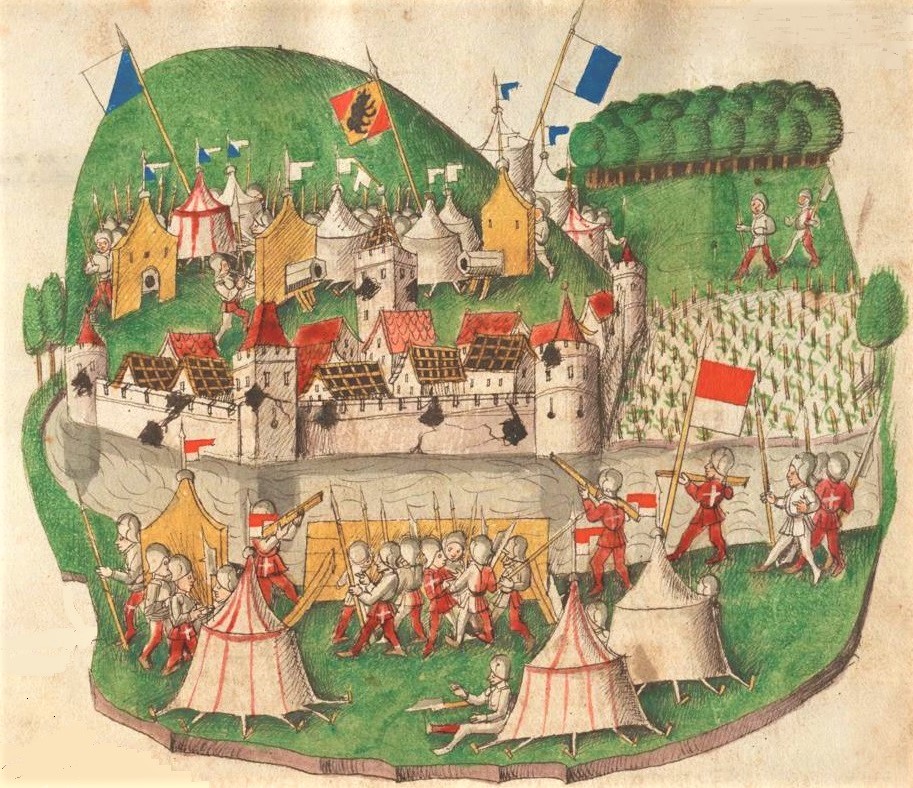
The Confederates besiege Waldshut, Tschachtlanchronik (1470)
Peace Treaty and Consequences
The city of Basel in particular, through its mayor Peter Rot, and the prince-bishops Johann V von Venningen (Bishop of Basel) and Hermann III von Breitenlandenberg (Bishop of Constance), sought to mediate a peaceful settlement between the Confederacy and the Habsburgs. The advisers of Duke Ludwig of Bavaria and Margrave Rudolf of Hachberg-Sausenberg also took part in the negotiations; Hans von Flachslanden represented the latter at the negotiating table. On 14 August 1468, the mediators established contact with the chief commanders of the Confederates, and on 16 August peace negotiations began in Dogern, which resulted on 27 August in the signing of the peace treaty known as the Waldshuter Richtung. According to this treaty, Duke Sigismund committed himself to paying war reparations of 10,000 guilders by 24 June 1469. As a guarantee, he provided the Confederates with the city of Waldshut and the Further Austrian part of the Black Forest. The Waldshut War led to only minimal territorial changes. The sole exception was the Lordship of Wessenberg south of the Rhine with the villages of Hottwil and Mandach, which Bern conquered and annexed to its territorial administration of Schenkenberg.
The siege of Waldshut was lifted on 28 August 1468. Duke Sigismund then borrowed 50,000 guilders from Duke Charles the Bold of Burgundy through the Treaty of Saint-Omer, pledging the Further Austrian territories in Breisgau and Upper Alsace in return. The administration of these pledged territories was initially taken over by a commission led by Margrave Rudolf of Hachberg-Sausenberg, which prepared a report on their condition. Subsequently, Charles the Bold appointed Peter von Hagenbach as Landvogt, who assumed his office in November 1468. Sigismund paid the Confederates the war reparations of 10,000 guilders on 23 June 1469. The mayor of Schaffhausen, however, had to wait until 1476 for the return of his ransom of 1,800 guilders, which was also due to him under the treaty. Emperor Frederick III, cousin of Duke Sigismund, declared the peace treaty void on 26 May 1469 and on 31 August imposed the imperial ban (Reichsacht) on the Confederacy. Neither of these decisions had any real consequences, however.
Although Waldshut suffered considerable damage during the siege, Emperor Frederick III renewed the city's privileges on 21 November 1468, and additionally on 24 February 1469 granted the city the right to collect a water toll on all imported goods on the rivers Aare, Reuss and Limmat. Duke Sigismund issued the city a “Schadlosbrief” (letter of indemnity) on 8 September 1468, in which he committed himself to compensating the damage caused by the siege. He fulfilled this obligation by pledging to the city the right to collect a road toll, thanks to which the city soon recovered economically.
French King Louis XI attempted to win both the Confederacy and Duke Sigismund as allies against Burgundy and mediated peace between them – the so-called Ewige Richtung (Perpetual Accord). After Charles the Bold fell in the Battle of Nancy in 1477, Duke Sigismund retook possession of the pledged Further Austria without returning the 50,000 guilders he had borrowed.
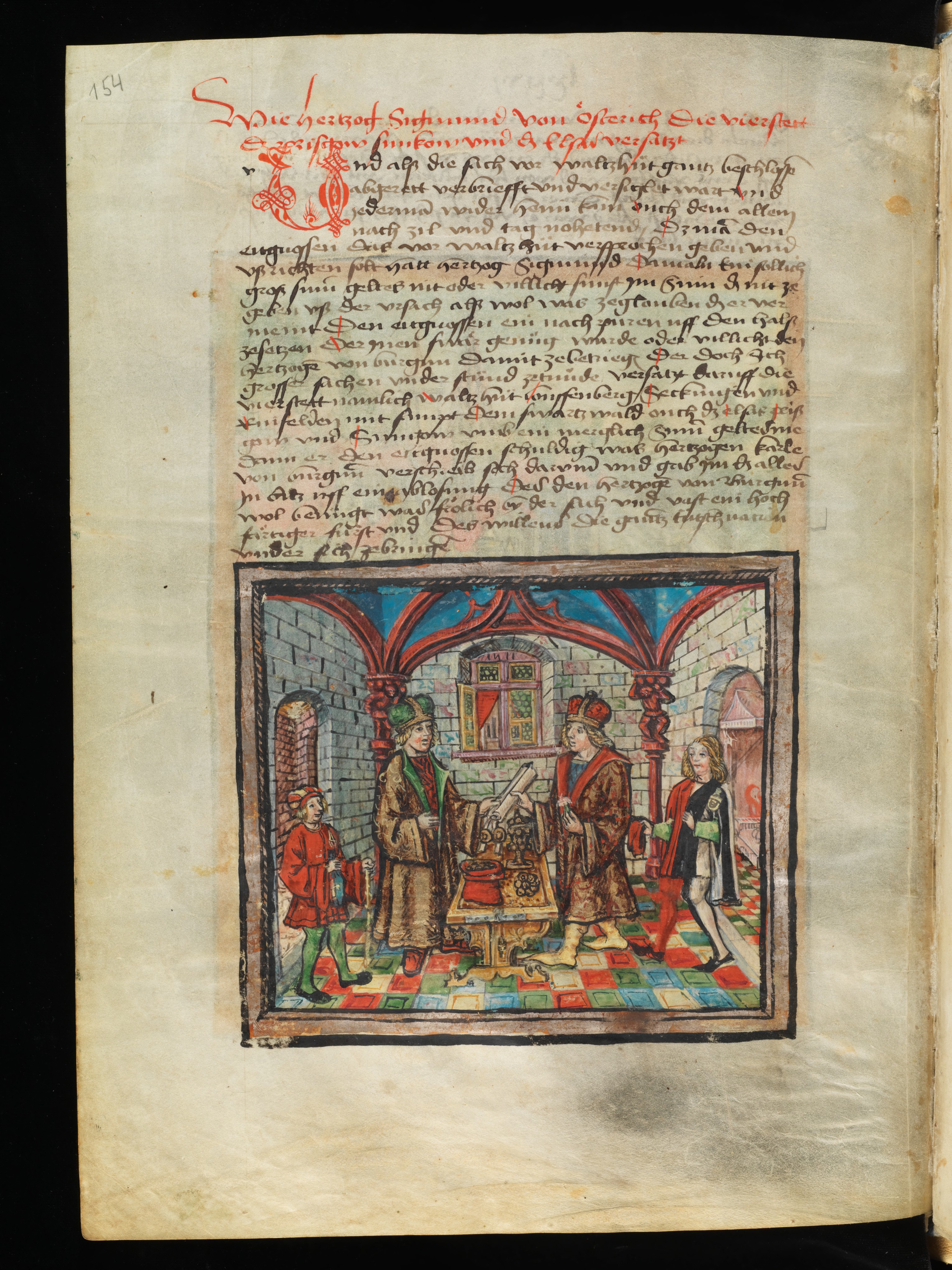
The pledging of Breisgau, Sundgau and Alsace by Austrian Duke Sigismund to Burgundian Duke Charles the Bold on 9 May 1469, Luzerner Chronik (1513)
Participation of Bohemian Mercenaries
Diebold Schilling writes in his Die Berner-Chronik about the participation of Bohemian mercenaries as follows:“It was then, when the camp was laid before Waldshut, that about sixteen hundred Bohemians were sent from the Empire by the duke to aid the lords; and when they came, no warlike action was taken on their part against the Confederacy, for they caused more harm to friends than to the Confederacy. Nevertheless, the Imperial Duke had it explained to the Confederacy through his envoys that he was in an agreement with Duke Sigismund of Austria, according to which he had to send him men, and even if those he sent him stayed somewhere along the way and did not return home, he cared little about it, for he had to send them to him for the sake of honour and on the basis of his earlier written agreement, which they had made together before this war; whatever else he could do and negotiate for peace and good in this matter, he wished to do so with good will, as he and his predecessors had done during those earlier fifteen-year truces and in other affairs.” This record is accompanied by a very peculiar depiction of Bohemian soldiers.
It appears that the Bohemian mercenaries were sent to Sigismund by Bavarian Duke Ludwig IX under the alliance treaty he had with Sigismund. Ludwig had long relied on Bohemian mercenaries, especially during the so-called Bavarian War (1459–1463). It is therefore no surprise that he also employed them in this conflict, about which he cared little, and thus provided only enough participation so as not to be accused of violating alliance treaties.
The Bohemians were probably preceded by their military reputation, since despite their low numbers, Schilling considered them not only worth mentioning, but also worth emphasising that their presence had no military effect. With the phrase that they “caused more harm to friends than to the Confederacy”, Schilling was most likely alluding to the widespread vice of Bohemian soldiers, who plundered more and more the further they were from Bohemia.
In the accompanying illumination, they are depicted as pagans and orientals with long hair, which is clearly an allusion to the public perception of the Bohemians as heretics.
Sources:
If you enjoyed this article, please consider making a small financial contribution. Writing articles is very time consuming and we do it in our free time.
IBAN: CZ39 2010 0000 0028 0346 2929
BIC/SWIFT: FIOBCZPPXXX