


Jindřich (Henry) Týřovský of Einsiedl (c. 1466–1556)
Jobst died in 1474, but his last will could not be entered into the land tables because it was sealed only after his death. The surviving son Jindřich (Henry), who always signed only as Henrich, was not yet of age, and so he remained under the guardianship of Litvín of Klinštejn, a counsellor of the chamber court, who was still writing his name with Týřov as late as 1491. From 1494, Jindřich himself was already giving permission for the sale of feudal estates in Mlečice. Note: The labour vassals in Mlečice and Zavidov were always obliged to serve Křivoklát, but as subjects on the Týřov estate, they could sell their properties only with the consent of their lord — the holder of Týřov.
In 1500, the chamber court heard a dispute between Jindřich and Jan of Gutštejn over ore mining, to which Gutštejn's smelter Ota supposedly had a claim. Jindřich objected that “mu odpoviedati povinovat nenie, poněvadž se majestátuov královských dotýče” (he was not bound to answer him, since the matter touched upon royal charters), and on 2 May 1500 the court quashed the summons, ruling that they were to seek their right before the land court, “poněvadž krále JMti v zemi nenie” (since His Majesty the King was not in the land).
Jindřich was an excellent manager. In a short time, he purchased manors in Nezabudice and Panošín Újezd, the villages of Hřebečníky, Skryje, Tytry and Novosedly, and built the Myslice manor. In Kožlany, he bought two deserted peasant farms with revenues there, which had belonged to Krakovec for many years, from Jindřich Albrecht of Kolovrat, and founded a pond with piping above the town.
In 1503, he bought the wasteland of Sadlno and the estate of Slabce, with which a feudal obligation towards Křivoklát was also connected, and Jindřich thus had to, when needed, “sám druhý na hrad přijeti ve všem holým železe.” (come to the castle with one companion, in full armour.)
During the war of 1505 waged against the Šlik lords, he fielded 4 men and 1 wagon. That year, Ambrož Chodaur of Loket also sued Jindřich, having paid Jindřich for grain that was subsequently not delivered – the matter concerned four schocks of strychs of oats at 13 Meissen groschen each and two schocks of barley at 11 groschen; on 14 November 1505 the chamber court found in Jindřich's favour, because Chodaur had not proved that Jindřich was obliged to let him know whether he was keeping to the bargain. In 1509, he was one of the Bohemian nobles waiting in Brno for the arrival of King Vladislav from Trnava, but they soon left again because the king kept failing to arrive. Albrecht Rendl of Oušava described it bluntly to Petr of Rožmberk on 5 February 1509: “Nayprv jeli pryč Pražané, potom Burjan Trčka, potom pan Novohradský, pan Maštovský, pan Tayrovský a někteří jiní s nimi; tu pan kancléř mluvil, že jich král žádá, aby s králem do Čech jeli, a oni jebíc jedou předse.” (First the men of Prague rode away, then Burjan Trčka, then Lord Novohradský, Lord Mašťovský, Lord Týřovský and some others with them; the lord chancellor told them that the king asked them to ride to Bohemia with the king, but they, damn them, rode off all the same.)
Jindřich then in 1513 resolved before the chamber court a dispute of his servant Rovný of Zavidov with Jindřich Tuchorský of Tuchořice, a servant of the lord of Krakovec. Witnesses testified that as they were riding from Jesenice, Rovný rode in among them on a mare, Tuchorský's horse bolted, and when he asked Rovný to ride ahead or behind, Rovný snapped back: “Co ty mi chceš rozkazovati, ano mi jest tak svobodno jeti královskou silnicí jako tobě?” (What do you want to order me about, when I am as free to ride the king's highway as you are?) Tuchorský drew his sword and struck him over the head. Jindřich, entered in the registers as “Heyndrych Eynsygl z Eynsydle a na Tayřově”, summoned Tuchorský for trespass, but the court turned its finding against him: whoever beat a servant who had himself drawn a hunting knife and “jinú svévolnost provozoval” (committed other wilful acts) had not committed trespass.
In 1514 Jindřich held the office of captain of the Rakovník and Podbrdsko districts – on 22 August 1514 Zdeněk Lev of Rožmitál turned to him and to Jan Vamberský of Rohatce to adjudicate a dispute of Wolf of Gutštejn over an imprisoned subject. He addresses him as “urozený pane” (noble lord), that is, as a member of the lordly estate, and styles him in the same way in his circulars of 1526 and 1527.
The Supreme Chancellor of the Kingdom of Bohemia, Adam of Hradec, obtained from King Louis in 1524 permission to redeem Týřov with all its appurtenances; the charter is given at Buda on St Wenceslas's day, 28 September 1524. Whenever Adam deposited the redemption sum, Jindřich was to hand over the estate immediately. Jindřich, who produced a charter from King George stating that he could not be redeemed by anyone during his lifetime, did not surrender the castle, and since Adam died in 1531 and Jindřich thus outlived him, the entry lapsed. In 1525, Jindřich Týřovský was summoned to the chamber court by Jan Pečkovský of Pečkovice for the reason of failing to testify at another court.
In the meantime, a heavy calamity befell Jindřich. With his wife Kateřina Řesanská of Kadov, he had 4 sons, namely Jan, Albrecht, Jobst and Jiřík. The last of these participated in the campaign against the Turks and in 1526 was captured at the Battle of Mohács. The father, who wished to ransom him, had to pledge Týřov in 1528 to Jáchym of Malcany, to whom the citizens of Plzeň sent a letter in 1530.
Lorenc Šlik took advantage of Jindřich's distress and obtained from King Ferdinand permission to redeem the Týřov estate. However, this could only take place by agreement with Jindřich, who again invoked King George's charter, did not agree, borrowed 375 schocks of groschen from Petr Cíl of Svojšice, 350 schocks of groschen from Zikmund Beřkovský of Šebířov and 230 schocks of groschen from Slavibor of Všechlapy, and in 1532 redeemed Týřov.
From the aforementioned sums, it follows that Týřov was pledged for 1000 schocks of groschen. When Jindřich could not satisfy his creditors, he sold the village of Novosedly, the Nezabudice manor and manors in Panošín Újezd, and additionally pledged the Kouřimec manor, the villages of Mlečice, Hřebečníky, Skryje and Tytry.
Zikmund Beřkovský summoned Jindřich to court for the debt as early as 1531, but Jindřich ignored three summonses, so an arrest warrant was issued for him and Beřkovský seized Jindřich's estates — 2 peasant farms in Kožlany and a fishpond above the town, which he intended to drain. Jindřich, however, forestalled him and drained it himself.
After Jiřík's return to Bohemia, the Bohemian estates interceded with the king for Jiřík's service to be paid.
Considerable difficulties were caused to Jindřich by his unruly sons, who were constantly before the court for brawls. Albrecht and Jiřík came in 1536 to the inn of Jiřík Čapek in Rakovník, where they found Jiřík of Bobrovice, lord of Děkov. When Bobrovice was speaking on the gallery with the innkeeper, Albrecht threw off his gown, grabbed a sword and stabbed Bobrovice in the side. The innkeeper rebuked Albrecht and he stopped. Then Petr Krašovský and Jiřík Týřovský stabbed Bobrovice with hunting knives on the side and wanted to murder him. Bobrovice was so badly injured that he could not even come down the stairs.
Albrecht, Jiřík and Jobst killed without cause in 1542 in Plzeň Petr Chlumčanský. Jobst was sentenced for this murder by the court of appeal that same year – Zikmund Winter cites him as one of the few cases in which such a sentence was actually passed on a nobleman, whereas the other suits were settled or “pro všelikteraké chyby z práva zdviženy” (quashed for all manner of legal flaws). Jiřík in 1544 wounded Václav of Martinice on the road; the same Jiřík in 1548 spoke at the barber's about Bořivoj Pešík of Komárov, calling him an arch-liar, and at a feast at Liblín in 1555 he insulted Bohuslav Zvíkovský, calling him an arch-liar. During the quarrel, Jiřík rushed at Bohuslav with a sword and wanted to fight him. Albrecht in 1554 clashed in Hřebečníky with Jan of Lobkovice, who in self-defence shot Albrecht through both legs.
Father Jindřich too had dealings with the courts. In 1536, Erhart Kfelíř summoned him over damages of 100 schocks of groschen, because his (Jindřich's) men allegedly went through the forests with handguns and shot game around Týřov. In 1544, Mikuláš Pešík of Komárov summoned Jindřich over 3 animal nets and a yew-coloured horse, which he had borrowed from Mikuláš's deceased brother Jan and not returned. It is interesting that Mikuláš and Jindřich were related in some way.
When Lorenc Šlik saw that he would not outlive Jindřich and would not live to see the Týřov estate, in 1545, with the king's permission, he transferred his right to Týřov to Václav Mašťovský of Strojetice, who immediately renounced all rights to hunting, and in return the king credited him 100 schocks of groschen against Týřov and allowed him to fell forests only for the needs of the castle and granted him the right to request from the Křivoklát captain each year 2 deer, 4 roe deer and 2 wild boar, but he could freely hunt small game. The pledge of Týřov was agreed for the lifetime of Mašťovský and his sons.
In 1554, Mašťovský obtained from the king and the Bohemian estates that an additional 100 schocks of groschen were credited to the initial sum, and Jan the Elder of Lobkovice on Zbiroh obtained permission to purchase the village of Mlečice, which he held in pledge, as a hereditary property.
In 1550, he borrowed 81 schocks from Jan Pešík of Komárov and secured the debt for him on the pond with its bottom near Kožlany, together with its margins and piping. Towards the end of his life he held the villages of Mlečice, Tytry and Zavidov in pledge.
At the land diets Jindřich appeared among the lords: on 4 May 1542 he is listed as “Jindřich Tajřovský z Einsidlu” among the relators of the diet's resolution for the lordly estate, and on 4 January 1552 again as “Hendrych z Einzidle na Tajřově”. In 1543 the estates laid before the king, among other things, “o Viléma Švihovského, Tejřovského a jiných mnohých osob dluhy” (the debts owed to Vilém Švihovský, Týřovský and many other persons) – that is, claims against the crown – and Ferdinand I replied that he “chce na jejich spravedlnosti vyptati rozkázati, to v radě uvážiti a v tom se spravedlivě zachovati ráčí” (would order an inquiry into their claims, consider them in council and deal justly in the matter). In 1554 Václav Mašťovský of Kolovrat then obtained the diet's consent for the king to add a further hundred schocks to his sums on Týřov, “kdyžby toho čas přišel a žeby tajž zámek Tajřov vyplatil” (when the time came and he redeemed the said castle of Týřov).
Jindřich was a regional captain in 1546; in 1545 he sold Slabce with Sadlno and in 1555 the Myslice manor. After dividing his property among his sons, in 1556 he moved to Jince, which belonged to Mikuláš Pešík of Komárov, where on 19 February 1556 he died and is buried in the local Church of St. Nicholas.
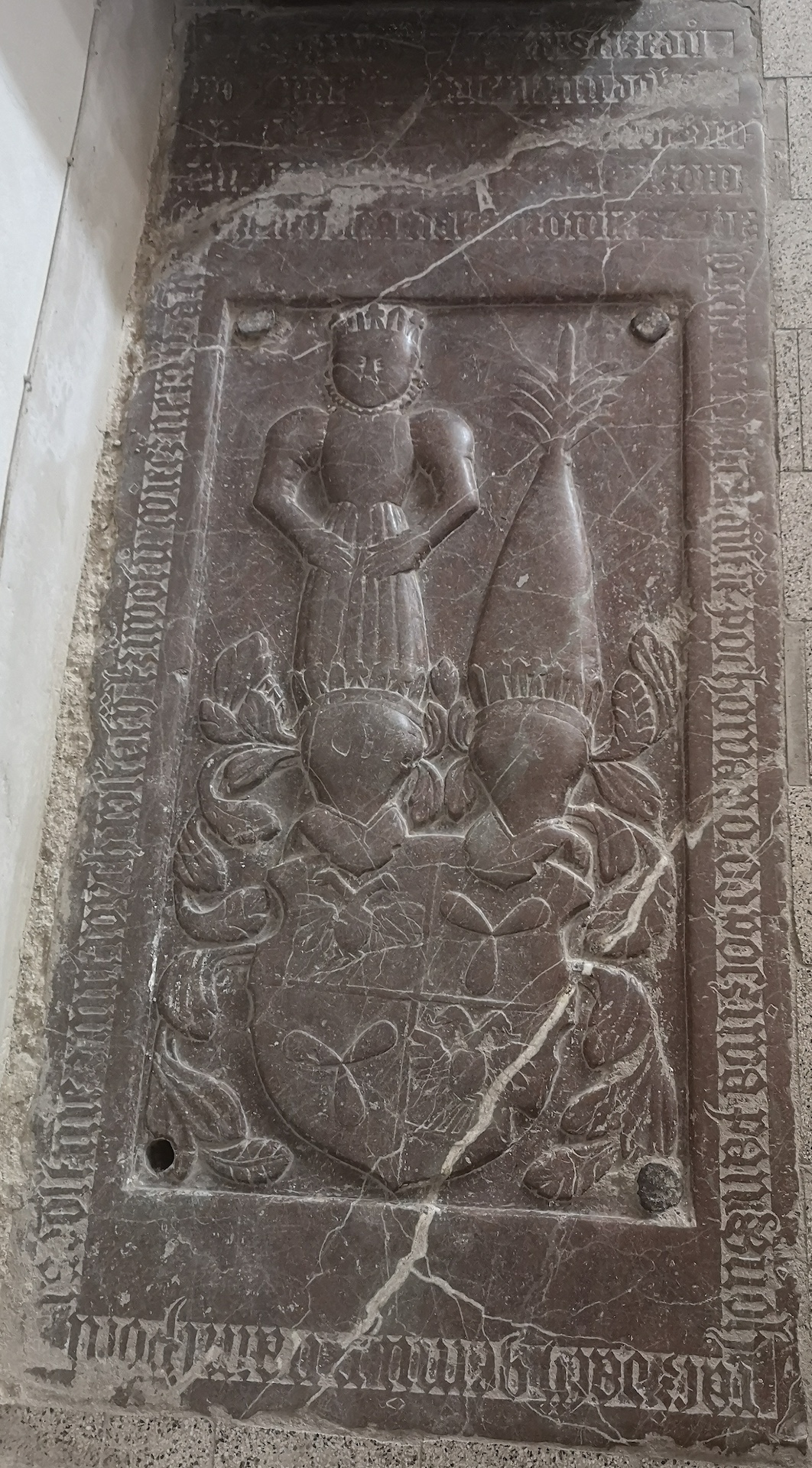
Tombstone of Jindřich Týřovský in the Church of St. Nicholas in Jince.
Sources:
If you enjoyed this article, please consider making a small financial contribution. Writing articles is very time consuming and we do it in our free time.
IBAN: CZ39 2010 0000 0028 0346 2929
BIC/SWIFT: FIOBCZPPXXX