


Jobst of Einsiedl (circa 1420 - 1474)
Family and youth
Jobst was born into a bourgeois family in the small town of Einsiedl, today's Mnichov in the Cheb district, likely around 1420; the town then belonged to the Teplá monastery. He most likely came from the Tullinger family. In a charter dated 16 June 1346, Beneda, abbot of Teplá, and the entire convent granted to Elizabeth and her brothers Oldřich and Bohuslav, descendants of Heinrich Tullinger, the estates that had reverted to the monastery after the death of the Teplá judge Jan Puchelberger, in particular the tin mines between the Ouša river and the brook called Goltwasser. In a charter of 25 May 1397, the Teplá abbot Bohuš and the monastery servant Bohuslav Tullinger of Mnichov reached an agreement concerning the tin mines near Mnichov. In its disposition the two issuers concluded that Bohuslav Tullinger held all rights to the village of Mnichov and that every third penny (orig. „pfannig“) of the mined metal would fall to him. Whether this is the same Bohuslav mentioned in the first charter cannot be said. Likewise it cannot be deduced whether this is Jobst's father, grandfather, or some other relative; nevertheless, his coat of arms (three feathers) is also known from Jobst's later coat of arms. He had a close connection to the city of Cheb and appears to us as a relative of the esteemed Cheb families of Schmidels and Puchelbergers, calling Jorg Schmidel his brother and Clement Puchelberger his uncle, with Puchelberger later becoming the burgomaster of Cheb. Jobst himself states that when he later stayed in Cheb, he lodged in the house of his brother Jorg. The kinship of the Tullingers and Puchelbergers is also indicated by the charter mentioned above.
Jobst could have received his education either at the school in Cheb or, more probably, at the Teplá monastery. There he could have learned to read and write in Czech, German, and Latin, which made him one of the few multilingual scribes in late medieval Bohemia.
Beginning of career
Thanks to his education, he was particularly suited to serve as a secretary and scribe, especially during the interregnum (1439 - 1453), when Czech lords conducted politics independently. Scribes who understood both languages of the land were recommended especially to those Czech lords who did not speak German, although they could not do without it during their frequent contact with neighboring German regions. For example, Lord Jan of Házmburk excused his letter to the city of Cheb written in Czech by stating that he currently did not have his German scribe available. In this capacity, Jobst actually appears in the service of Lords Aleš and Petr Holický of Šternberk, who at that time owned the nearby Bečov nad Teplou.
In February 1447, Duke William of Saxony approached Petr Holický of Šternberk to recruit an army in Bohemia for the Saxon Fratricidal War (1446 - 1451). The army was to assemble near Cheb, with Jobst entrusted with administrative and organizational matters. In a letter dated February 13, 1447, Duke William wrote:“Wir bedorffen wol eins endlichen diners, der dutschs und behemisch kan, uff den wir glauben gesetzen (...), dorzu uns Jobst, uwer diener, wol fuglich were.” (We absolutely need a servant who can speak German and Czech, whom we can trust (...), for this Jobst, your servant, would probably be suitable.)
These Czech mercenaries, due to an ensuing truce, were unable to participate in the Saxon Fratricidal War and seamlessly transitioned into the service of the Archbishop of Cologne, Dietrich II, in the Soest Feud. Since Petr Holický of Šternberk was the chief commander of the entire Czech corps, it is assumed that Jobst participated in the entire Soest campaign as Petr's right hand.
Jobst's next significant involvement occurred in 1450 when George of Poděbrady, after defeating the Strakonice Union at the battle of Mýto on June 4, 1450 led his campaign against their allies, especially Duke Friedrich of Saxony, resulting in the capture of the city of Gera. The following day, October 23, 1450 (some sources state October 16, 1450), a truce was concluded. Jobst of Einsiedl, who participated in this campaign in the retinue of Lord Petr Holický of Šternberk, wrote his letter on October 25, 1450 from the field camp near Salza, close to Plavno, the first preserved letter to the city of Cheb. Cheb was threatened by the returning Czech army, as in March 1450, the Cheb council had refused to allow George of Poděbrady and his partisans into the city for negotiations with the German fürsts, which had to be held in Wunsiedel instead. In the letter, Jobst warned the citizens and urged them to seek an agreement. The mediation was undertaken by Aleš and Petr Holický of Šternberk, who, with their secretary Jobst of Einsiedl, ensured safe conduct for the Cheb envoys. The negotiations took place at Skalná Castle (Vildštejn). However, on the way to the meeting, the Cheb diplomats, carrying gifts for George of Poděbrady, were ambushed and robbed. Jobst of Einsiedl was also attacked but saved his life by promising not to reveal the attackers.
Following the negotiations at Vildštejn, the city ultimately redeemed itself with 1000 gold in ransom: “Item wir haben geben vnd ausgerichthern Girziken tousent guldein, die jn der rat zu pranttschaczgeben musst.” (We gave Lord George 1000 gold, which must be given by the council as ransom.)
Petr of Šternberk received 200 gold for mediating the agreement, and other mediators also received rewards: “Geben dem Endresen I schock XXIII gr. zerung fur Hans von Kocza vnd fur den Jobst des von Sternbergs schreiber, als er zwischen eyn rat vnd den Behmen teidigat.” (Give the aforementioned 1 schock and 23 groschen to Hans of Kotzau and to Jobst, the scribe of the Šternberks, who participated in the negotiations between the council and the Czechs.)
In 1452 Jobst appears in connection with the disputes between the Nuremberg burgheress Margareta Vogel and Aleš Holický of Šternberk, when he wrote a letter of thanks to the Nurembergers for resolving the matter. Frederick III had apparently been calling for an end to the dispute since the beginning of the previous year. In the so-called Borschengrüner Fehde (Borschengrün feud), the war between Cheb and the Vogts of Plavno in 1452–1454, several representatives of the Czech nobility, including the Holický of Šternberk, were notably involved. Aleš Holický was displeased that Frederick of Saxony had stepped forward as mediator between Cheb and the Plaveners; after the experiences of the Soest war, the majority of Czech nobles regarded him as an enemy of the country. Aleš also pressured Mates Šlik to convince Cheb that it had to stop fighting the Plaveners. Throughout this conflict Aleš frequently used Jobst as his negotiator with the Šliks and with Cheb. Jobst remained in the service of the Šternberks until the end of 1453 or the beginning of 1454, after which he entered the service of George of Poděbrady.
In the service of George of Poděbrady
Jobst of Einsiedl remained with the lords from Šternberk until the end of 1453 or perhaps the beginning of 1454, for on June 24, 1453 Jobst still writes under the command of Lord Aleš of Šternberk. He then entered the service of the administrator George of Poděbrady, possibly motivated by familial ties to the Šternberk family. On October 28, 1454, he addresses as secretary of George to Görlitz scribe a letter announcing the imminent arrival of the administrator with King Ladislaus and urges the reservation of necessary accommodations. Correspondingly, the rescript of George to the mayor and council of Cheb, dated January 30, 1455 in Wroclaw, is already drafted by Jobst.
During this period, Jobst of Einsiedl was granted a coat of arms by King Ladislaus the Posthumous, which was elevated by Emperor Frederick III on November 23, 1455.
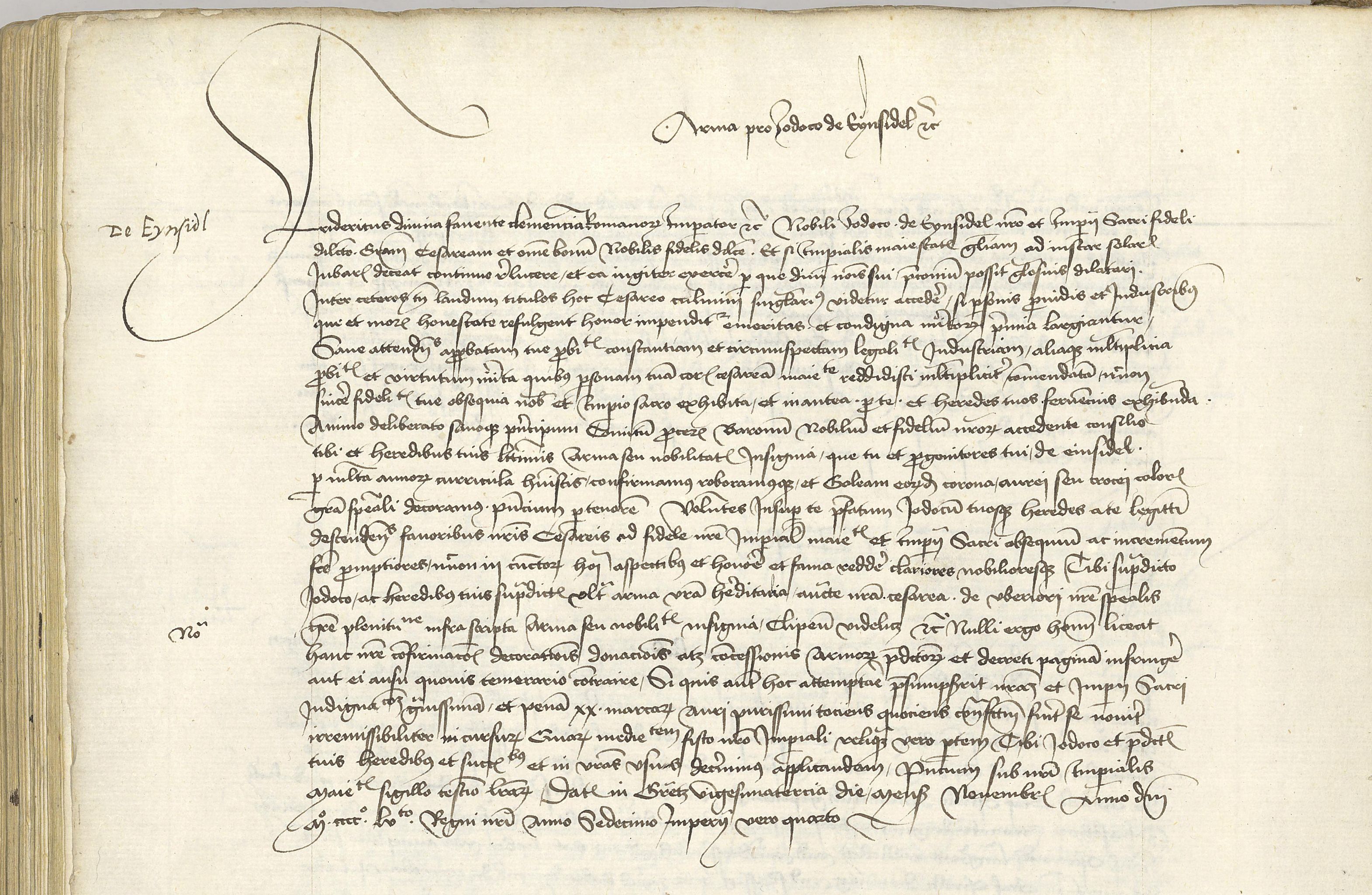
Original Latin record of the improvement of Jobst's coat of arms made on 23 November 1455 in Gratz.
In the administrator's service a broad and significant field of activity opened up for Jobst. Since George spoke no German at all, he made use of Jobst's bilingualism especially in dealings with the predominantly German-speaking towns. Although George himself, with rare exceptions, sent his letters to Cheb in Czech, only letters in German have survived from later periods, behind which the activity of his new servant can be sensed. George valued Jobst's services and it is therefore likely that he interceded with King Ladislaus for the granting of a fief — the village of Jeschedorf, today Jaśkowice Legnickie — in January 1455, which Jobst held jointly with Hynec Dehraw, or that he was behind the elevation of Jobst's coat of arms by Frederick III on 23 November of the same year. The entry concerning Jeschkendorf is dated on the feast of the Epiphany, that is January 6, 1455, and is preserved in the extracts from the registers of the Duchy of Wrocław.As his confidential scribe he was literally indispensable to him. Therefore, if he was not absent on some mission, he was always by the side of the land administrator, accompanying him on his major campaigns in Moravia, Silesia, and Austria, often engaging in trade, as in Brno, and informing his friends in Cheb with apparent satisfaction about the successful achievements of the governor. Although a Catholic and unconditionally devoted to the Roman Church, he maintained unwavering loyalty to his Utraquist lord at all times by — a rarity at the time — being able to rightly separate religious beliefs from loyalty to service. Therefore, he also enjoyed the full trust and favor of George and was often entrusted with tasks that required special care and reliability.
Jobst also accompanied George on long journeys, such as to Hungary in 1456, of which he did not hesitate to inform his Cheb relatives.
After the death of King Ladislaus the Posthumous on November 23, 1457 rumors began to spread that the young king had been poisoned by George of Poděbrady. At the assembly in Vienna on January 21, 1458, Jobst of Einsiedl strongly defended against these accusations. Jobst argued that it had never happened in history that the Czechs had poisoned a king. According to him, the Czechs were the king’s loyal subjects and had voluntarily submitted to him in everything that Kings Sigismund and Albert had sought to conquer by force (restoration of royal estates, levies, aid against the Turks). Ultimately, based on Jobst’s arguments, the assembly acknowledged that the king had passed away by the will of God.
As mentioned earlier, Jobst was often entrusted with tasks requiring special care and reliability. Such a situation arose immediately after George was elected king. At the large electoral assembly in Prague on March 1, 1458, the representatives of Duke Wilhelm of Saxony referenced old charters stored at Karlštejn to better substantiate his wife's claims to the Czech succession. The administrator immediately dispatched his chamberlain and Jobst of Einsiedl, his scribe, with an appropriate entourage to Karlštejn to retrieve the relevant documents, which were presented to the assembled estates the following day. When George of Poděbrady was proclaimed king that same day, Jobst welcomed this significant event with undisguised joy and immediately communicated it to Cheb, where the news was joyously received (only the response from Cheb is preserved). Since George had already become famous in previous years for his zealous efforts to maintain peace, his election was particularly desirable for a city like Cheb, which was located on the borders of various regions and conducted lively trade. Moreover, Jobst assured the citizens of Cheb of the king's favor and admonished them to disregard the slander and threats of their neighbors, but to remain firm and steadfast. For Jobst himself, George's election had another consequence, as the new king elevated him to the knightly status that summer, as evidenced by the congratulations from the people of Cheb on July 29, 1458 or a transumpt of Pope Pius II's bull from March 1459, which names Jobst as “Jodocus de Eynsedil, milites Pragensis”. The vidimus was drawn up on March 12, 1459 at Kłodzko by Nicholas, abbot of Kamieniec, and Michael, provost of Kłodzko, at the request of Jan of Warnsdorf, captain of Kłodzko, and of Jobst, who presented the bull in the name of King George.The people of Cheb were unofficially informed of the election by a letter from Jobst; officially they were notified by a great letter with many seals, whose author may also have been Jobst.
During George of Poděbrady's homage tour, Jobst accompanied his king, as testified by his reports sent to Cheb. He played a particularly notable role in Brno, which had closed its gates before George's arrival, and Jobst was sent as a negotiator with the city's representatives. In the autumn of 1458 Jobst accompanied George during his campaign in Austria.
Along with being elevated to knightly status, he received an inheritance worth 500 schocks of groschen at the Makotrasy estate. Around this time, he also acquired the villages of Skryje and Tytry. However, to enable the king to repay his debt to the Prague burgrave Zdeněk of Šternberk, Jobst returned the aforementioned inheritance and additionally lent 500 schocks of groschen in cash, for which the king registered him on July 2, 1460 the castle of Týřov with the town of Kožlany, the villages of Mlečice, Chmelištná, Zavidov, Týřovice, Broumy, Kouřimec, Újezdec, Hudlice with all benefits and taxes in Novosedly; according to the extract from the royal registers the whole pledge sum amounted to 1,050 schocks of groschen. It was stipulated that Jobst must not be repaid until his death, and after his death, only the king himself may repurchase the estates for 600 schocks of groschen. According to the resolution, Týřov Castle must remain open at all times and if the king were to spend on it due to wars, it would be at no loss to Jobst. With the forests, neither Jobst nor his heirs have anything to do nor sell timber, only to take it unimpeded for fuel and repairs to the castle. In hunting small game and birds, Jobst was free, whereas he was allowed to hunt 3 deer and 10 roes a year with the knowledge of the Křivoklát burgrave, who was obliged to lend him dogs and puppies. Since the castle needed repairs to its walls, underpinning, and buildings, the king added 100 schocks of groschen for repairs to Jobst. If the castle were to be captured by Jobst, the kings are obliged to help him recapture it or pay him within two years.
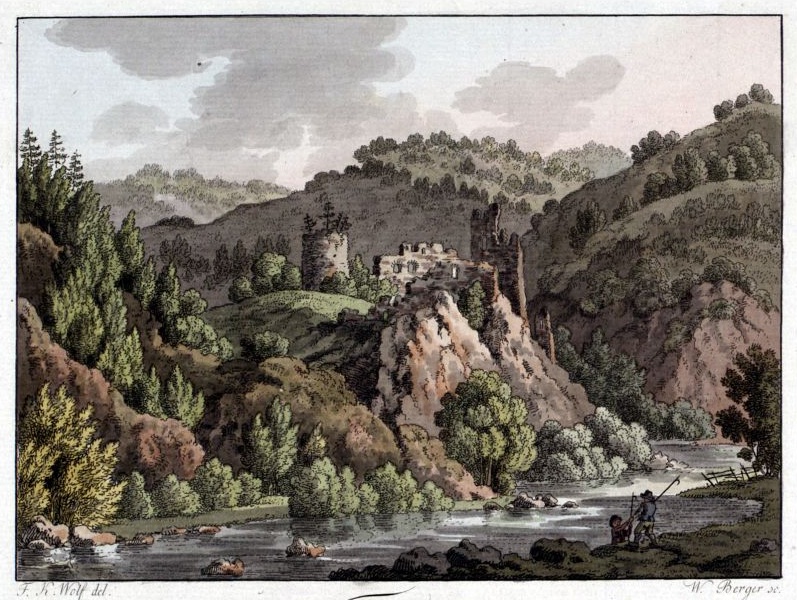
Ruins of Týřov, engraving by Václav A. Berger (1800) after a drawing by F. K. Wolf (1797)
As the royal secretary, Jobst had the opportunity to provide many services to the city of Cheb through advice or intercession with the king. This was evident from the royal rescripts to Cheb, many of which are marked “ad relationem Jodoci de Eynsedel secr.” The city, due to its exposed position, was frequently accused from one side or the other. It had frequent disputes with other territories, and also with its own subjects who wanted to dissolve their legal ties with the city, as well as problems with the abbot of Waldsassen over jurisdiction in several villages, including Albenreuth (today Mýtina, part of the municipality of Lipová), which were inhabited by both monastic and city subjects. Jobst was often asked for his intercession. He was willing to provide information, unless it involved official secrets, which he always strictly maintained. However, he always acted with great caution, and although this is also commendable, it surprises the reader unpleasantly when, for example, in the middle of an interesting letter, it states:“Although you yourselves want to learn the reason for this matter, you can send one of the council's friends who is known to me, and you will learn the whole matter thoroughly.”On the contrary, the city did not lack in recognition. On various occasions, it gave its friend a monetary gift, as evidenced by the Cheb expense book. For example at Christmas 1458:“Item so haben wir desmals durch Paul Ruduschen hern Jobst von Aynsidel awszgericht XII guldein, damit jn der rat vereret.” (Thus we then, through Pavel Ruduschen, handed Lord Jobst of Einsiedl XII gold, to honor him.) Also in the following year: “Item geben hern Jobsten von Aynsidel X gulde. r. damit jn unser hern verereten, als er jn das wortt redt ken vnsern hern konig von des abtes von Waltsassen wegen.” (Also given to Sir Jobst of Aynsidel were ten gold coins, r., so that our lords might honor him, as he spoke on behalf of our lord the king concerning the matters with the abbot of Waldsassen.) And when the city council honored the king with several barrels of the then-popular Cheb mead, one barrel also went to Jobst with the wish that“es mit seiner Gemalin in Fröhlichkeit und Gesundheit auszutrinken” (he may drink it with his wife in joy and health).
Jobst was actively involved in organizing the assembly at Cheb in the spring of 1459, aimed at resolving disputes between Bohemia and Saxony through the mediation of the politically astute Margrave Albrecht of Brandenburg. Jobst arrived in Cheb by Easter, March 25, 1459, to announce the king's arrival on April 8, 1459, and briefed the council on all details, requirements, and other matters related to the visit. This gave the city ample time to prepare in advance. King George arrived in Cheb on April 7, 1459, with his wife Johana of Rožmitál, son Viktorin, and daughter Zdena, accompanied by a large retinue including numerous servants and significant representatives of the Czech and Moravian nobility. His entourage included 43 nobles and 16 knights, totaling around 900 riders and 100 wagons, among them were several notable figures from Czech nobility.

Cheb Square in a depiction from 1472
Upon entering the city, the townspeople prepared a ceremonial welcome for the king and escorted him, with a canopy over his head, to a house directly on the square, where he was accommodated. The owner of the house on the square where the king was lodged was councilman Kašpar Junker, who was one of the most prominent figures of the city's patriciate at the time and had been elected mayor several times in succession. Given that George of Poděbrady was accommodated in his house, it can be assumed that this house was among the best equipped in the city.
On April 8, 1459, representatives of the imperial nobility also arrived in Cheb: Albrecht of Brandenburg arrived a day after George, thus on April 8, and Elector Frederick of the Palatinate on April 9. They were accompanied by other noble lords and various advisors. (Among the advisors, the internationally recognized diplomat Martin Mayer must be mentioned unequivocally.) Later, four dukes from Saxony also arrived, namely the Saxon-Meissen Elector Frederick with both his sons, Ernst and Albrecht, and his brother Wilhelm of Saxony. Along with them, another 13 imperial counts came with their wives. Furthermore, the Bavarian duke Otto, the Archbishop of Magdeburg, advisors of Duke Ludwig of Landshut, envoys of the Bishop of Würzburg, advisors of the Duke of Munich, Albrecht, and advisors of the Austrian Duke Albrecht arrived. Each of them came with a very large entourage, numbering dozens to hundreds of members.
The negotiations, which officially began on April 10, 1459, saw Jobst deeply involved as he often met with Margrave Albrecht of Brandenburg by the king's command and guidance. He dealt with the margrave on April 9, 1459, late in the evening, and during this occasion, he fervently advocated for a settlement with Saxony by maintaining that if the matter were referred to the emperor or the electors, the end would be “nowhere in sight”. The next day, when the margrave appeared with Saxon advisors at the king’s residence at Kašpar Junker's house to discuss the matter further, Jobst of Einsiedl acted as an interpreter. When the negotiations concluded and they were leaving Cheb, he received a gift of 100 schocks of groschen from the city for the king: “Item wir haben awszgericht vnserm hern konygk au newen groschen 1eschok gr., domit jn der rat vererat - hub auf her Jobst von Aynsidel” (Thus we have again presented our lord the king with 100 schocks of groschen, as a mark of respect by the council - handed over to Lord Jobst of Einsiedl).
Jobst likely held a similar agenda at the assembly also held in Cheb on Candlemas in 1461. Once again, Jobst was probably assigned an important role, as evidenced by his letter from December 14, 1460 to the mayor and council of Cheb, in which he requests:“to provide him accommodation at his brother's (Jorg Smidel) place, as he needs a comfortable place to rest, especially since he will not be able to sleep much, having a lot of work and needing to stay close to the king.”During this assembly, he also provided legal services in the dispute between Cheb and the abbot of Waldsassen over Albenreuth. For this and other services, he was given, besides ten gold coins, one arquebus and four hand cannons, all made in Nuremberg.
At the end of February 1461 Jobst was sent as part of the escort of Zbyněk Zajíc of Hazmburk to the imperial diet in Nuremberg. In the summer of the same year he set out as a member of a Czech embassy to Vienna. For the services he had rendered for the city of Görlitz in 1461, he received from the locals 6 schocks and 21 groschen. At the beginning of September 1461 at Laxenburg, Zbyněk Zajíc of Hazmburk, Vilém of Rýzmberk, Burian Trčka of Lípa, and Jobst of Einsiedl concluded a truce with Albrecht of Austria until June 1462. Jobst then took part in further negotiations at Leoben at the turn of September and October, from where he set out for Wiener Neustadt to meet Empress Eleanor in order to arrange a meeting between George and Frederick III.
In November 1462 Jobst appeared with George's army at Vienna, where the local burghers had risen against Frederick III and called Frederick's enemies — including Albrecht of Austria — to their aid. Frederick, besieged in the Vienna castle, asked George to break the siege; the Czech attack on Wiener Neustadt was unsuccessful, however, so that not long afterwards Frederick surrendered to his besiegers and concluded a peace treaty with them on disadvantageous terms.
Because Emperor Frederick III elevated George's sons Viktorin, Jindřich, and Hynek to the status of imperial princes on December 7, 1462, in Korneuburg, Jobst, Zdeněk of Šternberk, and Prokop of Rabštejn were sent to the emperor to bring back the princely cloaks and hats, which were formally presented at the Royal Court in Prague on February 21, 1463.
In March 1463, on George of Poděbrady's commission, Jobst became involved in the matter of the admission of the Jews Smahel, Gumprecht, Joseph and Sarah and their children to Cheb for six years at an annual rate of 150 Rhenish guilders. In this matter Jobst dealt with the Cheb burghers Kašpar Junker, Pavel Ruduš and Franz Scheller. At the beginning of summer 1463, George entrusted Jobst with negotiations with Hilary of Litoměřice. Their result was, on 11 June, the vidimus of George's earlier agreement with Princess Hedwig of Legnica concerning Legnica. In August 1463 George admonished the royal cities in writing to perpetual loyalty. The author of this text, however, may have been, as Urbánek concludes, none other than Jobst.
As a result of this diplomatic activity, Jobst of Einsiedl gained considerable influence and maintained written correspondence with foreign princes, especially with Margrave Albrecht of Brandenburg. Notably, in 1463, the margrave sent Jobst a confidential letter informing him of the papal legate's efforts against the king. “Dast wollest” (You may), the letter continues, “in grosser geheim vnnsern herrn dem konig sagen, dann es warlich also ist” (tell our lord the king this in great secrecy, for it is indeed so). Jobst also repeatedly relayed news from the Bohemian court to the margrave (a letter from July 4, 1464, and three letters from 1469 are preserved). The influence of the royal secretary was evident on various occasions. From afar, they sought his intercession, such as at the beginning of 1463 by the town of Zgorzelec. In 1464, Jobst, along with Chancellor Prokop of Rabštejn and Henry, Lord of Gera, mediated a dispute between Henry of Plavna and Günter of Bünau on the king's orders. Meanwhile, when a newly established noble association again raised the question of who exactly should oversee the imperial insignia, several lords and knights, including Jobst of Einsiedl from Týřov, were tasked with transferring state documents stored at Karlštejn to Prague and their supervision. One of the symptoms of the increasingly sharp disputes in the religious and political sphere was the religious confusion leading to the emergence of many sects. Jobst had one such in mind in his interesting letter from September 17, 1466. This was linked to the names of Liwin and Janek of Wirsberg, Franciscan apocalyptic preachers active in the Cheb region and influenced by the sermons of John Capistrano and the preaching of John Rokycana in Cheb in 1451. Fearing an interdict and also because King George had spoken out against the teachings of the Wirsbergs, the city council banned the Wirsbergs from entering the city. Jobst appears in his letter as a fervent Catholic and from his interesting expressions, we recognize a dogmatizing layman, as there were many at the time, especially in Bohemia. He took the decline of faith deeply to heart and let it culminate in a complaint, “das die werlt so falscher list ime mer ist, vnd nicht ansicht vnd betracht den gemein rechten cristen glawben” ( that the world is getting worse and the true faith is not generally seen) - a complaint shared by the contemplative souls of his time. However, events then unfolded in an unstoppable sequence, causing George's waning star to extinguish. The curse that befell him also engulfed his loyalists, and entire regions groaned under the weight of the interdict. Even the city of Cheb, which had maintained praiseworthy loyalty to its king (having sworn fidelity on September 4, 1461), was decidedly influenced by political reasons. Since 1315, the city of Cheb and its area had been pawned property of the Bohemian crown. Relying on its privileges, which delineated a favorable special status, it stayed aloof from all movements in Bohemia and swore allegiance and homage only to the crowned king. To pay homage to a king like Matthias who lacked a crown could have easily set a dangerous precedent. Therefore, the city, despite repeated admonitions, refused homage to the usurper king and preferred to have an interdict declared over it. That Jobst did not falter is easily understandable after all that has been said. As a man of conscience and character, he maintained loyalty to his king without even slightly violating the humiliating obedience to the punishing church. Despite his lips not uttering a word of reproach, he had to endure all difficulties; as a Catholic, he had the Utraquists as enemies and as a supporter of the excommunicated king, his own sovereigns, from whose community the church had excluded him. His estates were devastated, his subjects' villages burned and destroyed (he quantified his losses at 300 schocks of groschen). King George recognized the damage and by a charter of October 21, 1466 credited him with 100 schocks of groschen for the construction of ponds and granted him the favour that neither he nor his eldest son could be paid out from Týřov until their deaths.Faced with this devastation, Jobst fought a hard battle with himself; for conscience and faith, church commandments and sworn loyalty were in constant conflict: the fierce battle that stirred the whole era is reflected in the breast of this man, who resolutely adhered to what he recognized in his simple soul as right and good. Eventually, he decided on suffering obedience, because it was about the faith, which he did not want to weaken by resistance “nicht schwächen helfen” (help to weaken). Thus, he shared the same fate as the allied city of Cheb, which he tried to comfort and strengthen in obedience. Only when he saw that his opponents cared less about faith than about plunder, did he take up the sword to secure peace.
After the death of King George of Poděbrady on March 22, 1471, at the beginning of May 1471, Jobst successfully engaged in settling a dispute between Cheb and the highest Prague burgrave, Jan Jenc of Janovice at Petršpurk. The lord of Janovice had, after all, many concerns other than waging war on Cheb, as he was more preoccupied by his fight against the Šternberk garrison of Ostromeč Castle. During the same year Jobst also tried to help the Cheb burghers in peace negotiations with Vilém of Volfštejn and Beneš of Kolovrat, though without much success. After Vladislaus II Jagiello ascended the throne on May 27, 1471, Jobst remained in the office of secretary.
In 1472, Jobst acquired from King Vladislaus the same municipal rights for Kožlany as Rakovník had, including a coat of arms and permission to build a brewery in Kožlany. From June 1472, he also discussed a court dispute between himself and Friedrich of Šumburk. Jobst accused Friedrich of Šumburk's servants of stealing his cows, later found on “na jeho páně Šumburkuov zámek” (his lord Šumburk's castle). If Šumburk failed to appear in court against Jobst, he was to compensate Jobst for the stolen cows. The registers of the chamber court record both findings – of June 20 and of October 3, 1472 – and consistently style Jobst in them as the royal secretary.
He also continued to serve the people of Cheb as their informant about events in the kingdom. From the end of 1464 until the spring of 1465, for example, he dealt with the case of confiscated cattle which had been improperly declared and which the nobleman Jenec of Janovice at Petršpurk had seized from the Cheb burgher Jobst Lochner. Among the significant missions in which Jobst took part in the service of Vladislaus were, for example, the negotiations with Frederick III in 1473–1474, which he attended together with Burian II of Gutštejn and Beneš Libštejnský of Kolovrat. These negotiations, held in Nuremberg and Augsburg, were preceded by several further meetings with Albrecht of Brandenburg, the principal outcome of which was the recognition of Vladislaus as the legitimate king of Bohemia. Furthermore, an agreement was reached on military operations in Austria for the purpose of fighting Corvinus and the rebellious Austrian nobility. In July 1474 Jobst is documented as an assessor of the chamber court.
In 1473, King Vladislaus granted Jobst the right of mortmain to the estate at Hlince, and that same year confirmed all privileges granted to him by King George, and additionally allowed him to kill up to four deer or does in the forests and especially allocated 50 schocks of groschen for castle repairs. The charter concerning Hlince is dated at Prague on June 18, 1473: the king granted Jobst, his secretary, the right of escheat after Kateřina of Radkov to a peasant farmstead on which sat Matěj called Žižák. The holders of the farmstead – Jan of Miletínek and Újezd, Jan Vrš of Všetaty and Matěj of Hlince – were called upon to lodge their objections within two weeks, and on July 4, 1474 the chamberlain Valentin put Jobst in possession of the farmstead, appraised at 20 schocks of groschen. A further 100 schocks for the building work at Týřov were credited to Jobst by King Vladislaus at Kłodzko on August 21, 1473, and all the charters concerning Týřov were confirmed to him on March 7, 1474. However, Jobst died the following year. As late as June 11 and July 15, 1474, “Jodocus de Eynzidl” sat among the lords of the council at the chamber court beside the supreme chamberlain Vilém of Rýzmberk and the supreme burgrave Jan of Janovice, but by 1476 he was no longer alive, as noted in a letter from April 17, 1476: “Wie etwen herre Jobst vom Eynsidel, demegot gnade” (May God have mercy on Lord Jobst of Einsiedl). Jobst left behind a will that was entered into the land registers. Its wording has unfortunately not been preserved; we know, however, that it was invalidated, having been made “po smrti pečetín” (sealed after death). The books of findings of the land court made a general rule of it: “Kšaft podle práva na list mocný královský učiněný, ve dsky vložený, král zase s pány vyzdvihli a odvolali, protože jest byl po smrti pečetín. O tom nález Septimo Plana D. XXX, kdež Jošt z Eynsydle kšaft dělá.” (A will lawfully made under a royal letter of authority and entered into the land tables was annulled and revoked by the king and the lords, because it had been sealed after death. On this see the finding Septimo Plana D. XXX, where Jobst of Einsiedl makes his will.)
Sources:
If you enjoyed this article, please consider making a small financial contribution. Writing articles is very time consuming and we do it in our free time.
IBAN: CZ39 2010 0000 0028 0346 2929
BIC/SWIFT: FIOBCZPPXXX