


Hans (II) Harsdorfer (c. 1450–1511)
Hans Harsdorfer came from the Nuremberg patrician family of the Harsdorfers, whose origins date back to 1377, when two brothers, Heinrich and Friedrich Harsdorfer, moved from their estates to Nuremberg, where they obtained citizenship and began doing business in mining and metallurgy. They thus became so-called armorial burghers, all the more notable for having brought their coat of arms with them to the city. This coat of arms, which depicts a silver tower on a three-peaked hill on a red field, was allegedly granted to them as early as 1203 by the Roman King Philip of Swabia, when the family ancestors distinguished themselves during Philip's campaign to Italy, where they captured a tower on a hilltop.
Hans's father, Anton Harsdorfer, married Barbara Fritz, a burgheress of Plzeň, with whom he had two children, Hans and Kateřina. Anton purchased the Malesice estate, which had been alienated from the Kladruby monastery during the Hussite Wars. Anton Harsdorfer died on 12 March 1462 and was buried in the Cathedral of St Bartholomew in Plzeň. Malesice was inherited by his two children, with Kateřina selling her share to her brother Hans on 30 March 1474 for 1,000 florins.
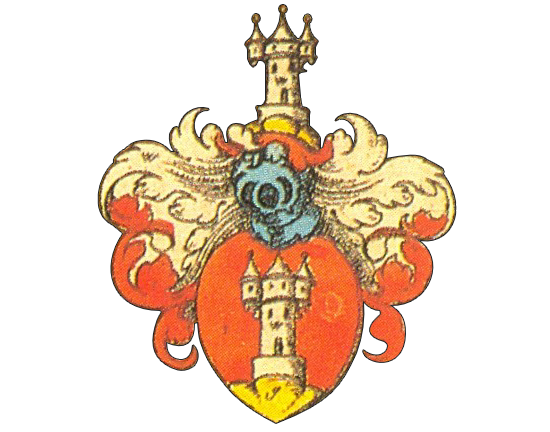
Coat of arms of the family according to J. A. Siebmacher (1605)
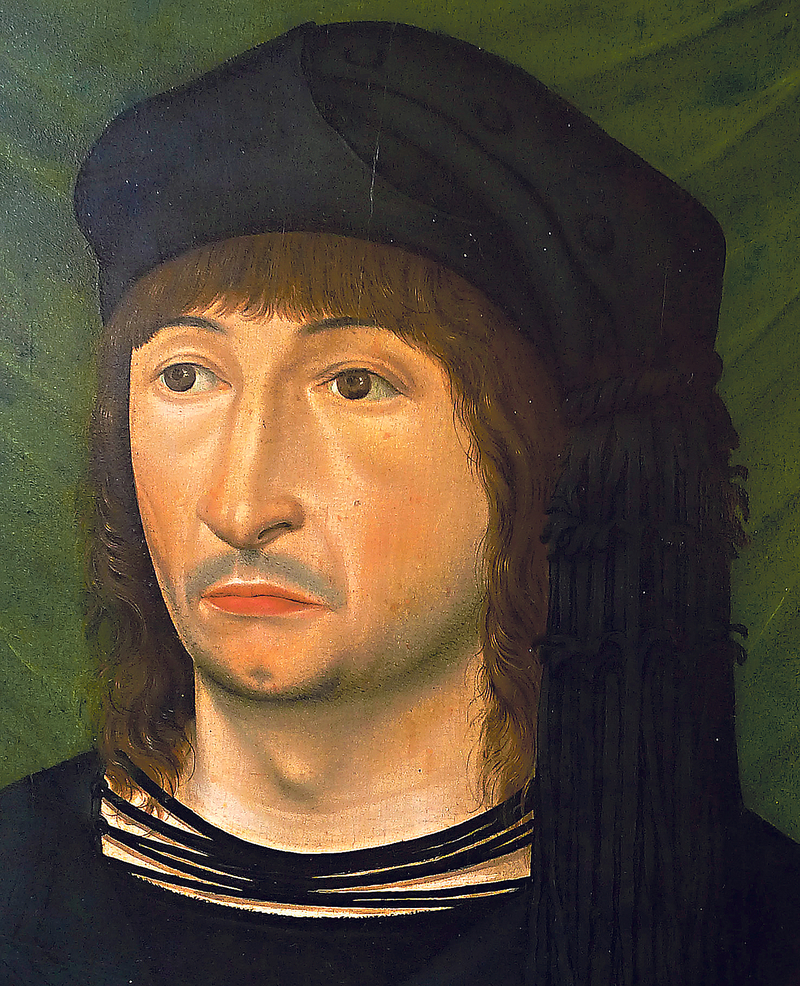
Portrait of Hans Harsdorfer, probably by Michael Wolgemut, 1484
Hans Harsdorfer was born sometime between 1450 and 1460 either in Malesice or in Plzeň. As mentioned above, in 1474 he became the sole owner of Malesice, after which he also styled himself. On 11 September 1481 he married Margareta from the Nuremberg armorial patrician family of the Nützels. He was a mining and metallurgical entrepreneur of the family company, active since 1460. Initially, he only traded in ores imported from Bohemian mines. Diplomatic contacts with the Bohemian King Vladislaus II Jagiellon, following the revolts of the Kutná Hora miners and the uncovering of financial fraud at the mint in 1496, earned him the post of Supreme Mint Master as well as participation in the Prague Diet of 1497.
He had the Chapel of St Wenceslas and Ladislaus in the Italian Court lavishly furnished, including three richly decorated altarpieces, which he apparently commissioned from a painting workshop directly in Nuremberg. The chapel was (re)consecrated on 20 July 1497 on the occasion of King Vladislaus II's visit. During his time in Kutná Hora he also had the Mint Master's house expensively rebuilt and acquired luxury goldsmith's scales housed in a decoratively painted case, the outer lid of which depicts a battle of wild men and the inner side shows two armed men holding the coats of arms of himself and his wife Margareta. He and his wife also donated to the chapel a chasuble adorned with embroidery of scenes from the Life of the Virgin and the Childhood of Christ. During the Baroque era, the embroidery was cut out, sewn onto a new backing and framed in gold. In 1499 he asked the king to be released from his office in order to devote himself entirely to business, as following the death of his uncle Endres Harsdörffer he had inherited his fiefs and estates, Eschenbach Castle, a copperworks and a hammer mill in Enzendorf (now part of Hartenstein in Lower Franconia). Vladislaus granted this request and in a document of November 1499 guaranteed him protection of all his property within the territory of the Bohemian Crown.
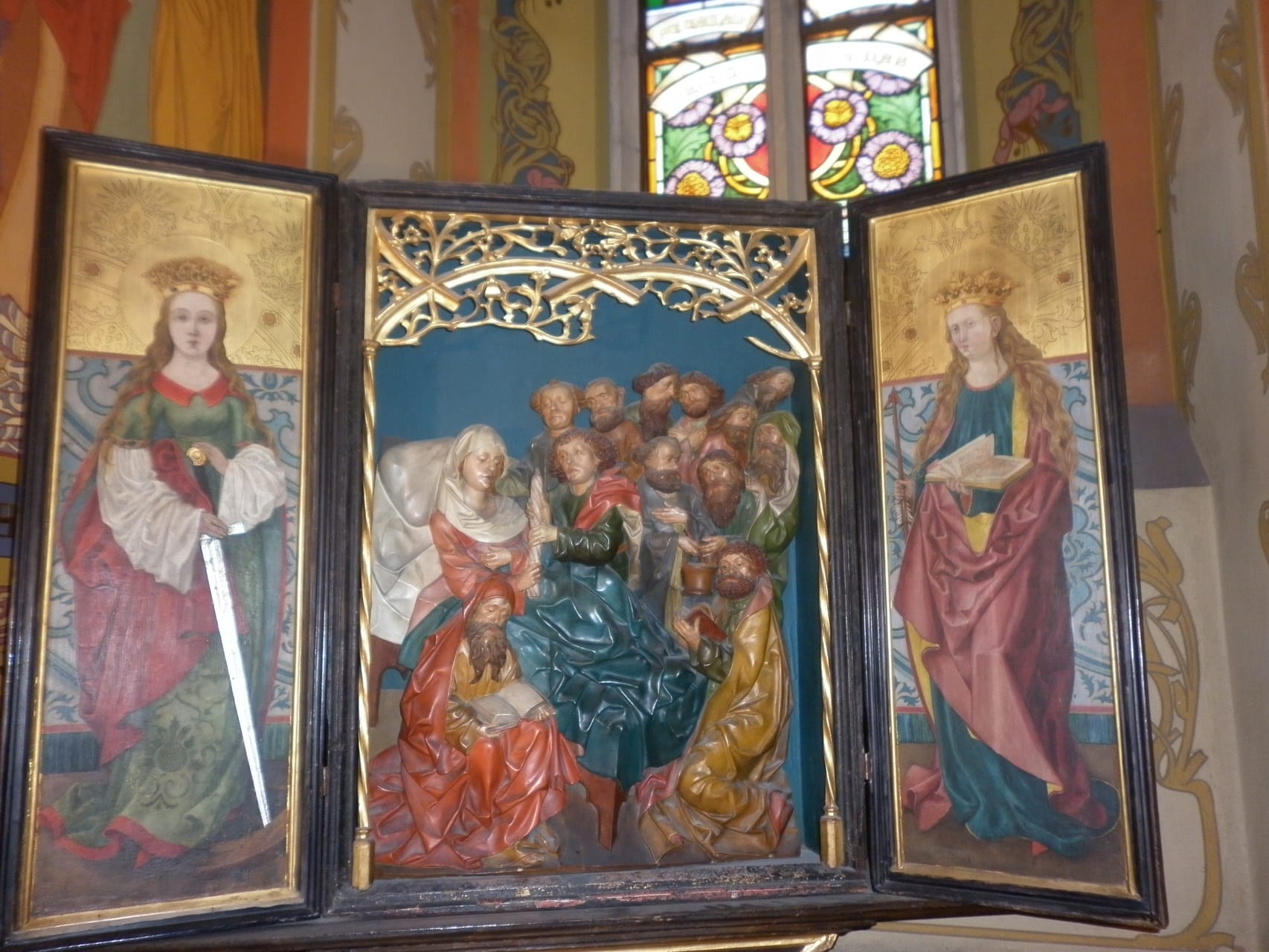
Left altarpiece in the Chapel of St Wenceslas and Ladislaus – the Virgin Mary among the Apostles
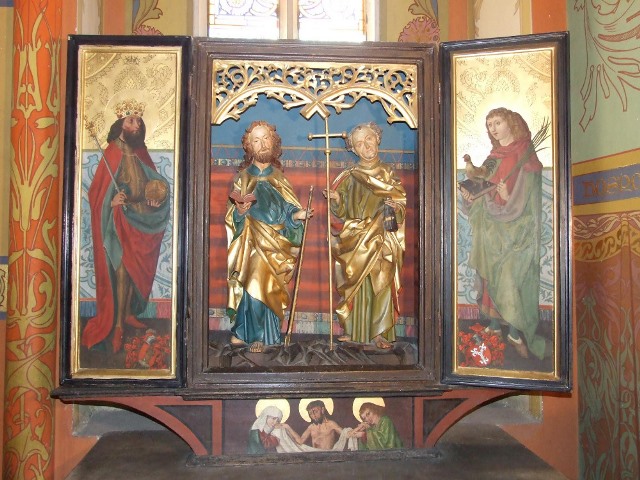
Right altarpiece in the Chapel of St Wenceslas and Ladislaus
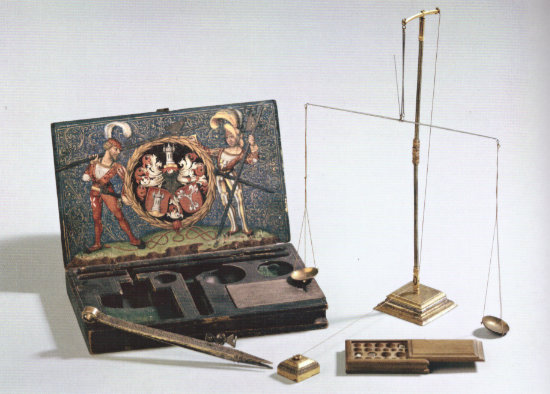
Goldsmith's scales of Hans Harsdorfer
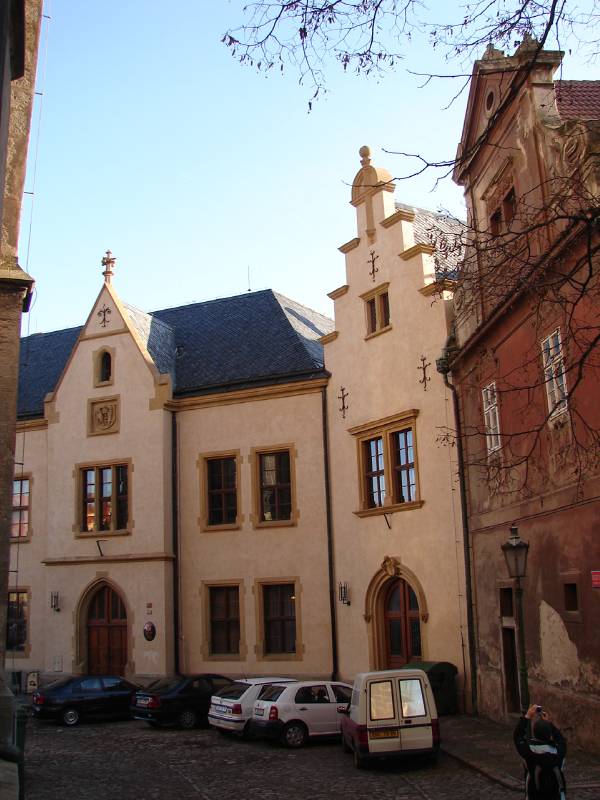
The Mint Master's house in the Italian Court complex in Kutná Hora
Thus Hans Harsdorfer left Kutná Hora on 5 April 1499, moved to Nuremberg, and in 1501 joined the city council (in which members of the families of his father-in-law Nützel and his brother-in-law Stromer hereditably served), and in 1505 was elected senior mayor.However, he never lost sight of his interests in Bohemia. In 1502 he procured four howitzers for Petr of Rožmberk, and in a lawsuit in Nuremberg in March 1512 it is mentioned that he had armour manufactured for Jan of Valdštejn for fifty foot soldiers and twenty mounted knights, which was a considerable military commission. For Plzeň he worked as a financial expert and, among other things, advised on how to handle finances after the city fire of 1507. The city council sent him on diplomatic missions to King Vladislaus, for whom he purchased a painting of the Madonna by Albrecht Dürer for 45 florins and delivered it to the king in 1504 as an official gift from the city of Nuremberg. It seems that he was bound to Dürer by a personal friendship, as Dürer in his letter of 7 February 1506 had him greeted most warmly as his friend. In the War of the Landshut Succession he became one of Nuremberg's three field commanders. He died without issue on 14 January 1511 in Nuremberg and, in accordance with his wish, was buried in Plzeň, in the Cathedral of St Bartholomew.
In addition to the above-mentioned works, Hans Harsdorfer was behind the creation of other works of art, such as the so-called Rábí Ark altarpiece, which some sources state was directly intended as a gift for Půta Švihovský of Rýzmberk and others that it was originally made for the Church of St George in Malesice together with a monstrance.He also purchased liturgical objects and textiles for the chapel in Aachen, where the Bohemian king had patronage rights, and through his mediation the royal court artist, the woodcarver Hanuš (probably a member of the Spiess workshop, Hans Scholler of Nuremberg), received a considerable sum of money, which apparently served to pay for the magnificent altarpiece for the chapel at Křivoklát Castle — the most representative commission that Vladislaus II Jagiellon had made in Bohemia in the early years of his reign.
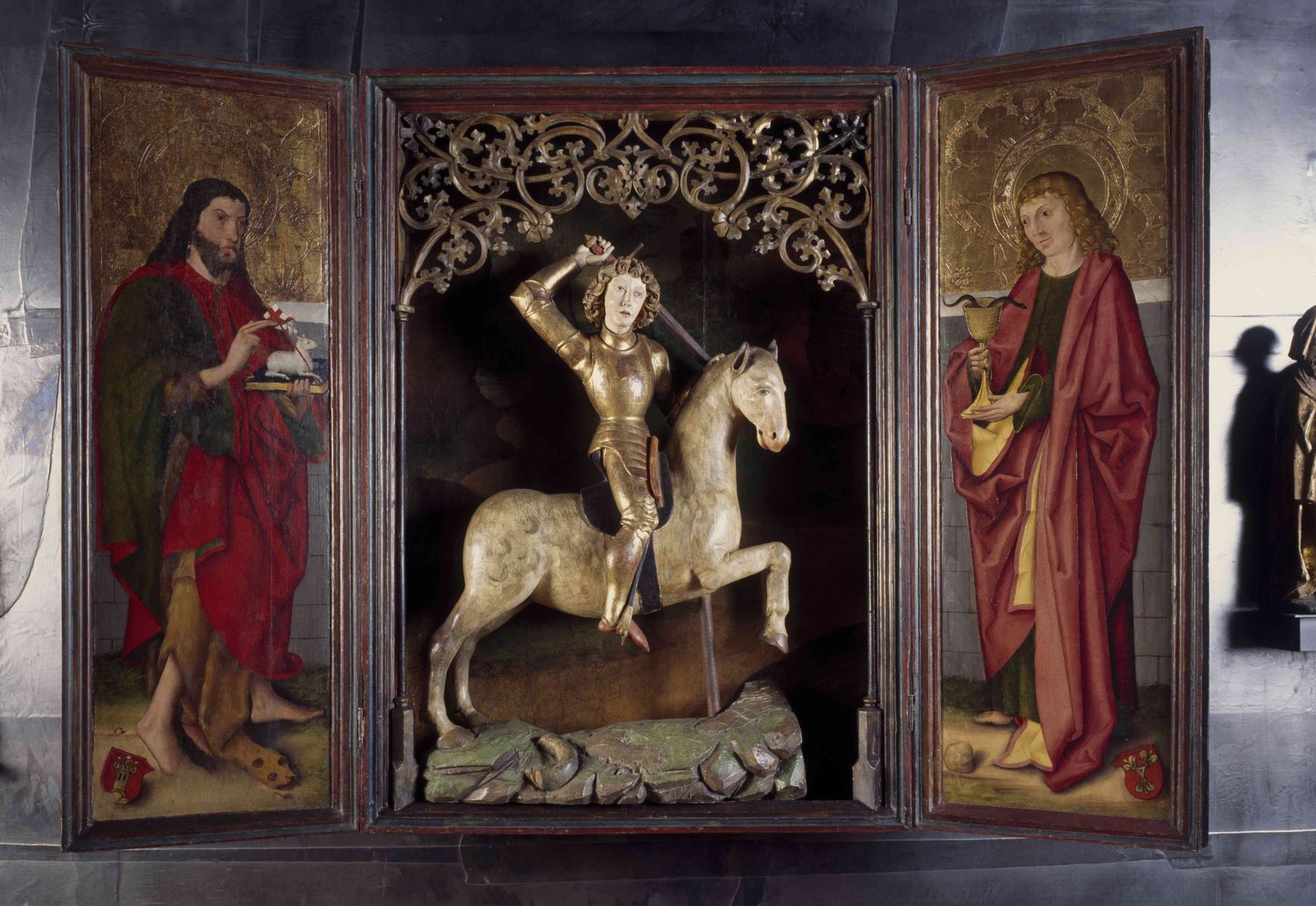
Altarpiece of St George from the castle church of the Holy Trinity in Rábí, the so-called Rábí Ark
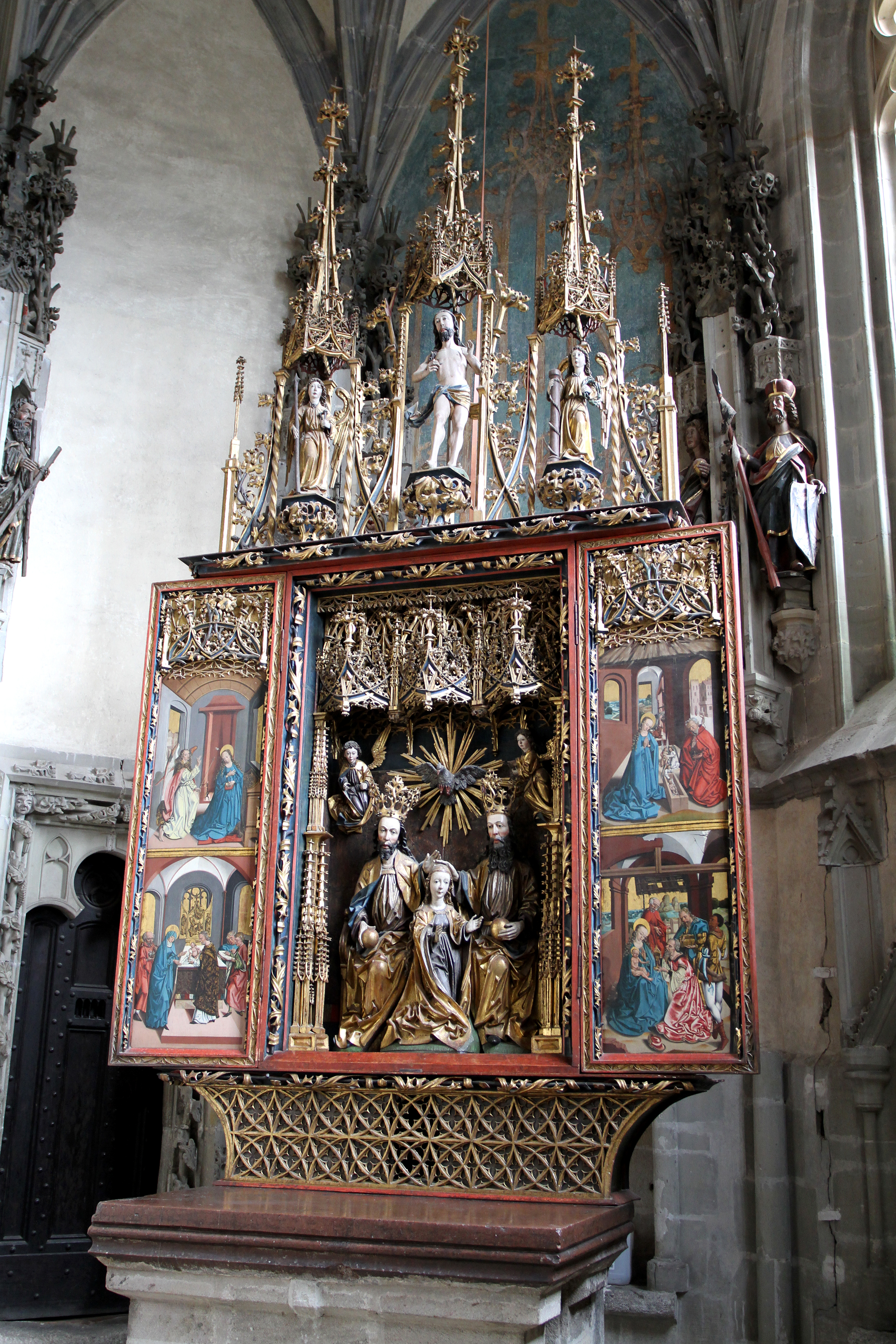
The Křivoklát altarpiece, 1480–1490
Sources:
If you enjoyed this article, please consider making a small financial contribution. Writing articles is very time consuming and we do it in our free time.
IBAN: CZ39 2010 0000 0028 0346 2929
BIC/SWIFT: FIOBCZPPXXX