


The Bavarian War
The Bavarian War of 1459 to 1463, also known as the Princes' War, was a consequence of the expansionist efforts of the principalities. The Margrave of Brandenburg, Albert III Achilles of the House of Hohenzollern, who had by then already unified the Principalities of Bayreuth and Ansbach, stood against the Duke of Bavaria-Landshut, Louis IX, known as the Rich. The so-called Mainz Diocesan Feud, also known as the Baden-Palatinate War, a military conflict over the seat of the Archbishop of Mainz, is sometimes considered part of this conflict.
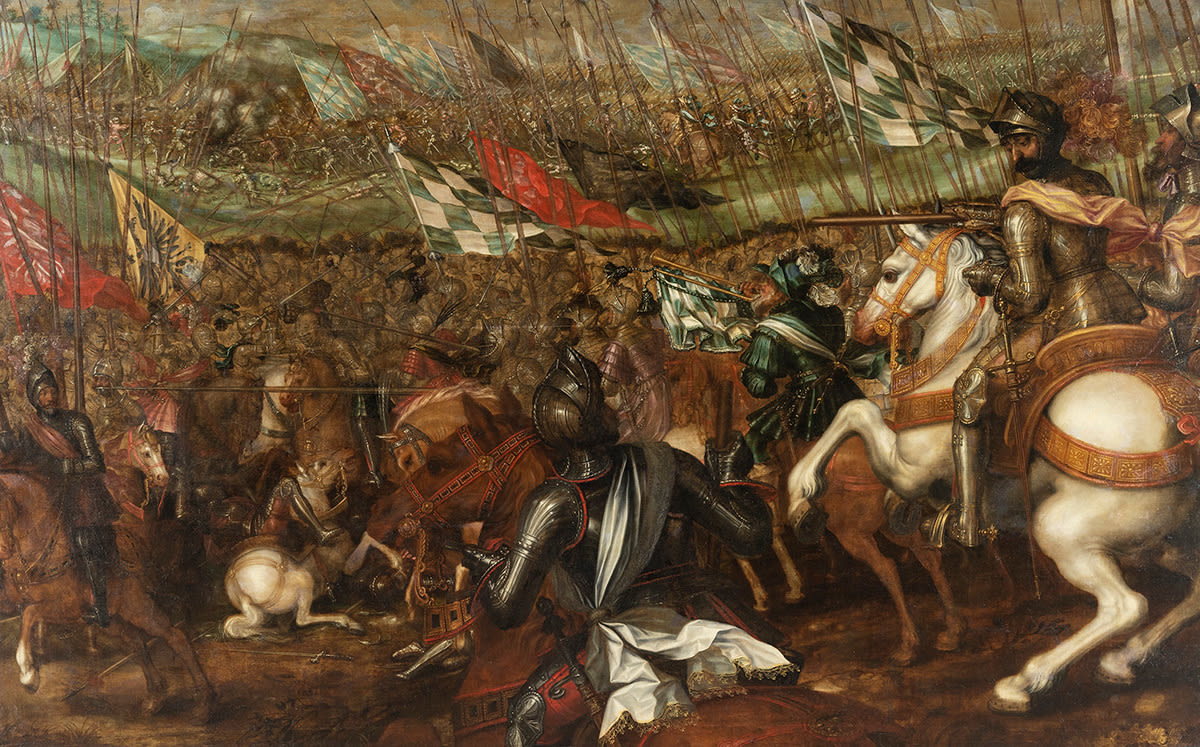
Victory at the Battle of Giengen 1462, painting by Hans Werl, circa 1603
Prelude
The Duke of Bavaria-Landshut, Louis IX the Rich (1450–1479), was, alongside Elector Frederick I of the Palatinate, known as the Victorious (1425–1476), and the Margrave of Brandenburg, Albert III Achilles (1414–1486), one of the most prominent figures among the German princes in the second half of the 15th century. His financial strength, which was based on a rich paternal inheritance and a well-functioning territorial administration, as well as his generosity and magnificent presentation, earned him a reputation for legendary wealth. In the field of imperial politics, he relied fundamentally on the Wittelsbach alliance system created jointly with Elector Frederick I of the Palatinate (both were Wittelsbachs). In particular, the Landfrieden alliance with Duke Albert III of Bavaria-Munich (also a Wittelsbach) and Count Palatine Frederick of 17 December 1451 held strong attraction for the princes, nobility, and cities in southern Germany. After the Swabian imperial cities, Duke Sigismund of Tyrol (1455) and the Bohemian King Ladislaus the Posthumous (1457) later also joined the Wittelsbach alliance system. In 1458, Duke Louis and Count Palatine Frederick renewed and strengthened their coalition through a lifelong alliance.
,_Herzog_von_Bayern-Landshut_-_4541_-_Bavarian_State_Painting_Collections.jpg)
Louis IX of Bavaria, painting by the German painter Julius Zimmermann (1824–1906)
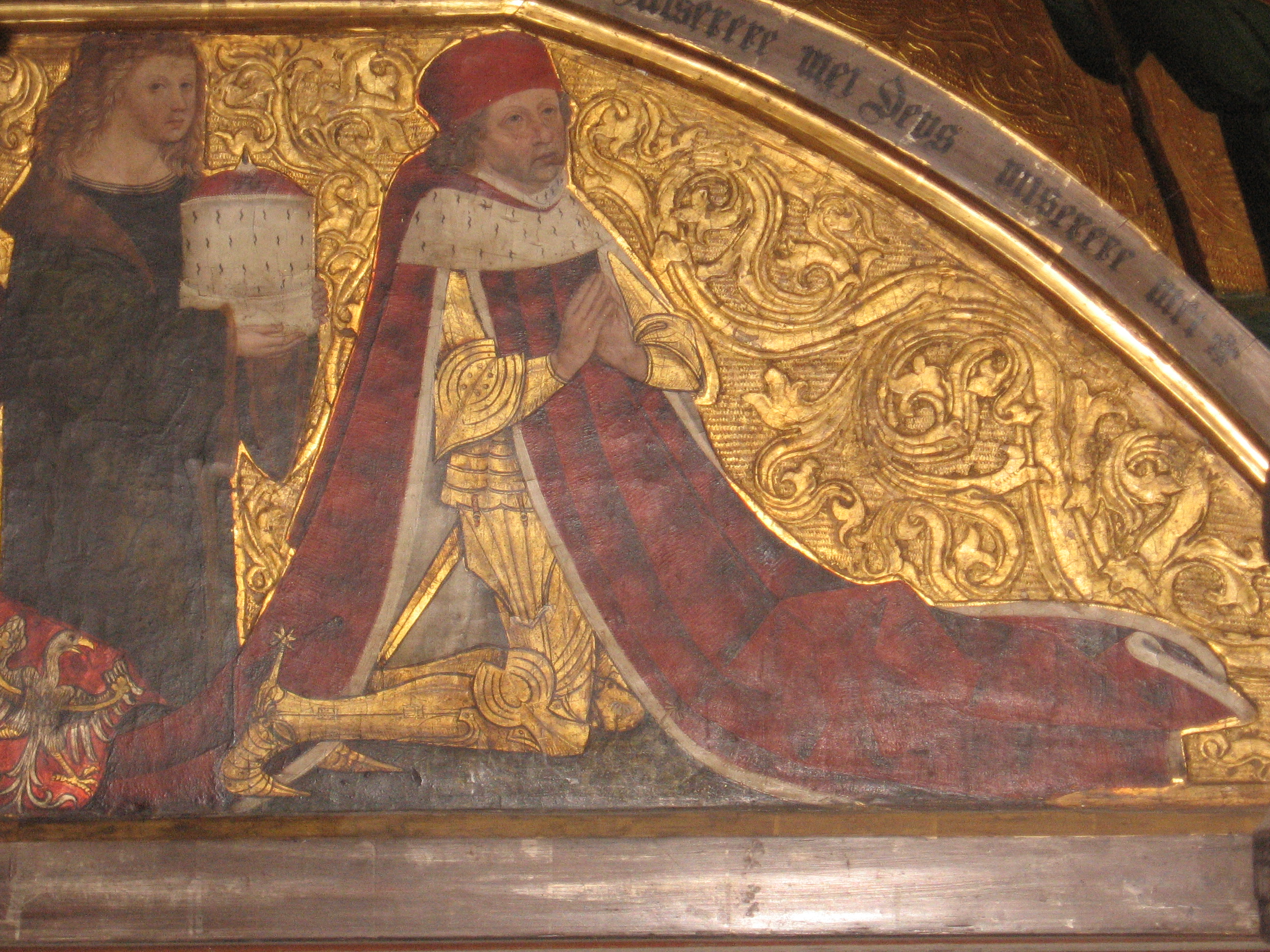
Depiction of Albert Achilles on the predella of the Swan Order altar he donated (1484) in St. Gumbertus Church.
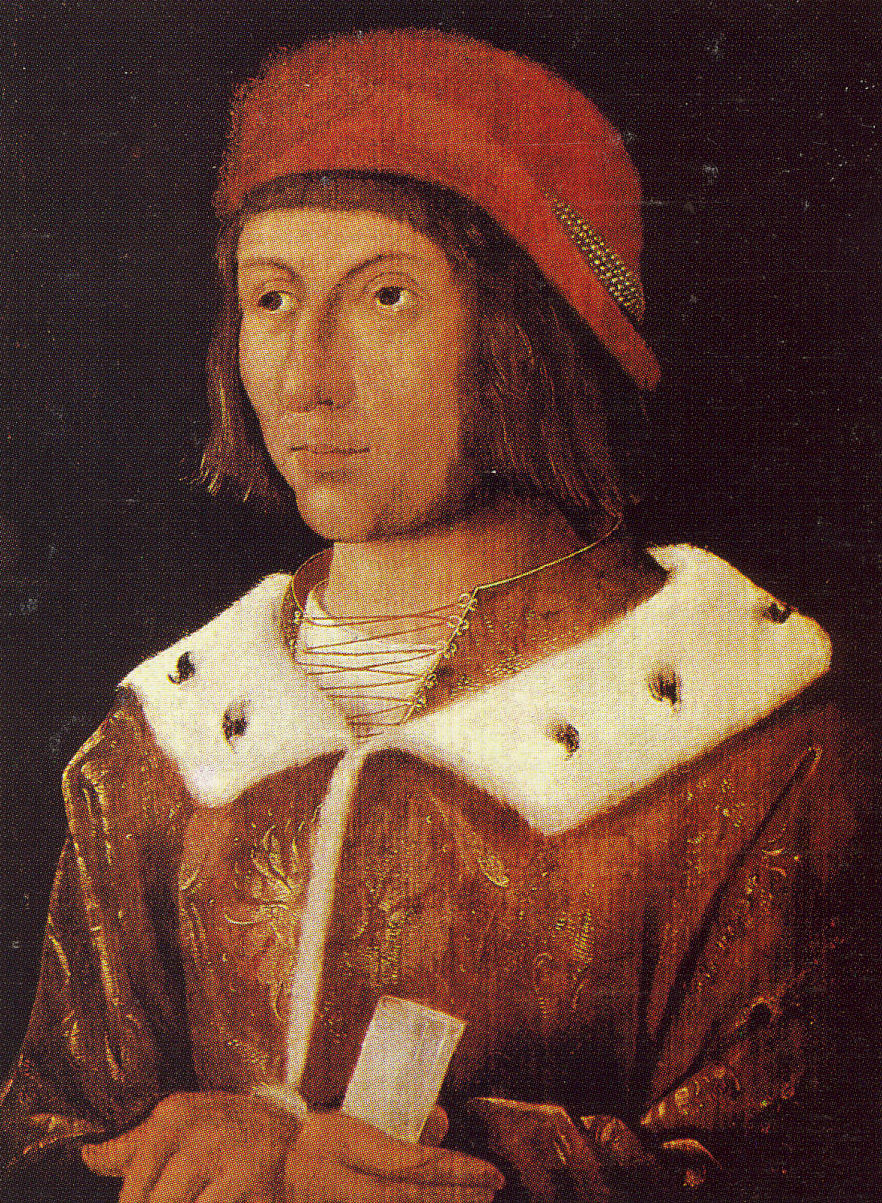
Frederick I of the Palatinate, painting by Albrecht Altdorfer (1480–1538)
But in particular, the relationship between Elector Frederick I of the Palatinate and Emperor Frederick III harboured a high potential for conflict, because the emperor never recognised the rule of the Count Palatine, which he had appropriated against the inheritance law of the Golden Bull. In addition, rivalry also arose between the Count Palatine and Margrave Albert III Achilles.Albert Achilles attempted to expand his jurisdiction and thereby his influence over neighbouring territories. For this reason, he elevated the Landgericht in Nuremberg, where he held the office of burgrave and thus had this court subordinate to him, to an imperial court. In this way, he asserted his claim to unlimited jurisdiction through the Nuremberg court for the entire Empire and, in the name of the emperor as supreme judge, claimed the right to take over court proceedings from all regions. This would have meant that he could influence the jurisprudence of neighbouring principalities and, as a higher court, could overturn decisions of subordinate courts. Behind Albert Achilles' efforts was also the idea of restoring the Franks under Hohenzollern dominion. In combination with ducal dignity, this idea remained alive for a long time in the Prince-Bishopric of Würzburg, without ever becoming reality again.Albert III thus inevitably came into conflict with the Count Palatine of the Rhine and in Mosbach, with the Franconian bishoprics, and finally also with Duke Louis IX.
On the other hand, princes in south-western Germany, who also felt threatened by the expansionist territorial policy of Count Palatine Frederick I the Victorious, joined the margrave's policy. The so-called anti-Palatinate alliance between the Margrave of Brandenburg, Duke William of Saxony, Margrave Charles of Baden, Count Ulrich of Württemberg-Stuttgart, and the Archbishop of Mainz, Diether von Isenburg, was, like the renewed Wittelsbach alliance, concluded in 1458. This prepared the ground for a decisive confrontation. And the appropriate trigger for the outbreak of conflicts indeed did not take long to appear.
Although the Duchy of Bavaria-Landshut was also affected by the interventions of the Nuremberg court, the good personal relationship between Margrave Albert III Achilles and Duke Louis IX prevented the territorial rivalry from escalating into open hostility until 1458. On the other hand, Margrave Albert remained a loyal defender of imperial interests in the Empire throughout his life. Rarely, however, could he gain any benefit from this for his own goals. It was precisely in the emerging confrontation between the Wittelsbachs and the Empire that he saw an opportunity to combine imperial interests with his plans regarding the Nuremberg Landgericht by acting as the emperor's representative while still primarily defending his own interests against his territorial neighbours in Franconia and Bavaria.
This became clearly apparent when the conflict with the Wittelsbachs actually materialised. After Duke Louis IX – initially still with the help of Margrave Albert – occupied the free imperial city of Donauwörth, strategically important for controlling the Danube, in October 1458, in order to incorporate it into his duchy on the basis of old legal claims, Emperor Frederick III pronounced the imperial ban over him on 4 June 1459. As its executor, he appointed – at his own request – alongside Duke William of Saxony, also Margrave Albert. Thanks to his alliance with the Habsburgs, Archduke Albert of Austria and with Duke Sigismund of Tyrol at his back, and with the beginning recruitment of mercenaries in Bohemia, Louis IX felt strong enough to wage war against the Empire. Open conflict between the Landshut duke and Albert of Brandenburg now seemed to be only a matter of time. Suddenly, however, Duke Louis was unexpectedly deprived of the prospect of numerous mercenaries from Bohemia and thus his hope for a decisive military striking force. Following the intervention of Pope Pius II and due to as yet unresolved disputed territorial points with Bavaria, the Bohemian King George of Poděbrady forbade his countrymen from serving as mercenaries for Duke Louis. On 16 July 1459 Louis had to surrender Donauwörth to the emperor and appear before the princely arbitration court.
The so-called “blind verdicts” of the arbitration court, which sat in July 1459 in Nuremberg, were a one-sided success of the diplomacy of the Margrave of Brandenburg (127). In the essential points, the decision went against the interests of the Wittelsbachs, and also in the important question of the jurisdiction of the Nuremberg court, the vague formulation of the arbitration court allowed an interpretation in the sense of Margrave Albert. The tension between the parties in the Empire thus continued, so that a new outbreak of open hostilities remained only a matter of time.
To prevent a situation similar to the dispute over Donauwörth, the Wittelsbachs jointly sought to improve relations between Duke Louis IX and Bohemia. Between the autumn of 1459 and the autumn of 1460, they actually succeeded in progressing from cautious rapprochement to a firm bond, which was even underpinned by the betrothal between King George's daughter Ludmila and Duke Louis IX's son George. The background was the plan of the Wittelsbach adviser Martin Mair to make the Bohemian king German king against the emperor's will and thereby increase the Empire's capacity for action. A plan for which the Bohemian king was absolutely enthusiastic, but which ultimately failed due to the lack of support from the princes around Margrave Albert III of Brandenburg loyal to Emperor Frederick III. This rejection finally brought King George definitively to the side of the Wittelsbachs, with whom he concluded an alliance primarily against Margrave Albert, but thereby ultimately also against the emperor.
On the basis of these changing relations with George of Poděbrady, Bavarian war preparations took shape rapidly in the spring of 1460. Duke Louis again relied primarily on mercenaries from Bohemia, of whom at least 5,000 entered his service that year. Some Czech condottieri stand out particularly for the size of their mercenary contingents: Dobrohost of Ronsperg and Horšovský Týn brought more than 1,300 mercenaries into the service of Duke Louis, Racek of Janovice and Rýzmberk about 1,000, and Mikuláš Kaplíř of Sulevice and Vimperk was represented in the ducal army by about 900 men. In addition, several other condottieri and mercenary commanders had strong contingents of up to several hundred men.
Course of the War
In March 1460, open armed conflict broke out, conducted according to the traditional forms of feud. When Count Ulrich V of Württemberg (ruled 1433–1480) and Count Palatine Louis of the Palatinate-Zweibrücken, allies of Albert III Achilles, attacked the Electorate of the Palatinate as part of the Baden-Palatinate War, Louis the Rich took the side of Elector Frederick of the Palatinate and, under the pretext of implementing the alliance treaty, had his long-prepared troops march against Margrave Albert into Hohenzollern Franconia. The ducal army had a clear superiority over the margrave's army and achieved some rapid successes. First, the main direction of the Bavarian attack turned against the Bishopric of Eichstätt, because Bishop Johann von Eich was an ally of Margrave Albert. After a short siege, the city of Eichstätt fell on 7 to 11 April 1460 into the hands of the duke, and Bishop Johann was forced to sign a treaty that permanently severely restricted the independence of his bishopric vis-à-vis Bavaria. In mid-April, Duke Louis continued his campaign in Franconia and marched through Heideck and Hilpoltstein to the small margravial town of Roth, which he began to besiege on 27 April 1460. With a short interruption between 30 April and 3 May, caused by supply difficulties, the army, by then probably about 20,000 men strong, now set up a fortified camp at Roth, from which reconnaissance raids by individual mercenary contingents were repeatedly launched into margravial territory. Among other things, the town of Windsbach was set ablaze and the duke's Czech mercenaries plundered the Augustinian monastery in Pillenreuth near Nuremberg.
On 5 May 1460, Margrave Albert appeared before Roth with an army of about 10,000 men and encamped with it at a “cannon shot's distance” from the Bavarian military camp. During the following seven weeks, no major battles that might have been decisive for the course of the war took place, even though the opponents lay so close to each other. Instead, there were almost daily smaller skirmishes between the camps or mutual shelling from the Wagenburg. At the same time, further reinforcements arrived before Roth, so the armies continued to grow. Duke Louis is said to have eventually had about 30,000 men in his army, the margrave several thousand fewer. Given the dramatically tense situation before the besieged Roth, in which neither side was willing to yield, a decisive battle could have broken out at any moment. Meanwhile, however, diplomatic efforts for a peaceful resolution of the conflict were again increasing on both sides and soon brought their first successes, even though both main opponents were hardly inclined towards peace. Duke Louis considered himself the military victor of the war, while Margrave Albert demanded the withdrawal of the Bavarian army before he was willing to negotiate at all. Only the threatened disintegration of his army through the departure of Saxon allies finally forced Margrave Albert to yield. The result of the conciliation negotiations was the so-called Roth Directive of 24 June 1460, which appears as a complete success of Wittelsbach policy. The “blind verdicts” from Nuremberg were annulled, the jurisdiction of the Nuremberg court was considerably restricted, the Bishopric of Eichstätt remained under Bavarian influence, and Duke Louis did not have to evacuate the occupied margravial territories. Regarding further disputed issues, such as compensation for war costs or the evacuation of occupied areas, the Bohemian King George of Poděbrady was to serve as arbitrator. When on 4 July 1460 Count Palatine Frederick also defeated his opponents at the Battle of Pfeddersheim, it seemed that the Wittelsbachs and their allies were triumphing all along the line.
The fragile peace, however, was once again not to last. In the following months, Margrave Albert of Brandenburg repeatedly sought to repudiate his recent recognition of the Roth Directive. In contrast, Louis of Bavaria-Landshut insisted on his acquired territorial positions in Franconia without accommodating the mediators' efforts at compromise. Meanwhile, he knew that the Bohemian King George, who had definitively turned away from Margrave Albert due to the rejection of the proposal regarding the election of a German king, was more than ever on his side.
Besides King George, another important link in the Wittelsbach alliance system was Archduke Albert VI of Austria, brother and dynastic rival of the emperor. When he launched open war against the emperor in the summer of 1461 in the dispute over the Austrian inheritance of Ladislaus the Posthumous, who had died in 1457, this also triggered another round of disputes between the Wittelsbachs and Margrave Albert of Brandenburg with their respective allies. Duke Louis's military alliance aid to Archduke Albert provided Emperor Frederick with a pretext to declare war on him in July 1461. As Imperial Captains, he appointed alongside Margrave Charles of Baden and Count Ulrich of Württemberg also Margrave Albert III Achilles, who saw in this an opportunity to revise the Roth Directive. Just as in 1459 in the dispute over Donauwörth, Albert here combined imperial policy with his hegemonic policy in southern Germany and Austria.
Similar to the previous year, Duke Louis was better prepared for the approaching conflict than his opponent. Already in the early summer of 1461, he began war preparations, which again included successful recruitment of mercenaries in Bohemia. At least 2,000 Czechs entered his service from August, strengthening the ducal army, which with a total of 16,000 men far exceeded the army of Margrave Albert. Racek of Janovice and Rýzmberk sent about 500 mercenaries, Přibík Šatava arrived with more than 400 men from southern Bohemia, Jan Jenec of Janovice and Petršpurk with about 250 men from western Bohemia, these being the largest contingents. In addition, active military support from the Bohemian king, who declared feud against the margrave and had a strong army march against the Upper Franconian territories of the Hohenzollerns, was also provided. Even though the military success of this deployment remained limited, it nevertheless tied down important forces of the margrave that he urgently needed on the main theatre of war in Central Franconia.
This time, Duke Louis advanced with his army even deeper into margravial territory than the year before. Neustadt an der Aisch and Uffenheim were conquered, Windsbach, Heilsbronn, and other places severely damaged. In total, at the very beginning of the campaign, 18 margravial towns, places, and castles are said to have fallen into the hands of the Bavarian duke, who, together with the contingents of the allied Franconian bishops and Count Palatine Frederick, dominated the battlefield. Margrave Albert, who waited in vain for the promised reinforcements from his allies, had to limit himself to holding Ansbach and Schwabach and from there launching occasional raids against the ducal army. Only when in October the allies left Duke Louis's army for various reasons and the strained supply situation, which worsened further with the onset of adverse weather, showed the necessity of splitting the army, did the situation gradually change. Decisive, however, was the behaviour of the Bohemian king, who accepted the role of mediator offered by the emperor, withdrew the Czech contingents from Upper Franconia, and called upon Duke Louis to also release the Czech mercenaries serving under him. Margrave Albert immediately exploited the ensuing Bavarian retreat by recapturing in rapid succession almost all the places occupied by the Bavarians.
When the disputing parties finally met in November 1461 in Prague to discuss the possibilities of concluding peace through King George, the chances of reaching an agreement were thus scarcely better than before the start of the war. While Duke Louis was unwilling to go back beyond the provisions of the Roth Directive and instead made ever more extravagant demands for war compensation, the margrave, after his recent successes, no longer felt like the defeated party and therefore showed little willingness to even participate in negotiations. He ignored the ceasefire concluded in December with the argument that it had no validity for the as yet unfinished imperial war against Duke Louis. And when Margrave Albert was certain that the emperor had his back, he indeed renewed the war against the Wittelsbachs in January 1462.
In 1462, however, unlike the previous year, Emperor Frederick's appeals to the imperial cities to fight against Duke Louis took effect. The balance of power thus developed differently this time than in the campaigns of 1460 and 1461. The Swabian cities, led by Augsburg and Ulm, now actively participated in the war against Duke Louis, which this time also shifted the centre of gravity of military operations more into the Swabian area. However, the imperial army was unable to exploit its initial superiority. Duke Louis managed relatively quickly to assemble a strong army again – once more with strong participation of mercenaries from Bohemia, whose number, however, cannot be determined for this year. In addition, the Bohemian king also resumed war against the margravial areas around Wunsiedel. With two great successes in the summer, it then seemed that the decision was finally falling in favour of the Wittelsbachs. On 30 June 1462, Count Palatine Frederick managed to win a crushing victory over his opponents from south-western Germany at the Battle of Seckenheim, in which Margrave Charles of Baden and Count Ulrich of Württemberg were taken prisoner by the Palatinate. A similar success was also achieved by Duke Louis of Bavaria-Landshut with his victory over the imperial army led by Margrave Albert on 19 July 1462 at Giengen.
The Baden-Palatinate War and the Battle of Seckenheim
It was part of the archiepiscopal dispute over the occupation of the Mainz archdiocese, also known as the Baden-Palatinate War. In 1459, the cathedral administrator Diether von Isenburg was elected new Archbishop of Mainz by a narrow majority over Adolf von Nassau. The price for this election was joining the anti-Palatinate alliance, and Diether was thus forced to march against Count Palatine Frederick I, but on 4 July 1460 he lost the decisive Battle of Pfeddersheim. In 1461, Diether convened a princely diet in Nuremberg, where he advocated for imperial and ecclesiastical reforms. He emphatically demanded the abolition of papal annate requirements through a general council. His critical stance towards Pope Pius II and Emperor Frederick III led to his deposition and excommunication by the pope on 21 August 1461. The pope then installed his rival Adolf von Nassau on the archiepiscopal throne in Mainz on 1 October 1461. Diether, however, refused to relinquish the archbishopric, supported by the city of Mainz, his brother Louis, and now also his former enemy Frederick I of the Palatinate, who in return for his help received the towns of Lorsch, Heppenheim, and Bensheim. Adolf allied himself with the Archbishop of Trier, John II of Baden, Bishop George of Metz, Bishop John II von Hoheneck of Speyer, and Count Ulrich V of Württemberg. Margrave Charles I of Baden initially attempted to mediate between the warring factions, but then took Adolf's side alongside his brother, Bishop George of Metz, which led to the Baden-Palatinate War, an attempt at the forcible conquest of the diocese.
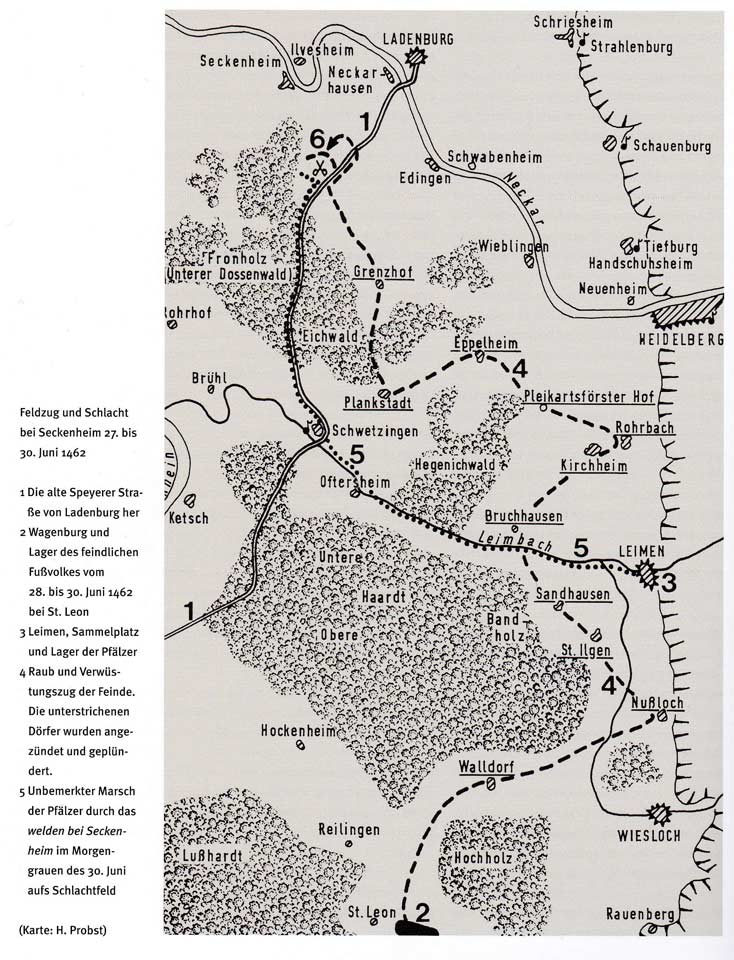
The opponents of Frederick I intended to invade the Palatinate from the south, as they believed the elector was with his troops in Bavaria to help Duke Louis IX against Albert III Achilles, and therefore assembled an army of 10,000 men near Pforzheim. A military camp was set up between Roth and St. Leon, and cavalry composed of princes and knights burned the surrounding fields and villages and massacred the inhabitants. Frederick I ordered his vassals and their men-at-arms to assemble at Leimen, where he could unobtrusively gather his forces. He himself did not arrive until 29 June and from there observed the nocturnal activities of his enemies. Couriers were sent to the Archbishop of Mainz, Diether von Isenburg, the Counts of Leiningen and Katzenelnbogen, who were on the left bank of the Rhine and were ready to march through Altrip to Lower Dossenwald. The number of fighters who pinned walnut leaves to their garments – the identifying marks of the Palatinate forces – increased due to the great influx of peasants from the region. The Baden forces, on the other hand, pinned tufts of oats to their garments.
On the night of 30 June, he marched with about 300 horsemen and additional infantry through the Schwetzingen Forest to “Frohnholz” (today's Dossenwald) south of Seckenheim, which the imperial forces intended to burn down the following day. During the march, the Palatinate forces were reinforced by a further approximately 300 horsemen and additional infantry from the contingents of the Archbishop of Mainz, Diether von Isenburg, and Count Philipp von Katzenelnbogen.
When the imperial attackers set out from their fortified camp the following morning and advanced on Seckenheim with 700 to 800 horsemen to burn it down, they were unexpectedly attacked from behind by 600 horsemen of the Palatinate side, with the battle cry of the Count Palatine: “Hut Palatzgraff oder nimmer mee!” (Hold on, Count Palatine, or never more!), while the infantry of about 2,000 men was kept by Frederick I out of sight in a nearby forest. Frederick's less numerous cavalry adopted an echelon formation with men-at-arms in the centre and two rows of mounted archers on the flanks. After a brief initial exchange of fire, the heavy cavalry of both armies charged at each other, and Frederick's knights only barely prevented the allied men-at-arms from breaking through. While the horsemen fought each other, Frederick's infantry emerged from its hiding place and encircled the imperial allies. A group of about 300 allied horsemen did manage to break out and then attacked the Palatinate grooms who were waiting for their men-at-arms and killed them, but this no longer changed the outcome of the battle.Ulrich of Württemberg refused to accept defeat but was challenged to a duel by Hans von Gemmingen, who cried: “Zkusím štěstí s Vaší Milostí!” (I shall try my luck with Your Grace!) and was defeated. 45 allied knights were killed and approximately 400 more horsemen captured. The rest scattered across the surrounding area and brought the terrible news to the camp at St. Leon. There they set off on the return journey in panic, fearing the vengeance of the Count Palatine and his enraged subjects. The Palatinate army achieved a decisive victory, killing 45 knights and capturing 124 nobles and 204 squires, while losing 12 of its own knights killed. Among the prisoners were three enemy leaders: Margrave Charles I of Baden with 40 nobles and 79 squires, Count Ulrich of Württemberg with 45 nobles and 71 squires, and Bishop George of Metz with 39 nobles and 53 squires. Only Louis of Zweibrücken escaped capture. By the following year, the princes were ransomed for large sums and significant territories.
The diocesan feud, however, was not yet over. Further fighting claimed many victims and caused devastation everywhere, and the city of Mainz itself suffered serious damage. On the night of 28 October 1462, Adolf von Nassau managed to penetrate the city with 500 men through the Gautor by the treachery of Mainz citizens, and after 12 hours of street fighting, he seized control. 400 people lost their lives and Adolf's men plundered and burned the city, including the Dominican monastery. As “punishment” for supporting Diether, Adolf stripped the city of its freedom privileges and thereby its status as a free city; the city came under the administration of a Vicedominus appointed by the archbishop. The following day, the citizens were summoned to the Dietmarkt. All 800 citizens who appeared were expelled from the city; about 400 of them were readmitted somewhat later and allowed to remain in Mainz.
Even these Wittelsbach successes, however, did not end the war. Instead, the heavy burden on Bavarian finances from conducting the war, primarily through the large mercenary army, became apparent. The resources of Duke Louis the Rich were exhausted. Shortly after his triumph at Giengen, he therefore felt compelled to dismiss the greatest part of his mercenaries, which once again changed the military situation. From now on, the scene in southern Germany was shaped by ongoing petty warfare with alternating successes.
In addition, meetings for negotiations took place again to finally settle the conflicts. After the ceasefire concluded at the end of August 1462 in Nuremberg, further arduous negotiations followed. Only a year later, in July 1463, a peace congress was held in Prague under the leadership of the Bohemian King George of Poděbrady, who had in the meantime reconciled with Emperor Frederick III. With this initiative, the Utraquist king hoped to avert the excommunication threatened by Pope Pius II. After complex negotiations, a peace agreement consisting of several individual treaties was concluded on 22 and 23 August 1463. The so-called Peace of Prague did not resolve all disputed issues, but it nevertheless proved lasting. Both sides had to make concessions. While Margrave Albert III Achilles had to definitively abandon his plans for the domination of Franconia, which he had sought to achieve by strengthening the Nuremberg Landgericht, Duke Louis IX was obliged to evacuate the still-occupied margravial territories and settle all compensation claims with the margrave. Nevertheless, he did manage to defend himself, which can be evaluated as a success in his case. A success for which he owed primarily to his strong mercenary army, which was to a large extent – probably even in the majority – composed of Czech mercenaries.
Sources:
If you enjoyed this article, please consider making a small financial contribution. Writing articles is very time consuming and we do it in our free time.
IBAN: CZ39 2010 0000 0028 0346 2929
BIC/SWIFT: FIOBCZPPXXX