


German Military Orders and Writings
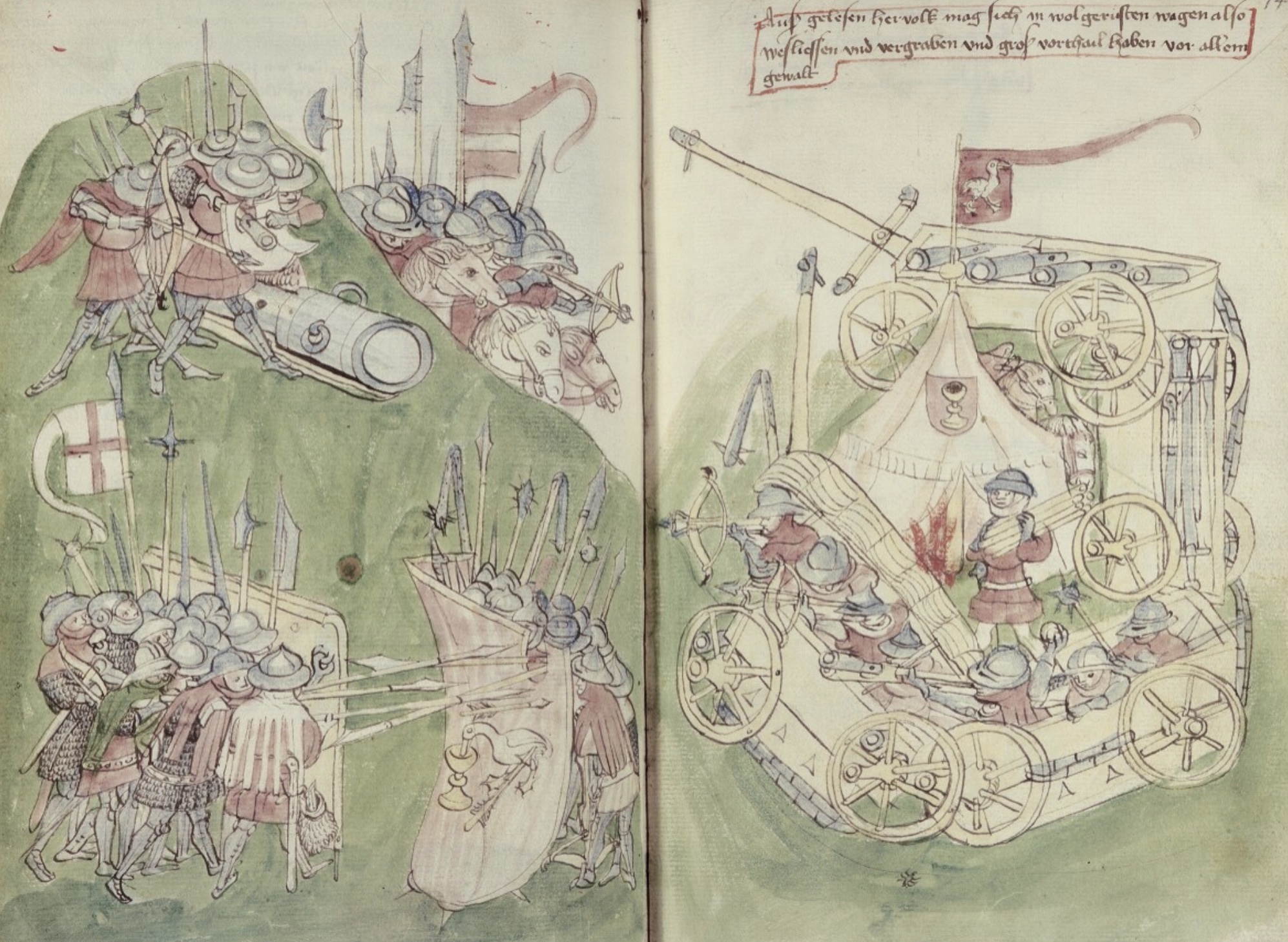
The opponents of the Hussites learned their way of fighting in the war itself. According to Max Jähns, they were forced to: anyone who wanted to set artillery of their own against artillery needed wagons, and anyone who wanted to take an enemy wagon fort had to leave the brunt of the fighting to the infantry. In the German lands the wagon fort thus became so closely bound up with the army that the word Wagenburg was often used for the army as such. The wagon fort ordinances of the period (Wagenburgordnungen) are therefore mostly army ordinances (Heerordnungen) as well. According to Toman, references to wagons armed in the Hussite manner appear in the resolutions of the estates of the neighbouring lands from the defeat at Ústí nad Labem (Aussig) in 1426 onwards. At first, however, they are very brief and merely list what is to be taken into the field with the wagons.
The wagon fort was not the only subject, however. According to Toman, three general military ordinances for the planned campaigns into Bohemia emerged from the deliberations of the imperial diets during the Hussite wars. They deal with the preparation of the campaign, discipline in the army and the allocation of artillery. The electors' proposals of 1426 are in his view merely a poor attempt, the Frankfurt resolution of 1427 already forms a complete ordinance of 48 articles, and the third ordinance was issued by the Nuremberg diet in 1431.
Maximilian von Wulf observes that, as far as the wagon fort is concerned, the ordinances of 1428–1450 are limited to the equipment of the wagons. In his view, the Nuremberg resolution of 1428 contains the very earliest provisions on the war wagons of the imperial levies. Only from a later period have more detailed ordinances survived that also describe the march and encampment of the wagon fort. According to Wulf, the most vivid picture of a wagon fort on the march and in camp is given by the ordinances of Margrave Albrecht Achilles.
As a source for Hussite warfare, both authors treat the later ordinances with reservation. Toman regards the ordinances from the first half of the century as direct sources. As for the later ones, he points out that they reflect the changes of the last quarter of the century – improved artillery and Swiss and Netherlandish models in the use of infantry. Even so, he finds much of value in them that rests on old traditions, above all on manoeuvring with wagons and on technical aids, about which the older sources are silent. Wulf goes even further: in his view the later ordinances lack any necessary connection with the Hussite model. They can therefore serve only to confirm and explain the scanty direct reports on Hussite warfare, not as proof.
Agreement of the Silesian Princes, Vassals and Towns at Grottkau (1421 or 1427)
The agreement against the Hussites was concluded by the Silesian princes together with the lands and towns of Breslau and Schweidnitz-Jauer. It regulates the garrisoning of the border castles with cavalry, joint action in the event of an invasion of Silesia, the equipment of the wagons and the allocation of guns, and finally lists what is to be taken along on the campaign. The document bears no year; it is dated only “on the Thursday of the Ember Days before Michaelmas”. Palacký printed it after Grünhagen's edition under 18 September 1421. Grünhagen connects it with the assembly of princes at Grottkau on that day and stresses its markedly defensive character. Toman, on the other hand, holds that the document belongs to a later period, perhaps to 1427. He regards it rather as a more detailed implementation of the league of the same principalities of 14 February 1427, and considers such a large number of guns altogether improbable for 1421.
Translation notes: I interpret the obscure words following Grünhagen's paraphrase of the document in modern German. According to him, the “landzocht” chain connected the two halves of the wagon, “czoë” are pitchforks and “pisschullen” are hand firearms. He explains “tarrasssteinbüchsen” as guns that are rested on something when fired, as opposed to hand firearms; I translate them as tarasnice (light pieces on a stand). I also follow Grünhagen in identifying the princes: Duke Kaske is Casimir of Auschwitz (Oświęcim), Bernhard is Bernhard of Falkenberg and Przemek is Přemek of Troppau (Opava). I leave the words “kriptücher”, “lythische schilde”, “poffeysen” and “fusseysen” untranslated. Grünhagen merely renders them in modern German (Halstragseln, lüttische Schilde (?), Puffeisen, Fußeisen) and their meaning is uncertain.
Einigung mann vnd stete vnd der fürsten in der Slesia.
Off den tag zue Grottkaw haben sich die fürsten und lande u. stete Breslaw Swednitz u. Jawer sich eyntrechtiglich geeynet u. beslossen wider die kätzer in Behem, also hienoch stehet geschreben:
Zum irsten die festen an den grentzen vff eine landwer zu besetzen, also: Item hertzog Johannes von Monsterberg u. land u. stete Breslaw, Swidnitz und Jawer sullen 230 pferde legen uff das Smedewerg (Schmiedeberg), off den Schetzler (Schatzler), vf Swartzenwalde (Schwarzwaldau) u. vf Conradswalde (bei Grüssau). Item der bischof 70 pferde. Hertz. Ruprecht von Löbin vnd Ludwig sein bruder 35 pferdt, h. Ludwig vom Brige 60 pferdt und h. Conrad Canthner 60 pferdt sullen sie kein Brawnaw legen. Item so sullen die von Ratibor Jegerdorff selbir mit 50 pferden besetzen. Item h. Bolcke von Teschen 30 pf. und der junge h. Bolco 25 pf. in die Ostra legen. H. Bernhard mit 30 pf., h. Kaske mit 20 pf., und der weisse h. Conrad mit 20 pf. sollen h. Przemken helfen, wo her der helfe am notlichsten dann wird bedürfen, uff 1/4 jar. Item zu welchen vnder den besatzten slossen die ketzer zuziehen würden, den sullen die andern von den besatzten slossen zur hulffe kommen. Item ap sie swach weren vnd den fürsten hinder sich schreiben wörden, so hat iglich furste vff sein mit gantzer macht, die her vor jugent vnd von alder vffbrengen mag, ein feld wieder die ketzer zu machen, dass sullen auch thun mann vnd stete. Item dozu sol iglich furste in das schicken, das is an im nicht dorffe gebrechen, nach des bundes lawt und auch land vnd stete.
Item ap es sich geburte, welch furste odir land adir stad seine macht dem andern entzihn vnd den bund brechen welde, den wellen die andern vorclagen vor dem bobiste, vor dem cardinal vnd vor dem römischen konige, vnd werde zurathe, wie sie es an jm gehaben konnen, en zu holffen vnd den bunden in seinen würden zu halden.
Item ap die kätzer in die Slesie zien werden, so sal iglich furste land vnd stete, die im lande sein, mit gantzer macht vff sein, sam jederman gesessin ist, vnd en enkegen zien, ein feld zu machen, beide aus landen vnd steten etc. Item iglich furste sal bestellen in seinen landen vnd steten, das 10 gebawer einen waijn haben mit irer were vnd speise vff drei monden. Nemlich itzlich waijn sol haben eine kethe, die man nennt eine landzocht, zwey brethe, zwey grabescheit, eine schauffel, zwu czoë, eine haue adir zwu. Vnd itzlicher sal seine beste were mit jm nemen, also spisse, armbroste vnd suste so er beste mag. Das sullen auch tun die obgenante lande vnd stete. Item itzlicher furste sal seine stete heissen mete nemen weren so sie beste mögen vnd ouch die lannt. Item itzlich furste sal mit jm nemen bochsen, nachdeme also es im ist angeslagen. Item die Sweidnitzer land vnd stete sullen mit jn nemen eine grosse bochse, 15 tarrasssteinbüchsen vnd 100 pisschullen. Item die andern fursten vnd land vnd stete werden och mete nemen iglicher nach seinem anslage. Summa summarum der bochsen, 20 grosse bochsen, domete man mawren fellen mag, 300 tarrasssteinbüchsen, 2000 pisschullen.
Ussrichtung vnd gerethe in die herfart zu habin: capelan mit eynem ornat, messebuch, lichte, kelich, wein, ampullen alterstein. Gelt, wein, byr, fleisch, speck, seitenfleisch, schmaltz, fysche, putter, behmische kese, cleine kese, saltz, tyschlag, hant tücher, kessel, dreifuss, würze, vnsletlichte, wichsinne stöckel, spisse, exsse, grabescheit, haulkin, muldin, schauffeln, schlegel, kriptücher, pfele, strenge, futterstricke, getzelt mit stangen vnd sinem gerethe, futtersecke, hobir vnd ein moss dorzu, hulzyne kannen, kopperinne tringgefese, lythische schilde, pfannen, tringtoppen, roste, brantreithe, schutzemeister, balbirer, czymmerleuthe, bochsenmeister, bochsen, pulver, poffeysen, kawlin, fusseysen, eiserne flegel, erbis, zugemüse.
Am dornstage in der quatertempora vor Michaelis.
Agreement of the vassals and towns and of the princes in Silesia.
At the assembly at Grottkau the princes and the lands and towns of Breslau, Schweidnitz and Jauer united in concord and resolved against the heretics in Bohemia, as is written hereafter:
First, to garrison the strongholds on the borders for the defence of the land, as follows: Duke John of Münsterberg and the lands and towns of Breslau, Schweidnitz and Jauer shall station 230 horse at Schmiedeberg (Kowary), at Schatzlar (Žacléř), at Schwarzwaldau (Czarny Bór) and at Konradswaldau near Grüssau. Item the bishop 70 horse. Duke Rupert of Lüben and Louis his brother 35 horse, Duke Louis of Brieg 60 horse and Duke Conrad the Kantner 60 horse shall station them at Braunau (Broumov). Item those of Ratibor shall garrison Jägerndorf (Krnov) themselves with 50 horse. Item Duke Bolko of Teschen 30 horse and the young Duke Bolko 25 horse shall station them at Ostrau (Ostrava). Duke Bernhard with 30 horse, Duke Kaske with 20 horse and the white Duke Conrad with 20 horse shall help Duke Przemek wherever he shall most need help, for a quarter of a year. Item whichever of the garrisoned castles the heretics move against, the others from the garrisoned castles shall come to its aid. Item if they were weak and wrote to the princes for help, every prince shall rise with all the might he can raise from young and old and take the field against the heretics; the vassals and towns shall do the same. Item every prince shall contribute to this so that nothing is lacking on his part, according to the terms of the league, and the lands and towns as well.
Item should it happen that any prince or land or town wished to withhold its might from the others and break the league, the others will accuse him before the pope, before the cardinal and before the King of the Romans, and will take counsel how they might bring him to help them and to keep the league in force.
Item if the heretics move into Silesia, every prince, land and town that is in the country shall rise with all its might, according to how each is settled, march against them and take the field, both from the lands and from the towns, etc. Item every prince shall arrange in his lands and towns that every 10 peasants have one wagon with their weapons and food for three months. Namely, each wagon shall have a chain called a landzocht, two boards, two spades, one shovel, two pitchforks, one hoe or two. And each man shall take his best weapon with him, that is spears, crossbows and otherwise whatever he best can. The aforesaid lands and towns shall do the same. Item every prince shall order his towns to take weapons as best they can, and the countryside too. Item every prince shall take guns with him according to his allotment. Item the land and towns of Schweidnitz shall take with them one great gun, 15 tarasnice and 100 pisschullen. Item the other princes and lands and towns will also take theirs, each according to his allotment. Sum total of guns: 20 great guns with which walls can be brought down, 300 tarasnice, 2000 pisschullen.
Equipment and gear to be had on the campaign: a chaplain with a vestment, missal, candles, chalice, wine, cruets, altar stone. Money, wine, beer, meat, bacon, flitches, lard, fish, butter, Bohemian cheeses, small cheeses, salt, tablecloths, towels, kettles, trivets, spices, tallow candles, wax tapers, spears, axes, spades, hooks, troughs, shovels, mallets, kriptücher, stakes, traces, fodder ropes, a tent with poles and its fittings, fodder sacks, oats and a measure for them, wooden jugs, copper drinking vessels, lythische schilde, pans, drinking pots, gridirons, firedogs, masters of the marksmen, barbers, carpenters, gunners, guns, powder, poffeysen, balls, fusseysen, iron flails, peas, vegetables.
On the Thursday of the Ember Days before Michaelmas.
Proposals of the Electors at Nuremberg, June 1426, Article 17
The proposals were drawn up by the electors at their meeting in Nuremberg between 7 and 10 June 1426. They deal with how to prepare and conduct the campaign against the Hussites, how to muster the people and who is to contribute to the campaign, as well as with the safety of the participants and compensation for their losses. Rules of military discipline appear only in Article 17, and even there, according to Toman, only in abridged form without details. Toman took the article from the Deutsche Reichstagsakten and divided it into paragraphs a–g himself. The text survives only in an 18th-century paper copy in the Breslau State Archive, which does not name its exemplar, and the editor corrected numerous misreadings in it. An older calendar of Upper Lusatian charters and Grünhagen both placed it in 1422. Toman's transcription differs from the edition mainly in spelling. The only difference in substance is in paragraph b), where Toman reads “fährde” and the edition “vehede”, that is, a feud. At this point the translation follows the edition. According to the editor, the ban on taking common women along with the army also appears in the Frankfurt ordinance of 1427.
Translation notes: I translate the words “wenn die hussen zusammenkommen werden” literally. They could, however, also be understood more loosely as the mustering of the armies against the Hussites.
The editor explains the phrase “umme niemands willen vorsehen” as to pardon or forgive; hence “not be remitted for anyone's sake”.
- Item dass man ausrufen hat, wenn die hussen zusammenkommen werden, dass itzlicher den hauptleüten an den enden, do sie beschieden worden, gehorsam zu sein.
- und friedlichen unter enander zu leben, und wär einige fährde adir unwillen zwischen jemands, die soll gänzlichen gestillet, gefredet sin, bis itzliche parteie wieder zu sinen landen und heimwärts kummet,
- und wer ouch eine missethat thäte, dem soll der hauptmann, under dem her ist, strafen nach gelegenheit der sachen, und soll auch keiner, unter des befehlnisse solicher missethätiger wäre, ihn beschirmen, sunder behulfen darzu sein, dass der bestrafet werde.
- Item soll man kein würfelspil gestattin, und
- keine gemeine frauen, besondere auch, wenn man zu felde ziehet, in das heer lassen.
- Wäre dass einige fraue, magd odir jungfraue genotzüget würde, wer das thäte, den sall man strafen ahn alle gnade, als sich das gebürt.
- So soll auch niemand den anderen, die sulchen zog riten, sie wären von städten oder andere, schmähen mit worten oder werken; wer das dorobir thäte, der sulde gestraft werden als sich gebüret, und soliche strafunge soll umme niemands willen vorsehen werden.
- It shall be proclaimed, when the Hussites gather, that everyone is to obey the captains at the places to which they have been assigned,
- and to live peaceably with one another; and should there be any feud or ill will between anyone, it shall be wholly stilled and settled until each party returns to its own lands and home.
- And whoever commits a misdeed shall be punished by the captain under whom he serves, according to the circumstances of the case; and no one under whose command such an offender is shall protect him, but shall help to see that he is punished.
- Dice games shall not be permitted, and
- no common women shall be let into the army, especially when marching into the field.
- Should any woman, maidservant or virgin be raped, whoever did it shall be punished without any mercy, as is fitting.
- Nor shall anyone insult by word or deed the others who ride on such a campaign, whether they come from the towns or elsewhere; whoever does so nonetheless shall be punished as is fitting, and such punishment shall not be remitted for anyone's sake.
Resolution of the Imperial Estates at Frankfurt, Shortly before 4 May 1427
The resolution was adopted by the imperial estates at the diet in Frankfurt shortly before 4 May 1427. It prepared a campaign that was to invade Bohemia from four sides in the summer of the same year – from Nuremberg, Saxony, Silesia and Austria. Toman counts it among the three military ordinances that emerged from the deliberations of the imperial diets during the Hussite Wars, and calls it at the same time an artillery allocation. Unlike the electors' proposals of 1426, which he calls a poor attempt, it forms in his view a complete whole. In August 1427 the imperial army then advanced to Stříbro and Tachov, where most of it took flight without engaging the enemy.
Palacký published the text from the copy of Andreas of Regensburg. The Deutsche Reichstagsakten print it from the Strasbourg copy and record the variants of nine further copies and of Windecke's work on Emperor Sigismund. Although Toman writes that he prints the ordinance after the DRA, his text in fact corresponds to Palacký's edition with modernised spelling. He gives additions and variant readings from the DRA in square brackets. The copies differ substantially in several points. As the place of assembly, the main text of the DRA names Nuremberg, while the copy of Andreas of Regensburg and most of the others name Eger (Cheb). Of article 2 on the captains, Andreas's copy has only the first words in their place and appends the full text at the end. According to the Magdeburg copy, this article was inserted into the ordinance later. Articles 26 and 41 are missing from the main text of the DRA; on the other hand, the article on Passau, which is absent from Andreas's copy, is not found in Toman either. Some numbers of weapons also differ. According to the main text of the DRA, for example, the archbishop of Mainz is to bring four chamber guns and 22 hand guns instead of six and thirty.
Translation notes: Square brackets in the translation correspond to Toman's brackets in the original. The reading “Risenberg” in article 1, which Toman gives in brackets, I have not found in the DRA; the main text there has Nuremberg, and one of the copies adds Freiberg in Meissen.
In article 16 Toman has “aust ziehen”, the DRA at this point “sunst ziehen”. I translate after the DRA as “otherwise to march”.
“Toressen [tarassen]” in article 17 I translate as “tarras”, i.e. portable barricades. As the word stands among guns, arrows and ladders, tarras guns may also be meant.
According to a note in the DRA, “fromm” in article 20 means “orthodox”.
The word “herre” in article 21 I translate from the context and after the DRA reading (“here”) as “armies”.
According to a note in the DRA, a “renner” in article 22 is a mounted servant or groom, or a mounted messenger.
The meaning of “verdingen” in article 30 is uncertain; I translate it as “to take under contracted protection”.
“Niederlande” in article 40 is most likely Lower Bavaria, but this is not certain.
Weapons: I translate “tarasbuchsen” as tarras guns, “kammerbuchsen” as chamber guns, “hantbuchsen” as hand guns and “steinbüchsen” as stone guns, i.e. guns firing stone balls.
- Zum ersten, dass unser herrn, die kurfürsten, alle fürsten, grafen, herrn, freien, ritter, knecht, städte, und all ander, die gott zu lobe und zu ehren, dem heiligen christenglauben zu stärkunge, die heilige römischen kirchen zu behalten und allen christenmenschen zu trost folgen, ziehen und thuen wollen wider die ketzer zu Beheim und die es mit ihn halten und den zulegung thuen, und denselben ketzern zu widerstehen etc. sollen sein und kommen gein Eger [Risenberg] oder an das nehst dorumb auf den sonntag sant Peters und sant Pauls tag, besunder die den daruf geboret zu ziehen.
- Item die haubtleute des zogs schullen sein: [würden die drei erzbischof von Meincz, Coln und Trier iglicher selber kommen, so soll der erzbischof von Coln ein hauptmann sein; oder ob der nit käme, der erzbischof von Triere; würde auch der keiner kömmen, so soll das sein der erzbischof zu Meincz und bleiben, oder der all dar käme. Und welcher unter den ein hauptmann sein würdet, soll von den andern werntlichen fursten einen oder mehr, wie note sin würdet, an sich nehmen, und mit den noch eins hauptmanns überkommen, und welichs die also überkommen würden in einem hauptmann, der soll das mit sulchem vorgenannten hauptmann sein und bleiben und darwider nicht sprechen.]
- Item der fürsten, der man zu hauptleuten ist überkommen, sollen und mögen zu ihn nehmen sechs oder mehr, achte redelich, ob sie des ein notdurft bedeuchte etc. Aus andern fürsten, herren, die dar kämen, und die sollen setzen, machen, ordiniren und schicken, wie man ziehen und folgen sollde, auch zu bestellen und heissen zu thunde, als des not zu thunde ist, und alle die, die also folgen, ziehen und kommen, niemand ausgenommen, sollen denselben fürsten oder ihrer gewalt ganz gehorsam sein und gewarten, ahne alle widerrede.
- Item menglich soll ziehen uf sein selbs eigen köste und zehrunge, andern leuten ahne schaden. Doch wo man nit in städten und zu felde ist, mag man nehmen ein zemlich notdurft von heu und stroh ungefärlich; ob man das auch nicht gehaben möchte, es wäre futter oder speise, oder ze kauf bekomen, so mag man das wohl nehmen, wo man das mag gehaben, und man soll das redlich bezahlen nach der hauptleute, oder wen die dorzu schicken würden, erkentnisse.
- Ein iglicher fürste, graf, herre und stadt sollen bestellen feilen kauf und sunderlich die, die an Beheimer lande sitzen und haben, dass notdurft zugefuhrt werde von allem dem, des not ist, und dieselben zufuhrer sullent für menglich sicher sein und unbeschädiget beleiben.
- Item wär dorüber jemand das sein nehm wider seinen willen oder raubte, dem soll man ohn gnade sein haubte abhauen, und wer da stiehlet, dem soll auch sein recht geschehen, und das soll niemand wehren, noch sich darwider setzen, thuen oder schicken, gethan werden.
- Item es soll auch keine frau, [spieler], noch kein ander pueberei, wie die genannt werden, mit ziehen oder nachfolgen.
- Item ein iglicher soll zum minsten all wochen einmal beichten, und ein iglich fürste, hauptmann etc. soll darzu die seinen halten, und messe hören, welichs tags sie die mögen gehaben, und dass do bei gotte demütiglich, inniglichen und mit ganzem fleiss gedienet werde.
- Item wer auch frevelich mit ufsatz swüre oder bos flüchte thäte gen einem andern menschen oder schulte, den sall man offentlichen sliessen in einem pranger, bis auf der hauptleute genade, oder soll den zu stund ausjagen blöss mit geiseln oder gärten.
- Item wer auch sein swert, messer, beile oder ander wehre oder waffen über einen andern zückte oder ruckte frevelich, der soll ane gnade ein hand verloren han. Wäre aber, dass er darzu jemand wundete, dem soll das haupt abgehauen werden.
- Item ob auch aufläufe, zwietracht oder stösse wörden under fürsten, herren, städten oder andern, so mögent obgenannt hauptmann zu ihn nehmen ander fürsten, oder wen sie sust wollten, die das nicht angieng, oder solich hauptleut mugent an ihr selbs statt, ob sie des nicht gewarten möchten, andere zu denselben schicken oder geben, und söllen solich sach richten, und wie es dieselben also geschedet und gerichtet hätten, dobei soll es beleiben, stete und unverbruchlichen gehalten werden.
- Item niemand soll im lande zu Beheim mit volk nach futter oder icht reiten, gehn oder fahren, es sei dann dabei die banier, die von den haubtleuten davon geschickt ist oder der haubtleute geheisse etc., und niemand soll in demselben lande brennen oder anstossen, es werde es dann von den haubtleuten geheissen, oder es sei dann auch dobei die banier, die darzu ist gescheiden.
- Item auch soll niemand keinen menschen morden oder abthun ohn redliche sach, es sei dann auf den rechten ketzern und die es mit ihn halten und ihn zulegunge thun, bei der obgenannten pöne des hals.
- Item wenn die hauptleute oder ihr mächtige gewalt geleit geben, das soll von meniglich gehalten werden bei der obgenannten pöne.
- Item wem die hauptleute oder ihr mächtige gewalt wachen, warten oder reiten gebieten, der soll des gehorsam sein ahn alle widerrede.
- Item es soll auch niemand aufbrechen, fur- oder nachziehen, es sei dann dabei die banier, die darzu geschickt, und wenn die hauptleut heissen fur- oder nachziehen oder aust ziehen zu storme, zum streit, zum laufen oder zum stehen, der soll des alles gehorsam sein.
- Item iglicher kurfürste und städte sollen bestellen mitzukommen zimmerleute, schutzen, buchsen, pulver, stein, pfeil, toressen [tarassen], leitern und ander gut wehre.
- Item iglicher kürfürste soll zu fuss oder zu wagen schicken und bringen zwei hundert schützen aus seinen städten und lande, ausgescheiden die erzbischöfe von Trier und von Colne, der soll iglicher hundert schützen bringen.
- Item dass die kürfürsten an einem ende, der herzog von Sachsen am andern, die us der Slesien am dritten, der herzog von Österreich am vierden enden einziehen, und dass das alles zugehe auf einen tag.
- Item die behemischen herren und die andern, die noch fromm sein, zu besenden, ob die auch wollten ein feld machen, und mit zu überkommen nach dem allerpesten.
- Item alle andern herre sollen auch warten, ob ihn die hauptleute, der man überkommen ist, botschaft thäten, bei sie zu kommen und ihn gehorsam sein etc. Worden auch dieselben herre also gedrungen, oder dass sie der hauptleut mit ihrem herre notdurftig worden, so sollen sie ihn botschaft thun, und die hauptleut schullen darauf bei sie kommen und ihn helfen und raten mit ganzer kraft.
- Item dass iglicher herr mit den seinen bestelle, dass keiner, er sei ritter oder knecht, mehre hab, denn einen knaben oder renner, sunder als wehrhaftige und gewappent leute, ausgeschieden die fürsten und grafen.
- Item zu versorgen, dass dieser vertrag einmale, drei oder vier, oder wie oft sein not würdet, jedermann verkundet werden, dass man dem gehörsam sei, und dass ein iglicher sich darnach wisse zu richten und darwider nit komme.
- Item dass ein iglicher herre glob und bestelle in seinem heere, dass jedermann alle sölich sache und stücke dies vertragens globe seinem hauptmann mit hande und munde zu halten gänzlich bei treuen und ehren und bei der pöne.
- Item eins iglichen fürsten, grafen, herren, ritters und knechtes, und auch einer iglicher stadt, lande und sloss, städte, märkte, gebiete, zugehorung und strassen, besunder der, die zu diesen sachen thäten zogen oder hülfen, sollen, dieweil sie nicht inländisch wären, sicher sein, unbeschädiget beliben und gelassen werden von allermeniglich, weliches staates, würdigkeit oder wesen der oder die sin oder wären. Und ob einer also uber das beschädiget wörde, wider den beschädiger, einen oder mehr, sollen wir andern kürfürsten, fürsten, herren und städte einträchtiglich sein, helfen und raten, also dass dem, der also beschädiget werde, wandel und ausrichtung widerfahre, und wir söllen sölich übergreifer für verwiesete leute haben, halten und durch des willen ihnen keinerlei genad zulegen, sie geleiten oder geleiten lassen, sunder zu ihrn leibe und gute griefen als zu einem schädlichen und ubersagten mann.
- Item ein iglicher herr, stadt und auch andre sollen die zeit friede halten und keinen zugriff thuen.
- Item sich soll kein fürste, herre oder stadt mit behelfen entschuldigen oder des zogen entreten durch oder mit dem andern durch seiner sumenisse oder keinerlei sachen willen, sunder der zog soll ganzen vorgang haben und gewinnen.
- Item die herren mit hülfe der städte sollen bestellen, wann sie heraus ziehen, dass dann die nächsten sloss oder städte im lande Böheim gelegen, die christen sein, besetzt und bestallt werden zu täglichem kriege, also dass den ketzern kein ferderung geschehe, notdurft zugelegt oder zugeführt werde.
- Item dass ein iglich bischofe gebiet geistlichen und weltlichen, gott zu dienen umb die sach auf nämlich tag in der wochen, und wer des nicht thäte, dass der swerlich gebüsset werde.
- Item es soll kein fürste oder herre keinerlei guter, märkte, dörfer oder gebiete im lande zu Beheim verdingen, vertreten, schützen oder behüten, oder das zu thunde den seinen gestatten, oder eincherlei fürteil für den andern an speise oder futter do inne süchen oder sust in keinen andern sachen; fünde aber jemand futter oder speise für den andern, davon mag er sein notdurft auf dasmal nehmen, und darnach einen andern ouch zulassen.
- Item es soll niemand nach keinerlei viehe umb willen der speise reiten, fahren oder senden, es sei denn mit des hauptmann geheiss, dann soll man von allen herren darzu schicken, das eigenlich ordiniren, und also darnach einträchtiglich bestellen, und solich spise nach gleicher anzahl theilen.
- Item worden auch keinerlei sloss, städte, märkte oder vesten gewunnen, oder die sich ergeben worden, damit soll man es halten nach der hauptleut und der, die zu ihnen geschickt oder gegeben worden, erkenntnisse oder des mehren theils under ihn, und zu gute wenden.
- Was auch ein jederman, der mit seinem herrn zu felde käme auf des herrn koste, versolden und zehrunge, gefangen gewönnen, die soll er demselben seinem herrn antworten und geben ahn widerrede. Was auch er sei, ritter oder knecht oder städte, der oder die auf ihr eigene köste, zehrung und ebenteuer gen Beheim zügen, gefangen ankämen, die mögen ihn sölich gefangen selber halten, oder damit thuen nach ihrem willen.
- Item wer auch von den herren aus dem heere reiten wollte, der soll weder fried noch geleit haben, er hat dann der hauptleute [zeichen], kundschaft oder brief.
- Item wer auch verbreche überführe oder schuldig, oder darumb flüchtig würde, derselbe soll in keines herrn lande, städten, märkten, gebieten oder an keinen enden geleit haben, sunder man soll dem gedenken nach innehalt der pöne an allen enden, als oben geschrieben steht.
- Item die zween herren und erzbischöfe von Triere und von Colne sollen iglicher bringen IIII tarasbuchsen, XX hantbuchsen, und iglicher Xm pfeil, und iglicher IIc feuerpfeil, und darzu pulvers, stein und zeugs darzu ein notdurft, und iglicher drei büchsenmeister.
- Item der erzbischofe von Meincz VI kammerbuchsen und XXX hantbüchsen, IIII tarasbüchsen, Xm pfeil, pulver, stein und gezeugs darzu ein notdurft; item IIc feuerpfeile und drei buchsenmeister.
- Item glich soviel soll der pfalzgraf bei Reyne bringen oder schicken an allen gezeugen als der erzbischofe zu Meincz, und darüber ein gross steinbüchsen, die da schiesst anderthalben zenten. Item drei büchsenmeister.
- Item der markgraf von Brandeburg ein gross steinbüchsen, IIII taresbüchsen, XX hantbüchsen, Xm pfeil, IIc feuerpfeil, pulver, steine und andere notdurft. Item sein büchsenmeister.
- Item die herren von Beyeren im Niederlande ein steinbüchsen, die da schiesst zwei zentner, IIII kleine steinbuchsen, XXII hantbuchsen, Xm pfeil, IIc feuerpfeil, pulver, stein und ander notdurft. Item sein büchsenmeister.
- Item herzog Johanns von Beiern ein gross büchsen, IIII taresbuchsen, XX hantbuchsen, Xm pfeil, stein, pulver und ander notdurft und gezeugs genüg. Item sein buchsenmeister.
- Item die bischöfe von Babenberg und von Wirczburg sullen bringen buchsein klein und gross mit pfeilen, pulver und gezeuge, so sie mächtilichst mögen, und iglicher IIII buchsenmeister.
- Item die stadt Nürenberg ein gross steinbuchsen, die da schiesst auf II zentner, VI klein steinbüchsen, XII taresbuchsen, LX hantbuchsen, XXm pfeil, VIc feuerpfeil und darzu gezeugs ein notdurft. Item sechs büchsenmeister.
- Item Regensburgk ein gut gross steinbuchsen und fürter kleinbuchsen, pulver, gezeug etc. nach ihrem vermögen, und darzu ihre buchsenmeister.
- Item die von Eger ein steinbuchs und sust buchsen, pulver, pfeil und gezeug nach ihrem vermügen mit ihren buchsenmeistern.
- Item die von Elnpogen, der burggraf und die stadt süllen kommen mit ihrer macht und bringen ein gross steinbuchsen und ander buchsen, gross und klein, pulver, stein und pfeil, gezeugs nach ihrem vermügen mit ihren buchsenmeistern.
- Item fürbass iglich stadt soll haben buchsen, pulver, stein und gezeug nach ihrem vermögen.
- Item ob icht geprechens in diesem vertrage funden würde, den mögen die hauptleute des zoges bessern.
- First, that our lords the electors, all princes, counts, lords, freemen, knights, squires, towns and all others who, to the praise and honour of God, to the strengthening of the holy Christian faith, to the preservation of the holy Roman Church and for the comfort of all Christians, wish to follow, march and act against the heretics in Bohemia and those who side with them and give them support, and to resist those heretics etc., shall be and come to Eger [Risenberg] or to the nearest place round about on Sunday, the feast of Saints Peter and Paul, especially those whom it befits to march there.
- The captains of the campaign shall be: [if all three archbishops, of Mainz, Cologne and Trier, come in person, the archbishop of Cologne shall be captain; if he does not come, the archbishop of Trier; if neither of them comes, the archbishop of Mainz shall be and remain captain, if he comes there. And whichever of them becomes captain shall take to himself one or more of the other secular princes, as need be, and agree with them on one more captain; and whomever they thus agree upon shall be and remain captain together with the aforesaid captain, and shall not speak against it.]
- The princes agreed upon as captains may take to themselves six or more, eight honest men, if they deem it necessary etc., from other princes and lords who come there. These shall set, make, ordain and arrange how the army shall march and follow, and also order and command what needs to be done. And all who thus follow, march and come, no one excepted, shall be wholly obedient to these princes or their deputies and attend to them without any objection.
- Everyone shall march at his own cost and provisions, without harm to other people. But where they are not in towns and are in the field, they may take a reasonable need of hay and straw without ill intent. If it cannot be had otherwise, be it fodder or food, nor obtained by purchase, they may take it wherever it can be had, and shall pay for it honestly at the discretion of the captains or of those whom the captains send for the purpose.
- Every prince, count, lord and town shall provide a market, especially those who reside and hold lands on the Bohemian border, so that everything needed is brought in; and these suppliers shall be safe from everyone and remain unharmed.
- If, in addition, anyone takes another's property against his will or robs, he shall be beheaded without mercy; and whoever steals shall also receive justice. And no one shall prevent this or oppose it, either himself or through others.
- Likewise no woman, [gambler] or other riff-raff, whatever they may be called, shall march with the army or follow it.
- Everyone shall confess at least once a week, and every prince, captain etc. shall keep his men to it and see that they hear mass on whatever days they can have it, and that God be served humbly, devoutly and with all diligence.
- Whoever wantonly and deliberately swears or utters evil curses against another person or insults him shall be publicly locked in the pillory until the captains show mercy, or be driven out at once, stripped, with whips or rods.
- Whoever wantonly draws or pulls a sword, knife, axe or other weapon against another shall lose a hand without mercy. But if he wounds someone, he shall be beheaded.
- If riots, discord or quarrels arise among princes, lords, towns or others, the said captains may take other princes or anyone else not involved in the matter; or, if the captains cannot attend to it themselves, they may send others in their stead. These shall judge the matter, and as they decide and judge it, so it shall stand and be kept firmly and inviolably.
- No one in the land of Bohemia shall ride, walk or drive with men for fodder or anything else, unless the banner sent for that purpose by the captains is present, or on the captains' order etc.; and no one shall burn or set fire in that land unless ordered by the captains or unless the banner designated for it is present.
- No one shall murder or kill any person without just cause, except the true heretics and those who side with them and give them support, under the aforesaid penalty of death.
- When the captains or their deputies grant safe-conduct, everyone shall respect it under the aforesaid penalty.
- Whomever the captains or their deputies order to keep watch, stand guard or ride out shall obey without objection.
- No one shall break camp or ride ahead or behind unless the banner assigned for it is present. And when the captains order the men to move ahead or behind or otherwise to march to an assault, to battle, to run or to stand, they shall obey in all of this.
- Every elector and the towns shall arrange for carpenters and shooters to come along and to bring guns, powder, stones, arrows, tarras (?), ladders and other good weapons.
- Every elector shall send and bring, on foot or on wagons, two hundred shooters from his towns and land, except the archbishops of Trier and Cologne, each of whom shall bring one hundred shooters.
- The electors shall invade at one end, the duke of Saxony at another, the Silesians at the third and the duke of Austria at the fourth, and all this shall take place on one day.
- To send envoys to the Bohemian lords and the others who are still orthodox, to ask whether they too would take the field, and to come to the best possible agreement with them.
- All other armies shall also wait to see whether the captains agreed upon send them word to come to them, and shall obey them etc. If these armies are hard pressed, or if they need the captains with their army, they shall send them word, and the captains shall then come to them and help and advise them with all their strength.
- Every lord shall arrange with his men that no one, whether knight or squire, has more than one boy or mounted servant, but that all are fighting men and armed, princes and counts excepted.
- To ensure that this agreement is proclaimed to everyone once, three or four times, or as often as needed, so that it is obeyed, that everyone knows how to follow it and does not act against it.
- Every lord shall pledge and arrange in his army that everyone pledges to his captain by hand and mouth to keep all these matters and articles of this agreement completely, on his faith and honour and under penalty.
- Every prince, count, lord, knight and squire, and also every town, land and castle, towns, markets, territories, appurtenances and roads, especially of those who take part in this cause by marching or by helping, shall, while they are away from home, be safe, unharmed and left in peace by everyone, of whatever estate, dignity or condition. And if anyone is nevertheless harmed, we the other electors, princes, lords and towns shall unanimously stand, help and advise against the offender, one or more, so that the injured party receives redress and compensation. And we shall hold and regard such transgressors as outlaws, and for that reason grant them no grace, neither give them safe-conduct nor allow it to be given, but seize their persons and goods as those of a harmful and convicted man.
- Every lord, town and others shall keep the peace during this time and make no raids.
- No prince, lord or town shall make excuses or withdraw from the campaign by pointing to another, to his negligence or to anything else; rather the campaign shall proceed fully and succeed.
- With the help of the towns, the lords shall arrange that, when they march out, the nearest castles or towns in the land of Bohemia that are Christian are occupied and garrisoned for daily warfare, so that the heretics receive no support and no supplies are delivered or brought to them.
- Every bishop shall order clergy and laity to serve God for this cause on a set day of the week; and whoever does not do so shall be severely punished.
- No prince or lord shall in the land of Bohemia take any estates, markets, villages or territories under contracted protection (?), represent, protect or guard them, or allow his men to do so, nor seek any advantage over others there in food or fodder or in any other matter. But if someone finds fodder or food before the others, he may take from it what he needs for the time being and then let others at it too.
- No one shall ride, drive or send for cattle for food unless by the captain's order; then all the lords shall send men for this, organise it properly, arrange it unanimously and divide such food in equal shares.
- If any castles, towns, markets or fortresses are won, or if they surrender, they shall be dealt with according to the judgment of the captains and of those assigned to them, or of the majority among them, and put to good use.
- Whatever prisoners are taken by anyone who came to the field with his lord at the lord's cost, pay and provisions, he shall hand over and give to that lord without objection. But whoever, whether knight, squire or towns, marched to Bohemia at his own cost, provisions and risk and took prisoners, may keep such prisoners himself or do with them as he pleases.
- Whoever among the lords wishes to ride away from the army shall have neither peace nor safe-conduct, unless he has the captains' [token], attestation or letter.
- Whoever commits an offence and is convicted and found guilty, or flees because of it, shall have no safe-conduct in any lord's land, towns, markets or territories, or anywhere else; rather he shall be dealt with everywhere according to the penalty written above.
- The two lords and archbishops of Trier and Cologne shall each bring 4 tarras guns, 20 hand guns, each 10,000 arrows and each 200 fire arrows, with powder, stones and equipment as needed, and each three gunmasters.
- The archbishop of Mainz 6 chamber guns and 30 hand guns, 4 tarras guns, 10,000 arrows, powder, stones and equipment as needed; also 200 fire arrows and three gunmasters.
- The Count Palatine of the Rhine shall bring or send just as much of all equipment as the archbishop of Mainz, and in addition one great stone gun that shoots a stone of one and a half hundredweight. Also three gunmasters.
- The margrave of Brandenburg one great stone gun, 4 tarras guns, 20 hand guns, 10,000 arrows, 200 fire arrows, powder, stones and other necessities. Also his gunmasters.
- The lords of Bavaria in the Lower Land (?) one stone gun that shoots a stone of two hundredweight, 4 small stone guns, 22 hand guns, 10,000 arrows, 200 fire arrows, powder, stones and other necessities. Also their gunmasters.
- Duke John of Bavaria one great gun, 4 tarras guns, 20 hand guns, 10,000 arrows, stones, powder and other necessities and enough equipment. Also his gunmasters.
- The bishops of Bamberg and Würzburg shall bring guns small and large with arrows, powder and equipment, as much as they are able, and each 4 gunmasters.
- The city of Nuremberg one great stone gun that shoots a stone of two hundredweight, 6 small stone guns, 12 tarras guns, 60 hand guns, 20,000 arrows, 600 fire arrows and equipment as needed. Also six gunmasters.
- Regensburg one good great stone gun and further small guns, powder, equipment etc. according to its means, and in addition its gunmasters.
- Those of Eger one stone gun and other guns, powder, arrows and equipment according to their means, with their gunmasters.
- Those of Elbogen, the burgrave and the town, shall come with their force and bring one great stone gun and other guns large and small, powder, stones and arrows, equipment according to their means, with their gunmasters.
- Furthermore every town shall have guns, powder, stones and equipment according to its means.
- If any shortcoming is found in this agreement, the captains of the campaign may amend it.
Nuremberg Resolution of 23 April 1428
Translated by PhDr. Zdeňka Kopková.
The text is the last, seventh article of the resolutions of the assembly in Nuremberg. The preceding articles concern the convening of a further assembly and the share of the common people to be called up: a quarter, or half in an emergency. The document itself is undated. The date of around 23 April 1428 was only assigned to it by the editor of the Deutsche Reichstagsakten; earlier editors placed it in 1422 without any basis. The campaign never took place, so according to Toman the resolution remained only on paper.
- Item einen streitwagen zu bestellen.
- Item in den städten 10 mann zu einem wagen.
- Item auf den dörfern 20 mann zu einem wagen.
- Item zu iglichem wagen zween büchsenschützen mit pulver und bleis genug.
- Item zween schützen mit armbrust, iglicher schütz 2 schock pfeil.
- Item 2 mann mit drischeln.
- Item 2 mann mit spiessen, die hinden an der tülle ein eisen schneidende haken haben.
- Item 2 mann mit stabschleudern.
- Item vier starker pferde zu einem wagen.
- Item 2 stark fuhrmann, die ihre wehre haben.
- Item ein kurb uf den wagen, da man stein einlist.
- Item 1 eisene schaufeln, 1 hauen, 1 mulden, 1 axt, 1 stein- pickel.
- Item ein wagenketten, die als lang sei, als sunst ander drei sind.
- To equip a war wagon.
- In the towns, 10 men to one wagon.
- In the villages, 20 men to one wagon.
- To each wagon, two handgunners with a sufficient amount of powder and lead.
- Two crossbowmen, each with 2 threescore bolts.
- Two men with flails.
- Two men with spears that have an iron cutting hook at the back of the socket.
- Two men with staff slings.
- Four strong horses to each wagon.
- Two strong drivers who have their own weapons.
- One basket on the wagon to load stones into.
- One iron shovel, 1 mattock, 1 trough, 1 axe, 1 stone pick.
- One wagon chain, which shall be as long as three others combined.
Silesian Resolution on Wagon Formation, May 1429
According to Toman, King Sigismund agreed on an order for the formation of wagons with the Silesian princes and had it sent, in a German translation, to the princes and cities of the Empire. It has survived as an enclosure to a letter of 23 May 1429 in which Ulm informed Nördlingen about the meeting of the cities with the king's councillors held at Ehingen on 8 May, where the cities received the order. In the letter from Ulm the order is called “anschlag und ordnung der wagenburgen, als die denne unser herre der küng und och die herren uß der Schlesien hand”. The order itself is undated, so the edition of the Deutsche Reichstagsakten only places it before 23 May 1429. According to the same edition, the envoys of Wrocław (Breslau) had already written to their city from Pressburg on 18 April about the division of the troops into tens, hundreds and thousands (art. 12).
Toman regards this order as the most convincing proof that the German wagon orders are based on Czech sources, because it contains words that the German scribes did not understand. He explains “fassonswise” as the Czech “ve způsobu fasuňku” (in the manner of a fasuněk), “gethariast” as the Czech zatarasený (barricaded) and the unintelligible “sels” as a scribal error for “felde”, i.e. “from the field”, meaning on the outer side of the wagon fort.
Toman printed the order with normalised spelling and numbered the articles himself. In square brackets he added the variants and additions of a second copy preserved by Windecke. The edition of the Deutsche Reichstagsakten is based on the copy in the Nördlingen records of the Swabian League of Cities. Compared with it, Toman has articles 14 and 15 in reverse order, and in article 17 he reads “dem volke” instead of “dem folge”.
Translation notes: According to Toman, each wagon has 18 men in total: six crossbowmen, two handgunners, four men with hooked spears (“haken”), four flailmen and two drivers; Windecke's reading of 48 does not match this. The edition of the Deutsche Reichstagsakten explains “kilhoven” as an iron, wedge-shaped pointed hoe for hacking loose crumbly rock, translated here as “pickaxe”. It explains “in fassonswise” as a wagon onto which much can be loaded, “gethariast” as “barricaded”, and unlike Toman it considers the meaning “rope” or “strap” for “sels”. According to the edition, “howfnicze” is the Czech houfnice (howitzer), and “huldung” (in the edition “huldnung”) probably means the relationship of a dependant or a servant. Uncertain passages: “hacken” may mean axes as well as hoes; Windecke's “eine messung wit” in article 4 is left untranslated; in article 6 the word “wagons” is an interpretation; the meaning of article 13 and of the end of article 12 (“uf den andern sehe”) is uncertain. The word “(klötz)” in article 1 does not appear in the edition of the Deutsche Reichstagsakten.
- Item zu einem stritwagen söllen gehören sechs schutzen, und zu jetlichem armbrost vier schock pfile, zween mann mit handbuchsen, zu jeglicher vier schock kugelin (klötz) und pulvers gnüg; vier mann mit haken, vier mann mit drischeln, zwo hacken, zwo schufeln, zwo kilhoven oder grabschit [schufeln].
- Item zu jetlichem [wagen] vier stark hengst, welcher aber nit starker pferd [hengest] hant, der nehm sünst sechs; dass doch jeglicher wagen zween fürmann habe [wohl] gewappent.
- Item die schufeln, grabschit und hacken dörfen nit [hon] sunder lüte, sunder wird man ihr dörfen, so nimmt man sie [wohl] aus dem hufen, da lut genug sin werden. Summa zu einem wagen 18 [48] person, die sich von dem wagen nit sullen scheiden, es si denne mit des hauptmanns geheiss [und auch sine willen].
- Item sölicher starker wagen soll sin in fassonswise [eine messung wit] mit hohen leitern, gethariast von dem sels [felde] zwischen den leitern und under den leitern mit [guten] hangenden brettern an starken widen oder ketten.
- Item zu jetlichem wagen sullen ketten sein, dieselben zu binden, ob es sin not wird [not sin wurde.]
- Item allwegen zu fünf soll sein ein steinbuchs genannt howfnicze, und zu jetlicher ein schock stein zum mindsten und pulvers gnüg; und zu denselben [derselben] buchsen und ihren steinen muss man einen besunder wagen hon.
- Item man muss och uf denselben wagen kein spis legen, sunder ein statt darauf lassen, darin man [der lut] wurfstein leget.
- Item was übriger lut seind über befehlung der wägen [die bestellung der wagen], die sullen alle ihr wehre [gewehre] haben und thun nach geheiss des hoptmanns.
- Item viel sache und befehlung [bestellung] mag man darzu thun, die da nit zu schriben, sunder nach gelegenheit der lute und ordnung uszerichten sind, als man denne für ögen sehen wird [also man das fur ougen sehen].
- Item ehe man zu felde uszucht, dass danne alle obgeschrieben stucke bereit seiend.
- Item zu allen obgeschrieben sachen sullen lute auserkorn sein, die alle ding besehent und ordnent, dass das vollkumelich zugehe.
- Item es soll unter dem volk eine söliche ordnung sein, dass je zehn mann einen hoptmann haben, und hundert einen, und tusend einen, und also immer mehr für sich bis uf den obersten hoptmann, als man der lute genügig haben wird, die söliche sache und schickung wohl ordnen können, und dass je ein hoptmann uf den andern sehe, als denn [dann] ein gewohnheit ist.
- Item man soll underston, dass alle huldung obsi.
- Item dass jedermann uf si mit seim selbs libe.
- Item wer aber von alter und krankheit selber nit geziehen möcht, der möcht einen andern an sein statt bestellen.
- Item wer sich in den obgeschrieben sachen ungehorsam finden liesse, zu des lieb und gut man grifen soll, als zu einem zuleger und helfer der ketzer, ohn all gefährde.
- Item dass reisige pferit [dass man reisig volk] zu ross ufbringen soll, so man meist mag, und dass man dem volke [fussvolk] och gereisig lüte in die wagenburg zuschicken sülle.
- Item och süllen die fürsten, herren und städt gross und kleine buchsen und anderen gezüge mit ihn bringen, so sie meist mügen.
- To one war wagon shall belong six shooters, and to each crossbow four sixties of bolts; two men with handguns, to each four sixties of bullets (klötz) and enough powder; four men with hooks, four men with flails, two axes, two shovels, two pickaxes or spades [shovels].
- To each [wagon] four strong stallions; but whoever does not have strong horses [stallions] shall take six instead; and each wagon shall have two [well] armed drivers.
- The shovels, spades and axes do not need [to have] special men; but if they are needed, they are [well] taken from the troop, where there will be men enough. In total, 18 [48] persons to one wagon, who shall not leave the wagon except by the captain's command [and also with his will].
- Such a strong wagon shall be in the manner of a fasuněk [eine messung wit], with high ladder sides, barricaded from the field between the ladder sides and below the ladder sides with [good] hanging boards on strong withies or chains.
- Each wagon shall have chains to bind the wagons together, should it be necessary.
- For every five (wagons) there shall be one stone gun called a houfnice, and for each at least sixty stones and enough powder; and for these guns and their stones one must have a special wagon.
- Also no food may be loaded on these wagons, but a place shall be left on them where [the men] put throwing stones.
- Whatever men remain beyond the manning of the wagons shall all have their weapons and act on the captain's command.
- Many things and arrangements may be added to this that cannot be written down but must be settled according to the circumstances of the men and the order, as one will see before one's eyes.
- Before marching out into the field, all the things written above shall be ready.
- For all the things written above, men shall be chosen who inspect and arrange everything so that it is done completely.
- There shall be such an order among the troops that every ten men have a captain, and every hundred one, and every thousand one, and so on upwards up to the supreme captain, as far as there are enough men who can arrange such matters and dispositions well; and that each captain look to the other, as is the custom.
- One shall undertake that all bonds of dependence be suspended (?).
- That everyone set out in person.
- But whoever cannot go himself because of age and illness may appoint another in his place.
- Whoever proves disobedient in the things written above shall be seized in life and property as a supporter and helper of the heretics, without any deceit.
- That as many mounted horses [mounted men] as possible be raised, and that mounted men also be sent to the people [foot soldiers] in the wagon fort.
- Also the princes, lords and cities shall bring with them as many large and small guns and other equipment as they can.
Nuremberg Proposals for the Wagon Fort, c. 1430
These are two documents from the Nuremberg archive, a draft and a fair copy of a proposal on how to set up a wagon fort for a planned campaign into Bohemia. Both are written in the same hand, and in the 17th century they were given the heading “Alte fragmenta historica von denen geschichten Königs Wenzeslai in Böhmen, wobei eine beschreibung einer vollkommenen selbiger zeit gebrauchten wagenburg mit ihrer zugehörung”. The draft (a) is richer in content but terse, and in places contains only keywords that the fair copy (b) elaborates, while omitting many of them. The notes that both Toman and Würdinger print after the individual articles of the draft are set in italics here. According to Würdinger, they were written by the same hand as the proposal itself.
Toman believes the proposal refers to the campaign to Domažlice (Taus) in 1431 and dates it most probably to 1430, where Würdinger had already placed it, or to the first half of 1431. According to Wulf, Würdinger gave no reason for his dating. In Toman's view, the author was a man experienced in battle who had perhaps become acquainted with wagon formations on an earlier campaign into Bohemia and then adapted his proposal to conditions in Germany. Toman considers the text very important: the author does not confine himself to describing and equipping the wagons, but was the first to grasp the organic whole of Žižka's wagon formations and the division of wagons and men, and he sets out the number and placement of the guns relatively correctly.
Toman printed both documents with modernised spelling and numbered the articles himself. Würdinger's complete edition of 1872 retains the spelling of the original and differs from Toman's text in several places. In the note to the third article of the draft, Toman prints “Pert beware”, whereas the edition has “Pest bewarn”. The word that Toman renders as “wahrhaftig” (a/7, b/1) reads “werhafftig” in the edition, i.e. armed. Instead of Toman's “vorstehnden prediger” (a/11), the edition has “verstaden prediger”. In his earlier, merely paraphrased version, Würdinger speaks of men “wehrhaftig auf die Wagenpferde”, able and armed to ride the wagon horses, and of a “verständigen Prediger”. Conversely, “zu eim schutze” (a/5, b/3) and “antwerk” (a/14) are Toman's emendations; the edition has “schusse” and “hantwerk”.
Translation notes: I translate the divisions of the wagon fort as follows: “glied” section (5 wagons), “bund” company (25 wagons), “schickung” or “geschick” formation (100 wagons), “zeile” row.
The notation iijm means two and a half thousand; the fair copy (b/6) speaks of “dritthalb tausend volkes”.
The meaning of several notes in the draft and of some names of tools is uncertain. Such passages are marked with a question mark in the translation; Toman had already marked the word “Hogcken” with a question mark. For “Pest bewarn”, “werhafftig” and “verstaden”, the translation follows the reading of the edition.
a)
Von der zugs wegen gein Beham.- Zum ersten ein ganze genug fertige wagenburg zu voller richtigkeit auf ganzen ernsten gehorsam aller volker in allen ernsten krigesgeschäften.
Regierer alle genug thun. - Auch ein sunderliche schickung und auch gar ein richtige rotirunge alles reisigen zeuges neben der wagenburg ab- und zuzukommen.
Alle hauptleute willig sein sullen. Gezelte. - Sunderlichen auch ein nutzliche fursichtigkeit, wie man soll brot, bier, futterunge und notdurft mit gutem rate erkriegen und gewinnen und dabei ganze sicherheit zu haben.
Pert beware
gelt enthalten. - Es ist auch zu wissen, welcherlei geräte ein jeglicher streitwagen sunderlichen haben soll zu sulchen ernsten kriegesgeschäften, die jezund gegenwärtig sein vor augen in landen.
Ein teil in der feinde lande. - Ein jeglich streitwagen soll haben fünf starke pferde und zween richtig wagenknechte und fünf ledig reitsättel, sechs handbüchsen, je drei büchsen zu eim schutze.
Setztartschen übrig geweren. - Auch soll sein dabei drei ketten, eine XXV ellen lang, eine X ellen lang und eine drei ellen lang, und auch kratze, hauen, äxte, grabscheit, schaufeln, eiserein stangen, pickel, feustel, schuch, eiserein brettnagel und häspen.
Laufgraben mit pflugen. - Dabei sullen auch sein bei jeglichem streitwagen XXI person, ein zimmermann, ein maurer, ein steinmetz, ein schmied, ein wagner, ein gestellmacher und ein bergknapp, ob man mag gehaben auch fünf wahrhaftig auf die wagenpferde, vier zun püchsen, vier mit armbrosten, und über die XXI ein hauptmann zu einem wagen.
Hogcken (?) mit leinen und grabenfüllen. - Sölich werkleute hie aber benennet worden, die sullen bei ihn haben jeglicher seinen werkgezeuge, harnasch, sein gewehr, als viel jeglichem not ist zu haben auf sulch ernste geschäfte zu furdernusse.
Mehr wagen zu gewinnen. - Als gehoren sulcher streitwagen fünf zu einem geliede, und derselben wagen vier sullen dem fünften oder seinem hauptmann gehorsam sein. Sulcher geliede fünf machen einen bund, dar sei dann 25 wagen, die gehn nach einander in einer zeilen.
Zeichen, spitzerreiter. - Sulcher bund vier, die machen dann ein rechte schickung, das sein ein hundert streitwagen, und die gehen nebeneinander in vier zeilen, und jeglicher bund hat seinen überhauptmann. Dieselben vier hauptleute haben dann einen sunderlichen überhauptmann uber die ganze schickunge derselben hundert streitwagen etc. Die haben iijm (2500) volkes.
Banier, gleichen teil. - Ein sulch ganz schickung soll haben ein richter mit vier schöpfen und einen vorstehnden prediger. Ein jeglich bund soll haben einen richtigen kaplan. Ein jeglich gelied soll haben ein eigen gezelt oder ein gesperre.
Auf vier geschicke Xm volkes. - Sulch hundert streitwagen sullen auch haben hundert speiswagen, die sullen auch in sonderlicher schickunge geordiniret sein mit sunderlichen hauptleutein geleich den streitwagen.
Reiten dabei. - Bei denselben speiswagen sullen sein bierbrauer, mälzer, müllner, becken, botener genug, mader, drescher, schnitter aller teil genüg sein, zu schaffen mühlwerk und braupfannen. Das muss man bescheren in stadten, märkten und auf schlosser, die dann werden gelegen sein.
Stärken, pest
mehren, gleichen teil. - Auch mancherlei tarras, schirmen und gut antwerk zum stormen, die werden wir dann ausrichten im felde, so die heere zusammen kommen werden, dass jegliche der heere mit fürsichtigkeit mögen zugehen gegen den feinden und dabei sicher beleiben.
Antwerk zu usboren (sic). - Auch sulden ein jeglich glied besunder haben ein steinbuchsen oder tarasbüchsen auf ein halben wagen mit zweien pferden, und ein jeglich bund ein steinbuchsen auf einem wagen mit fünf pferden, und eine ganze schickunge mit hundert wägen ein gross steinbuchsen mit XVI, XVIII oder XX pferden.
Pulver, steine, netze, spesse, gezelte, gelot genug.
a)
Concerning the campaign into Bohemia.- First, a complete, sufficiently prepared wagon fort in full order, with complete and serious obedience of all the people in all serious matters of war.
Let all who command do their duty. - Also a special arrangement and a proper division of all the cavalry into companies, so that it can ride out and back alongside the wagon fort.
All captains shall be willing. Tents. - Especially also a useful foresight as to how, with good counsel, to procure and obtain bread, beer, fodder and necessities, and to be entirely safe while doing so.
Guard against plague
withhold money (?). - It must also be known what equipment each war wagon in particular is to have for such serious matters of war as are now plainly before our eyes in the lands.
A part in the enemy's land. - Each war wagon shall have five strong horses and two skilled wagoners and five spare riding saddles, six hand guns, three guns for each shooter.
Pavises, other weapons. - There shall also be with it three chains, one 25 ells long, one 10 ells long and one three ells long, and also scrapers (?), hoes, axes, spades, shovels, iron bars, picks, mallets, drag shoes (?), iron board nails and hasps (?).
Trenches with ploughs. - With each war wagon there shall also be 21 persons: a carpenter, a mason, a stonemason, a smith, a wheelwright, a cartwright and a miner, and, if they can be had, also five armed men for the wagon horses, four for the guns, four with crossbows, and over the 21 one captain for each wagon.
Hogcken (?) with ropes and filling of ditches. - The craftsmen named here shall each have with them their tools, armour and weapon, as much as each needs to further such serious business.
To obtain more wagons. - Five such war wagons belong to one section, and four of these wagons shall obey the fifth or its captain. Five such sections make one company, that is 25 wagons, which travel one after another in one row.
Signs, lead riders (?). - Four such companies then make a proper formation, that is one hundred war wagons, and they travel side by side in four rows, and each company has its chief captain. These four captains then have a special chief captain over the whole formation of these hundred war wagons, etc. They have 2,500 people.
Banner, equal share. - Such a whole formation shall have a judge with four assessors and a sensible preacher. Each company shall have a proper chaplain. Each section shall have its own tent or shelter.
For four formations 10,000 people. - These hundred war wagons shall also have one hundred supply wagons, which shall likewise be specially arranged under special captains, just like the war wagons.
Riders with them. - With these supply wagons there shall be enough brewers, maltsters, millers, bakers, coopers (?), mowers, threshers and reapers, enough of every kind, to run the mills and brewing pans. This must be provided in the towns, market towns and castles that will then be nearby.
Strengthen, plague (?)
increase, equal share. - Also various mantlets, screens and good siege engines for storming, which we will then set up in the field when the armies come together, so that each of the armies may advance against the enemy with foresight and remain safe in doing so.
Siege engines … (?). - Each section shall also have in particular one stone-shot gun or light cannon on a half wagon with two horses, and each company one stone-shot gun on a wagon with five horses, and a whole formation with one hundred wagons one large stone-shot gun with 16, 18 or 20 horses.
Powder, stones, nets, spears, tents, lead enough.
b)
- Eine ganze rechtfertige wagenburg zu ernstlichen kriegesgeschäften die soll haben in jeglichem geschicke hundert streitwagen wohl angericht. Bei solchen hundert streitwagen sullen geschicket sein zwei tausend fussvolkes und funf hundert mit reisigen pferden, und bei jeglichem wagen sullen bleiben nach sulcher schickunge zwanzig fussvolkes, und jeglich streitwagen soll haben fünf starke wagenpferd mit vier starken wahrhaftigen wagenknechten, die sullen ihren harnasch haben bei ihn auf ihren wagen.
- Auch sullen bei jeglichem wagen aus den zwanzig fussgängeln fünf starke männer jeglicher sein harnasch bei ihm auf dem streitwagen haben, und dabei fünf ledige sattel auf die wagenpferd zu werfen, so es würde not thun. Also sullen auch bei jeglichem sein unter den zweinzig fussgängeln ein zimmermann, ein steinmetze, ein maurer, ein schmied, ein bergknappe, ein wagner, ein geschirrmeister, zween büchsenschiesser und etliche armbrostschützen, der jeglicher soll bei ihm haben sein werkzeug und dabei seinen harnasch und sein gewehre besundere.
- Auf jeglichem wagen sullen auch sein zwu gute axte oder mehr, kratzen oder hauen, grabscheit, schaufeln, keilhauen, pickel, gänsfüss, feustel, eiserein stangen, guter ketten vier, troge, eiserein schuh, häspeln, brettnagel, und auf jeglichem streitwagen sechs handbüchsen, und je zu eim schutze drei büchsen.
- Auch sollen bei solchen hundert streitwagen hundert speisewagen geschicket sein, gleich den streitwagen mit ihren sunderlichen schickung durch eigene hauptleute.
- Auch soll ein iglich streitwagen besunder unter seinen zweinzig männern ein eigen hauptmann haben; und funf wagen, das ist ein glied, die stehen einem besunderen hauptmann zu gehorsam unter ihn selbs; und also machen fünf glied fünf und zweinzig wagen, die gehn nach einander in einer zeilen. Sulcher bunde vier gehen in vier zeilen, die haben vier oberhauptleute, und dieselben vier hauptleute die haben aber über ihn ein oberhauptmann mit eim roten fahn; der ist dann über hundert streitwagen.
- Also sein dieselben hundert streitwägen eine rechte volle schickung auf dritthalb tausend volkes; oder die fünfhundert reisigen pferde, die in sulche schickunge mit hinein gehören, die haben auch ihre sunderliche rotten, mit sunderlicher regierung neben dem fussvolke in der wagenburg zu bleiben, oder aus der wagenburg zu rücken, als oft es not thun würde, mit einer nachfolge der funfhundert wagenpferd, die dann auch reisig geschickt würden, als oben begriffen ist.
- Auch soll jeglich glied haben ein kleine steinbüchsen auf einem halben wagen zu führen mit zweien pferden; sunderlichen so soll in jeglichem glied ein erberger (sic) priester geschickt sein, die forchte gottes und den willigen gehorsam im volke zu bestätigen. Auch thät wohl not, dass ein jeglich glied ein sunderlich eigen gezelt haben möcht. Fürbass mehr, dass ein jeder bund soll haben eine besunder grosse steinbuchsen zu fünf oder sechs pferden, und also fugte sich wohl, dass ein ganze schickung möcht haben ein rechte grosse steinbuchs zu achtzehn oder zu zweinzig pferden, umb willen rechter ernstlicher hauptstürme zu schlossen und zu städten.
- Durch willen grosser und mehrer gottlicher erkenntlichkeit in gutem willen und rechtem fürsatze alle werke der geschäfte ernstlichen zu vollbringen, thut wohl not, dass in jeglichen geschick ein williger und verständiger prediger zugegeben werde zu mehrung der seligkeit in dem volke gottes, und auch dass in einem jeglichen geschicke ein richter mit vier schöpfen gesetzt und von den obersten hauptleuten bestätiget werde, umb willen der mutwilligen und boshaftigen alle unredlichkeit zu stören. Sunderlich und zu voran vor allen dingen, dass der dienst gottes in ernster furchte unter allem volke ordentlichen bestätiget werde, gott zu lobe und aller christenheit zu gute.
b)
- A complete, proper wagon fort for serious matters of war shall have in each formation one hundred well-prepared war wagons. With these hundred war wagons there shall be assigned two thousand foot soldiers and five hundred with riding horses, and with each wagon, according to this arrangement, twenty foot soldiers shall remain. Each war wagon shall have five strong wagon horses with four strong armed wagoners, who shall have their armour with them on their wagons.
- Also, with each wagon, five strong men out of the twenty foot soldiers shall each have his armour with him on the war wagon, and with it five spare saddles to throw on the wagon horses should need arise. Likewise, among the twenty foot soldiers with each wagon there shall be a carpenter, a stonemason, a mason, a smith, a miner, a wheelwright, a harness master (?), two gunners and several crossbowmen, each of whom shall have his tools with him and, in addition, his own armour and weapon.
- On each wagon there shall also be two good axes or more, scrapers (?) or hoes, spades, shovels, mattocks, picks, crowbars (?), mallets, iron bars, four good chains, troughs (?), iron drag shoes (?), windlasses (?), board nails, and on each war wagon six hand guns, and three guns for each shooter.
- With these hundred war wagons there shall also be assigned one hundred supply wagons, arranged like the war wagons, with their own special organisation under their own captains.
- Each war wagon shall also have its own captain among its twenty men; and five wagons, that is one section, obey a special captain from among themselves; and so five sections make twenty-five wagons, which travel one after another in one row. Four such companies travel in four rows; they have four chief captains, and these four captains have above them a chief captain with a red banner; he is then over one hundred war wagons.
- Thus these hundred war wagons are a proper full formation for two and a half thousand people. The five hundred riding horses belonging to such a formation also have their own special companies under special command, to remain in the wagon fort alongside the foot soldiers or to ride out of the wagon fort as often as necessary, followed by the five hundred wagon horses, which would then also be sent out as cavalry, as stated above.
- Each section shall also have a small stone-shot gun, carried on a half wagon with two horses. In particular, in each section there shall be an honourable priest to strengthen the fear of God and willing obedience among the people. It would also be very necessary for each section to have its own special tent. Furthermore, each company should have a special large stone-shot gun for five or six horses, and so it would be fitting for a whole formation to have a truly large stone-shot gun for eighteen or twenty horses, for proper and serious main assaults on castles and towns.
- For the sake of a greater and fuller knowledge of God, and so that all works of these matters may be seriously accomplished in good will and right intent, it is very necessary that a willing and sensible preacher be assigned to each formation to increase salvation among the people of God, and also that in each formation a judge with four assessors be appointed and confirmed by the supreme captains, in order to put a stop to all dishonesty of the wanton and malicious. Especially and above all things, that the service of God be properly established among all the people in earnest fear, to the praise of God and for the good of all Christendom.
Nuremberg Resolution of 9–10 March 1431 on the Order for the Campaign into Bohemia
Both texts came out of the negotiations of the Imperial Diet in Nuremberg in February and March 1431, which was preparing a great expedition into Bohemia. The order on how the army is to conduct itself (part a) is dated by the edition of the Deutsche Reichstagsakten to 9 or 10 March 1431. The schedule of guns and arrows to be supplied by the individual princes and cities (part b) is printed there as a separate document and placed between 19 February and 13–14 March 1431. According to the order, seven armies were to set out, each with its own wagon fort. In the summer of 1431 the German army did advance on Domažlice, in three armies with as many wagon forts. Toman believed that this order, like the German orders of 1426 and 1427 and Hodětín's order, drew on Czech military orders that have not survived, rather than directly on Žižka's order. Max Jähns saw in the provision that the princes are to keep assessors and an executor of punishments with their armies (art. 24) the first step towards a code of military justice.
Toman took the text from Palacký's edition, based on a manuscript in the Prague Chapter Archive, and added articles and readings from the Deutsche Reichstagsakten in square brackets. The round brackets contain his explanations and, in part b), also words and an article that are missing from that edition. The Deutsche Reichstagsakten are based on other copies and differ even in places that Toman did not mark. In article 4 they also name the dukes of Bavaria and the count of Württemberg, in article 5 the dukes of Brunswick (Toman has a duchess), the princes by the sea and the young margrave of Brandenburg, and in article 7 the Grand Master of Prussia instead of the German Master. In the schedule they additionally list the town of Windsheim and give different numbers of arrows for several cities, for example 6,000 for Ulm and 3,000 for Mainz, Speyer and Heilbronn. In the last article they read “nút angeslagen”, i.e. the princes and cities that are not listed in the schedule, whereas Toman reads “mit angeslagen”. In this article the translation follows the edition.
Translation notes: I translate “buchse” generally as gun, “steinbuchse” as stone gun (firing stone balls), “kammerbuchse” as chamber gun and “tarrasbuchse” as tarras gun. The size of the ball is given by comparison: as big as a head (“als ein haupt”) or as a skittle ball (“bosskaule”, “bosskugel”). The archbishops of Mainz, Cologne, Trier and Magdeburg are called merely bishops in the text, and I keep this in the translation.
“Rennbanner” (art. 18) is the banner of the vanguard, which according to Jähns opened the march. “Stroffer” (art. 24) is the executor of punishments; Jähns identifies him with the provost. For the word “burnen” (art. 20) the editor of the Deutsche Reichstagsakten hesitates between branding and burning at the stake. “Für pfil” (art. 36) are fire arrows according to the edition (fúrpfil). The text does not say how many of them are to go with every thousand ordinary arrows.
a)
Das ist die begreifunge, wie man sich in den heeren halden sall, als hernoch stehet geschrieben.
- Item alle die, die in das heer kommen, sullin vore beichten und gottis leichenam empfoen und sich gottlichin halden.
- Item der bischof von Mencz, der bischof von Kölln, der bischof von Tryren, der pfalzgrafe vom Reyne sullin ein herr und ein wagenburg haben und ihren streit bestellen.
- Das ander der herzog von Sachsen, der lantgrafe von Doringin, der lantgrafe von Hessen, sullen auch ein heer und ein wagenburg haben und ihren streit bestellen.
- Item der markgrafe von Brandenburg, der bischof von Wirczburg, der bischof von Bobinberg, die grafin und ritterschaft von Swabin und was aus dem lande der Franken kummen, die sullin auch ein heer und ein wagenburg haben und ihren streit bestellen.
- Item der bischof von Maitburg, der bischof von Hildesheim, der bischof von der Halberstadt, die herzoginne von Brawnesczweyk und der markgrafe von Brandeburg von der Marke wegen, die sullin ein heer und eine wagenburg bestellen mit ihrem streite.
- Item die reichsstädte sullin ein heer und ein wagenburg haben, und ihren streit bestellen, und sich mit ihrem vulke zu einem fursten halden, zu welchim sie wollen und thuen das recht, das es wohl bestellt sei.
- Item die fursten, herrn aus der Slezia und Lowsicz und die VI städte und der deutsche meister von Prewssen sullin ein heer und ein wagenburg haben und bestellen einen streit.
- Item alle herzoge von Osterreich sullen ein heer und wagenburg haben und ihren streit bestellen.
- Und wenne die fursten, herrn und städte zusammen kommen mit ihren heeren in das land zu Behemin, so sullen sie denne ihren streit und wagenburg bestellin und das beste thuen, wie des sie eines werdin.
- Item was ein itzlicher furste, hirre ader stadt fussgänger oder wappener brenget, die sollen gleich halb buchsen und halb armbrost haben mit pfeilen, blei, pulver und was dorzu gehöret.
- Also sall man uber X fussganger einen hauptmann geben, und uber hundert einen hauptmann, uber tausint einen hauptmann.
- Wer das, dass jemand so ubel tete, wer der wär, und von dem streite fliehen wurde, ader aus dem lande zu Behemin rette (reite), gienge oder fuhre ane seiner hauptleute willin ader wissin, der ader die, ehre weib und kinder sullin ewiglichen vortreben sein und all ihr gut ist verloren.
- [Auch soll ein jeglicher, der in die heere führet spise, trank, kaufmannschaft, welicherlei das ist, zu und ab von den heeren sicher und fehlig sein vor aller menglich, niemand usgenommen, ohne gefährde, und wer dawider täte und sie beraubete oder verhinderte, der oder die sollent ihren lib verloren haben und soll kein gnad helfen.]
- Ouch so sullen die fursten und herrn einen markt bestellen in dem heer, als das gewohnlich ist, und wer doweder täte, der soll seinen leib verloren haben.
- [Ouch solle ein jeglich wagen, den man in das heer bringet, stark und gut sin, und soll ein isin kettin haben 15 schuh lang, und 2 dielen (pretter); und jeglich wagenknecht soll ein flegel haben, grabschufel und solich notdurft.]
- Auch so sall kein furste ader stadt sich vor keine stadt oder burg legen, die zu notigen mit stormen länger denne eine nacht, is sei denne mit wissen und mit willen aller fursten, herrn und städte.
- Auch sall man bestellin, wenne die herrn zusammen kommen, dass ein heer einen tag vor ziehe und das ander hernoch, [und darnoch alle tage ein heer vor, das ander noch], also das redelich und bequemlichen ist, und als man des eines wird.
- Ouch soll ein itzlichs heer seine wäppener bestellen [rennbanner], welchir der von dem panierhen reitet ader fähret ahn des hauptmannes willen, denne ader den sall man seine pferde ader wagen nehmen, und sall das beuten, und do sall niemand umbreden, uf das, dass man dister gehorsamer in dem heer sei, und bei dem paniere bleiben.
- Item so sall niemand in dem heer spelen; wer das täte, dem sall man eine hand abe slohen.
- Item so sall niemand eine gemeine fraue do haben; wer das thuet, den sall man burnen.
- Item wer ein messer gewinnet, und einen wundt, dem sall man eine hand abe slohen; ist dies aber eine fährliche wunde, ader tödt einen, das sall man richten nach rechte.
- Auch sall man in dem heer nicht besaunen; besunder wenne man besaunet, so soll ein itzlicher bereit werdin, und an die statt kommen, do her hin wird geschicket.
- Item wer da stehlet ader jemande das seine nimmt, is sei in dem heer, ader vor dem heer, wo das geschiet, is were harnusch ader pferdt, ader welchirlei das wäre, den sall man hängen, und ihm sall keine gnade helfen.
- Ouch sall itzlicher furste, hirre, stadt in ihrem heer sunderliche schöppen dorzu haben und bestellen, ab eine klage vor sie käme, die darober richten und finden sullin, was do recht sei, und ihren stroffer dorbei haben, als das not wäre, dorober zu richten all zu hand.
- Wär is auch, ob jemande im heer wurde mit dem andern zwetrachtig, welchirlei das wäre, der sall is dem andern nicht ofrucken noch gedenken in keinem wege, besunderer sall das gutlichen halden und lossin bestan bis zu seiner behausunge.
- Auch sall man bestellen, ab ein oflauf in dem heer wurde, dass sich niemand dorzu woppen sall, und auch niemand dorzu laufen sall; besunder denne, die dorzu geschicket werden, also itzlichen fursten, herrn und städten dorzu zweene schicken sullin, und also viel dorzu, bis man eines wird, die dorzu kamen und den oflauf understehen und unfuge bewaren.
- Item so sall ein itzlich heer vier oder funfe wohl gelehrte pfaffen haben, die dem volke predigen, und lehren, wie man sich halden sall, und um den heiligen christenlichen glauben streiten sall, so man das allerbeste ausgerichten kann.
- Item sich sall auch kein heer in keinerlei sache unterwinden, auszurichten und einzunehmen, ader zu thuen ahn des obirsten hauptmanns willen und wissen.
- [Item sich soll auch kein furst, herre oder stadt oder sust jemand keiner städte, märkt, dörfer oder anderlei annehmen, die zu versprechen oder zu vertedingen, es si dann mit wissen und willen der houptlut.
- Auch soll ein jeglicher dem houptmann gehorsam sin, und solich gehorsam von jemand, wer der wer, gebrochen wurde, den oder die soll der houptmann stroffen nach dem und der bruch der gehorsams geschehen wär, und des soll sich niemand annehmen in kein wise.]
b)
Das ist der anschlag der büchsen und des gezeuges, das man haben sall.
- Item der herzog von Sachsen soll haben XIIII steinbuchsen zu dem streite und eine grosse buchse und dorzu XIIm pfeile.
- Item der landgrafe von Doringen VIII buchsen (und eine grosse buchse) und VIm [10.000] pfeile.
- It. der markgrafe von Brandenburg VII buchsen [zum strit] und eine grosse buchse und VIm pfeile.
- It. Herzog Albrecht und herzog Erinsteskind von Osterreich sullen haben so viel buchsen, gross und kleine, also sie der bedurfen und gehaben mogen, dorzu obir die geschoss [schutzen] XIIm pfeile.
- It. der bischof von Salczburg VI buchsen, itzliche die scheisst als [gross als] ein haupt, und VIm pfeile.
- It. der bischof von Passaw IIII buchsen, der itzliche scheisst als ein haupt, und VIm pfeile.
- It. herzog Lodewig Mortain IIII buchsen in der vorgenannten mosse und eine grosse buchse und VIm pfeile.
- It. herzog Ernest, herzog Wilhelm von Beyeren VIII kammerbuchsen, dass eine scheisst als eine bosskaule, und VIm pfeile.
- Herzog Heynrich von Beyeren eine grosse buchse, VI kleine [kammerbuchsen], und sust dreie [die als] gross als ein haupt schiessen, und VIm pfeile.
- It. herzog Hanns II kleine buchsen [kammerbuchsen], eine grosse buchse und III [IV]m pfeile.
- It. herzog Otto mit des pfalzgrafen land zu Beyeren II buchsen, die gross schiessen als ein haupt, IIIm pfeile.
- (It. der bischof von Mencz IIII buchsen, der itzliche als ein haupt scheisst, und VI kleine und VIm pfeile.)
- [It. der bischof von Wirtzpurg 4 buchsen, der itzliche schiesse als ein heubt, 6 kammerbuchsen, und 6000 pfil.]
- It. der bischof von Bobemberg II buchsen, die do schiessen als ein haupt, und IIII kammerbuchsen [und 4000 pfil].
- It. der bischof von Aussburg VIm pfeile.
- It. der bischof von Anstat [Eystetten] eine buchse, die do scheisst als ein haupt, drei kleine [drie kammerbuchsen] und VIm pfeile.
- It. die Lusacia und die VI städte und alle fürsten in der Silesia, herren und städte sullen so viel buchsen haben zum streite, halb [sust andere buchsen] klein und gross mit en fuhren, als an ehren ort not ist und sie getragen mögen, und sullen sich dorin selbist anslohen und beladen nach redlichkeit, wenne wir ihr vermogen[s hie] nicht wissin.
- It. die von Nurenberg sullen haben ihre [eine] grosse buchse, IIII steinbuchsen, IIII kammerbuchsen, VIm pfeile.
- [Item die von Regensburg 2 buchsen, die da schiessen als ein heubt, 4 kammerbuchsen und sechstusend pfil.]
- It. die von Ratenburg [Rotenburg] II grosse buchsen [steinbuchsen], II kammerbuchsen, IIIm [4000] pfeile.
- It. die von Dingspugel [Dinckelsbuel] I steinbuchse, II kammerbuchsen, IIm [1500] pfeile.
- It. die von Weisenburg ein steinbuchse, II kammerbuchsen, IIm pfeile.
- It. die von Furdelingen [Nordlingen] II kammerbuchsen, II steinbuchsen, IIIm pfeile.
- It. Egern eine grosse buchse, VI kammerbuchsen, VIm pfeile.
- It. der Elbogen II steinbuchsen, die do schiessen als [gross als] ein haupt, IIIm pfeile.
- Ausburg VII kammerbuchsen [steinbuchsen], die schiessen als ein bosskaule, VIm pfeile.
- Ulmm VI steinbuchsen in derselben mosse, Im pfeile.
- Gemünd zwei buchsen in derselben mosse, Im pfeile.
- Erfurt eine grosse buchse, VIII steinbuchsen, die do schiessen als ein haupt, Xm pfeile.
- Sweinfurt ein steinbuchse, IIm [1500] pfeile.
- Franckefurt VIm pfeile.
Mencz VIm „
Bormss [Wormss] IIIm „
Speyrer IIIIm „
Hill [Halle] IIIIm „
Esslingen IIIIm „
Hu[ey]lbronn IIIIm „
Lindaw IIIIm „
Schaffhausen IIIIm „
Paszel VIm „
Hagnaw IIIIm „ [3000]
Wympfen IIIm „
Custenicz VIm „
Rabelsburg [Ravensburg] IIIm „ [4000]
Bibbrach IIIm „
Mommingen IIIm „
Snygen [Gyngen] IIIm „ [2000]
Uberlingen IIIIm „
Strossburg VIm „
Collmar IIIm „
Sleczstat IIIm „ - [Item der bischof von Meydeburg 4 steinbuchsen, 4000 pfil.
- Item der bischof von Nuwenburg 2 steinbuchsen und zwei tarrasbuchsen, und dreitusent pfil.
- Item der bischof von Merszburg 2 steinbuchsen, 3000 pfil.
- Item iglich furste und städte, die vorgeschrieben stehen, sollen zu solichen ihren buchsen furen lassen stein und ander noitdurft, die darzu gehoret, und die auch mit buchsenmeistern bewahren, als sich das noch noitdorft geburt, und sollen auch sust ihren schutzen eine güte notdurft pfile geben über soliche anzahl der pfil, die einen jeglichen insunderheit in vorgerürter weis geschrieben sin.
- Item ein jeglich furste und stadt, den also pfil zu haben zugeschrieben sin, sullent zu jeglichem tusend für pfil mit führen lossen.
- Es sullen ouch sust alle fürsten und städte, die hie mit büssen und gezüge mit angeslagen sin, kammerbuchsen, die schiessen als gross als ein bosskugel, mit ihn bringen und führen lassen, so sie derein meisteil gehaben mögen etc.]
a)
This is the provision on how one is to conduct oneself in the armies, as written below.
- All who come into the army shall first make confession, receive the Body of the Lord and conduct themselves in a godly manner.
- The bishop of Mainz, the bishop of Cologne, the bishop of Trier and the Count Palatine of the Rhine shall have one army and one wagon fort and set up their battle array.
- The second: the duke of Saxony, the landgrave of Thuringia and the landgrave of Hesse shall also have one army and one wagon fort and set up their battle array.
- The margrave of Brandenburg, the bishop of Würzburg, the bishop of Bamberg, the counts and knighthood of Swabia and whatever comes from the land of Franconia shall also have one army and one wagon fort and set up their battle array.
- The bishop of Magdeburg, the bishop of Hildesheim, the bishop of Halberstadt, the duchess of Brunswick and the margrave of Brandenburg on behalf of the Mark shall set up one army and one wagon fort with their battle array.
- The imperial cities shall have one army and one wagon fort, set up their battle array and join with their people whichever prince they wish, and do this properly, so that it is well arranged.
- The princes and lords of Silesia and Lusatia, the six towns and the German Master of Prussia shall have one army and one wagon fort and set up a battle array.
- All the dukes of Austria shall have one army and wagon fort and set up their battle array.
- And when the princes, lords and cities come together with their armies in the land of Bohemia, they shall set up their battle array and wagon fort and do the best, as they agree.
- Whatever foot soldiers or men-at-arms any prince, lord or city brings shall have in equal share half guns and half crossbows, with arrows, lead, powder and whatever belongs to them.
- A captain shall be appointed over every ten foot soldiers, a captain over every hundred and a captain over every thousand.
- If anyone, whoever he may be, should do so ill as to flee from battle, or ride, walk or drive out of the land of Bohemia without the will or knowledge of his captains, he or they, together with their wives and children, shall be banished for ever and all their property is forfeit.
- [Also everyone who brings food, drink or goods of whatever kind into the armies shall be safe and protected on the way to and from the armies from everyone, no one excepted, without guile. And whoever acts against this and robs or hinders him, he or they shall forfeit their lives and no mercy shall help them.]
- Also the princes and lords shall set up a market in the army, as is customary, and whoever acts against it shall forfeit his life.
- [Also every wagon brought into the army shall be strong and good and have an iron chain 15 feet long and 2 planks (boards); and every wagon servant shall have a flail, a spade and such necessities.]
- Also no prince or city shall lay siege to any town or castle and press it with assaults for longer than one night, unless with the knowledge and will of all the princes, lords and cities.
- It shall also be arranged that, when the lords come together, one army marches ahead one day and the other behind [and thereafter every day one army ahead, the other behind], as is reasonable and convenient and as they agree.
- Also every army shall appoint its men-at-arms [vanguard banner]. Whoever rides or drives away from the banner without the captain's will shall have his horses or wagons taken and shared out as booty, and no one shall intercede for him, so that people are all the more obedient in the army and stay with the banner.
- No one shall gamble in the army; whoever does so shall have a hand cut off.
- No one shall keep a common woman there; whoever does so shall be burned (?).
- Whoever draws a knife and wounds someone shall have a hand cut off; but if it is a dangerous wound or he kills someone, it shall be judged according to law.
- Also no trumpets shall be blown in the army; but when the trumpet is blown, everyone shall make ready and come to the place to which he is sent.
- Whoever steals or takes from someone what is his, whether in the army or in front of the army, wherever it happens, be it armour or a horse or anything else, shall be hanged and no mercy shall help him.
- Also every prince, lord and city shall have and appoint special assessors in their army who, if a complaint is brought before them, shall judge it and find what is right, and shall have their executor of punishments with them, so that, if necessary, judgement can be carried out at once.
- If anyone in the army should fall out with another, over whatever matter, he shall not reproach him with it or bear it against him in any way, but shall bear it amicably and let it rest until he is back home.
- It shall also be arranged that, if a riot breaks out in the army, no one shall arm himself for it and no one shall run there except those who are sent: every prince, lord and city shall send two for this, and as many as are agreed, who shall go there, quell the riot and prevent disorder.
- Also every army shall have four or five well-learned priests who shall preach to the people and teach them how to conduct themselves and fight for the holy Christian faith, as best they can.
- Also no army shall undertake anything in any matter, carry it out, seize anything or act without the will and knowledge of the supreme captain.
- [Also no prince, lord or city, nor anyone else, shall take under his protection any towns, market towns, villages or anything else in order to defend or answer for them, unless with the knowledge and will of the captains.
- Also everyone shall be obedient to the captain, and if anyone, whoever he may be, breaks this obedience, the captain shall punish him or them according to how the breach of obedience occurred, and no one shall take their side in any way.]
b)
This is the schedule of guns and equipment that are to be had.
- The duke of Saxony shall have 14 stone guns for battle, one great gun and in addition 12,000 arrows.
- The landgrave of Thuringia 8 guns (and one great gun) and 6,000 [10,000] arrows.
- The margrave of Brandenburg 7 guns [for battle], one great gun and 6,000 arrows.
- Duke Albrecht and the children of Duke Ernst of Austria shall have as many guns, great and small, as they need and can have, and in addition to the ammunition [of their shooters] 12,000 arrows.
- The bishop of Salzburg 6 guns, each of which shoots [a ball as big] as a head, and 6,000 arrows.
- The bishop of Passau 4 guns, each of which shoots as a head, and 6,000 arrows.
- Duke Ludwig (count of) Mortain 4 guns of the same size, one great gun and 6,000 arrows.
- Duke Ernst and Duke Wilhelm of Bavaria 8 chamber guns, each of which shoots as a skittle ball, and 6,000 arrows.
- Duke Heinrich of Bavaria one great gun, 6 small [chamber guns] and also three [that] shoot as big as a head, and 6,000 arrows.
- Duke Hans 2 small guns [chamber guns], one great gun and 3,000 [4,000] arrows.
- Duke Otto with the Count Palatine's land in Bavaria 2 guns that shoot as big as a head, and 3,000 arrows.
- (The bishop of Mainz 4 guns, each of which shoots as a head, 6 small ones and 6,000 arrows.)
- [The bishop of Würzburg 4 guns, each of which shoots as a head, 6 chamber guns and 6,000 arrows.]
- The bishop of Bamberg 2 guns that shoot as a head and 4 chamber guns [and 4,000 arrows].
- The bishop of Augsburg 6,000 arrows.
- The bishop of Anstat [Eichstätt] one gun that shoots as a head, three small ones [three chamber guns] and 6,000 arrows.
- Lusatia, the six towns and all the princes, lords and cities in Silesia shall have as many guns for battle, half [and other guns] small and great, and take them along, as are needed in their region and as they can bear. They shall assess and burden themselves fairly, since we do not know their means [here].
- The citizens of Nuremberg shall have their [one] great gun, 4 stone guns, 4 chamber guns and 6,000 arrows.
- [The citizens of Regensburg 2 guns that shoot as a head, 4 chamber guns and six thousand arrows.]
- The citizens of Rothenburg 2 great guns [stone guns], 2 chamber guns, 3,000 [4,000] arrows.
- The citizens of Dinkelsbühl 1 stone gun, 2 chamber guns, 2,000 [1,500] arrows.
- The citizens of Weißenburg one stone gun, 2 chamber guns, 2,000 arrows.
- The citizens of Nördlingen 2 chamber guns, 2 stone guns, 3,000 arrows.
- Cheb (Eger) one great gun, 6 chamber guns, 6,000 arrows.
- Loket (Elbogen) 2 stone guns that shoot [as big] as a head, 3,000 arrows.
- Augsburg 7 chamber guns [stone guns] that shoot as a skittle ball, 6,000 arrows.
- Ulm 6 stone guns of the same size, 1,000 arrows.
- Gmünd two guns of the same size, 1,000 arrows.
- Erfurt one great gun, 8 stone guns that shoot as a head, 10,000 arrows.
- Schweinfurt one stone gun, 2,000 [1,500] arrows.
- Frankfurt 6,000 arrows.
Mainz 6,000 arrows.
Worms 3,000 arrows.
Speyer 4,000 arrows.
Hall [Halle] 4,000 arrows.
Esslingen 4,000 arrows.
Heilbronn 4,000 arrows.
Lindau 4,000 arrows.
Schaffhausen 4,000 arrows.
Basel 6,000 arrows.
Hagenau 4,000 [3,000] arrows.
Wimpfen 3,000 arrows.
Constance 6,000 arrows.
Ravensburg 3,000 [4,000] arrows.
Biberach 3,000 arrows.
Memmingen 3,000 arrows.
Giengen 3,000 [2,000] arrows.
Überlingen 4,000 arrows.
Strasbourg 6,000 arrows.
Colmar 3,000 arrows.
Sélestat (Schlettstadt) 3,000 arrows. - [The bishop of Magdeburg 4 stone guns, 4,000 arrows.
- The bishop of Naumburg 2 stone guns, two tarras guns and three thousand arrows.
- The bishop of Merseburg 2 stone guns, 3,000 arrows.
- Every prince and city listed above shall have stones and other necessities belonging to their guns carried along, and provide them with gunners as need requires. And they shall also give their shooters a good supply of arrows over and above the number of arrows written for each of them individually above.
- Every prince and city to whom arrows are thus assigned shall have fire arrows carried along with every thousand.
- Also all other princes and cities that are not assessed here for guns and equipment shall bring and have carried along chamber guns that shoot as big as a skittle ball, as many as they can possibly have, etc.]
Military Order of Duke Albrecht of Austria, Probably of 28 April 1431
The order records what Duke Albrecht of Austria, Margrave of Moravia, agreed with the estates of his land against the Hussites. It has survived in a contemporary copy in the archive of Riedeck Castle and was published by Franz Kurz in 1825. The document gives only the day, the Saturday before the feast of Saints Philip and James, but not the year. Kurz dated it to 1426; Toman considers his reasons very weak and places the order in 1431. Among other things, Kurz relied on the fact that Leopold Krajíř, named here as supreme captain in case illness prevented the Count of Schaumberg, actually commanded the Austrian army against the Hussites in a battle at the beginning of 1427. Toman, by contrast, points out that under the Nuremberg resolutions of March 1431 the imperial armies were to assemble at the end of June near the Bohemian border and the Austrian expedition at Laa in the same days, that Duke Albrecht held a diet in Vienna in April 1431, and that according to his letter of 24 May 1431 every tenth man was to join that year's campaign. He regards as the weightiest reason that the order already counts on wagons armed in the Bohemian manner and on a well-developed ratio of men to wagons, their organisation and command, whereas he finds no trace of wagon equipment in the neighbouring lands before 1426.
Compared with Kurz's edition, Toman's text has modernised spelling (e.g. “und” instead of “vnd”, “ein” instead of “ain”), is divided into numbered articles and departs from Kurz in several places. In art. 3 it reads “unter denselben Landleuten und ihren Holden”, whereas Kurz has “vnder denselben Lanndlewten von Iren Holden”, i.e. it concerns landholders who cannot raise every tenth man from their subjects. In art. 14 Toman omitted that the official pays the fine “demselben vnsern gnedigen Herren”, i.e. to the duke. Instead of Toman's “ubernarund (sic)” in art. 13, Kurz has “vberuarund”, i.e. they transgressed. Toman's readings “fein Kundschaft” in art. 15 and “Wipen” in art. 22 are misprints; Kurz has “sein kuntschaft” and “wissen”. In these places the translation follows Kurz.
Translation notes: I translate “Landschaft” as “estates”, “Landleute” as “landholders”, i.e. members of the estates holding land in the country, both ecclesiastical and secular, and “Holden” and “Hindersessen” as “subjects” and “cottagers”.
According to Kurz's gloss, the “Gäst” in art. 16 are foreigners owning estates in Austria.
I have not been able to verify the meaning of “Schesslir” in art. 4; from the context it is a kind of helmet. Also uncertain are “Schiessjoppen” (perhaps a padded shooter's jacket), “Mässl” in art. 6 (perhaps a powder measure) and “gediegens Fleisch” in art. 8. These places are marked with a question mark in the translation.
I translate the phrase “ein Abschlag thun” and the word “ausgesten” (to which Kurz already added “sic”) in arts. 11 and 12 according to the sense.
In art. 19 Toman has “an etlich Ursach”, Kurz “an ydlich vrsach”. The preposition “an” here means “without”, so I translate “without due cause”.
Hernach ist vormerkt ein Ordnung, der unser gnädiger Herr Herzog Albrecht, Herzog zu Österreich und Markgraf zu Merhern x, und die Landschaft seines Lands wider die Ketzer von Pöheim sind überein worden.
- Von erst, aus der Landschaft sechs Person aus den Landleuten sind benennt worden, dass sie daraus ein obristen Haubtman gedächten zu erwählen und zu benennen, hat dieselb Landschaft darauf gedacht, und gemeingleich Graf Johansen von Schaumberg benennet, dass ihn der zumal gefiel zu ein Haubtmann, ob ihn sein Krankheit nicht irret. Wurd ihn aber sein Krankheit daran verhindern, so gefall ihnen wohl, dass unser gnädiger Herr Herrn Leupolte von Kreyg zu einem obristen Haubtmann nähme; gefiel aber seiner Gnaden einer aus den andern vieren bass, dem wöllen sie auch gern gehorsam sein.
- Von erst, dass aus der Pauerschaft allenthalben im Land die stärkisten und wehrlichsten, und auch die bass geschickisten Leut genommen werdent, und dass allweg die zehentist Person gesessner Leut werd aufgebracht und erwält, und dass die neun Person denselben zehentisten mit Zehrung und andern Notdurften versorgen und ausrichten soll, dass derselb Zehner in dieselb Reis nichts pflichtig soll sein zu leiden, denn als hernach geschrieben steht. Und sullen derselben Zehner zwainzig Person ein guten starken Gereiswagen mit einer Deichsel, vier Pferden und dreien Pretten haben, und darzu ein Ketten, die fünfzehen Schuh lang sei mit ein Ring und eim Hacken an dem andern Ort daran. Und soll mit Speis und andern Notdurften, die darzu gehörent, wohl zugericht sein, als hernach begriffen ist.
- Aber nachdem meniger geistlicher und wertleicher Herrn und Landleut Holden und Hindersessen enthalb Tunnaw zu menigern malen von den Feinden fast verprennt und verderbt sein worden, ob denn durch solcher Beschwerung willen einer oder meniger unter denselben Landleuten und ihren Holden ungefährlich die zehentist Person als viel Person, die ein Wagen prächten, nicht aufbringen, mochten, und sunder nach solchem Verderben, als menigern ihr Pferd und ander ihr Gut ist genommen worden: dass der oder die dannoch ihr Holden, als sie der meist mügen, ungefährlich aufbringen, und das setzt man in ihr Treu und Gewissen, und dass den solcher Abgang dem andern oder denselben Landleuten wider die Pön und den Fall in der Ordnung begriffen, nicht zu Schaden chomme, sonder ihr halben unschädlich sei.
- Item so ist begriffen und beredt worden, dass dieselben zwanzig Erwält' ihr eigen Wehr und Harnasch auf ihr selbs Geld haben sollen. Doch welich das nicht vermochten, den sullen die andern, die daheim bleibend, darinne zu statten kommen: und dass derselber zwanzig Person drei Büchsenschützen, acht Armbstschützen, vier mit Spiessen, vier mit Drischeln sein; und soll jeder darzu haben ein Schwert oder ein Messer, einen geringen Eisenhut oder ein Schesslir, ein Pantzir oder ein Schiessjoppen und zween Plechhandschuh.
- Item es ist auch beredt worden, ob die zehentist Person, die also von den neun aufbracht unt erwält wurd, icht Weingarten, Aecker oder Wiesmahd hiet, dem sullen die neun zusammt der obgemeldt und hernach beschrieben Zehrung und Zurichtung in sein Abwesen seinen Erib, was er der hat, helfen zu pauen, und die Nutz daraus zu fechsen.
- Item es soll jeder Püchsenschütz haben ein Pfund Pulver, Pleikugel ein Pfund schwer, und darzu ein Ladeisen und Mässl; und die Armbrustschützen soll ihr jeder zehn Geschoss in seim Köcher haben.
- Item, dass unter denselben zwanzig Person eine der andern Hauptmann, und einer ihr Führmann sei.
- Item, dass jeder Wagen werd gespeist gen den Feinden von erst mit Prod für vier Schilling Pfennig, Käs für sechzig Pfennig, ein Seiten Pecheinfleisch (Geräuchertes); gediegens Fleisch auf ein Vierteil eins Rinds, und mit ein Eimer Weins; und soll man dieselben Speise nicht angreifen noch zehrn, nur wo man nicht Nahrung findet, da mag man die gezehru und genutzen.
- Item so ist beredt worden, dass man einer jeden Person, die in das Feld ziehen wirdet, auf ein Moneid sechs Schilling Pfennig geben soll, also dass die ein Haubtmann des Wagens inhabe, und sie denn mit Wissen der andern auf ihr aller Notdurft, und besunder umb Speis ausgebe, und damit handeln soll nach dem Pesten und Treuisten, als er dann versteht.
- Item, dass allweg über zehen Wägen und das Volk, das darauf ist, ein Haubtmann werd gesetzt, und dass auch über fünfzig Wägen und das Volk darauf ein Haubtmann, und darnach über hundert Wägen auch ein Haubtman werd gegeben und gesetzt, und dass also hinfür nach der Menge der Wägen und des Volks, als viel des wird, Haubtleut gesetzt und gemacht werden, und dass denn ein obrister Haubtmann, wer der wird, die Haubtleut über die zehen Wägen und über die fünfzig, und über die hundert Wägen ordnen und setzen soll, damit der Zeug desto ordentlicher zugericht und geschickt werde.
- Item ob einer under den Landleuten über die zwainzig Person, die bei einem Wagen sein wurden, ein oder etlich seiner Holden übrig hiet, die soll er einem andern oder menigen seiner Nachbauren, die nit erfolgen und von ihre Holden kein Wagen mügen gehaben, zuteilen, damit der oder die auch ein Wagen bestellen, als oben geschrieben steht. Wär aber, dass einer ungefährlich von sein übrigen Holden nicht ein Nachpauern darzu mocht gehaben, so soll er denselben sein Holden dennoch ein Abschlag thun, nach Inhaltung der Ordnung, und die dann ihm die andern sein Holden mittheiln, damit die nach derselben Ordnung ausgesten.
- Item ob einer auch under den Landleuten geistlich oder wertleicher hinder zehen Holden hiet, und nicht die zehentist Person daraus gehaben mocht, so soll er ein andern seiner Nachpauren ungefährlich zu ihm nehmen, damit er und derselb sein Nachpauer auch die zehentist Person aufbringen, und die dem obristen Haubtmann zuschicken, damit von wehrlichen Leuten, und die zu dem Streit sind geschickt, auch Niemand ausgeste nach Ausweisung der ehegenannten Ordnung.
- Gescheh aber, dass einer oder meniger under den Preleten, Herren, Rittern, Knechten, Pfarrern und auch Burgern, die Holden auf dem Land habent, einer oder meniger ihr Holden nach laut der Ordnung zu solchem Zug nicht ausprächten: als oft sie das ubernarund (sic) wissentlich gemacht wurden, so soll ihr jeder für itlichen derselben seiner Holden, den er nicht ausprächt hat, zweiunddreissig Pfund Pfenning verfallen sein; derselben Summ Pfenning sullen denn unserm genadigen Herren, dem Herzogen, zwei Theil gefallen, die denn ferrer zu dem gemein Nutz des Zugs sollen gewendet werden, und der dritt' Theil soll eim obristen Haubtmann, wer der wird, gepüren.
- Wär aber, dass ein Amtmann von Saumniswegen durch Freundschaft, Gunst oder Gab willen oder sust listigleich etlicher seins Herrn Holden uberhub, und die nicht ausprächt nach laut der Ordnung, und dass das ahn desselben seins Herrn Wissen und Willen gescheh, der soll von jeder Person, die er also überhebt, zehen Pfund Pfenning geben, die denn auch in gemein Nutz sullen gekehrt werden, und soll darzu an Leib werden gepüsst.
- Item so ist beredt worden, dass unser gnädiger Herr in allen Vierteiln Lands und in den Pfarrn bestellen und seinen Amtleuten emphehlen soll, dass sie sich erfahrn und auch fein Kundschaft haben, ob indert einer under den Landleuten, Geistlicher oder Wertlicher, funden wird, der sein Leut, einen oder menigern nach Inhaltung der Ordnung nicht genz ausbrächt, den oder dieselben, die nicht auspracht sind, sullen denn dieselben Amtleut, den er das emphehlen wird, lauter in Geschrift bringen und die unserm gnädigen Herrn dem Herzogen angeben, damit solich Ungehorsam nach der ehgenannten Ordnung und Pön gestraft werden.
- Item von der Gäst Güter wegen, Geistlicher und Wertleicher, ist geraten worden, dass unser gnädiger Herre von Österreich zu igleichen Vierteil zween darzu geb und schaff, die derselben Gäst Leut auch nach Begreifung der Ordnung ausbringen. Wär aber, dass jemand under den Gästen nicht Holden, sunder liegund Güter und Land hiet, darauf soll unser gnädiger Herr gedenken, damit sie von denselben ihren Gütern leiden als ander Leut im Land nach Inhaltung der Ordnung.
- Item so hat sich die Landschaft gemeinigleich unserm gnädigen Herrn dem Herzogen gewilligt und verfangen, dass ihm die Landleut all, wer vor Jugend und Alter mag, in eigner Person und auf ihr eigen Zehrung und Schäden ein ganz Moneit zu Dienst wider die ungläubigen Ketzer innerlands oder ausserlands reiten und dienen wollen nach ihrem Vermögen, doch ob sie in demselben Moneit von Haus aus in das Heer zu ziehen, oder süst in ander Weg von den Feinden icht Schaden nehmen wurden, dass sie unser Herr gnädigleich bedenk nach seiner Gnaden, denn nach Ausgang des Moneit soll er ihn für redlich und ritterlich Schäden stehn, der sie nehment von den Feinden nach Geschäft seiner Gnaden und seines obristen Haubtmanns, und ihn darumb Schädenbrief geben nach seins Hof Sitt und Gewohnheit, als er ihn dann in der Reis vor Prag geben hat, sie derselben Schäden zu entrichten nach seiner Rät Rat und Erkanntnuss.
- Item hat sich unser gnädiger Herr, der Herzog, gegen der Landschaft verfangen, ob einer oder meniger under den Landleuten im Feld abgiengen und nicht Sun hinder ihn liessen, dass er die Lehen, die sie jetzt von ihm zu Lehen habent, ihrn Töchtern und andern nächsten Freunden von Gnaden leihen wölle.
- Wär aber, dass sich jemand von edeln Leuten an etlich Ursach daheim enthielten und nicht aufprechen: wenn das wissentlich gemacht wird, den oder dieselben ungehorsamen soll unser gnädiger Herr an Leib und an Gut swerlichen bessern, und soll sich dawider Niemants insetzen, noch dawider reden in kein Weise.
- Item so ist unsers gnädigen Herrn des Herzogen ernstliche Meinung, als sein Gnad der Landschaft selber geoffent und mündlich gesagt und emphohlen hat, dass aller Krieg, Unwillen und Feindschaft, so ein Landmann zu dem andern hat oder gehaben mag, von dem heuntigen Tag, das ist an Samstag vor sanct Philipps und sanct Jacobs Tag, gänzlich aufgehebt und angesten soll, unz dass unser gnädiger Herr wieder aus dem Feld kumpt und darnach uber vierzehn Tag, also dass in der Zeit einer mit dem andern in Ungüten und Unwillen gar nichts soll ze schaffen haben; und nach Ausgang derselben Zeit hat denn einer zu dem andern icht ze sprechen, der mag das thun mit eim Rechten.
- Item dass derselb unser gnädiger Herr bestell in dem Heer ein frein Markt also, dass man seinem Heer Speis und Tränk und ander Notdurft zuführen mug, damit die Fuhrleut sicher und frei vor allermeniglich ab und zu dem heer chommen und gefahren mügen; und ob jemand solich Fuhrleut wider den Aufsatz beraubt oder hindert in kein Weise, der oder die sullen an Leib und an Gut gestraft werden ahn alle Gnad.
- Item von der Pauerschaft wegen aufzebringen ist beredt worden, dass all Präleten, Herren, Ritter und Knecht, Pfarrer und auch Burger, die Holden auf dem Land haben, all diese ihr Holden selber nach Inhaltung der Ordnung fürderlich ufbringen sullen, also, dass die Landleut geistleich und werntleich in den undern Vierteiln enhalb und hie dieshalb Tunnau sich zu eigner Person und mit ihren Dienern und Holden zu unserm gnädigen Herrn dem Herzogen auf dem Samstag nach St Johanns Tag zu Sunbenden schierist kunftig gen Laa fügen, und dass denn ein iglich sein Leut und Holden und dartzu sein gereisig Volk, was des ein jeder für sich selber haben wird, angeben soll; damit er dasselbig ferrer wiss' zu ordnen. Was aber Landleut in den obern Vierteiln enhalb und hie dieshalb der Tunnau gesessen sein, die sullen mit ihrem gereisigen Volk und ihren Holden zu Egenburg chommen, zu Graf Johansen vom Schaumberg, Herrn Reinprechten von Wallsee und andern Landleuten, die oberhalb der Enns herab daselbs hin gen Egenburg chommen werdent, die denn ihr Volk und Leut, was des ihr jeder haben wird, auch den Anwelden, die man darzu schaffen wirdet, in Geschrift angeben süllen, damit man des ein Wipen hab, und dass ferrer mug geordnen und geschicken.
- Item von Püchsen und anders Gezeugs wegen zu dem Streit, das sull unser gnädiger herr selber bedenken zu ordnen.
Here is recorded an ordinance on which our gracious lord Duke Albrecht, Duke of Austria and Margrave of Moravia etc., and the estates of his land have agreed against the heretics of Bohemia.
- First: when six persons from among the landholders were named to the estates so that they might consider electing and naming a supreme captain from among them, the estates considered the matter and unanimously named Count Johann of Schaumberg, as he pleased them most as captain, provided his illness does not hinder him. But should his illness prevent him, they are content that our gracious lord take Lord Leopold of Kreyg as supreme captain; and should one of the other four please His Grace better, they will gladly obey him too.
- Further, that the strongest, most able-bodied and also the most skilful men be taken from the peasantry throughout the land, and that in every case every tenth man of the settled people be raised and chosen, and that the other nine provide this tenth man with food and other necessities and equip him, so that on this expedition he is obliged to bear nothing other than what is written below. And twenty such tenth men are to have one good strong campaign wagon with a shaft, four horses and three boards, and in addition a chain fifteen feet long with a ring at one end and a hook at the other. And the wagon is to be well supplied with food and other necessities belonging to it, as set out below.
- But since the subjects and cottagers of many ecclesiastical and secular lords and landholders beyond the Danube have many times been badly burnt and ruined by the enemy: should one or more of these landholders, because of such hardship, honestly be unable to raise from their subjects every tenth man, as many persons as would man a wagon, especially after such ruin, when many have had their horses and other property taken, then that one or those shall nevertheless honestly raise from their subjects as many as they can, and this is left to their faith and conscience; and such a shortfall shall not be to the detriment of them or the other landholders with regard to the penalty and forfeiture laid down in the ordinance, but shall be without harm to them.
- Further, it has been set down and agreed that these twenty chosen men are to have their own weapons and armour at their own expense. But whoever cannot afford it is to be helped in this by the others who stay at home. And of these twenty persons there are to be three handgunners, eight crossbowmen, four with spears and four with flails; and each is also to have a sword or a long knife, a light kettle hat or a helmet (?), a mail shirt or a padded jacket (?) and two plate gauntlets.
- Further, it has also been agreed: if the tenth man, raised and chosen in this way by the nine, has any vineyard, fields or meadow, the nine, besides the food and equipment mentioned above and described below, are to help cultivate his inheritance, whatever he has of it, during his absence and gather its yield.
- Further, every handgunner is to have one pound of powder, lead balls weighing one pound, and in addition a ramrod and a measure (?); and each of the crossbowmen is to have ten bolts in his quiver.
- Further, that of these twenty persons one be captain of the others and one their driver.
- Further, that every wagon be provisioned for the march against the enemy at the outset with bread for four shillings of pennies, cheese for sixty pennies, one side of smoked meat; meat (?) amounting to a quarter of an ox, and one pail of wine; and these provisions are not to be touched or eaten except where no food is to be found; there they may be eaten and used.
- Further, it has been agreed that each person who goes into the field is to be given six shillings of pennies per month, in such a way that the captain of the wagon keeps them and spends them, with the knowledge of the others, on the needs of them all and especially on food, and deals with them as best and most faithfully as he understands.
- Further, that in every case a captain be appointed over ten wagons and the men on them, and also a captain over fifty wagons and the men on them, and then also a captain be given and appointed over one hundred wagons, and that thus further, according to the number of wagons and men, however many there are, captains be appointed; and that the supreme captain, whoever he may be, then arrange and appoint the captains over the ten, the fifty and the hundred wagons, so that the army may be the more orderly prepared and dispatched.
- Further, should one of the landholders have one or several of his subjects left over beyond the twenty persons belonging to a wagon, he is to assign them to another or several of his neighbours who fall short and cannot raise a wagon from their subjects, so that that one or those may also furnish a wagon, as written above. But should someone honestly find no neighbour for his remaining subjects, he is nevertheless to assign these subjects a share (?) according to the ordinance, and his other subjects are then to share it with them, so that they too are not left out under the same ordinance.
- Further, should one of the landholders, ecclesiastical or secular, have fewer than ten subjects and be unable to raise the tenth man from them, he is honestly to join with another of his neighbours, so that he and this neighbour of his may also raise the tenth man and send him to the supreme captain, so that no one of the men fit and able for battle escapes, according to the aforesaid ordinance.
- But should it happen that one or more of the prelates, lords, knights, squires, parish priests and also burghers who have subjects in the countryside do not send out one or more of their subjects on such a campaign according to the ordinance: as often as it is proven that they have transgressed, each of them is to forfeit thirty-two pounds of pennies for each such subject whom he has not sent out; of this sum two parts are to go to our gracious lord the duke, to be further applied to the common benefit of the campaign, and the third part is to go to the supreme captain, whoever he may be.
- But should an official, out of negligence, friendship, favour or for a gift, or otherwise by guile, exempt some of his lord's subjects and not send them out according to the ordinance, and should this happen without the knowledge and will of his lord, he is to give to our same gracious lord ten pounds of pennies for each person he has so exempted, which are likewise to be applied to the common benefit, and he is also to be punished in body.
- Further, it has been agreed that our gracious lord is to arrange in all quarters of the land and in the parishes, and to order his officials, that they inquire and gather information whether any landholder, ecclesiastical or secular, is found anywhere who has not fully sent out his people, one or more, according to the ordinance; those who have not been sent out are then to be clearly recorded in writing by the officials to whom he gives this order and reported to our gracious lord the duke, so that such disobedience may be punished according to the aforesaid ordinance and penalty.
- Further, concerning the estates of foreigners, ecclesiastical and secular, it has been advised that our gracious lord of Austria appoint and assign two men in each quarter who are to send out the people of these foreigners too according to the ordinance. But should one of the foreigners have no subjects but landed estates in the country, our gracious lord is to take care that they too bear the burden from these estates like other people in the country according to the ordinance.
- Further, the estates have unanimously consented and bound themselves to our gracious lord the duke that all the landholders, as far as youth and age allow, will in person and at their own cost and risk ride and serve for a whole month against the unbelieving heretics within or outside the land according to their means; but should they in that month suffer any damage from the enemy on the way from home to the army or otherwise, our lord is graciously to take them into account according to his grace; after the end of the month, however, he is to answer to them for honest and knightly damages which they suffer from the enemy at the command of His Grace and his supreme captain, and to give them letters of damages for this according to the custom and usage of his court, as he gave them on the campaign before Prague, and to compensate them for these damages according to the advice and judgement of his councillors.
- Further, our gracious lord the duke has bound himself to the estates: should one or more of the landholders die in the field and leave no son behind, he will graciously grant the fiefs they now hold from him to their daughters and other nearest kin.
- But should any of the nobles stay at home without due cause and not set out: as soon as this is proven, our gracious lord is to punish that one or those disobedient severely in body and goods, and no one is to oppose this or speak against it in any way.
- Further, it is the earnest will of our gracious lord the duke, as His Grace himself has announced, said orally and ordered to the estates, that all feuds, ill will and enmity that one landholder has or may have against another are to cease and be suspended entirely from today, namely from the Saturday before the feast of Saint Philip and Saint James, until our gracious lord returns from the field and for fourteen days thereafter, so that during this time no one is to have anything to do with another in malice and ill will; and if after the end of this time one has any claim against another, he may pursue it by law.
- Further, that our gracious lord establish a free market in the army, so that food, drink and other necessities can be brought to his army, and so that the carters may come to and go from the army safely and freely before everyone; and should anyone rob or in any way hinder such carters against this provision, that one or those are to be punished in body and goods without any mercy.
- Further, concerning the raising of the peasantry, it has been agreed that all prelates, lords, knights and squires, parish priests and also burghers who have subjects in the countryside are themselves to raise all these subjects of theirs promptly according to the ordinance, in such a way that the landholders, ecclesiastical and secular, in the lower quarters beyond and on this side of the Danube are to present themselves in person with their servants and subjects to our gracious lord the duke at Laa on the next Saturday after the feast of Saint John at midsummer, and that each is then to report his people and subjects and also his mounted troops, as many as each will have for himself, so that he may further arrange them. The landholders settled in the upper quarters beyond and on this side of the Danube, however, are to come with their mounted troops and their subjects to Eggenburg, to Count Johann of Schaumberg, Lord Reinprecht of Wallsee and other landholders who will come down there to Eggenburg from above the Enns; they are then also to report their troops and people, as many as each will have, in writing to the agents who will be appointed for this, so that this may be known and further arranged and dispatched.
- Further, as concerns guns and other war equipment for battle, our gracious lord is to consider and arrange this himself.
Wagon Order of the Teutonic Knights of 19 April 1433
The order was an enclosure to a letter sent by the Grand Master of the Teutonic Order from Marienburg (Malbork) to the city council of Danzig (Gdańsk) on 19 April 1433. In it he requested that Danzig equip thirty good iron-clad war wagons according to the enclosed description. Compared with Toman's edition, one reading differs in the original. Toman gives that the wagon should be wider “dann andere weyen”, i.e. than the other wagons. However, both the Danzig original and the surviving draft in Königsberg read “denne unser wagen”, i.e. wider than our wagons.
Translation notes: After consideration, I translated the term “fuhrweyn” as “war wagon”. Based on the description, it refers to a sturdy wagon, somewhat wider than the others.
The term “lotbuchse” has so far only been found in connection with the Teutonic Order. It should refer to a firearm shooting lead bullets without further specification. Both lotbuschen, which are handheld weapons, and lotbuchsen, which are mounted on carriages, are mixed together. Here I chose the equivalent light cannon, i.e. a small carriage-mounted cannon, but it could also be a hook gun.
The term “warpen” is probably an abbreviation of “warpenweyn”, which in Prussian German is a wagon for transporting military material.
Translated by PhDr. Zdeňka Kopková, corrections by Daniel Burger.
- Zum ersten einen guten, starken, grossen fuhrweyn mit hohen raden, die beslagen sin, und dass der etwas weiter sei, dann andere weyen und darzu gute pferde, funfe oder sechse.
- Item zum weyen zehn manne und vier oder funf gute armbrost mit sin pfilen im köcher, und iderman einen guten schild.
- Item zum weyen vier gute lange lotbuchsen.
- Item zu itzlicher buchsen 4 pfund pulver und zwee schock gelote.
- Item zum weyen zwee schock pfeile.
- Item zum weyen zwee glevenien.
- Item zwee stark ketten, als die fuhrleute pflegen zu führen.
- Item zu zwenzig weyen eine buchse, die ein stein schiesst alls ein gut haupt.
- Item zum weyen eine haue, ein spaten und ein schufel.
- Item zum weyne unden ein brett zweier guter finger dicke, das da reichet an der breite eine spannen von der erden.
- Item itzlicher gebietiger soll mit seinen leuten und untersassen bestellen, dass man von zween oder drien warpen oder speiseweyen usrichte einen guten fuhrweyn, und dass die leute zusampen spannen und gute vier pferde darzu usrichten.
- First, a good, strong, large war wagon with tall wheels that are iron-clad, and it shall be somewhat wider than the other wagons, and good horses for it, five or six.
- To each wagon, ten men and four or five good crossbows with bolts in quivers, and each man with a good shield.
- To each wagon, four good long light cannons.
- To each cannon, four pounds of powder and two threescore lead bullets.
- To each wagon, two threescore bolts.
- To each wagon, two glaives.
- Two strong chains, such as drivers are accustomed to carry.
- To twenty wagons, one cannon that shoots a stone the size of a good head.
- To each wagon, one mattock, one spade, and one shovel.
- To each wagon below, a board two good fingers thick, which reaches in width one span from the ground.
- Each commander must order his men and subjects to equip each such war wagon with two or three wagons of provisions or military supplies, and that the men harness together and provide four good horses for it.
The So-Called Frankfurt Wagon Order of 1444
Translated by PhDr. Zdeňka Kopková, corrections by Daniel Burger.
Although this text is traditionally referred to as the Frankfurt wagon order, it is not an ordinance of the city of Frankfurt. It is an enclosure to a circular letter of Louis IV, Count Palatine of the Rhine, whom the Roman King Frederick III had appointed supreme imperial captain against the Armagnacs. He issued the circular in Heidelberg on 13 October 1444 and sent the same enclosure to other imperial cities as well, including Cologne, St. Gallen and Nördlingen. Frankfurt was only one of the recipients.
Ouch haben wir fürgenommen und lüte bestallt mit der wagenburge dem volk zu widerstehn, und sollen tusent wagen, iglicher mit zwein starken knechten, die wohl gefahren können, und vier starken wagen- hengsten, wohl gemähnet und gestallt, mit leitern, zäunen, starken lüssen [leisten], halb mit leinem tuch gedeckt, und unden zwischen den zwein achsen an der langwide ein stark brett an ketten hangen, gestalt, dass man das anhenken und abthun möge, wann man will; und sollen je zween wagen ein ketten haben, die acht ellen lang sei, mit einem ring und einem hacken, dass man die an und abthün möge, wann man will; und sollen zu iglichen wagen zwo handbüchsen, und zu iglicher handbüchsen zum minsten sechzig bleiklötz, und zu zwein wagen ein kammerbüchs und darzu zum minsten dreissig stein, als gross als ein haupt ist, und zu iglichem wagen zween flegel, die beslagen und mit ketten angehenkt sind, zwoo gleen [gleven] und hacken daran, drei setztartschen von borten mit stecken hinden daran, ein schufel, ein haue und ein bickel gehören, und darumb so wollent uwer wagen also zustellen, und auch stein, pulver, blei und pfeil, so ihr meiste mögent mit uch bringen.
Dat. ut supra.
And we have arranged and enlisted men with the wagon fort to resist the enemy, and there shall be a thousand wagons, each with two strong servants who can drive well, and four strong draught stallions, well maned and formed, with ladders, fencing, reinforced braces, half covered with linen cloth, and below between the two axles on the longitudinal side a strong board shall hang on chains, arranged so that it can be attached and removed whenever one wishes; and every two wagons shall have one chain, eight ells long, with a ring and a hook, so that it can be attached and removed whenever one wishes; and to each wagon two handguns, and to each handgun at least sixty lead bullets, and to every two wagons one chamber gun and at least thirty stones the size of a head, and to each wagon two flails that are iron-clad and attached with chains, two glaives with hooks on them, three set pavises with boards and stakes at the back, one shovel, one mattock, and one pick; so therefore equip your wagons thus, and also bring stones, powder, lead, and bolts as much as you can carry with you.
Nuremberg Wagon Order of 1450
Translated by PhDr. Zdeňka Kopková.
It was printed in Chroniken der deutschen Städte, Nürnberg, II, on pages 252 to 254. It mentions the expedition to Spalt, which ended in June 1450.
- Item darnach steht geschrieben, was man wägen und karren mitgenommen hat, die zu der wagenburg gehören, wenn man ausgezogen ist.
- Item man hat zu dem ersten mitgenommen 2 wagenpüchsen, die Widersteinin genannt, darzu 50 stein, die hat man geladen auf 3 wägen, und darmseil darzu; und an die zween püchsenwägen 16 pferd, und an ein jeden steinwagen 4 pferd.
- Item mer hat mitgenommen 3 wägen, darauf da lagen 3 püchsen mit einem kreuz, und auf jedlichem wagen 15 stein; an jedlichem wagen 4 pferd.
- Item mer hat mitgenommen 2 karrenpüchsen mit zweien kreuzen, an einem karren 3 pferd, und zu jedlicher püchsen 25 stein, die soll man besunder legen auf einen wagen und 3 pferd daran.
- Item mer hat mitgenommen 7 karrenpüchsen mit einem kreuz, und an ein jedlichem karren pferd, und zu jedlicher püchsen 25 stein, die soll man besunder legen auf ein wagen und 4 pferd daran.
- Item mer hat mitgeführt 2 schermpüchsen auf karren, zu jedli- chem karren 20 pleikugeln, gezeichnet mit zwei strolen, die kugeln in ihrem trüchlein; an jedem karren 3 pferd.
- Item mer 4 karren mit pleipüchsen, die schiessen pleikugeln als die taubeneier; an jedlichem karren 2 pferd.
- Item wer aber, dass man her reisen wollt mit brennen oder feld zu slahen, so hat man nit als viel zeugs genommen als vor; sunder der püchsen soll man dester minner mit nehmen, ob es an ein treffen gieng, als vor Spalt, aber der stein hat man am halbteil genug.
- Item zum ersten hat man mitgenommen 2 wägen mit pulver und hauspfeil und feuerpfeil und feuerkugeln, an einem wagen 4 pferd.
- Item ein wagen mit pafesen und daran 4 pferd.
- Item zween wagen mit leitern, lang und kurz, bei 7, und an eim wagen 4 pferd.
- Item zwei wägen mit mauerbanken, an einem wagen 4 pferd.
- Item man hat auch einem jedlichen geschrieben wagen geben ein ketten bei 1½ kloftern lang, ob man wollt ein wagenburg schliessen; und die ketten beschreib man, wenn man sie leiht, dass man sie wiss an ihm zu fordern.
- Item man hat auch einem jedlichen viertelmeister hie heim ge- sendt von der stadt zeug 25 spiess und 25 helmparten, dass sie die ihren hauptleuten antworteten oder liehen, ob man auszug, dass einer eim ein wehr liehe, der keine hätt oder gehaben möcht, als vor geschrieben ist.
- Item mer was bestellt zu einem jeden wagen ein grosse plahen, und wenn man auszohe, dass man die mitführet, ob sein not geschehe, dass man darein lüde.
- Item mer hat man bestellt zu jedem wagen, der an dem sold war, ein grosse lagelen; und wenn man auszohe, so musst sie der wagen- mann füllen mit wasser und auf den wagen legen, wann der wein was gar teuer; auch was bei einem jeden wagen ein haue und ein schaufel.
- Item dieselben wägen sammten sich am markt und den bott auf der Puchner und die aufdinger.
- Item mer hätt bestellt bretter, und wenn man auszoch, so mussten sie die bretter an die wägen hängen, und welcher sie nicht anhieng, dem gab man dieselben wochen kein sold.
- Hereinafter is written what wagons and carts were taken along, which belong to the wagon fort, when we set out.
- First, we took along 2 wagon cannons called Widersteinin, plus 50 stones, which were loaded onto three wagons, and gut rope to go with them; and for both cannon wagons 16 horses, and for each stone wagon four horses.
- Furthermore, we took along three wagons on which there lay three cannons with a cross, and on each wagon 15 stones; for each wagon 4 horses.
- Furthermore, we took two carriage-mounted chamber guns with two crosses, for each cart 3 horses, and for each gun 25 stones, which are to be loaded separately onto one wagon, and 3 horses for it.
- Furthermore, we took seven carriage-mounted chamber guns with one cross, and for each cart a horse, and for each gun 25 stones, which are to be loaded separately onto one wagon, and 4 horses for it.
- Furthermore, we took along two shielded cannons on carts, for each cart 20 lead balls, marked with two arrows; the balls in their small chest; for each cart three horses.
- Furthermore, 4 carts with lead guns that shoot lead balls the size of pigeon eggs; for each cart two horses.
- However, if one wished to travel hither to burn or to take the field, one did not take as much equipment as before; rather, one should take fewer cannons, in case it came to an engagement as before Spalt, but half the stones are sufficient.
- First, we took along two wagons with powder, crossbow bolts, fire arrows, and fireballs, for each wagon four horses.
- One wagon with pavises and four horses for it.
- Two wagons with ladders, long and short, about 7, and for each wagon four horses.
- Two wagons with full wooden sideboards, for each wagon four horses.
- Each registered wagon was also given a chain about 1½ fathoms (approx. 2.6 m) long, in case one wished to close the wagon fort; and the chains were recorded when lent, so that one knew from whom to reclaim them.
- Each quarter-master was also sent from the city 25 spears and 25 halberds, which they were to hand over or lend to their captains when marching out, so that one man might lend a weapon to another who had none or could not obtain one, as written above.
- Furthermore, a large tarpaulin was ordered for each wagon, to be taken along when marching out, in case of need, to load goods into.
- Furthermore, a large barrel was ordered for each wagon that was on the payroll; and when marching out, the wagon driver had to fill it with water and place it on the wagon, as wine was very expensive; also, each wagon had a mattock and a shovel.
- These same wagons assembled at the market and were called up by Puchner and the summoners.
- Furthermore, boards were ordered, and when marching out, they had to hang the boards on the wagons, and whoever did not hang them received no pay that week.
Instruction of Margrave Albrecht of 15 May 1475 on Defending the Wagon Fort
Translated by PhDr. Zdeňka Kopková
The instruction dates from the time when the imperial army marched to relieve Neuss, besieged by Duke Charles the Bold of Burgundy, and Margrave Albrecht Achilles was among its leading commanders. The text on this page follows Toman, who took it from Joseph Würdinger. Würdinger dated the instruction to 15 May 1475, citing the Nuremberg archive, and does not give it in its original wording but in a retelling in 19th-century German. The original wording of the same order was published by Felix Priebatsch among the documents relating to the council of war of 25 April 1475, from a copy in the Strasbourg city archive. In it, Margrave Albrecht is referred to in the third person, Lutz Schott and Köckeritz are named as wagon masters, and the order also reckons with gunfire from the town of Zons on the Rhine.
- Man soll Graben und Bollwerk um die Wagenburg bessern, Büchsen und andere Geschoss an die vier Seiten vertheilen, die Pferde aus der äusseren Zeile entfernen.
- Zu jedem Wagen sechs Mann zu Fuss bestellen, von dem reisigen Zeug soll ein Viertheil vor den Wagen bleiben, die übrigen zur Vertheilung in die Wagenburg geschickt werden.
- An jegliches der zwei Thore kommen 1000 Mann Fussvolk mit einigen Reitern. An jedes äussere Eck der Wagenburg 500 Fussknecht, die da auf beiden Seiten, wo es Not wird, zur Wehre sind bis auf das andere Eck, das gegen sie herauf dient.
- Zwei tausend sollen mitten auf dem Platz in der Wagenburg mit den andern Haufen bleiben, und von da aus, wo es Not thut, zu Hilfe eilen.
- Die Wartleut sollen sich mit dem Feind in kein Scharmützel einlassen.
- Hat ein Viertheil der Büchsen- und Armbrustschützen abge- schossen, soll das andere warten, bis das erste wieder geladen, oder die Armst gespannt hat.
- Der Obersthauptmann und die ihm zugegebenen vier Hauptleut sollen mit dem frühesten herumreiten, und wo es Not thut, die Leute zur Wehr bringen.
- (Zur Verfolgung des abgetriebenen Feindes werden besondere Abtheilungen bestimmt.)
- It is necessary to improve the ditch and fortification (bastion) around the wagon fort; distribute cannons and other projectiles to the four sides, and remove the horses from the outer row.
- Assign six men on foot to each wagon; one quarter of the cavalry shall remain in front of the wagons, the rest shall be sent to the wagon fort for distribution.
- To each of the two gates, 1,000 infantrymen with several horsemen shall report. To each outer corner of the wagon fort, 500 infantrymen, who shall stand ready for defence on both sides where needed, up to the other corner that serves opposite them above.
- Two thousand shall remain with the other troops in the middle of the square inside the wagon fort and from there rush to aid wherever there is need.
- The sentries shall not engage in any skirmish with the enemy.
- When one quarter of the handgunners and crossbowmen has fired, the other quarter shall wait until the first has reloaded or respanned the crossbow.
- The supreme commander and the four captains assigned to him shall ride around at the earliest opportunity and, where there is need, bring the men to defence.
- (Special detachments are designated for the pursuit of the repelled enemy.)
Instruction of Margrave Albrecht of 1477 on Wagon Formation
Translated by PhDr. Zdeňka Kopková
The text comes from the so-called Praeparatoria, the instructions of Elector Albrecht Achilles of Brandenburg for assembling and deploying an army intended for the war against Duke John of Sagan in 1477. They are preserved in the Prussian Privy State Archives in Berlin and were published in full by the Great General Staff in 1884; Toman printed only a selection. The section Ordenung eines heerzoges is written in a different hand. The editors assume that these are instructions drawn up on the Elector's order, approved by him and then added to the rest of the text.
Translation notes: In German, the term wagenberg is used for the wagon fort, which corresponds more closely to the translation wagon castle. When the text speaks of the wagon fort, it refers to all the wagons collectively, regardless of whether the wagon fort, as understood in the Czech context, has been established, or whether the wagons are in motion, as discussed in the following text.
- Zu der macht des heerzugs muss man haben tausend wagen
- Item IIm dort in, ausserhalb der frunt ...
- Item zu den tausent wagen sollen zu iglichen wagen X mann geordnet werden, das macht: X tausend mann, nemlich tausend wagenknecht, tausend schäufler, die da graben zu befestigung und notdurft des heers und gewinnung der sloss, und VIIIm guter gerüster drabanten; das ist die austeilung der zehner, die zu einem jeden wagen gehören, die bleiben halb bei den wagen, und halbe uf den platz.
- Item ein iglicher wagen muss haben zwei schaufel, einen bickel, ein beiel und ein hauen.
- Item zwu zaun gegen einander, und darüber ein höbelen (häub- lein) uf das geringst mit einer groben leinwand uberdeckt.
- Item under den tausent wagen mussen IVc wagen sein, die zu der äussersten zeil, die man beschliessen muss, dienen; der jeder muss haben ein britt, das man of der äusseren seiten anhenkt zu notdurft der wagenburg, das zuoberst an den leiterbaum gehenkt werden und herabreichen soll bis zu halbem rad, und unden an dem wagen zwuschen den rädern ein angehangen britt. Es mussen auch dieselben IIIIc wagen haben: ketten, damit man sie zusammen schleusset. Und die andern VIc wagen sollen haben seil, damit man sie sperret als ander wagen, und mussen alle sein nach dem muster, das wir zu Berlin gelassen haben...
Ordenung eines heerzoges.
Item es zeihet (ziehet) E. G. mit einer grossen wagenborg, und sunderlich wenn die wagenborg im zoge ist, so bestelle E. G. die warte gar wohl und vorn, hinder und vordern wagenborg, und blibt mit allem volk in der mitte neben der wagenborg, ab sie hindern oder vorn angegriffen worden, dass man kan zu holfe kommen. Ein wagenborg kann nicht an allen orten ubern wasser, graben, thale, berge und holz in ihren IV zeilen, wie sich das geboret, gehen; und also sic IIzeilicht gehet, mussen sie sich gar lang erstrecken, daromb kann man zu zeiten hinden oder vorn ein rad abgehen, sunderlich als ich gehort, E. F. G. habe uber tausend heerwagen, ane (ohne) futterwagen, nechstmals im felde gehabt.
- For the strength of the military campaign, one must have a thousand wagons...
- Also 2,000 therein, outside the front...
- To the thousand wagons, X men shall be assigned to each wagon, making X thousand men, namely a thousand wagon servants, a thousand diggers who dig earth for the fortification and needs of the army and the capture of castles, and 8,000 well-armed attendants; this is the division into tens that belong to each wagon, and they remain half at the wagon and half at the square.
- Each wagon must have two shovels, one pick, one axe, and one mattock.
- Two fences facing each other and above them a canopy covered at the least with a coarse linen cloth.
- Among the thousand wagons, there must be 400 wagons that serve for the outermost row, which must be closed; each must have a board that is hung on the outer side for the needs of the wagon fort, which shall be hung at the very top of the ladder beam and shall reach down to half the wheel, and below the wagon between the wheels a hung board. These same 400 wagons must also have chains to lock them together. And the other 600 wagons shall have ropes to bar them like other wagons, and all must be according to the pattern that we have left in Berlin...
Order of the military campaign
Your Grace marches with a large wagon fort, and especially when the wagon fort is on the march, Your Grace shall arrange the watch very well at the front, rear, and before the wagon fort, and remain with all the men in the middle beside the wagon fort, so that if they are attacked from behind or in front, one can come to their aid. A wagon fort cannot travel in its IV rows as is proper at all places across water, ditches, valleys, hills, and woods; and when it goes in two rows, they must stretch very far, therefore one wheel can sometimes come off at the back or front, especially as I have heard, Your Princely Grace had over a thousand war wagons in the field last time, not counting the supply wagons.
Military Order of Margrave Albrecht of 1478
The order has survived in a codex of the Electoral Brandenburg feudal archive containing records of the war that Elector Albrecht Achilles of Brandenburg waged against Pomerania in 1478–1479. It was first printed by Raumer in 1830 in the Allgemeines Archiv für die Geschichtskunde des Preußischen Staates. In that edition the order is undated and only follows a levy list from Easter 1479. The year 1478 was assigned to it by Max Jähns.
Translated by PhDr. Zdeňka Kopková.
- Item bei Leib und Gut soll niemand keinen Freund beschädigen oder berauben und keinerlei Unfug treiben mit denen, die im (dem) Heere zuführen. Welcher darüber thut, der soll gestraft werden ohne Gnad mit dem Schwert, als Raubes Recht ist.
- Item alle, die Rumor anheben, die sollen gestraft werden nach Erkenntnis meines gnädigen Herrn und seiner Gnaden Räthe, die sein Gnaden ungefährlich zu ihm nimmt, und ein jeder nach seiner Gebühr.
- Item wo sich aber Rumor begeben, das doch nicht sein soll nach Verliesung der Strafe vor angezeigt, so soll niemand bei Verliesung des Leibs dem andern zulaufen, ausserhalb der, die daran geordnet sind, die sollen scheiden und darin handeln nach Gebühr bis an meinen gnädigen Herrn und Hauptleute. Denn wenn das sollt sein, dass jedermann zulief, so erschlügen wir alle cinander; sonst ist es leicht zu steuern; und man soll niemand darin ansehen, Freundschaft oder einigerlei Verwandnis dem andern, sondern einen gemeinen Nutzen darin suchen, zu Nutz meinem gnädigen Herrn, der Herrschaft und dem Heer. Und wer sich der Strafung enthielt (weigert), soll männiglich den Hilfe thun, die dazu beschieden sind, dass die strafen mögen und Ordnung halten.
- Item wer da stiehlt, der soll ohne Gnade gestraft werden mit dem Strang.
- Item wer den Freunden nehme, der soll ohne Gnade gestraft werden nach Erkenntnis meines gnädigen Herrn oder seiner Gnaden Haupt- leute nach Gestalt der Sachen.
- Item es soll niemand futtern, dann wie es alle Nacht beruft wird auch nicht ausschlagen (ausziehen) ohne (in) Geschäft meines gnädigen Herrn oder des Hauptmanns. Welcher darüber thut, dem will man für keinen Schaden stehen, ob man was verlöre.
- Item dass niemand keine Grube im Heere graben soll, dadurch die Leute am Reiten und Gehen verhindert würden.
- Item dass man still sei im Heere.
- Item so man futtern will, soll jedermann auf das Fähnlein und Wagen warten und alles nach dem Fähnlein reiten, fahren und gehen; und sollen futtern, da man sie hinzeigt, bei einander, unzertrennt; and ob sie an einem Ende nicht alle zu futtern fänden, so soll doch keiner heim- fahren, reiten oder gehen, sie haben denn alle gefuttert, und ferner mit einander fahren, wo man Futterung findet; und sollen dann, so sie alle gefuttert haben, in der Ordnung wieder heim ziehen, als sie ausgezogen sind. Und soll der Nicolastkan (Nikolassken) mit den Wagen und Tra- banten, so viele man deren schafft, mitziehen.
- Item der Futterhauptmann, dem wird man alle Wege zuordnen, davon er die Feld bestellt und die warten, das Volk zu bewahren.
- Item wo man futtern will, da soll man alle Wege voraus das besichtigen lassen.
- Item alle Morgen, es sei in Städten oder im Feld, soll man ausschicken Knechte, den zu verwahren ist, die da besichtigen alle Ding, ehe man auszieht zu futtern oder anderes, und nach ihnen wieder zu- sperren, bis sie wieder kommen.
- Item dass man Ordnung mache und das Heer theile in 8 Theile, dass alle Tage der Theile eines das Heer Tag und Nacht bewahre in Fut- terung und wo es Not ist. Derselbigen Theile einen lege man zu den Büchsen, damit kommt es in 8 Tagen wieder an einen.
- Item wo man Buchsen wird legen, dass man dazu lege tausend, darunter 200 Reisiger mit Wagenknechten und allem, die sich vergraben bei den Büchsen, damit die Büchsen allweg bewahrt sind und man nicht alle Tage ab darf wechseln.
- Item dass niemand jage aus dem Heer oder aus den Städten, sondern wenn man auftrummet (trompetet), dass jedermann auf den Platz zu Haufen rücke, es sei in dem Heer oder in den Städten, wie jeder ge- ordnet sei, so lang, dass die Hauptleute das Ding besichtigen lassen und zu Rathe werden, wie man thun will; dass man auch dann heem (heimlich) Geschäft handle. durft.
- Item zu bestellen die Scharwächter Tag und Nacht nach Nothdurft.
- Item zu ordnen über jegliche Zeile einen Hauptmann, der alle Nacht wisse, was sich seine Zeil mindert oder mehrt, oder wer Fremdes darin käme, das den Hauptleuten wisse zu entdecken.
- Item Viertelmeister zu setzen im Heer in den äusseren Zeil, in jeglichem Viertel zwei, auf dass man wisse allwege Tag und Nacht, dass die Wagenburg bewahrt sei.
- Item alle Nacht je über 10 Wagen bei der Nacht ein klein Feuer zu machen, einen Steinwurf von der Wagenburg.
- No one shall harm any friend in body or goods, nor rob them, nor commit any mischief against those who are brought into the army. Whoever does so shall be punished without mercy by the sword, as the law of robbery prescribes.
- All who start quarrels shall be punished at the discretion of my gracious lord and his grace's councillors, whom his grace safely brings to him, and each according to his due.
- Where quarrels arise, which ought not to happen after the announcement of the aforementioned punishment, no one shall, on pain of death, run to help the other, except those appointed for that purpose, who shall separate the parties and act according to the instructions of my gracious lord and the captains. For if it were so that everyone ran to help, we would all slay one another; otherwise it is easy to control. No one shall show regard for friendship or any kinship to the other, but shall seek the common good, for the benefit of my gracious lord, the lordship, and the army. And whoever refuses punishment shall manfully assist those who are appointed to punish and maintain order.
- Whoever steals shall be punished without mercy by the rope.
- Whoever takes from friends shall be punished without mercy at the discretion of my gracious lord or his grace's captains, according to the nature of the matter.
- No one shall forage except as called for every night, nor march out without the business of my gracious lord or the captain. Whoever does so shall not be compensated for any loss they may incur.
- No one shall dig any pit in the army camp that would hinder people from riding or walking.
- There shall be silence in the army camp.
- When foraging, everyone shall wait for the banner and wagon, and all shall ride, drive, and walk following the banner; and they shall forage where they are directed, together and undivided; and even if they cannot all find forage in one place, no one shall ride, drive, or walk homeward until all have foraged, and shall then drive on together wherever forage may be found; and when all have foraged, they shall march home again in the same order as they set out. And Nikolassken shall march along with the wagons and attendants, as many as can be managed.
- The foraging captain shall be assigned all the roads from which he shall manage the field and guard the people.
- Wherever one wishes to forage, all roads shall first be inspected in advance.
- Every morning, whether in towns or in the field, servants shall be sent out to inspect all things before one marches out to forage or for other purposes, and after them shall lock up again until they return.
- Order shall be established and the army divided into eight parts, so that each day one part guards the army day and night during foraging and wherever there is need. One of these parts shall be assigned to the cannons, so that the duty returns to each in eight days.
- Wherever cannons are placed, a thousand men shall be assigned to them, including 200 horsemen with wagon servants and all, who shall dig in near the cannons, so that the cannons are always guarded and there is no need to rotate every day.
- No one shall chase from the army or from the towns, but when the trumpet sounds, everyone shall move to the assembly place in their unit, whether in the army or in the towns, as each is assigned, until the captains have inspected things and decided what to do; and one may then also conduct secret business.
- Sentries shall be posted day and night as needed.
- A captain shall be appointed over each row, who shall know every night whether his row has decreased or increased, or if any stranger has entered it, so he can report it to the captains.
- Quarter-masters shall be placed in the outer rows of the army, two in each quarter, so that it is always known day and night that the wagon fort is guarded.
- Every night, for every 10 wagons, a small fire shall be kept burning, a stone's throw from the wagon fort.
The So-Called Wagon Order of Philip of Seldeneck, Late 15th Century
This wagon order has survived in a codex commissioned by the Franconian nobleman Philip of Seldeneck. The manuscript is now kept in the Badische Landesbibliothek in Karlsruhe (formerly the Grand Ducal Library) under the shelfmark Cod. Durlach 18 and is fully digitised. It contains a German translation of Vegetius followed, on folios 78r–87r, by the order Ordnung und geschick der wagenburg in 76 paragraphs. On folio 87r it is followed by a supplement of 7 paragraphs, Wie du mit wenig wägen ein wagenburg machen sollt, intended for smaller circumstances. Various treatises on army formation and military matters in general, intended for Seldeneck's sons, were written on further folios. Notes on folios 111b and 115b show that the writer made them as an old man who recalled the wars in Bohemia, Poland and Prussia as events of his youth. Toman believed that these additions and the supplement to the wagon order were written in Seldeneck's own hand. A more recent description of the manuscript, however, attributes the order and the supplement to a single scribe and, following Kurt Neubauer, the later additions to Seldeneck's son Hans. The dating also differs: Max Jähns placed the additions no later than 1480, Neubauer dates the manuscript to 1480–1493, and the watermark of the paper points to the last quarter of the 15th century. Jähns also doubted that Seldeneck himself composed the wagon order and considered it rather an inherited text. This order is particularly significant because it largely explains the manner of manoeuvring with wagons and the wagon formation both on the march and in battle. Unfortunately, its explanations are sometimes incomprehensible.
Translated by PhDr. Zdeňka Kopková.
Zu merken notdurft, ordnung und geschick der wagenburg in ein feld zu den feinden und von den feinden.
Zum ersten.
- It. ein gut wagenburgmeister, dem man getrauen möge und der wiss ime anfang und alle zugehorung zu geben und das zu sagen, und wess auch antwort um die frage der wagenburg, was die wagenburg innen halt, entscheid zu geben.
Wie die reiswägen geschickt sollen sein. - It. ein jeglicher reiswagen zu der wagenburg geschickt mit ketten.
- It. zu jeglichem reiswagen gehorn drei redlich knecht zuvorderst, dass der ein kunn wohl fahren, und die zween sollen wohl gerüst sein mit ihren wehren und mit ihren dartschen uf den seiten, die allwegen uf den wagen warten und helfen futtern.
- It. ein jeglicher wagen soll haben zwue schaufeln und zwue hauen, und zween harken oder pickeln, und zwei multerlein, und etlich ubrig seile, auch ein oder zween ubrig sättel, die zugericht sein mit gurteu und stegeraf.
- It. es soll auch ein jeglicher wagen haben ein gut eimerich fäss- lein, das wohl gebundt sei und wasser halten möge.
- It. ein jegliche wagenburg soll (haben) sechszehn grosser fähnlen, die zwue farb haben, rot und weiss, der sichtbarlichkeit willen.
- It. darzu vier grosser fähnleiu bedarf der wagenburgmeister, die vier farb haben; an das eine gemalt sei hauptbuchsen, an das ander arm- brust, an das dritt helmbart und an das viert spiess, damit man dem volk unterrichtung geben möge.
- It. mehr gehort darzu, dass der wagenburgmeister hab ein red- lichen hauptmann bei ihme, mit dem er uber die wagenburg und der not- durft schaffen moge.
- It. mehr muss ein wagenburgmeister haben einen gezimmerten galgen und den henker darzu; das soll man alles führn auf ein wagen mit der wagenburg.
- It. es soll auch an dem galgen hangen ein schwert, ein kolb, ein strick, ein beil und ein besen.
Nun merk die ausweisung der genannten stuck am galgen. - Item zum ersten, wer raubt, den soll man mit dem schwert richten.
- It. wer da stiehlt in dem heer, soll man an den galgen henken.
- It. wer im heer aufruhr macht mit schlagen oder anderen an des marschalks oder der hauptleut wissen und willen, den soll man mit dem beil umb cin hand strafen und ihme die abhauen.
- It. wer lügen aufbringt von den feinden, den soll man strafen mit dem besen oder nach ungenaden mit dem kolben durch die zeil oder gassen der wagenburg.
- It. vierundzwanzig geschickter und redlicher knecht sollen in- sonder auf den wagenburgmeister warten; der soll ihn unterrichtung gehen, die zeil der wagenburg zu führen.
- It. es soll auch zehen wägen ein antreiber haben.
- It. die führer der wagenburg sollen verständig und keck sein, und die weg des landes, die ebenen, berg und thale wissen haben.
- It. ein summ kammerbuchsen, die mit der wagenburg gehn und stein schiessen als gross als passkugel.
- It. ein summ buchsen, die blei schiessen als gross als die eier.
- It. aber mehr buchsen, die man nennt wagenbuchsen, der eine sechs zentner schwer sei.
- It. von solchen buchsen soll man ordnen zu den rennwägen: die hackenbuchsen mit zweien grossen buchsen und mit zweien klein buchsen, als sie vor genannt sein.
- It. zu diesem geschoss allen soll buchsenmeister, die domit schiessen können, und was notdurft zu den buchsen gehoren, das soll alles darzu gemacht werden und mit den buchsen führen.
- It. es soll auch darzu etlich hundert stabschlingen gemacht und geordnent werden, damit man stein werf, das ist zum sturm, auch ime schlagen wider ross und mann, fast gut.
Brücken. - It. vier brücken gemacht mit balken oder tramen und mit brittern dass je ein wagen ein brücken tragen möge, wo es nöt geschehe, dass man damit die zeil der wagen über graben oder moose geführen möge.
- It. etlich hundert beschlagener mit zacken und ringen flegl oder drischl genannt, die dienen zu dem schlagen.
- It. auch etlich hundert aalspiess, die dienen zu dem sturm in die wagenburg.
Wie man sich schicken soll mit der wagenburg über graben und über moose mit derm [denen?] brucken, die vorgeschrieben sein. - It. die vordersten wägen soll die brucken tragen, und so es not würd, so legt man solch brucken dar, und so das heer überkommt, so legt man die brucken wieder auf ihre wägen, und dieselben wägen sollen wieder hiefür an ihr ersten stätt, ob ihr wieder not würd, sein.
- It. der wagenburgmeister soll mit etlichen, die uf ihn warten, die moos und die gräben, vor che das heer darzu kommt, begehen und wohl ersuchen, wo die an dem engsten und am besten überzufahren wär; und ob er bei dem moos und graben holz findt, oder ehe er darzu käme, durch holz zuge, das soll er alles sammen bei zeit besehen, und sich darzu schicken, dass er wellen oder buschel machen lass, der jegliche mit dreien wieden gebundt sei, und in die graben und auf das moos legen lassen, damit den weg machen, dass die wagen und zeug darüber kommen mogen; ob aber die büsche zu weit von dem graben wären, so leg uf jeglichen wagen zwue, drei oder vier wellen, also gebundt, bis zu den graben oder moos führen.
Nun merk, wie man die wagenburg, so das heer an ein hohe gebirg gedrungen würdt von den feinden, und nit von den bergen kommen mogt, über das gebirg zu bringen sei. - It. so soll der wagenburgmeister das fussvolk theilen und einem jeden wagen zehn oder zwanzig zugeben, und jeglicher seinen theil hinauf auf den berg bringen und wieder an den wagen antworten und machen.
- It. desgleichen so soll man die ross in aftersilen fassen, und bei den ersten auf die seiten dem ross zween oder drei zugeben, und auch bei dem kopf helfen, das pferd schalten oder ziehen, und das solchs gar heimlich an geschrei auf das stillst zugehe und geschche bei nacht, dass die feind nit wissen, was man thue oder handel.
- It. der wagenburgmeister soll die äusseren zeil der wägen, so gegen den feind ist, zum ersten abräumen lassen, und das gut, das so die- selben zeilwägen geben, ob das verloren sei, das muss man wägen, und bei derselben zeil herein in der wagenburg soll der wagenburgmeister ein verlorne rott volks schicken, dass dieselben in derselbigen zeil viel dampfs und rauchs machen mit feuchtem stroh oder heu, oder anders, was das mag gesein, damit man die feind mocht blenden, aber nichtdesterminder dabei die wart bestellen, ob die feind etwas wollten fürnehmen, das man des mocht innen werden.
- It. dasselbig volk und gesellen und das ander volk alles die nacht wachen und die ganze nacht zimmern, hauen, arbeten und klopfen, also wollt man den feind da beuten; mit dem geht die wagenburg und das volk dazwischen auf den berg; und so man auf den berg kommt, so mag man dann wohl aufblasen, ob man will. Dies ist das geschick der wagenburg über die berg.
- It. nun merk, wie man die langen spiess mit den hacken an dem sturm des vorigen heimlichen brauchen soll.
- It. nun merk die wagenburg, so du die vergraben willt, so mach den graben drei schritt weit hintan von den rädern der wagen.
- It. darzu vergiss des heimlichen grabens nit, der offentlich nit zu nennen ist.
Der wagenburgmeister soll erkennen, was zu der wagenburg und dem läger gehöre. - It. holz, wasser und fütterung zu finden, steht der wagenburg und dem volk darinne zu; darnach soll der wagenburgmeister die wagenburg legen, und ob es sein not ist, alle nacht darumb fürschlagen.
- It. der wagenburgmeister soll selber alle läger, darzu die weg, auch berg und thale bei tag und nacht suchen, und niemand anders dann ihme selbst darumb getrauen.
So man ein wagenburg zu machen anheben und ordnen will. - It. so soll der wagenburgmeister das volk überschlahen zu ross und zu fuss, und darauf, wie viel er wagen haben soll, darzu sein summ machen und anslaben, was man dessen notdürftig ist und am feld darzu haben muss.
- It. so der wagenburgmeister die wägen zählt und ein theilung damit macht nach fülle des volks zu ross und zu fuss, wie es darzu not- dürftig ist:
- It. so müssen zwölf tausend*) fussknecht ungefährlich sechst- halb hundert wägen haben.
- It. zu drei tausend pferden muss man haben drei hundert wagen.
- It. zu den obgemelten summ volks macht neunthalb hundert wägen, die man haben muss zu ihr notdurft.
- It. aus der summ magst du theilung nehmen.
- It. die mittelsten zwue zeil, darauf der platz soll werden, die soll haben hundert wägen, und an jeder zeil fünfzig wägen.
- It. die nächsten zwue zeil darnach uf beiden seiten sollen auch haben hundert wägen.
- It. darnach die äussersten zwue zeil sollen haben drei hundert wägen, und die drei hundert wägen soll man strecken in das feld, die sechs zeil hinuber das feld, als man reisen will.*)
- It. ob man dann daraus wollt machen acht zeil, so brich mitten die äusser zeil uf beiden seiten eine ab, und führ sie herfür zu der vor- dersten banner, so werden der zeil acht, so sie alle gleich fahren; und ob man mehr zeil wollt machen, so thue imme, wie vor geschrieben steht.
So man von haus aus kommt zu dem nachtläger. - It. so soll man halten uf der weide und äussersten zeil wieder machen am läger mit der wagenburg, und dass die nit gar scheibelicht sei, sunder gestreckt nach der länge, und dass es hab ein gevierte gestalt und einen weiten, geraumen platz.
- It. so man in das läger gefahren ist, und etlich wägen über- blieben sein, so treih die zeil der wägen hart zusammen oder zu hauf, so kommen die übrigen wägen auch hinan; ob aber etlich wägen zu wenig wäre an den zeilen, so streck die wägen hinter sich, so wird die zeil ganz.
- It. so in den gassen nit thore sein, da sollen hinten und vornen aus jeglicher seiten drei wagen mit allen den, so zu den wagen gehören, stehen bleiben, und dieselben sollen darauf warten, das man ihnen über die läng die gassen nicht angewinne.
- It. es soll alle nacht ein jeglicher zeilführer für des obersten hauptmanns gezelt kommen, und soll die losung und auch, was man des morgens thun woll, ihm zu sagen fordern und das hören, und deshalb, soviel ihme gebühret, seiner zeil verkunden.
- It. ob man muss wägen haben und die nach speis oder ander notdurft schicken, dieselben wagen sollt du von allen zeilen von jeglicher ein theil nehmen, und dieselbigen lücken, da du die wägen ausgenommen hast, mach wieder zu und ganz. Und also ruck dieselbigen zeilen hinter sich und für sich, also machst du's wieder ganz; und so dann die wägen wieder kommen, so ruck dieselben zeil, dahin sie gehoren, wieder, wie vor- geschrieben steht, so kommen auch dieselbigen wägen wieder an ihren ort.
- It. mitten in dem platz soll der fürst liegen, und auf der rechten seiten sollen liegen des fürsten kammerer, und soll niemands anders uf dem platz liegen, dann der fürst mit seinen zugehorungen, rossen, hütten, gezelten, kanzleien, küchen, kirchen, kellern, und sunst anders niemands, dann von sein genad zu ihme auf den platz haben wollt.
- It. an der nächsten zeil an dem ring uf beden seiten solln liegen die grafen, freien, ritter und edeln.
- It. an den äussersten zween zeilen solln liegen die gemeinen guten leut von der landschaft.
- It. die besten von den städten solln liegen an den vier orten bei den thorn, dieselben sollen der thor hüten und der merken.
- It. der markt vor der wagenburg thor, darauf man wein und brot feil haben soll, die sollen zu den zweien seiten hinden an der wagen- burg liegen.
- It. man soll auch haben einen heerschreier, der do verkundt geleit und der wagenburg freiung und anders, das dem heer not ist.
- It. die buchsen uf den wägen und karren, auch das pulver, blei und ander gezeug, so zu der wagenburg gehort, darzu soll man einen besundern hauptmann geben, derselbig hauptmann soll des tags vor den wagen liegen, beschlossen in einem sundern haus.
So man aus dem läger will fahren. - It. wie viel zeil liegen, also führ man sie hinaus die vordersten, wägen, und die in der krumb liegen, dieselben sollen sich strecken für- derlin, das ist uf rechten seiten; und uf der linken seiten zwuterhinaus, so vor die zeil gestreckt werden mag. Alsdaun so soll er halten bis so lang, dass die ander zeil mit dem banner herfür kommen und vornen gleich stehen.
Also hat man die ordnung über land und dass jedermann wiss, wie er sich halten soll nach der rechten ordenung, so hör und hab acht. - Item zu der zeit, so man das erstmal ime heer aufbläst, so soll jeglicher sein ross tränken und futtern; und so man zum andermal bläst so soll jedermann anspannen; und so man zum drittenmal bläst, so soll jedermann auf den pferden sein und warten, wenn man sie von stat heisst fahren oder ziehen.
Sunder arbeiter mit schaufeln zu den wägen. - It. hundert schaufel muss man zu allen andern vorgeschrieben stücken in der wagenburg auch haben, und denselbigen schaufeln muss man ein eigen hauptmann geben, der sie allemal dem wagenburgmeister antwort, so er der begeehrt und notdürftig ist, die zeilwege damit zu machen und raumen, die gräben auszuwerfen, und was die notdurft damit zu thun erheischt.
Wie man ein wagenburg schicken soll zu dem streit, so man des warten(d) ist. - It. so soll der wagenburgmeister acht haben und sehen auf des feind wagenburg, und siehe auf der eben in der feind spitzen ihrer wagen- burg und arbeit ihr wagenburg mit den geschoss auf der rechten seiten, und siehe eben auf der feind wagenburg und ihren hauptmann, dass sie dir nit den vortheil angewinnen, darumb so brauch dein geschoss der buchsen gegen ihn bezeit, doch zu rechter mass, und mach sie mit dein geschoss irre, dass dir der wagenburghauptmann mit seinem geschick und vortheil zu nahent komm, ehe denn das volk an den streit tritt.
Ob beide heer inne (sic) oder an bergen gegen oder zu einander kämen. - It. so soll der wagenburgmeister ernstlich und fleissig sein, dass er mit seiner wagenburg die weiten und grossen hohe vor den feinden mit ersten einnehme, dass er mit seiner wagenburg gegen den feind gein thal sunken moge, und ob er vorkommen moge, dass die feind solchen vortheil vor ihme nit einnehmen, das thu er; ob es aber wär, dass du in deinem vortheil lägst zwuschen den feinden, und der hauptmann oder der wagenburgmeister konnt zu keinem andern vortheil kommen, so verziehe in deinem vortheil und begibe den nit, und lass dich die feind suchen und zu dir kommen, und lass dich keins wegs aus dem vortheil reissen.
Die wagenburg zu dem streit führen gegen den feind thue also: - It. mach acht zeil die wagenburg gemeinlich; ob aber des rei- sigen zeugs und des fussvolks so viel wär, so magst du zwölf oder vier- zehn daraus machen; und dass die wagenburg gleich in die vierung stund, so kann man daraus oder darinnen streits pflegen und auch das nacht- läger dem volk dester sicher darin haben; es soll auch die wagenburg mit dreien plätzen stehen und gehn gegen den feind.
- It. auch soll der wagenburgmeister schicken, dass die äusseren zeil mit den püchsenwägen und karren allweg unterfahren werden, zwuschen fünf wägen ein, so man anders die gehaben mag.*)
Nun merk, wie man ein wagenburg schicken soll, eilens und bald zu schlagen. - It. so sie über land geht, so nehm der wagenburgmeister von den inderen zeilen allein ein theil wägen, und theil sie an die äussere zeil zu den vier orten, hinden und vorn; und so die wagenburg gehn würd, so schleuss mit denselben ortern die wagenburg zu, so mag man darinnen das volk schicken.
Wie man die wagenburg legen soll, so man darin sturms warten will. - It. der wagenburgmeister soll die wagenburg schicken mit acht oder zehen zeilen, oder soviel man notdürftig ist zu dem zeug, und solle die wagenburg legen in die vierung, dass sie gleich lieg nach der läng und nach der breit. Der wagenburgmeister soll auch die äusseren zwue zeil mit dem buchsengeschoss auf karren und wägen an den vier orten der wagenburg und dazwuschen nach notdurft wohl versorgen.
- It. man soll auch die ross von der äussersten zeil der wägen nehmen und sie binden hinein in die inneren zeil, dass das volk an den wägen an dem sturm davon kein irrung hab.
- It. man soll auch die wagenburg nit zu eng führn mit dem an- fahren, dass man die buchsen gegen den feind daraus brauchen mag; darzu soll man auch die wagen nit zu eng in einander führen, dass die haupt- buchsenschützen *) nit zu hoch darumb schiessen müssen, sunder der feind pferd zu den fürbugen zielen und schiessen.
- It. man soll auch in der wagenburg gassen durch die zeil machen, dass die haufen mögen zusammenkommen und einer dem andern zu hilf und auch an den sturm mogen reiten.
So man gern darinnen wäre, wie man sich eilens darzu schicken soll bei nacht oder tag. - It. so wend sich der fuhrmann auf die linken seiten, der ander auf die rechten seiten auf den platz; verstehe und merks recht: die drei zeil auf der rechten hand, die wenden sich auf die linken seiten, und die zu der linken seiten wenden sich auf die rechten hand, inmassen wie sie in dem läger stehn, dass sie auf dem platz aus dem läger fahren, auf welche seiten sie welln.
Wie man von den feinden ziehen muss an ein besser gewahrsam, ob man von den feinden an ein läger zusehr beschwert würd. - It. so soll der wagenburgmeister etlich wägen in der äussersten zeil, die do leer sein, zu gesicht den feinden in der nacht oder an dem tag stehn lassen; und so man durch eine enge muss fahren, so soll der wagenburgmeister vier zeilen führn, und soll sie vornen kurz lassen und dieselbigen lassen still halten. Dardurch lässt man gelin den ganzen zeug und darzu die wagenburg; und so das alles überkommt, so schliess vornen, bis das hintertheil auch hin nachkommt; alsdann so geht die wagenburg also, wie vor angezeigt.*)
- It. wär es aber, dass du durch einen wald musst mit der wagen- burg, der einer halben tagreis breit wär ongefährt, so schick die wagen- burg uf das genest **) zusammen in vier zeil, und soviel fussknecht darzu mit hauen oder hacken, als du gehaben magst, dass sie den zeilen der wägen raume machen neben dem weg; und so man dann über wald kommt, so schick und richt die wagenburg wieder über land zu gehn mit soviel zeilen, als man der feind halben notdürftig ist.
So du willt ufbrechen mit dem heer und willt von den feinden oder sunst an ein ander statt ziehen. - It. so soll zuvorderst, ehe man aufbricht, der feldhauptmann oder der fürst, so er selber ime feld ist, durch die heerschreier lassen gebieten bei leib und gut, dass jedermann sein herdstatt und feuer ab- löscht, damit kein feuer auskomme, dass dem heer nit entzundung und schaden brächt.
- It. ist dann das feld enge, so theil das volk zu ross und zu fuss, wie das feld leiden mag, so sie nit in der wagenburg konnen ziehen.
- It. so du abbrichst und die wagenburg geht über land mit acht zeilen, und willt du dann machen sechszehn ***) zeil, so chaff [schaff?] uf der rechten seiten die vier zeil nach mit vier roten bannern, und im abbruch mach vier gelber banner, und auf der rechten hand ein farbe; desgleichen mach uf der linken seiten im abbruch auch ein farb, und auf der linken seiten zwuschen den zeilen auch vier banner, die weiss sein, und vornen im ab- bruch vier banner auch mit einer farb.
Also hast du die ordenung eigentlich, wie und was aus notdurft zu einer wagenburg gehört.
- Item wie du mit wenig wägen ein wagenburg machen sollt, dich mit grosserem darnach habst zu richten.
- Item wenn einer III hundert wagen hot, und will die zu einer wagenburg machen, so soll er machen:
- Item XLV wagen zu der ersten zeil, item XXV wagen zu der andern zeil, item XV wagen zu der dritten zeil, item XV wagen zu der vierten zeil, item XXV wagen zu der fünften zeil.
- Item XLV wagen aber zu der äussern zeil.
- Item darnach soll er machen zween schliessflügel, der jeglicher flügel einer soll haben item XV oder XIIII wagen.
- Item er soll auch zween lang rennflügel,*) der jeglicher einer soll haben, wie hernach folgt, item XXXXX oder ein wenig minder wagen.
- Item dieselben sollen uf jeglicher seiten einer am alleräussersten sein, und wo das not thut, so sollen die fürschlagen und zu statten kommen, das alles konn ein verständiger geübter hauptmann wohl bessern.
To note the necessities, order, and skill of the wagon fort in the field towards the enemy and away from the enemy.
Firstly.
- A good wagon fort commander, whom one may trust and who knows how to give the beginning and all that pertains to it, and who can also give a decisive answer to the question of what the wagon fort holds within.
How the campaign wagons must be equipped. - Each campaign wagon is to be attached to the wagon fort with chains.
- To each campaign wagon belong three honest servants at the very front, so that one can drive well, and the two shall be well armed with their weapons and with their shields on the sides, always waiting by the wagon and helping to load.
- Each wagon shall have two shovels and two mattocks, and two rakes or picks, and two billhooks (small sickles on a long handle with a small hook on the back), and several spare ropes, also one or two spare saddles fitted with girths and stirrups.
- Each wagon shall also have a good bucket-sized barrel, well bound and able to hold water.
- Each wagon fort shall have sixteen large banners in two colours, red and white, for the sake of visibility.
- In addition, the wagon fort commander needs four large banners in four colours; on one shall be painted a cannon, on the second a crossbow, on the third a halberd, and on the fourth a spear, so that the troops may be instructed.
- Furthermore, the wagon fort commander must have an honest captain with him, with whom he may manage the wagon fort and its necessities.
- Furthermore, the wagon fort commander must have a constructed gallows and an executioner; all of this shall be carried on one wagon with the wagon fort.
- On the gallows there shall also hang a sword, a cudgel, a rope, an axe, and a broom.
Now note the meaning of the aforementioned items on the gallows. - First, whoever robs shall be executed by the sword.
- Whoever steals in the army shall be hanged on the gallows.
- Whoever causes rebellion in the army by violence or otherwise against the will and knowledge of the marshal or the captains shall have his hand cut off with the axe.
- Whoever spreads lies about the enemy shall be punished with the broom, or in disgrace driven with the cudgel through the rows or lanes of the wagon fort.
- Twenty-four skilled and honest servants shall attend specifically upon the wagon fort commander; he shall give them instruction on how to lead the rows of the wagon fort.
- Also, every ten wagons shall have a driver.
- The leaders of the wagon fort shall be prudent and bold, and shall know the roads of the land, the plains, mountains, and valleys.
- A number of chamber guns that go with the wagon fort and shoot stones as large as cannonballs.
- A number of guns that shoot lead as large as eggs.
- But more guns still, called wagon guns, each weighing six hundredweight.
- From such guns, one shall arrange for the assault wagons: the hook guns with two large guns and with two small guns, as named before.
- For all this ordnance, gunners who can shoot with them shall be provided, and whatever is needed for the guns shall all be prepared and carried with the guns.
- Also, several hundred staff slings shall be made and arranged for throwing stones; this is necessary for the assault and also very useful in fighting against horse and man.
Bridges. - Four bridges made with beams or timbers and with planks, so that each wagon may carry one bridge, and where necessary, the row of wagons may be led across ditches or marshes.
- Several hundred iron-clad flails with spikes and rings, called threshing flails, which serve for striking.
- Also several hundred eel spears, which serve for the assault in the wagon fort.
How one must manage with the wagon fort across ditches and marshes with those bridges prescribed above. - The foremost wagons shall carry the bridges, and when the need arises, such bridges are laid down, and when the army has crossed, the bridges are placed back on their wagons, and those same wagons shall again be at their original position in case of further need.
- The wagon fort commander shall, with several men who attend upon him, inspect the marshes and ditches before the army arrives, and seek out where they are narrowest and best to cross; and if he finds wood near the marshes and ditches, or if before reaching them he passes through a wood, he shall inspect all of this in good time and arrange to have fascines or bundles made, each bound with three withies, and have them laid into the ditches and upon the marshes, thereby making a path so the wagons and equipment may cross; but if the brushwood is too far from the ditches, then load two, three, or four fascines, also bound, onto each wagon and transport them to the ditch or marsh. Now note how the wagon fort is to be brought over mountains when the army is driven by the enemy onto high ground and cannot descend from the mountains.
- Then the wagon fort commander shall divide the foot soldiers and assign ten or twenty to each wagon, and each shall carry his share up the mountain and load it back onto the wagon.
- Likewise, the horses shall be harnessed in breeching straps, and two or three men shall be assigned to the sides of each horse at the front, and also help at the head to push or pull the horse, and all this must proceed entirely in secret, without shouting and as quietly as possible at night, so the enemy does not know what is being done or undertaken.
- The wagon fort commander shall first have the outer row of wagons facing the enemy cleared, and the goods that these row wagons carry, whether they be lost, must be weighed up, and within that same row inside the wagon fort the commander shall send a forlorn band of men to create much smoke and fumes with damp straw or hay, or whatever else may serve, so as to blind the enemy, but nonetheless post guards, so that if the enemy wishes to undertake something, one may learn of it.
- Those same men and fellows and all the other men shall watch all night and all night long carpenter, chop, work, and hammer, as though one wished to attack the enemy on the spot; meanwhile the wagon fort and the people between them move up the mountain; and when one reaches the mountain top, one may then sound the trumpets if one wishes. This is the art of bringing the wagon fort over mountains.
- Now note how the long spears with hooks are to be used secretly in the assault described above.
- Now note concerning the wagon fort: if you wish to entrench it, make the ditch three paces behind the wheels of the wagons.
- Also do not forget the secret ditch, which is not to be named publicly.
The wagon fort commander shall know what belongs to the wagon fort and the camp. - Finding wood, water, and fodder is the concern of the wagon fort and the people within it; accordingly, the wagon fort commander shall position the wagon fort, and if necessary, entrench around it every night.
- The wagon fort commander shall himself inspect all camps, as well as the roads, also mountains and valleys by day and by night, and trust no one else but himself in this matter.
When one wishes to begin building and ordering a wagon fort. - Then the wagon fort commander shall estimate the people on horseback and on foot, and accordingly calculate how many wagons he shall need, make his total, and determine what is required and must be available in the field.
- When the wagon fort commander counts the wagons and makes a division according to the number of people on horseback and on foot, as is necessary:
- Then twelve thousand foot soldiers need approximately five hundred and fifty wagons.
- For three thousand horses, one must have three hundred wagons.
- For the aforementioned number of people, this makes eight hundred and fifty wagons that one must have for their needs.
- From this total you may take the division.
- The middle two rows, upon which the plaza is to be, shall have one hundred wagons, with fifty wagons in each row.
- The next two rows on both sides shall also have one hundred wagons.
- Then the outermost two rows shall have three hundred wagons, and these three hundred wagons shall be extended into the field, the six rows across the field in the direction of the march.
- If one then wished to make eight rows from this, break the outer row on both sides in the middle and lead them forward to the foremost banner, thus there will be eight rows when they all drive equally; and if one wished to make more rows, do as prescribed above.
When one comes from home to the night camp. - Then one shall halt at the pasture and form the outermost row again at the camp with the wagon fort, and it shall not be entirely round but elongated in length, having a rectangular shape and a wide, spacious plaza.
- When one has driven into the camp and some wagons remain over, push the row of wagons tightly together or into a heap, and the remaining wagons will also fit in; but if there are too few wagons in the rows, stretch the wagons backward and the row becomes complete.
- Where there are no gates in the lanes, three wagons with all their belongings shall remain standing at the back and front on each side, and they shall guard that the enemy does not gain the lanes along their length.
- Every night each row leader shall come before the supreme captain's tent and shall request to be told the password and what is to be done in the morning, and hear it, and thereafter, as far as it concerns him, announce it to his row.
- If wagons are needed and must be sent for provisions or other necessities, you shall take those wagons from all rows, a portion from each, and the gaps where you have removed the wagons, close them again and make them whole. And so shift those rows backward and forward, and thus you make them whole again; and when the wagons return, shift those rows back to where they belong, as prescribed above, and those same wagons will be back in their place.
- In the middle of the plaza the prince shall lodge, and on the right side shall lodge the prince's chamberlains, and no one else shall lodge on the plaza but the prince with his retinue, horses, huts, tents, chancelleries, kitchens, churches, cellars, and no one else, except those whom His Grace wishes to have with him on the plaza.
- In the nearest row on the ring on both sides shall lodge the counts, free lords, knights, and nobles.
- In the outermost two rows shall lodge the common good people of the country.
- The best from the cities shall lodge at the four corners by the gates; they shall guard the gates and the markets.
- The market before the wagon fort gate, where wine and bread shall be sold, shall be on both sides at the rear of the wagon fort.
- One shall also have an army crier, who proclaims safe-conduct and the wagon fort's protection and other matters that the army needs.
- The guns on the wagons and carts, also the powder, lead, and other equipment belonging to the wagon fort, shall be given a special captain; that same captain shall by day be positioned before the wagons, locked in a separate house.
When one wishes to depart from the camp. - However many rows there are, lead them out — the foremost wagons — and those lying in the curve shall stretch forward, that is to the right side; and to the left side outward, as far as the row can be stretched. Then he shall halt until the next row with the banner comes forward and stands even at the front.
Thus one has the order across the land, and that everyone may know how to conduct himself according to the proper order, listen and pay heed. - At the time when the trumpet is first sounded in the army, each man shall water and feed his horse; and when it is sounded a second time, everyone shall harness up; and when it is sounded a third time, everyone shall be mounted and wait for the command to move or march.
Special labourers with shovels for the wagons. - One hundred shovels must also be available in addition to all other prescribed items in the wagon fort, and these shovels must have their own captain, who shall always bring them to the wagon fort commander when he requests and needs them, to make and clear the paths between the rows, dig out the ditches, and whatever else necessity demands.
How one shall arrange a wagon fort for battle when one is expecting it. - The wagon fort commander shall take heed and observe the enemy's wagon fort, and on the plain watch the point of the enemy's wagon fort, and work their wagon fort with ordnance on the right side, and observe closely the enemy's wagon fort and their commander, so that they do not gain the advantage over you; therefore use your gun ordnance against them in time, but with proper measure, and confuse them with your ordnance so that the enemy wagon fort commander does not come too close with his skill and advantage before the troops engage in battle.
If both armies came upon plains or at mountains against or towards one another. - The wagon fort commander shall be earnest and diligent to be the first to take the wide and great heights before the enemy with his wagon fort, so that he may descend with his wagon fort against the enemy into the valley, and if he can prevent the enemy from taking such advantage before him, let him do so; but if it were so that you lay in your advantageous position between the enemies, and the captain or the wagon fort commander could reach no other advantage, then remain in your advantage and do not give it up, and let the enemy seek you and come to you, and let yourself in no way be drawn out of your advantage.
Leading the wagon fort to battle against the enemy, do as follows: - Make the wagon fort generally with eight rows; but if there were so much cavalry and infantry, you may make twelve or fourteen from it; and so that the wagon fort stands squarely, one may fight from it or within it and also have the night camp more safely for the troops; the wagon fort shall also stand and advance with three plazas against the enemy.
- Also the wagon fort commander shall arrange that the outer rows are always interspersed with gun wagons and carts, one between every five wagons, if one can have that many.
Now note how one shall arrange a wagon fort to strike swiftly and soon. - When it goes across country, the wagon fort commander shall take from the inner rows only a portion of wagons and assign them to the outer row at the four corners, back and front; and when the wagon fort moves, close the wagon fort with those same corners, and then the troops can be arranged within.
How one shall position the wagon fort when one wishes to await an assault therein. - The wagon fort commander shall arrange the wagon fort with eight or ten rows, or as many as needed for the equipment, and shall position the wagon fort in a square, so that it lies evenly in length and breadth. The wagon fort commander shall also well supply the outer two rows with gun ordnance on carts and wagons at the four corners of the wagon fort and in between as needed.
- The horses shall also be taken from the outermost row of wagons and tied within the inner rows, so that the troops at the wagons are not hindered during the assault.
- The wagon fort shall also not be driven too tightly together, so that the guns may be used against the enemy from it; also the wagons shall not be driven too closely into one another, so that the chief gunners need not shoot too high, but rather aim and shoot at the enemy's horses at the shoulders.
- Also lanes shall be made through the rows in the wagon fort, so that the troops may come together and one may come to the aid of another and also ride to the assault.
When one would gladly be within, how one shall arrange swiftly by night or day. - Then the driver turns to the left side, the other to the right side onto the plaza; understand and note this correctly: the three rows on the right hand turn to the left side, and those on the left side turn to the right hand, just as they stand in the camp, so that they may drive from the camp onto the plaza, to whichever side they wish.
How one must withdraw from the enemy to a safer place, if one is too hard pressed by the enemy in camp. - The wagon fort commander shall leave some wagons in the outermost row that are empty, in sight of the enemy at night or by day; and when one must drive through a narrow passage, the wagon fort commander shall lead four rows and shall leave them short at the front and let them stand still. Through this the entire equipment and the wagon fort passes slowly; and when all has passed, close at the front until the rear also follows; then the wagon fort proceeds as indicated before.
- But if it were that you must pass through a forest with the wagon fort, which is about half a day's journey wide, then pack the wagon fort as tightly as possible into four rows, and as many foot soldiers with mattocks or axes as you can have, so they clear space for the wagon rows beside the road; and when one comes through the forest, arrange and direct the wagon fort again to march across country with as many rows as are necessary on account of the enemy.
When you wish to break camp with the army and march away from the enemy or elsewhere to another place. - First of all, before breaking camp, the field captain or the prince, if he himself is in the field, shall have the army criers command upon life and goods that everyone extinguish his hearth and fire, so that no fire breaks out that would bring conflagration and damage to the army.
- If the field is narrow, divide the people on horseback and on foot as the field allows, if they cannot march in the wagon fort.
- When you break camp and the wagon fort goes across country with eight rows and you wish to make sixteen rows, then arrange on the right side four rows with four red banners, and at the departure make four yellow banners, and on the right hand one colour; likewise make on the left side at the departure also one colour, and on the left side between the rows also four banners that are white, and at the front at the departure four banners also of one colour.
Thus you have the order properly, how and what of necessity belongs to a wagon fort.
- How you shall make a wagon fort with few wagons, so as to guide yourself thereafter with a larger one.
- When someone has three hundred wagons and wishes to make a wagon fort from them, he shall arrange:
- Forty-five wagons in the first row, twenty-five wagons in the second row, fifteen wagons in the third row, fifteen wagons in the fourth row, twenty-five wagons in the fifth row.
- Forty-five wagons then in the outer row.
- Thereafter he shall make two closing wings, each wing having fifteen or fourteen wagons.
- He shall also have two long pursuit wings, each having, as follows hereafter, fifty or slightly fewer wagons.
- These shall be on each side one at the very outermost, and where it is necessary, they shall charge forward and come to aid; all this a prudent and experienced captain can well improve.
Vegetius on the Wagon Fort from Manuscript Cgm 356, Late 15th Century
The text is written in manuscript Cgm 356 of the Bavarian State Library in Munich, an anonymous book on fireworks and gunnery. The whole manuscript was written by a single hand in Bavarian dialect with some East Swabian features; its provenance is unknown and the paper watermarks point to the last decade of the 15th century. The catalogue lists the text as a wagon fort ordinance (Wagenburgordnung). In fact it is based on chapters 22–25 and 27 of the first book of Vegetius' Epitoma rei militaris in the German translation by Ludwig Hohenwang, as known from the Augsburg print of about 1475. In these chapters Hohenwang renders the Roman military camp as a wagon fort (wagenburg), which is why the text speaks of the praetoria and decumana gates, of cohorts and centuries. The scribe of the manuscript shortened and altered Hohenwang's text in places and added to the end of the chapter on fortifying the wagon fort a passage that is not in the print. Besides hoes and shovels he calls for axes, flails, scythes and sickles, and for every wagon in the wagon fort a 24-foot spear with a hook, a Bohemian flail with iron spikes and two hook-gun shooters. Würdinger paraphrased the content of these pages in modern German as an excerpt from a late 15th-century book on fireworks.
Notes on the transcription and translation: abbreviations are expanded, the spelling of the manuscript is kept and u with a superscript sign is transcribed as ü. Doubtful readings were checked against Hohenwang's print.
Following Hohenwang, “ritter” here corresponds to Latin miles and is translated as “soldiers”. With the ditch, “hoch” means depth; “spitz” is the battle line, “auffbietter” the herald (Hohenwang has büttel), “getüll stecken” palisade stakes and “beichel” axes.
The numeral read as x has the same form in five places in the chapter on fortification. For the proper ditch Hohenwang's print gives a width of 12 and a depth of 9 feet, and after the earth is heaped up a depth of 13 and a width of 12 feet. According to him the first ditch is 9 feet wide and 7 deep, whereas the manuscript has 7 or 8 and 6 feet. Würdinger read 10 feet in the manuscript. For the ten thousand paces the manuscript agrees with the print.
The phrase “an die wege” in the chapter on fortification has no counterpart in the print and its meaning is uncertain.
Aber von der wagenpurg
Aber die wagenpurg voran, so die feind nahet sein, süllen an einer sichern stat gemacht werden, besunder do holtz genüg und futer genüg ist und auch wassers genüg ist. Und ob lenger do zu bleyben sey, so sol erwelt werden gesuntheit der stat. Es ist zu hütten, das kein nahender perg sey bey der wagenpurg, also daz die feind den perg nit ein nemen und in belegern. Auch daz das feld mit guss wasser nit gewon sey zu überwessern, von welhem das heer ungemach leyden müst. Auch nach der zal reitter und knecht und auch des zeugs, so zu inne gehört sein, die wagenpurg zu bewaren, nit daz die mengin des folcks bezwungen werd in ein engin oder die wenig in ein weittin mer dan not ist sich auss zu brayten etc.
Von der wagenpurg
Unter weile gefiert wagenpurg, zu zeitten dreyeket und zu zeitten halb sinwel, dar nach die statt oder notturfft haischet, sein die wagenpurg zu machen. Aber daz tor, daz man heist pretoriam, sol eintweders gegen der sunne auffgang stan oder gegen der stat, do man dan die feind sicht. Ist aber sach, das man im zug ist, so sol es an den tail sehen, da hin dan der zeug ziehen wil, auff welhem sy dan die erste cohortes, daz ist der erst hauff, gezelt, paner und zaichen geordnet. Aber die port, die man heist decumanam, die ist nach der port, die dan pretoria heist, und ist die port, durch welche die straff wirdige ritter zu der pen gefürt werden etc.
Wie man die wagenpurg beware sol
Der wagenpurg bewarung ist mangerlay, aber besunder dreyerlei. Wan ist das grosse nott nit bezwingt, so sol man die wagenpurg mit wasen umb machen oder mit ertreich, und auss dem wirt gemacht gleich als ein maur dreyer schüch hoch, also das vornen an ein grab wirt und das ertreich hin ein an die wege geworffen von dem, so die wasen hin dan genomen sind. Wirt dar nach ein grab siben oder acht schüch brayt und wirt sechs schüch hoch. Aber da man die feind am meisten besorgt, so sol der recht grab der wagenpurg bewart werden, also das er x schüch brayt sey und x schüch hoch nach der linien, als man dan spricht, x schüch. Auch auff die graben der wagenpurg sol man gut zeün machen, und das ertreich, das dan hin und her auss graben wirt, sol man zu samen tragen. Das selb ertreich bringt in die höch des grabes fier schüch. Also wirt der grab x schüch hoch und x schüch brayt, zu welchem man haben müss getüll stecken von starcken holtz, die dan die trabanten oder fuss knecht gewon sein zu tragen, dar zu hawen und schauffel und auch gute beichel, gut flegel, sensen und sichel genüg. Item auff yettlichem wagen, der dan an der wagenpurg stet, ein langen spiess, der xxiiij schüch lang sey und forne ein scharpffs eysen, daz gut stechen sey, und ein hacken an dem eysen, und ein Behemische dryschel mit eysnen zencken, und auch auff yettlichem wagen zwen haken büchsen schützen mit irem zeug, wan es mag gesein etc.
Wie man die wagenpurg beware sol so der feind nahet ist
Wan sölichs gering ist, wa nit feind sein, die wagenpurg zu bewaren. So aber der feind zu statt, so sol der ganz gereisig zeug und der halb tayl der fuss knecht ab zu treiben den einbruch an eine spitz geordnet werden, und die andern nach in graben machen und die wagenpurg bewaren. Und durch den auffbietter gezaigt werden, welche erste centuria, welche andre, welche dritte ein yettlichs werck vol bracht hab. Dar nach wirt von den centuriones geheissen daz beschawet und gemessen, und die sölichs mit sawmnuss getan haben, werdent gestrafft. Dar umb zu solicher gewonheit ist zu ordnen der new ritter, wan sölichs not aischet, das die wagenpurg on irrung und behend mügen bewart und versehen werden etc.
Von römischer bewarung reitter und fuss knecht
Darumb ist alte gewonheit beliben, und durch die auffsetzung Augusti und auch Adriani wirt gepoten, das zu dreyen maln in dem monet die reitter und auch die fuss knecht spacieren gefürt würden, wan mit dem wort wirt sölichs übung bedeut. Also die fuss knecht wurden geheissen zu gen und wider keren in die wagenpurg geharnascht und gerüst mit allerlay wer x tausent schritt, also das sy ein tail des wegs mit lauffen vol prachten. Auch die reitter getaylt in turmas und geharnascht vol brachten so vil wegs, also daz sy nach reyttlicher ordnung zu zeitten nach volgten und zu zeitten wichen und mit wider lauff gleich mit einer ungestiem wider umb kerten. Aber nit alain in dem feld, sunder auch in tellern und hohen stetten auff und ab zu steigen wart yettweder spitz bezwungen, dar um daz kein sach beschehen möcht, das dann streng vest ritter mit steter übung vor nit hettend erlernet etc.
Further on the Wagon Fort
The wagon fort, above all when the enemy is approaching, is to be made in a safe place, especially where there is enough wood, enough fodder and also enough water. And if one is to stay there longer, a healthy place is to be chosen. Care must be taken that there is no hill close to the wagon fort, so that the enemy does not seize the hill and besiege it. Also that the field is not liable to be flooded by torrents, from which the army would have to suffer hardship. The wagon fort is also to be fortified according to the number of horsemen and foot and of the equipment belonging to them, so that the multitude of people is not crammed into a narrow space, nor a small number spread out over a wide space more than is necessary, etc.
On the Wagon Fort
Wagon forts are made sometimes square, sometimes triangular and sometimes semicircular, as the place or necessity requires. The gate called praetoria should face either the sunrise or the place from which the enemy can be seen. But if the army is on the march, it should face the side towards which the army intends to move, and behind it the first cohorts, that is the first body, the tents, banners and standards are placed. The gate called decumana lies behind the gate called praetoria, and it is the gate through which soldiers deserving punishment are led out to be punished, etc.
How the Wagon Fort Is to Be Fortified
The fortification of the wagon fort is of many kinds, but especially of three. When no great necessity presses, the wagon fort is to be surrounded with sods or with earth, and of this something like a wall three feet high is made, so that a ditch is formed in front, and the earth is thrown inwards (?) from the place where the sods were taken. Then a ditch is made seven or eight feet wide and six feet deep. But where the enemy is most feared, the wagon fort is to be secured with a proper ditch, so that it is x feet wide and x feet deep below the line, as they say, x feet. Good fences are also to be made on the ditches of the wagon fort, and the earth dug out of the ditch this way and that is to be heaped together; this earth adds four feet to the height of the ditch. Thus the ditch becomes x feet deep and x feet wide. For this one must have palisade stakes of strong wood, which the trabants or foot soldiers are accustomed to carry, and also hoes and shovels and good axes, good flails, scythes and sickles in sufficient number. Item on every wagon standing in the wagon fort a long spear, which is to be 24 feet long with a sharp iron in front, good for thrusting, and a hook on the iron, and a Bohemian flail with iron spikes, and also on every wagon two hook-gun shooters with their equipment, if it can be, etc.
How the Wagon Fort Is to Be Fortified When the Enemy Is Near
It is easy to fortify the wagon fort where there are no enemies. But if the enemy is at hand, all the cavalry and half of the foot soldiers are to be drawn up in line of battle to repel the attack, and the others behind them are to dig ditches and fortify the wagon fort. And the herald is to announce which century completed its work first, which second and which third. After that the centurions have it inspected and measured, and those who have done it negligently are punished. Therefore the new soldiers are to be trained to such a practice, so that when necessity demands, the wagon fort can be fortified and secured without confusion and quickly, etc.
On the Roman Exercise of Horsemen and Foot
Therefore the old custom has remained, and by the ordinances of Augustus and Hadrian it is commanded that three times a month the horsemen and the foot soldiers are led out for a walk, for by this word such exercise is meant. The foot soldiers were ordered to march ten thousand paces and return to the wagon fort, armoured and equipped with all kinds of weapons, so that they covered part of the way running. The horsemen too, divided into turmae and armoured, covered the same distance, so that according to cavalry order they sometimes pursued, sometimes gave way and then turned back again in a fierce counter-charge. And not only in the field but also in valleys and high places each line was made to climb up and down, so that nothing could happen that brave and steadfast soldiers had not learned before by constant exercise, etc.
Sources:
If you enjoyed this article, please consider making a small financial contribution. Writing articles is very time consuming and we do it in our free time.
IBAN: CZ39 2010 0000 0028 0346 2929
BIC/SWIFT: FIOBCZPPXXX