


Men's clothing
Undergarments
Undergarments served several functions. Given that the vast majority of outer garments were made from woolen materials, they prevented the wool from directly chafing against bare skin, which would otherwise cause irritation. Outer garments were also very difficult to clean, as medieval washing employed mechanical methods that damaged the fabric. Therefore, garments could not be cleaned too frequently. Washing undergarments, which were predominantly made of linen, was not as difficult. They absorbed sweat, and if they became soiled, the cost of making another piece for changing was not nearly as expensive as it would have been for a woolen garment.
Men's Shirt
The shirt, called rubáš or rubáč in Old Czech, was the basic piece of men's undergarment. Shirts were of a simple cut, resembling the letter T, and usually reached to the knee area. Shoulder gussets at this time were still made without pleating. The shirt could have a simple oval neckline, a V-shaped opening on the chest, or a slit along its entire length.
It seems that the difference between košile (shirt) and rubáš lay primarily in length, as one inheritance from Litomyšl from 1510 bequeaths “košile tři a rubáč dlouhý” (three shirts and a long rubáš). This would place the rubáš more, though not exclusively, in the women's wardrobe. This is also suggested by other testaments of Litomyšl townswomen: the judge's wife Tisovská had two linen rubáče in 1497; Marta, sister of the burgrave's wife, bequeathed in 1499 „Mandě písařce dva rubáče, jeden žemniový a druhý lněný“ (two rubáče to the scribe Manda, one of hemp and the other of linen). Kateřina, a townswoman from Prague's New Town, bequeathed in 1483 “tři rubáše sváteční a tři košile všední” (three festive rubáše and three everyday shirts).
Undergarments were mostly white or in the natural color of the material, but when we do have evidence of colored undergarments, for some reason they are most often blue. For shirts, this is documented both in writing from the Old Czech Annals, which state that at the Battle of Vyšehrad „čeští a moravští páni byli zbiti a všeho odění a rúcha až do modré košile obnaženi“ (Czech and Moravian lords were slain and stripped of all their clothing and garments down to their blue shirts), and iconographically in the miniatures of the Life of St. Francis from 1500.
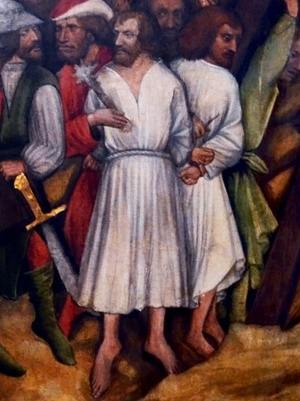
A shirt reaching below the knees with a V-shaped neckline, excerpt from the panel painting Carrying of the Cross on the Rajhrad Altarpiece, around 1440.
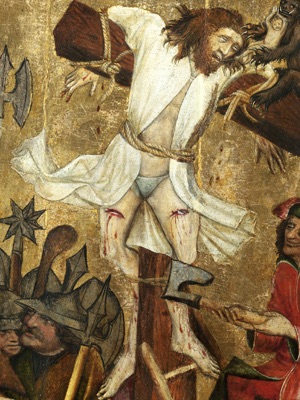
A shirt reaching to the knees with a full-length slit and short slip-cut braies, excerpt from the panel painting Crucifixion from Nové Sady on the Rajhrad Altarpiece, around 1440.
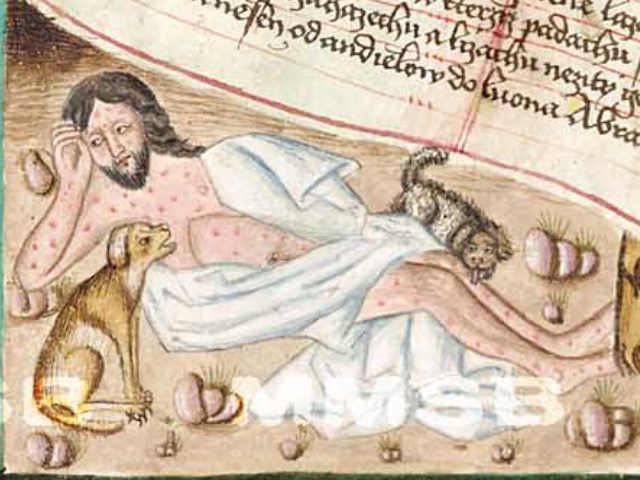
Lazarus in a shirt with a full-length slit, excerpt from the Codex of Jena (1490-1510).
Reconstruction
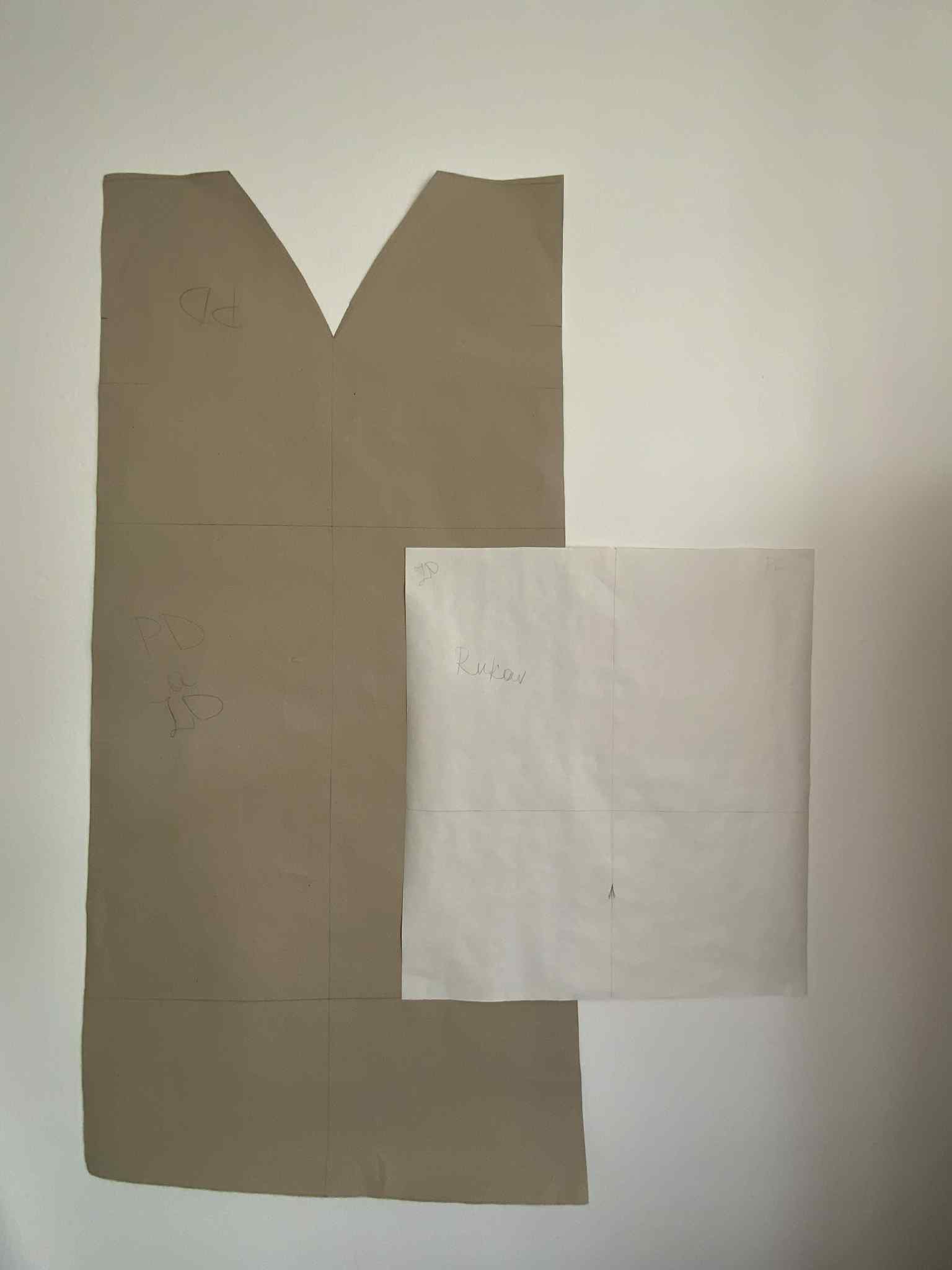
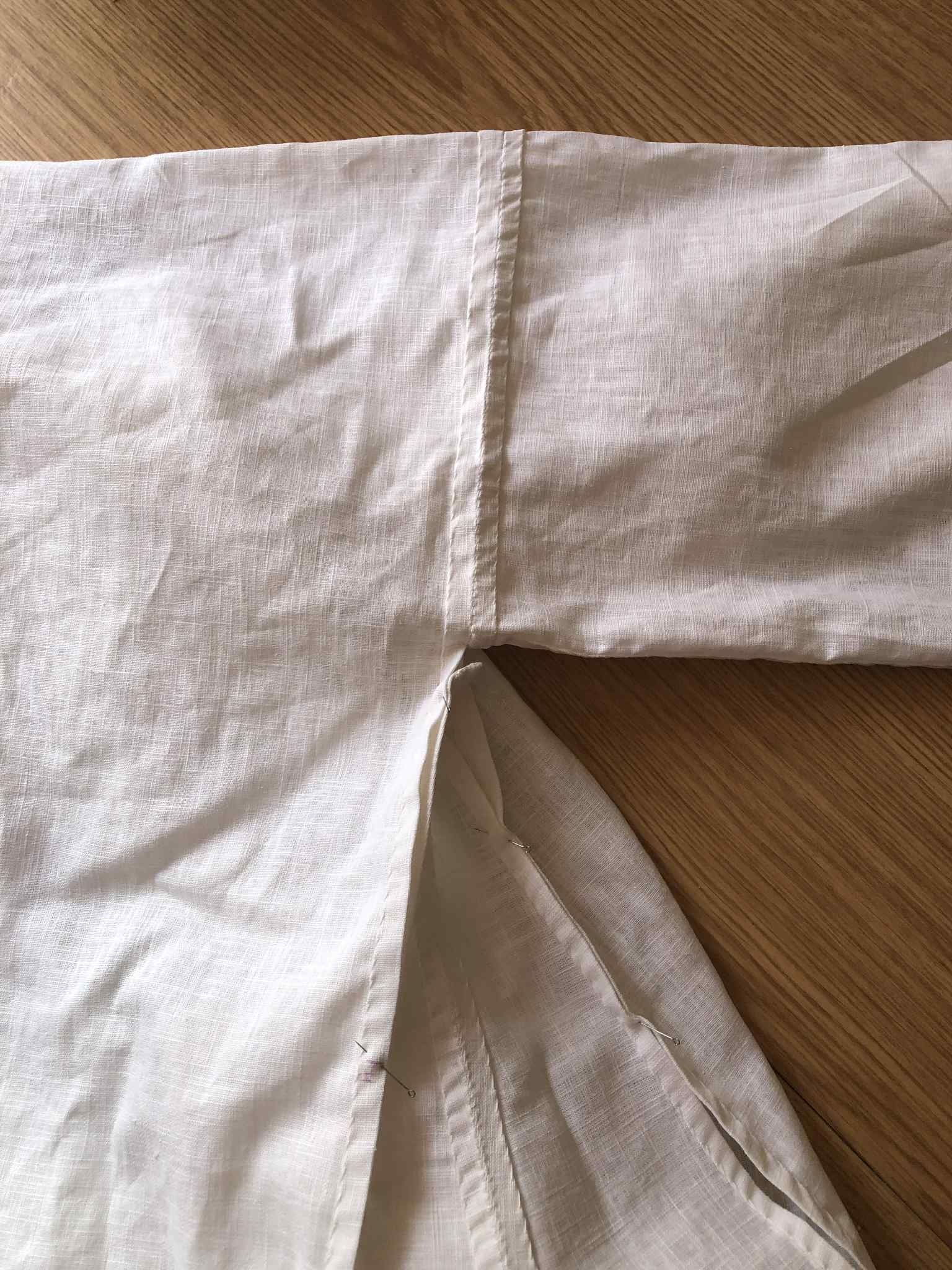
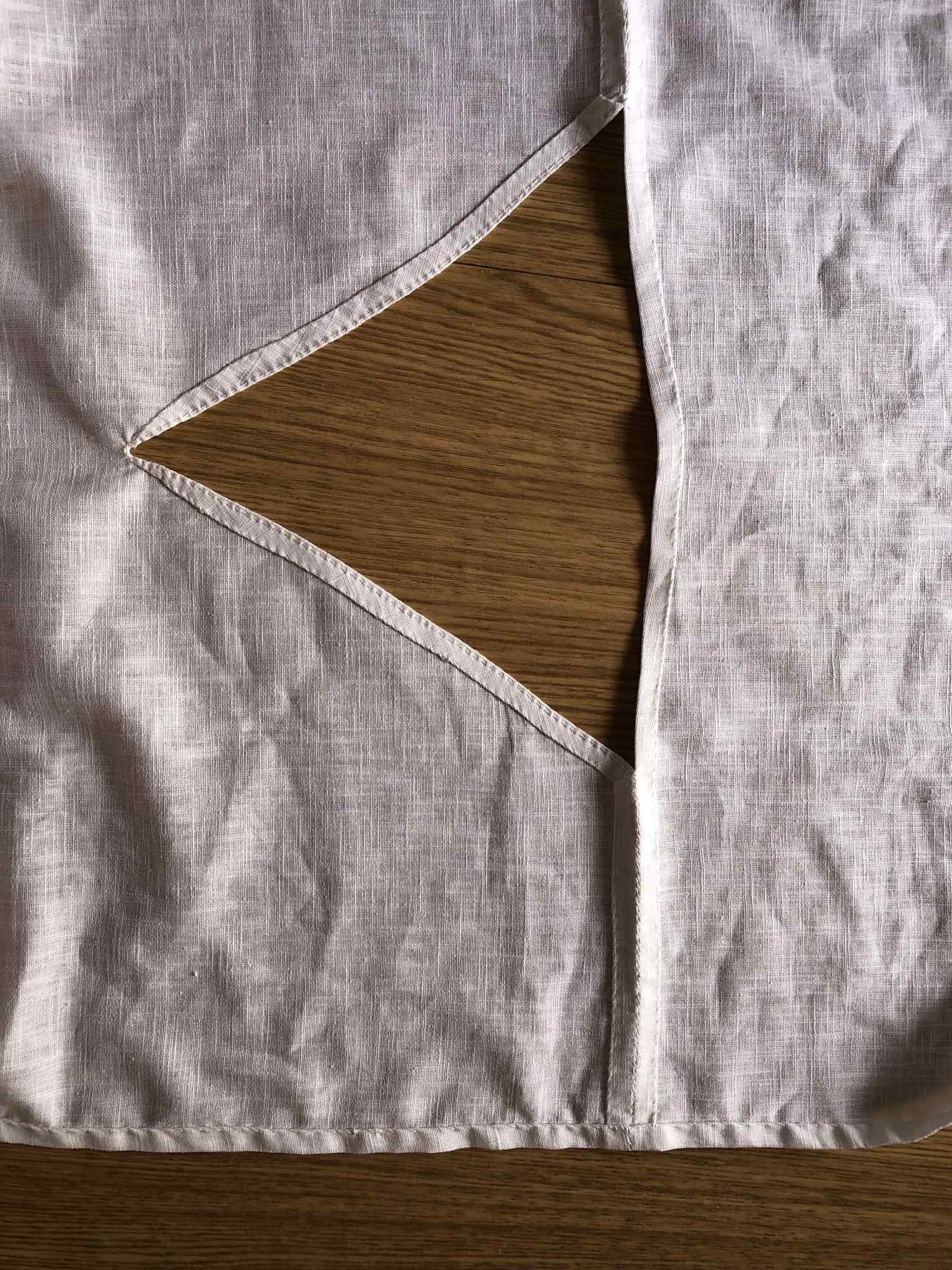
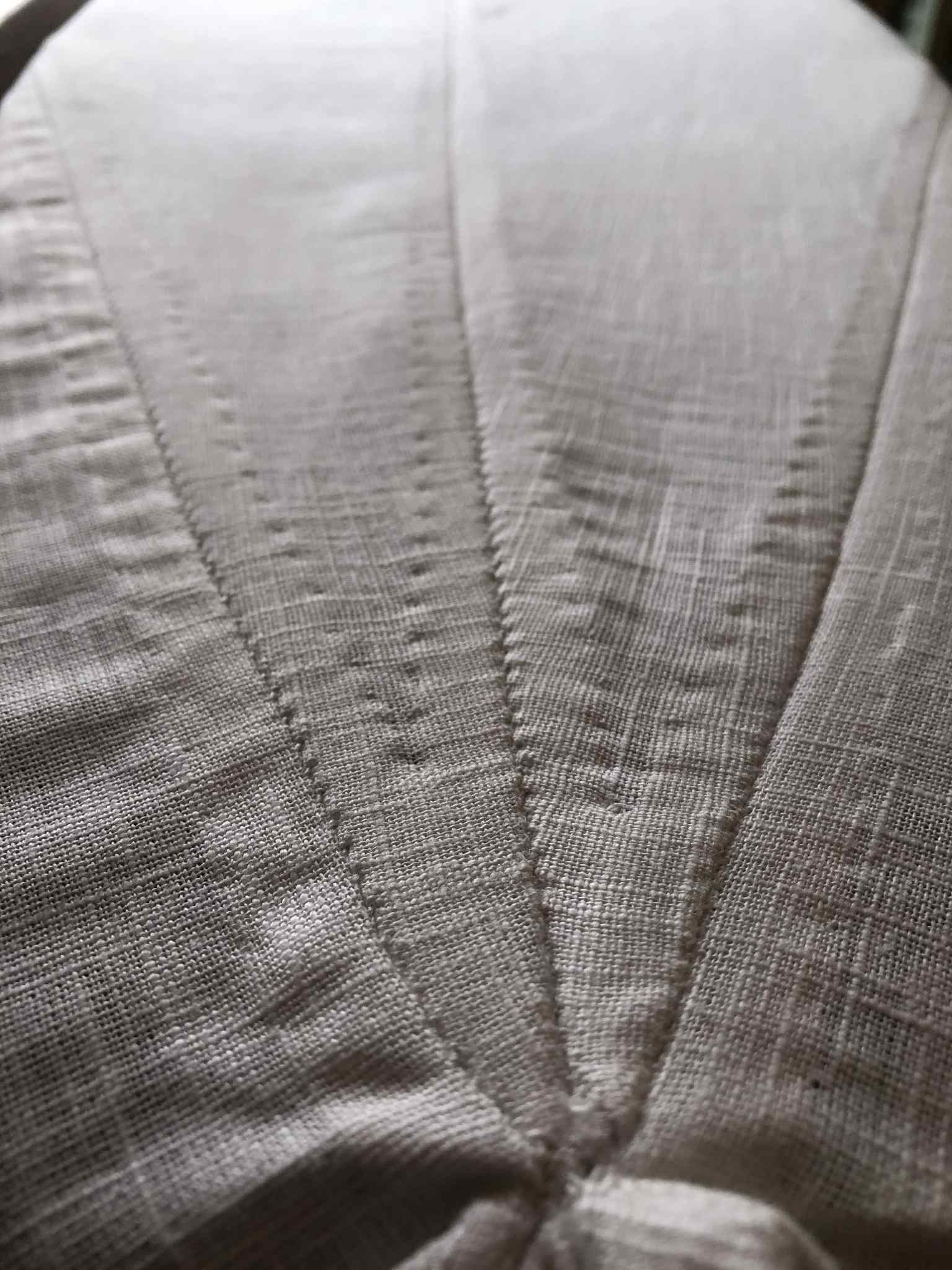
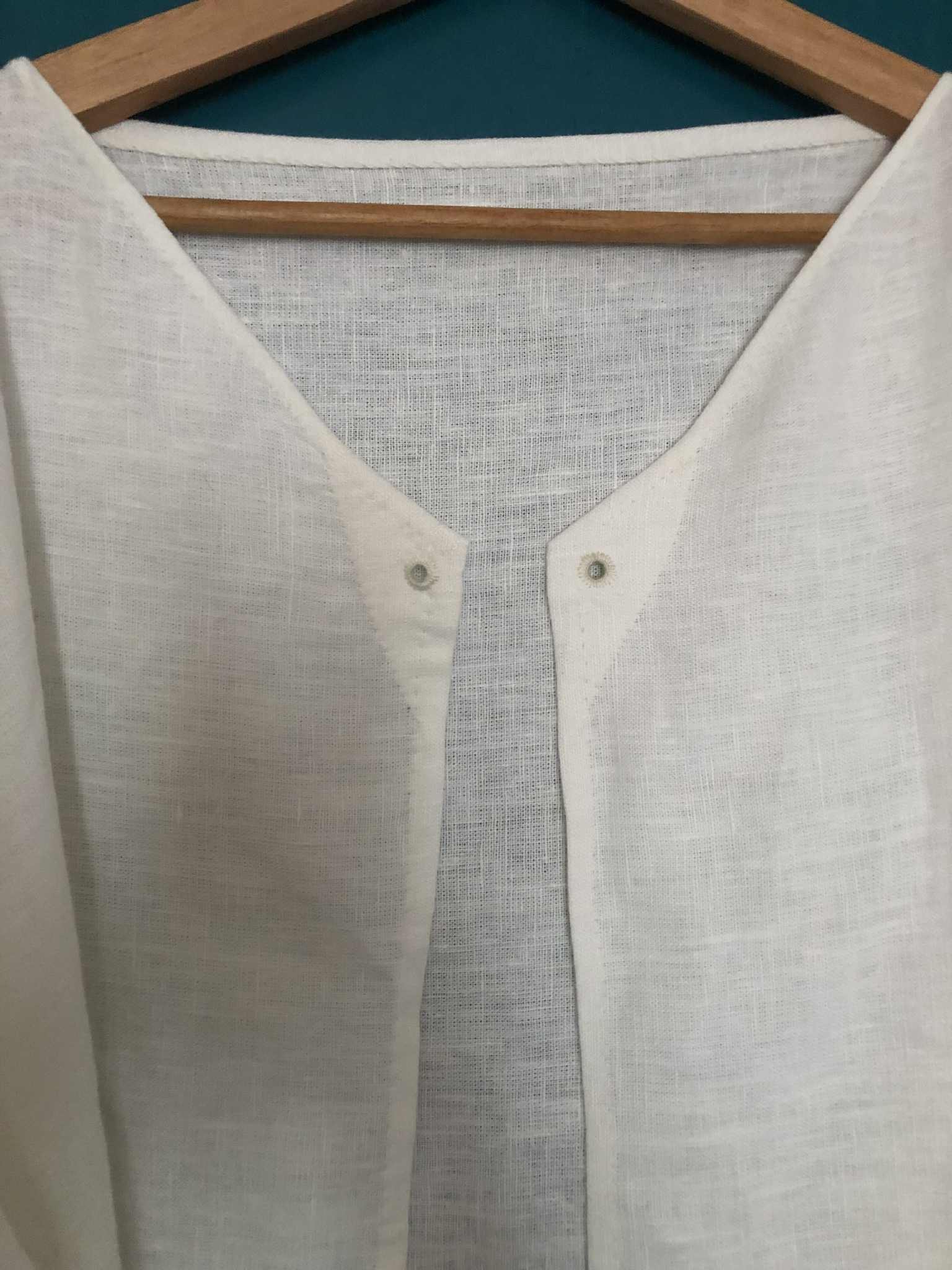
For the reconstruction, we chose the shirt from the panel painting Crucifixion from Nové Sady on the Rajhrad Altarpiece. One was left with a slit as shown in the original, while the other was reconstructed without a slit. Both shirts are hand-sewn from fine linen cloth. The reconstruction was made by Daria Litvinova.
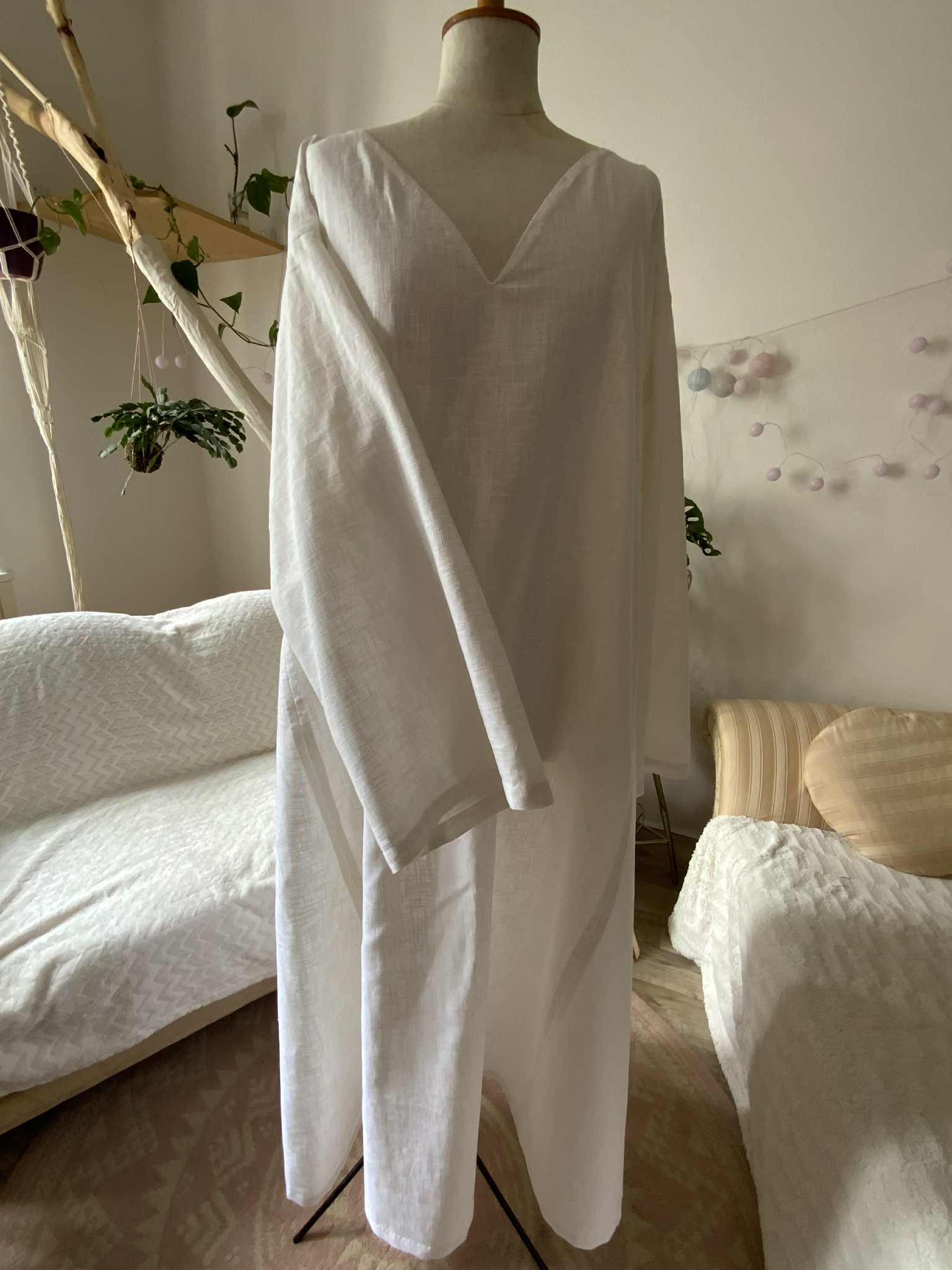
Women's Chemise
Compared to men's undergarments, there is considerably less evidence of their female counterparts. Women wore simple long chemises with shoulder straps under their outer clothes. We encounter them most frequently in illuminations depicting bath attendants, who even wore them as work clothing, and working women are also depicted in them. Furthermore, they can be found in intimate scenes depicting bedroom interiors. One of the oldest archaeological finds of a women's chemise dates to the 14th century from Ranis Castle in Germany.This chemise is sewn from two panels, front and back. Another type consists of three panels. The first two essentially form the front and back bodice, while the third is inserted at the waist to form a pleated skirt. At the side, this type of chemise had lacing for a better fit, later the bodice cut could be extended to include breast cups, as is evident from four finds from Lengberg Castle in East Tyrol, dated to the 1480s.
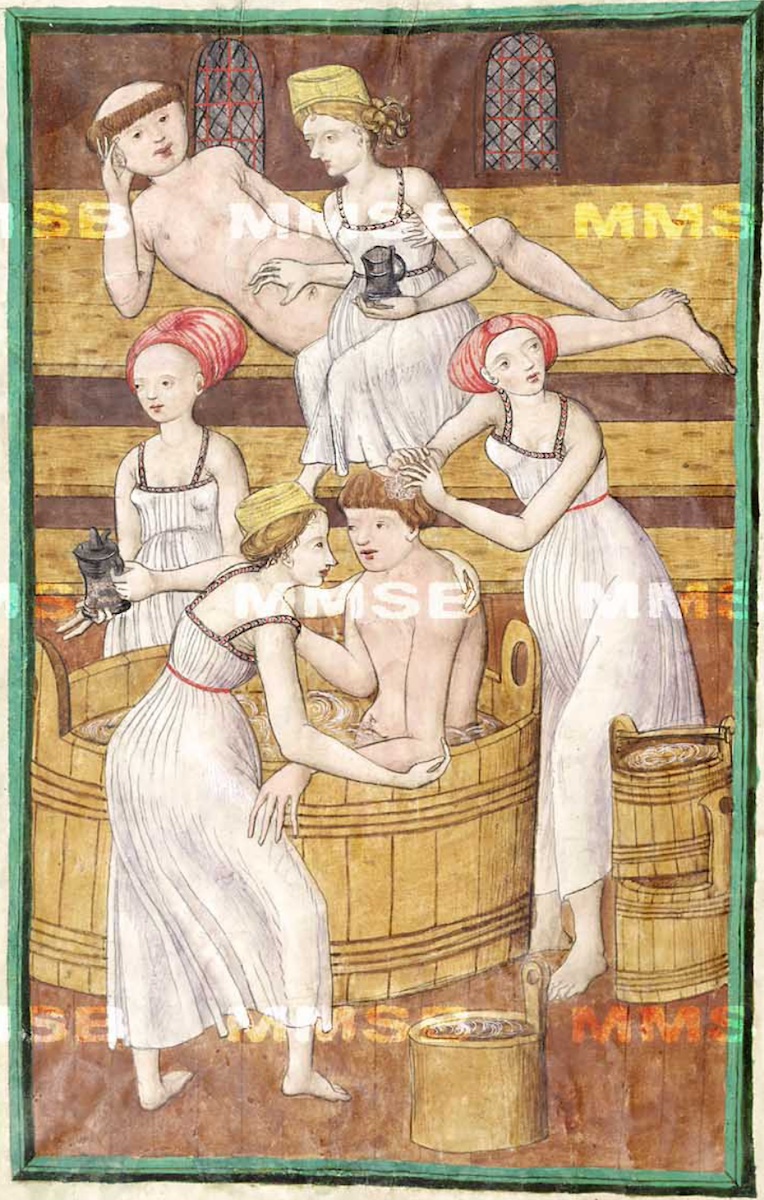
Bath attendants in chemises, Codex of Jena, 1490-1510.
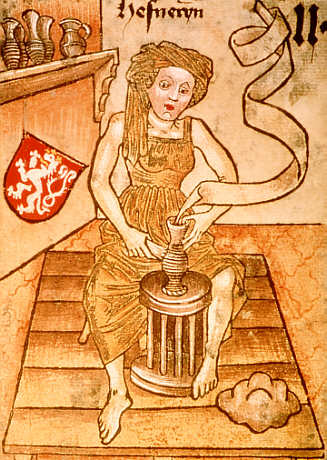
A Czech potter in a chemise at work, a playing card from the Hofämterspiel deck commissioned by Ladislaus Posthumus, 1450s.
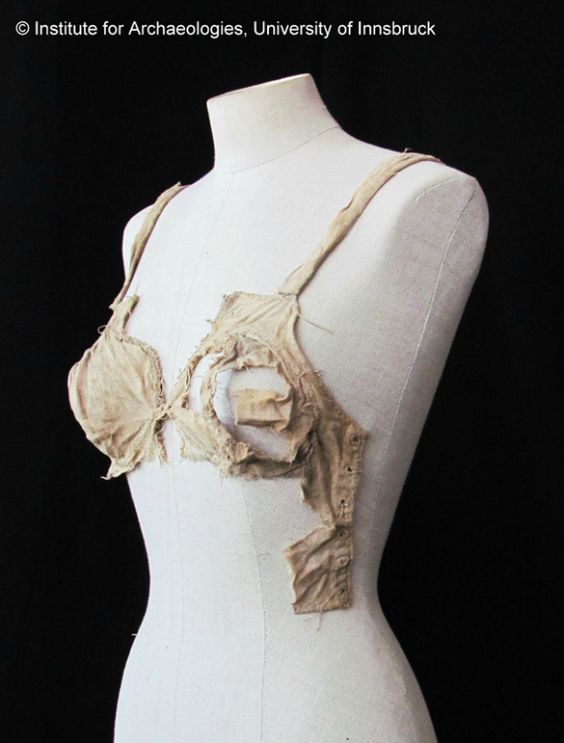
A chemise find from Lengberg Castle in East Tyrol with breast cups, 1470s-1480s.
Braies
The second basic piece of men's undergarment were braies, in Old Czech known as hace (before the loss of jotation in the 14th century pronounced hácě), also found in records as hacze, Old Czech rúšce, Latin bragas or bracca. In earlier times, they reached to or below the knees. These longer braies gradually disappeared and after the mid-15th century are no longer encountered.
Later, braies were referred to in written sources more often by the new Latin neologism femoralia, literally translated as nábedrnie (thigh coverings). This is also what Vavřinec of Březová calls them in his chronicle, when describing the Battle of Vyšehrad. After the battle, fallen knights were reportedly stripped of their armour until they were left wearing only braies: “... baronibus et militibus sunt velut porci crudeliter interempti et statim omnibus armis et vestibus usque femoralia denudaci.”
Braies were made of thin linen cloth, as evidenced by the Kladruby Bible of 1471: “Učiníš i rúčce lněné, aby přikryly mrzkosti tvé od ledví až po bedr.” The simplest type consisted of a more or less shaped strip of fabric that passed between the legs and was held in place at the sides by a cord that was tied on one or both sides. Such braies are known both from various period depictions and from archaeological finds at Lengberg Castle in East Tyrol. Another variant could have a cut where the cord at the sides was replaced by a channel with a drawstring, whose ends were brought out at the front. When pulled and tied, a sort of pouch for the genitals was formed at the front of the braies. While older braies (with short legs) are found in depictions only in white, the slip-cut braies can also be found in blue or even black depictions.
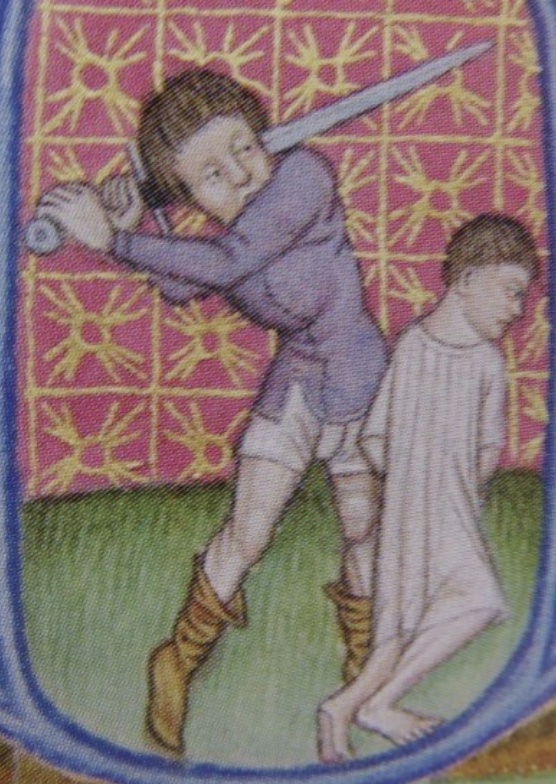
Braies (still with short legs), Brno Legal Book of Václav of Jihlava, 1446.
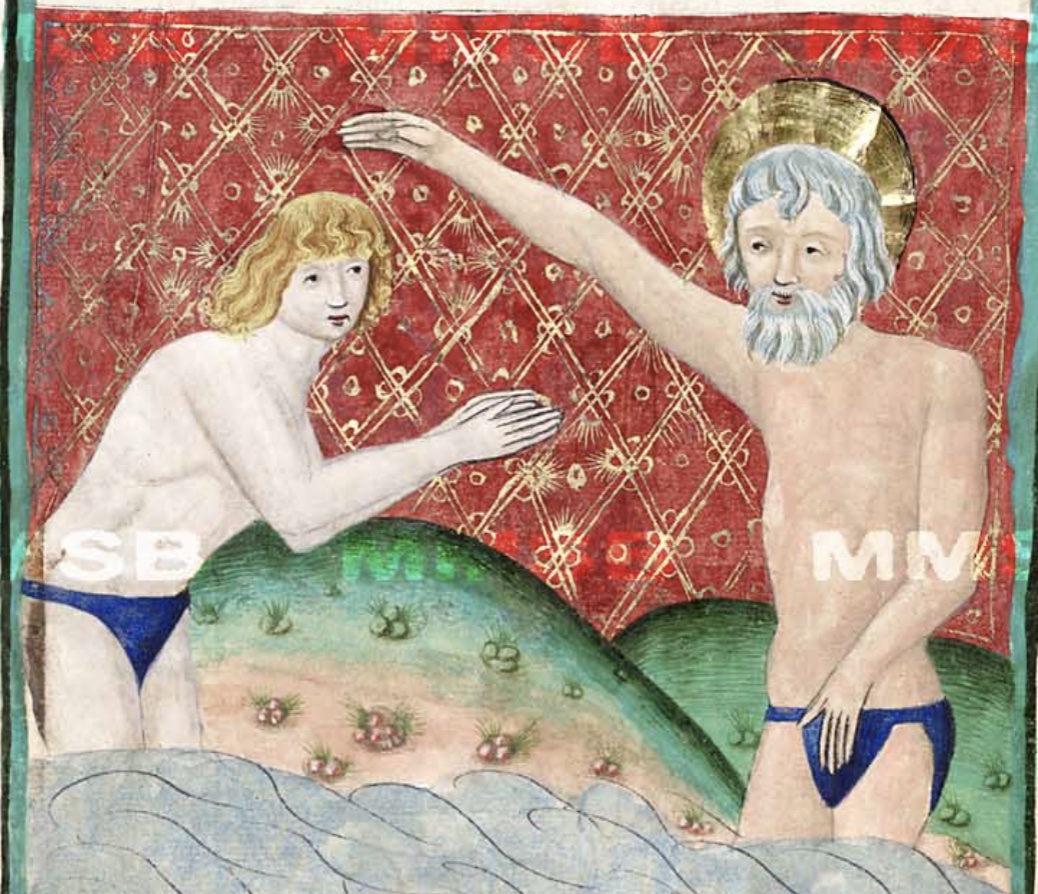
Baptism scene where the figures are wearing blue slip-cut braies. Codex of Jena (1490-1510).
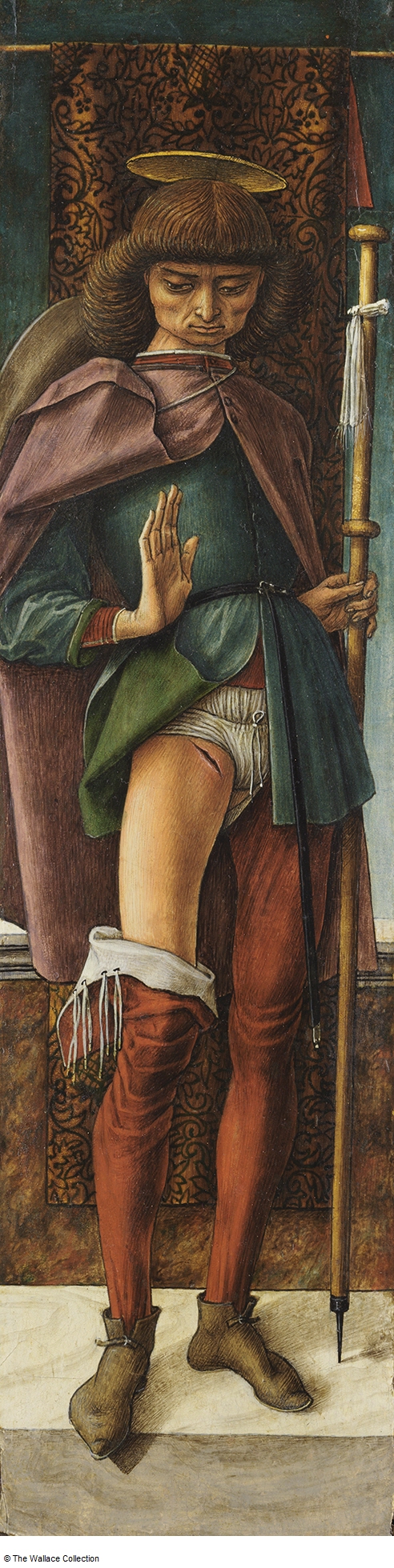
On the painting of St. Roch from 1480, of Italian provenance, it is visible that slip-cut braies were practically identical throughout Europe at the time. In this case, it is the second type with a drawstring tied in the middle.
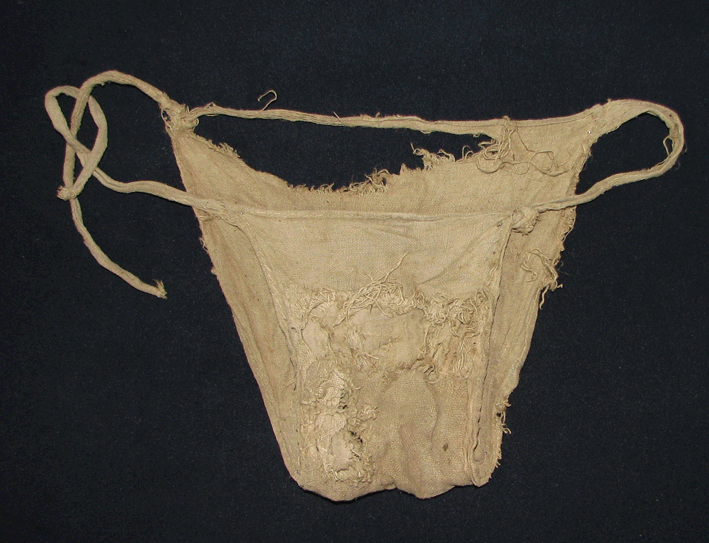
Braies from Lengberg Castle in East Tyrol, dated to the 1480s.
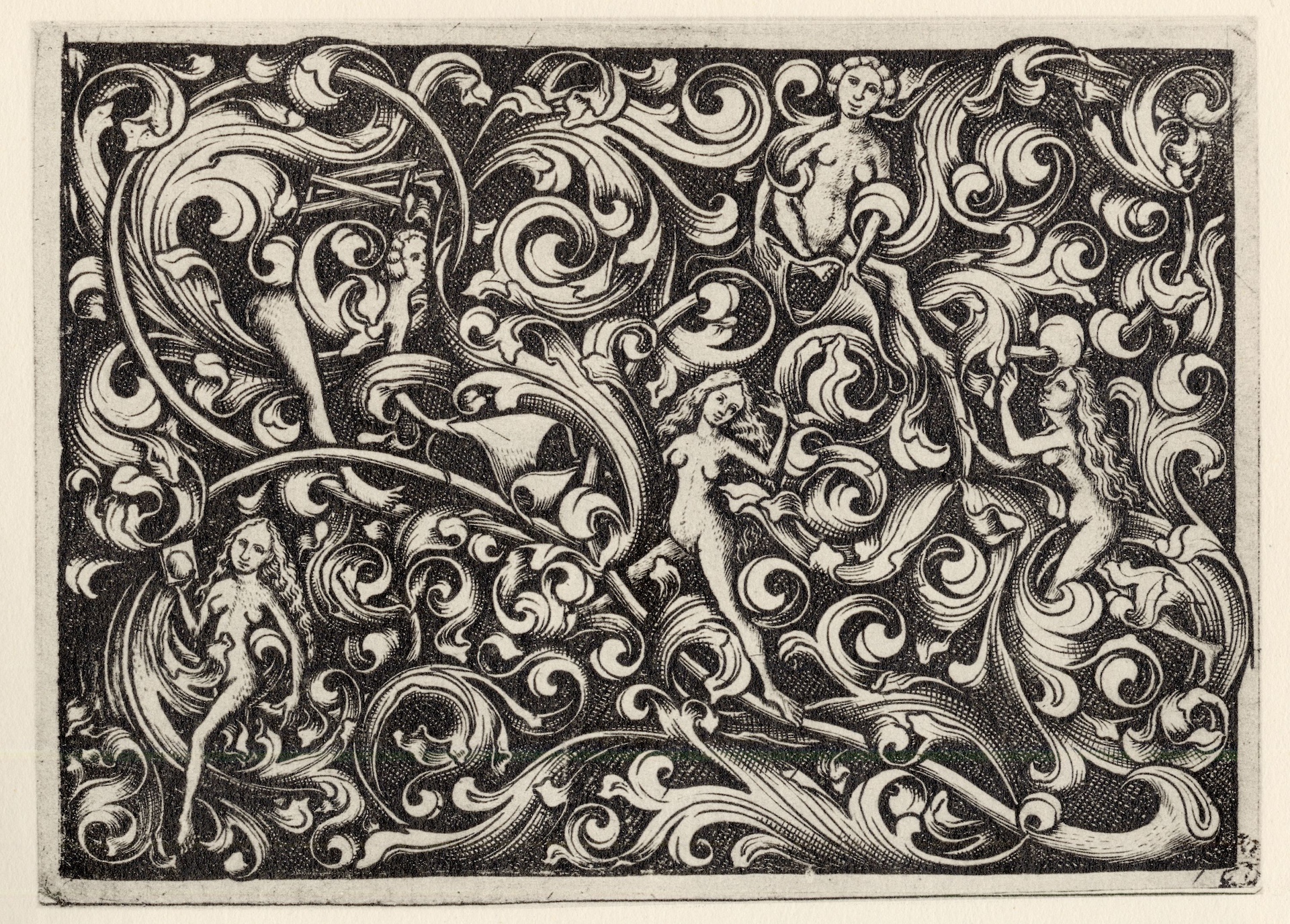
Various types of braies in the engraving “Boj o kalhoty” (Fight for the Trousers) by Monogrammist E.S., Germany, 1440-1467.
While for a man in the 15th century it was considered a grave insult to “bez hacz choditi” (go without braies), whether women also wore braies (femoralia) is currently the subject of a lively debate, sparked by the aforementioned textile finds at Lengberg Castle. It is not possible to clearly prove whether the above-mentioned and depicted braies belonged to a man or a woman. However, it is interesting that for the Czech context, they are documented by name as early as 1455 in the Clementinum Dictionary, specifically as their feminine variant feminale.For the Italian context, braies for women are securely documented at the turn of the 16th and 17th centuries.
Both braies and shirts were considered intimate garments that were improper to show in public. The gradual revealing of the shirt began in the second half of the 15th century in connection with the penetration of Renaissance fashion through Germany, but for example in the moralistic Codex of Jena, visible parts of the shirt appear only on figures who are in some way sinful.
Outer garment
Doublet
In medieval Czech, the term kabát was used for doublet. This term has been used since the 14th century to denote a shorter and fitted garment and as a synonym for the German wams, jacke, schecke, or rock, the French pourpoint, rochet, roquette, or the English jacket, rocket and doublet, from the Italian giubbetta.
The words kabát, rock (waffenrock), doublet (arming doublet), and pourpoint also denoted a type of quilted garment, and in Czech, the first use of the word kabát at the turn of the 13th and 14th centuries is associated specifically with the term for a quilted garment in the Alexandreida and it remained at least throughout the entire 15th century, as we can read in the Very Nice Chronicle about Jan Žižka: “Tiem jest polniem vojskem vládl kněz Prokop Holý. Pak ten jest býval k bitvě na špici v tlustém kabátě.” (Thereby the field army was led by Priest Prokop the Holy. Then he used to be at the front in battle in a thick doublet.) It is a question whether the Czech word kabát originated from the Old German gewæte or is also derived from the Italian giubbetta.
Although doublets were used to attach hose earlier, as evident from the hose ties on the pourpoint of Charles de Blois, the combination of a doublet and attached hose became widely popular in Bohemia around the mid-15th century, making the doublet a functional part of clothing that straddles the line between undergarment and outerwear, which also corresponds to the establishment of a separate doubletmakers' guild in 1441. As hose gradually become pants and their waistline is raised, doublets also become shorter and by the end of the 15th century, they once again become a full-fledged outer garment. A brief outline of the evolution of the doublet can be seen in the following images.
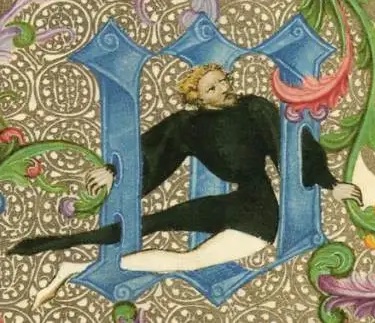
Early doublet with wide sleeves, worn as an outer garment, on a cut-out from the Bible of Wenceslaus IV (1389-1395).
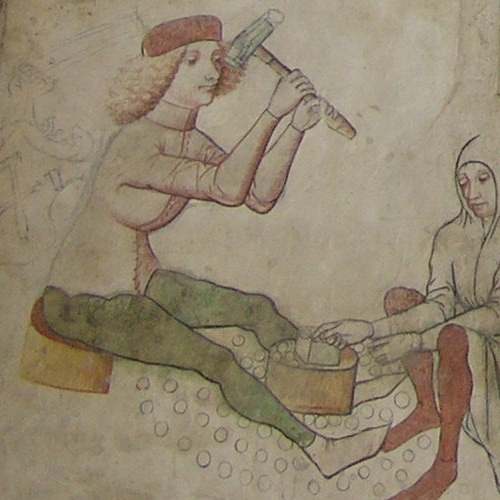
A coinmaker who is stripped down to just his hose and doublet when working. The second coinmaker in the same fresco is wearing a vestina-type skirt over his doublet. Cutout from a fresco in the Coinmakers' Chapel of the Cathedral of St. Barbara in Kutná Hora (1460-1470).
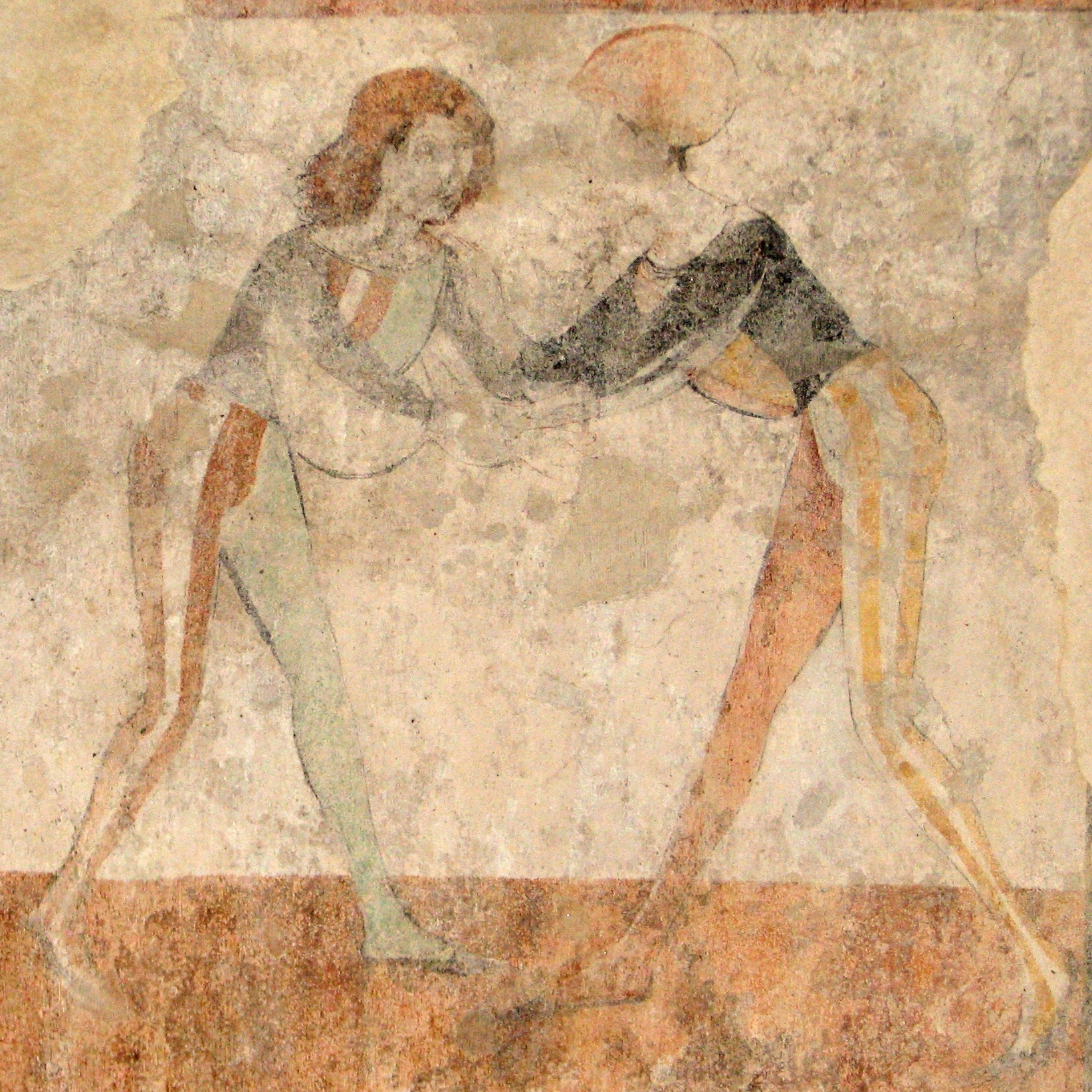
Wrestlers in short doublets of fashionable cut and colour on a fresco from the Red Bastion at Švihov Castle, around 1500.
As previously mentioned, during King George of Poděbrady's era, the doublet was somewhat of an intermediate stage between undergarment and outerwear, not only in Bohemia. Therefore, the body of the doublet could be made from cheaper, for example, undyed fabric. This is also reflected in the will of the kettle-maker Martin from what is now Spálená Street in Prague, who in 1477 left “dva rukávy aksamitové od kabáta” (two velvet sleeves from a doublet). Given that the doublet formed a single entity with hose, it was fashionable to have hose and a doublet, or at least their visible parts, in the same color, ideally contrasting with the outer skirt or cloak.
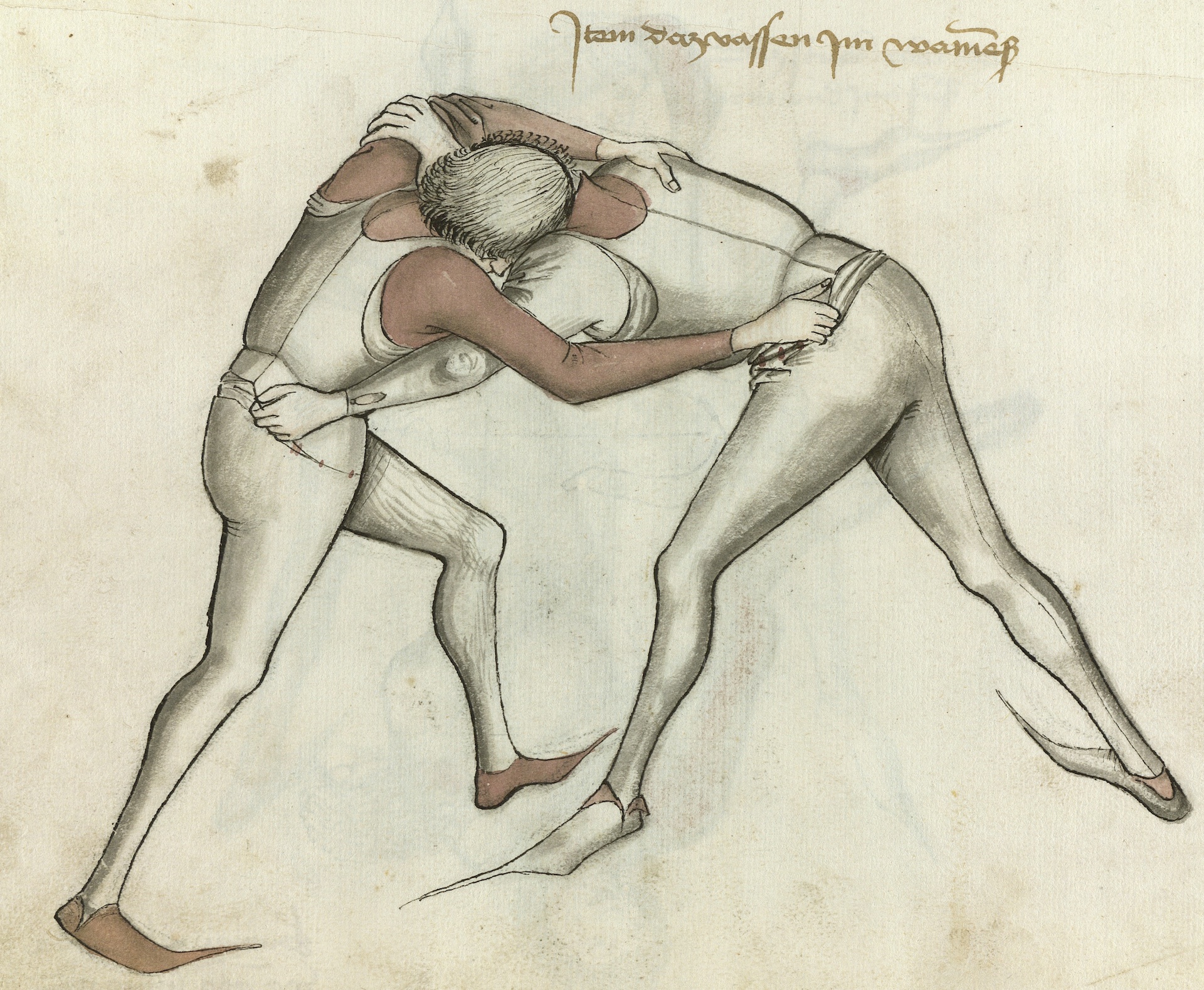
A doublet with undyed body on illumination from Hans Talhofer's fechtbuch, Germany, 1459.
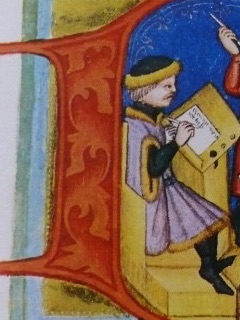
A doublet and hose in the same (black) colour. Cutout from the Brno Law Book of Václav of Jihlava (1446).
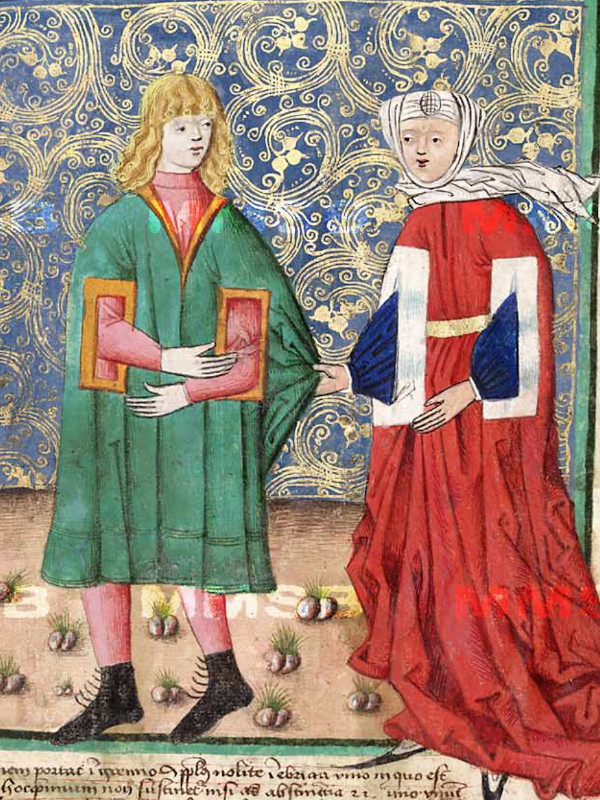
A doublet and hose in the same (red) colour. Cutout from the Codex of Jena (1490-1510).
The lack of Czech pictorial sources and the fact that during King George of Poděbrady's era the doublet was an intermediate layer between the undergarment and the outerwear greatly complicates research efforts. Nevertheless, some details and differences compared to other regions can be traced. The sleeves of Czech doublets are either narrow or wide, tightened with a short cuff at the wrist. In contrast, shoulder padding according to Burgundian fashion or gathering of the upper half of the sleeve as in Italian fashion is not found.
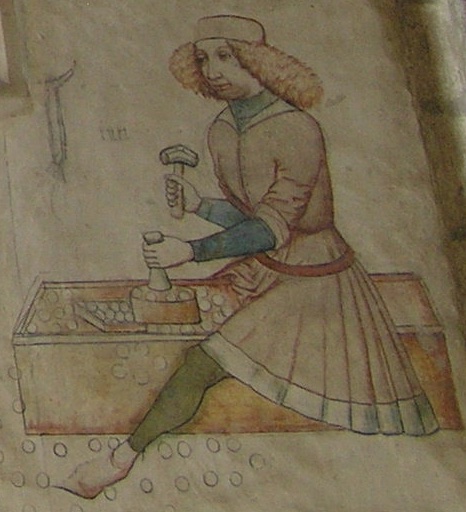
A coinmaker in a doublet with narrow sleeves. Cutout from a fresco in the Coinmakers' Chapel of the Cathedral of St. Barbara in Kutná Hora (1460-1470).
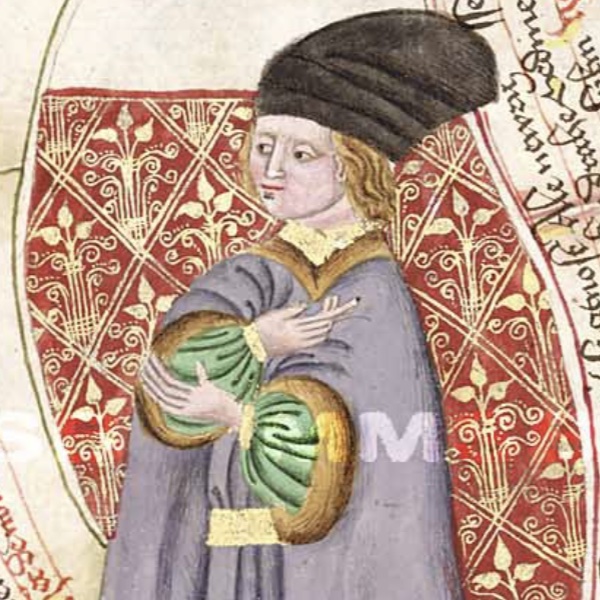
A priest wearing a doublet with wide sleeves, cuffed at the wrist. Cutout from the Codex of Jena (1490-1510).
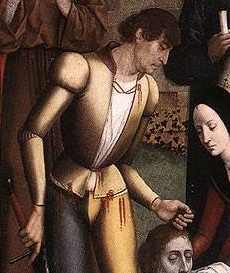
A doublet with padded shoulders according to Burgundian fashion. Detail from the painting The Execution of the Innocent Count by the painter Dieric Bouts, Netherlands, 1460.
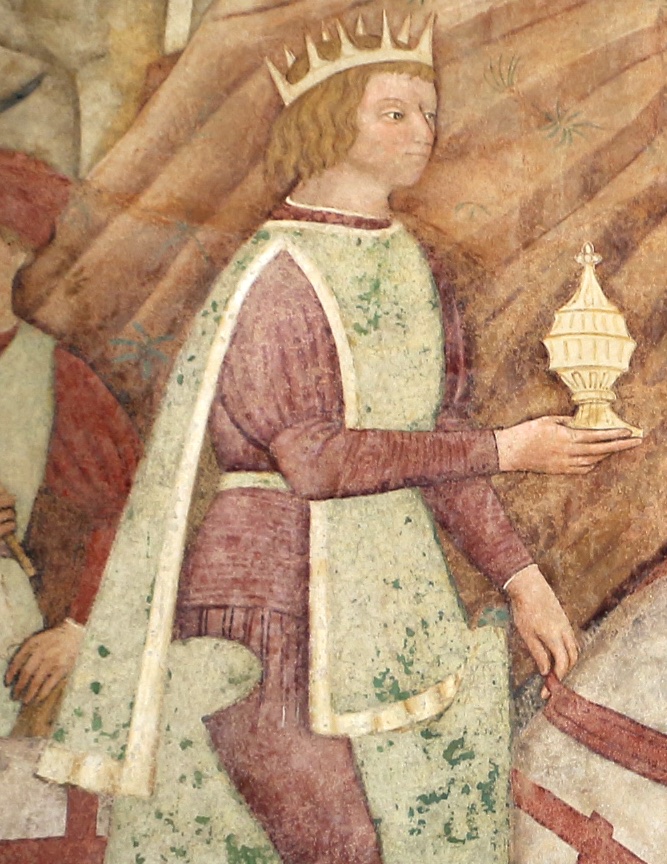
A doublet with ruffled upper half of sleeves, cut-out from a fresco by Paolo di Stefano Badaloni, Florence, 1460
Comparing the doublet from the fresco in the Coinmakers' Chapel of St. Barbara's Church in Kutná Hora with contemporary German patterns, it seems that Czech doublets were somewhat more archaic in style, i.e., with a long part tightly wrapping around the belly and tied with a single lace, and a very arched, likely padded chest, which however may not be as tightly fastened as the abdominal part and thus either fastened with buttons or several laces passing through opposing pairs of holes.
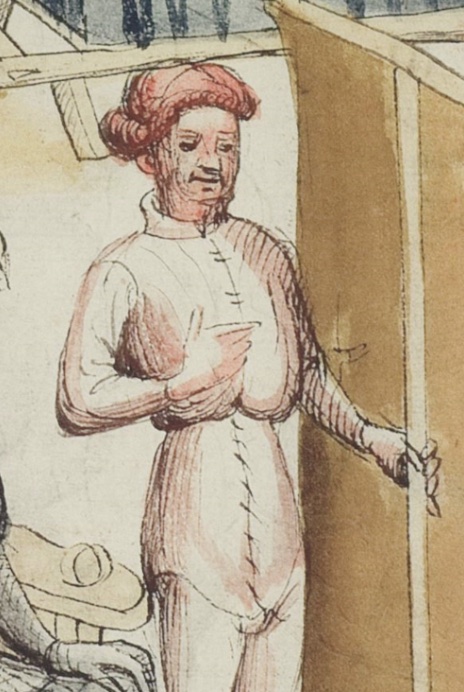
A doublet with a long belly-hugging part tightened tightly on one lace. The chest no longer needs to be so tightly cinched and is fastened with several laces passing through opposing pairs of holes. Cut from Königsegg Treatise, Germany, (1446-1459).
Although this doublet should be similar in date to the German doublet in the following picture, it retains its archaic shape with a tightly tightened single-laced belly-hugging part and a looser buttoned chest. Cutout from a fresco in the Coinmakers' Chapel of St Barbara's Cathedral in Kutná Hora(1460-1470).
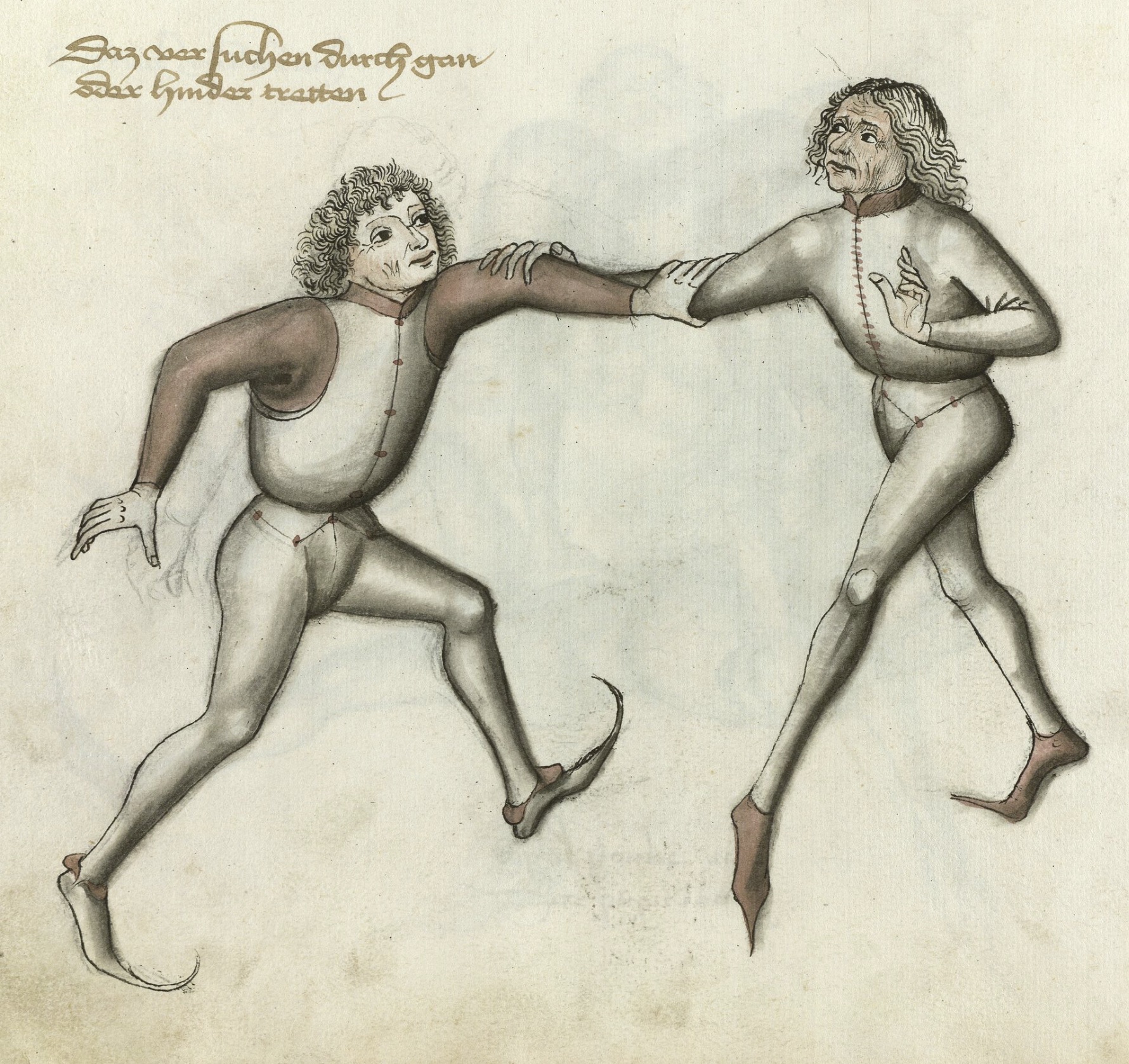
A younger type of short belly part doublets, worn in Germany at that time. Page from Hans Talhofer's Fechtbuch, Germany, (1459).
Some insights into the construction of doublets can be gleaned from certain articles of the New Town doubletmakers' guild, which were confirmed on August 16, 1448:
“Třetie, aby byly dělány barchanové kabáty v prostředku plátnem novým, a bavlna aby byla v prsy, a vespod aby bylo plátno nové nebo cvilink bez přimiešenie vetchého; a v kožené kabáty aby bylo vetché plátno v prostředek, a vespod nové bez přimiešenie vetchého. Také aby vetché plátno nebylo děláno pod barchanové kabáty ani kožené ani cvilinkové, nebo pod rukávy aby žádného vetchého mandlovaného na trh nedělali.” (Thirdly, that fustian doublets be made with new linen in the middle, and a raw cotton should be in the chest, and below there should be new linen or coarse linen fabric without the addition of old material; and in leather doublets, there should be old linen in the middle, and new at the bottom without the addition of old. Also, old linen should not be used under fustian doublets nor leather nor coarse linen doublets, nor should any old quilted material be made for the market under the sleeves.)
“Desáté a poslednie, v harasové kabáty aby bylo děláno dvuoje plátno v prsy svrchnie, a v pokošinové též, pod pokutami svrchupsanými.” (Tenth and last, in woolen doublets there should be two layers of fabric in the upper chest, and in the (another) woolen ones as well, under the penalties mentioned above.)
While in Western Europe the laces used to tie hose to the doublet were visibly tied to a single loop, in Central Europe it was customary to wear these laces hidden, as evident from the following images.
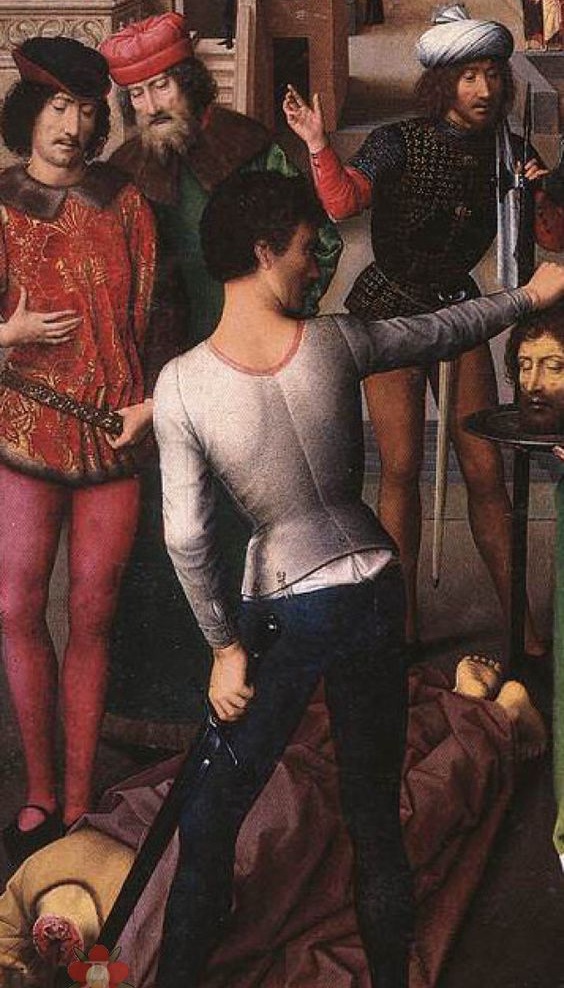
A doublet tied to hose with visible knots on the laces. Cutout from the altar of St. John by Hans Memling, 1479.
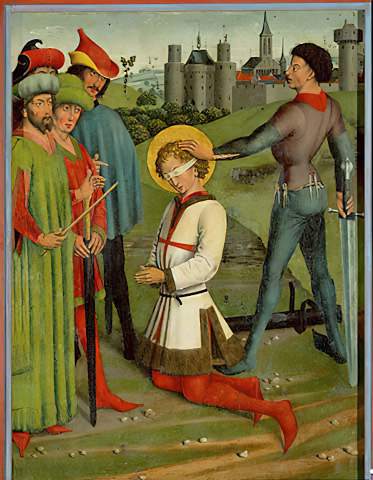
A doublet tied to hose with visible knots on the laces. St. George's Centenary, Friedrich Herlin, 1462 - 1465.

The laces between the hose and the doublet are only hinted at here, as the knot is hidden on the inside. Page from Hans Talhofer's Fechtbuch, Germany, (1459).
In the Czech environment, the laces that connect the doublet to the hose are so hidden that they are not even hinted at, unlike the laces on the belly. A cut-out from a fresco in the Coinmakers' Chapel of St. Barbara's Cathedral in Kutná Hora (1460-1470).
Reconstruction
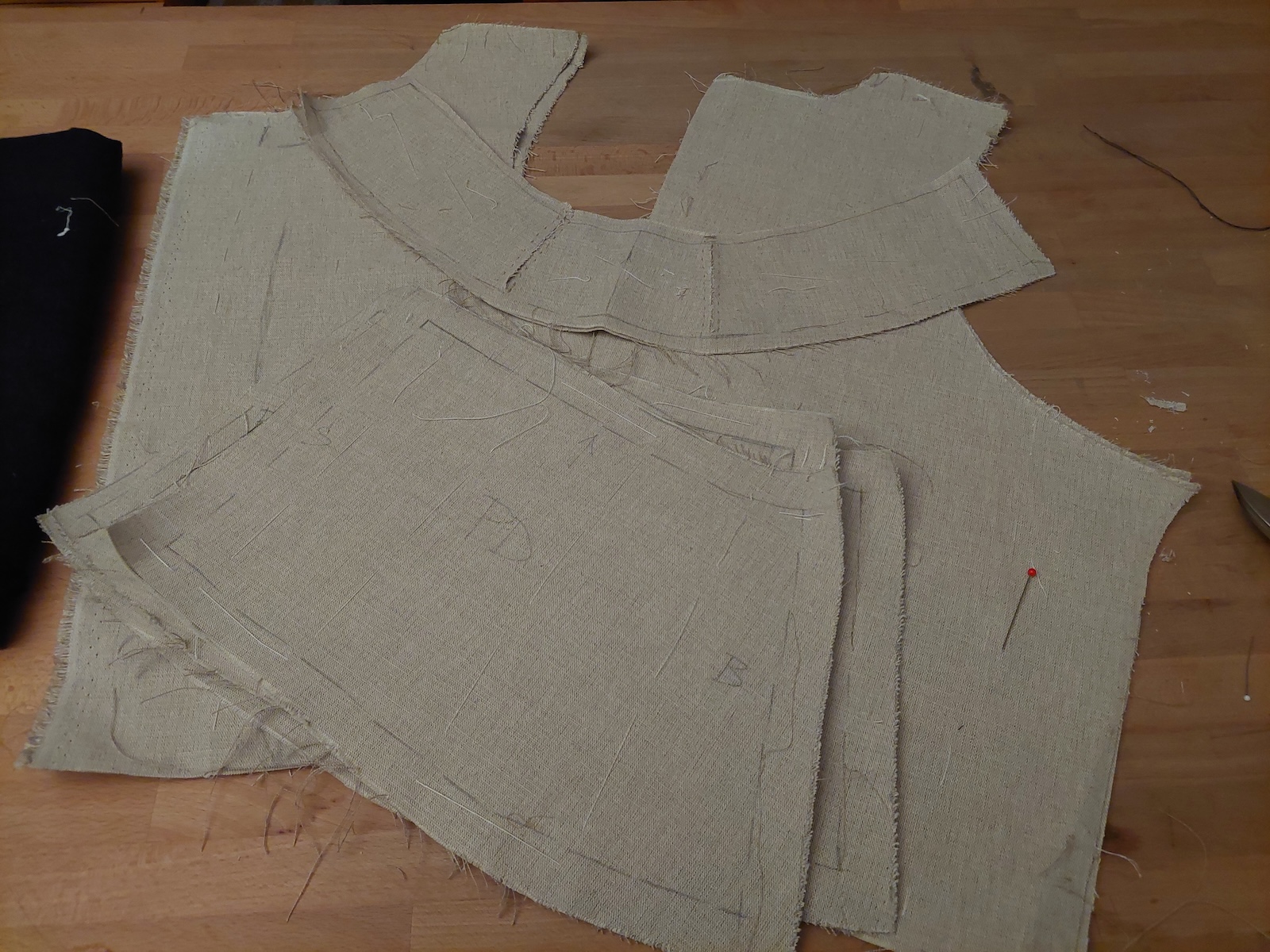
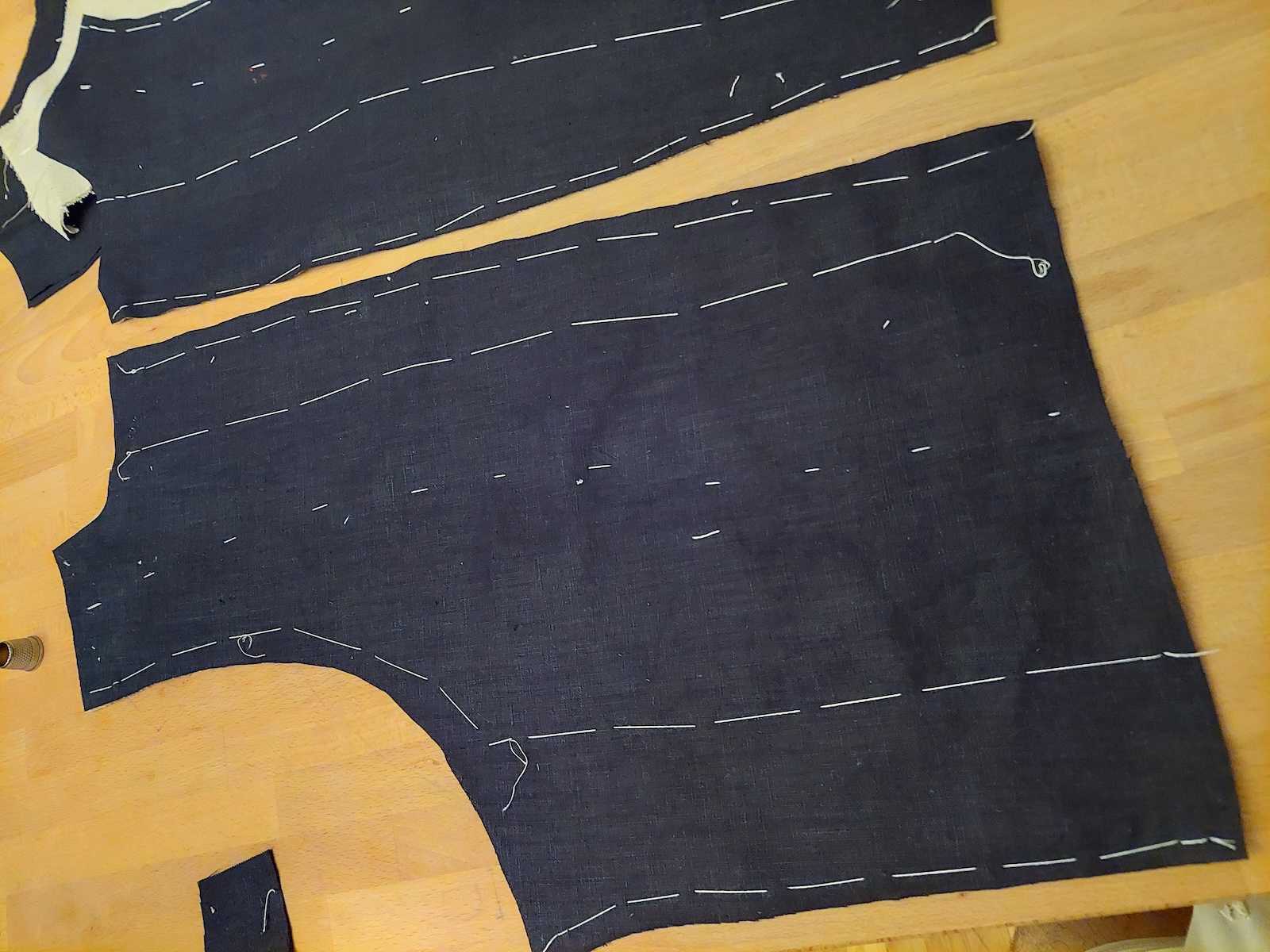
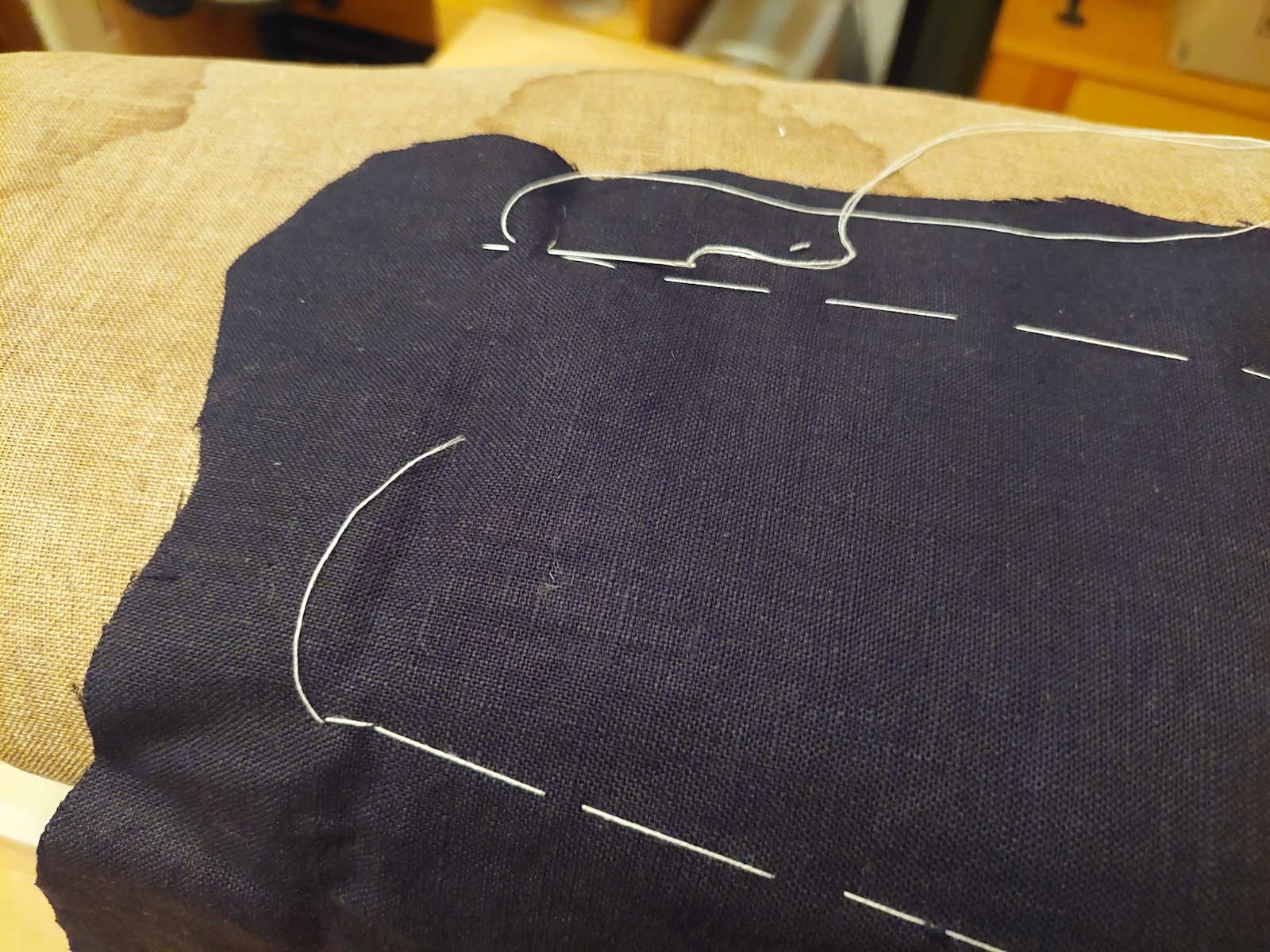
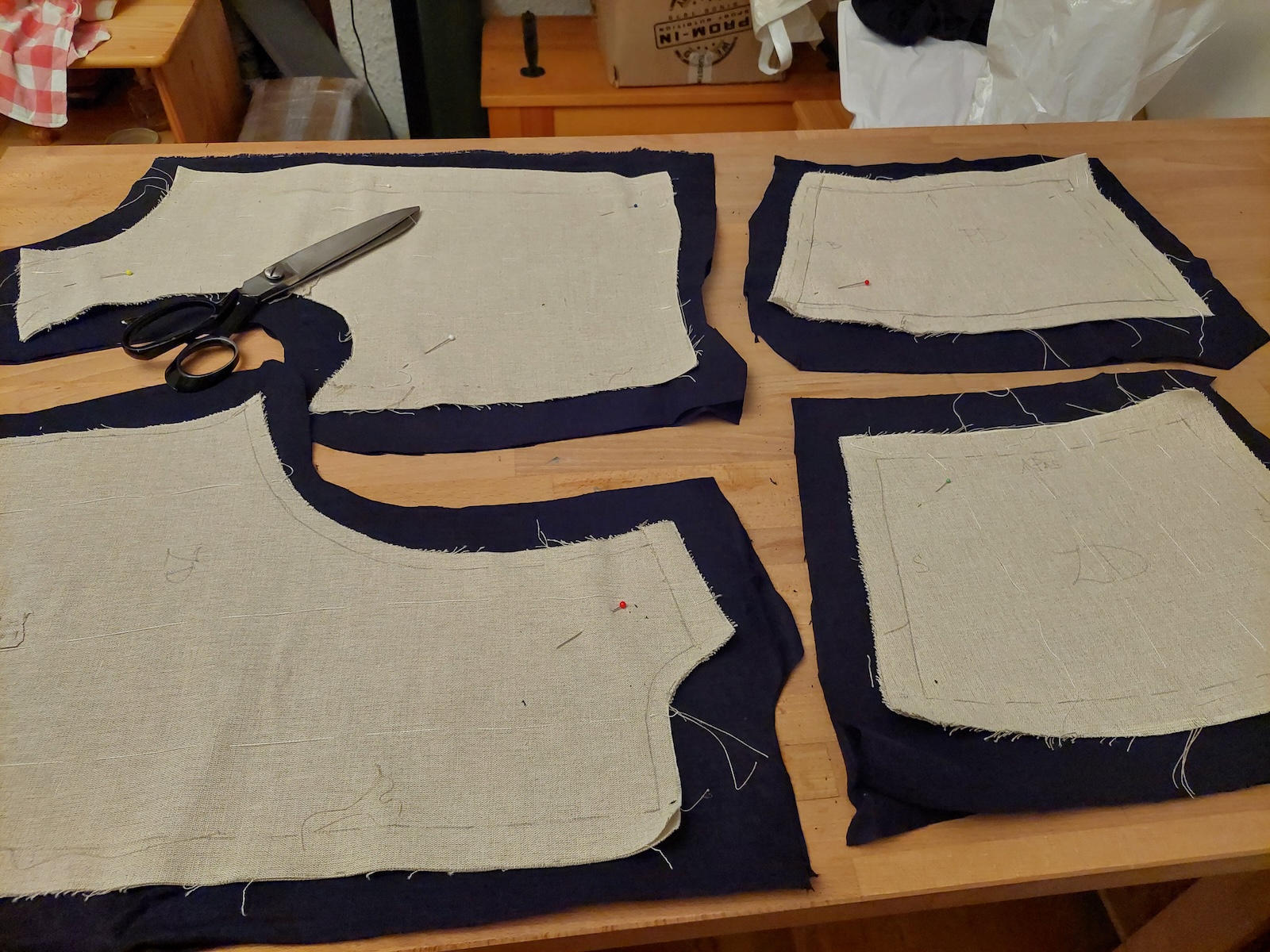
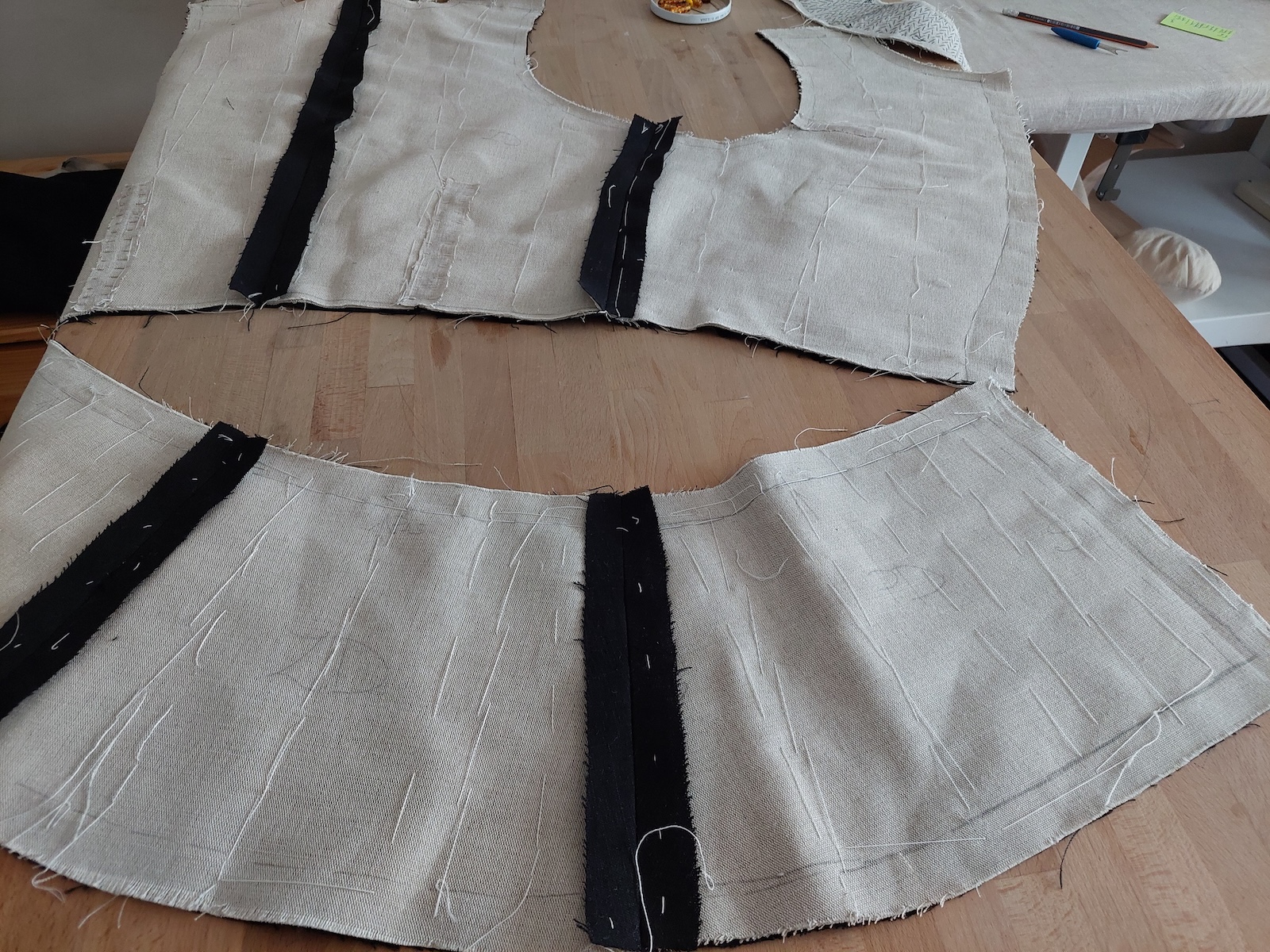
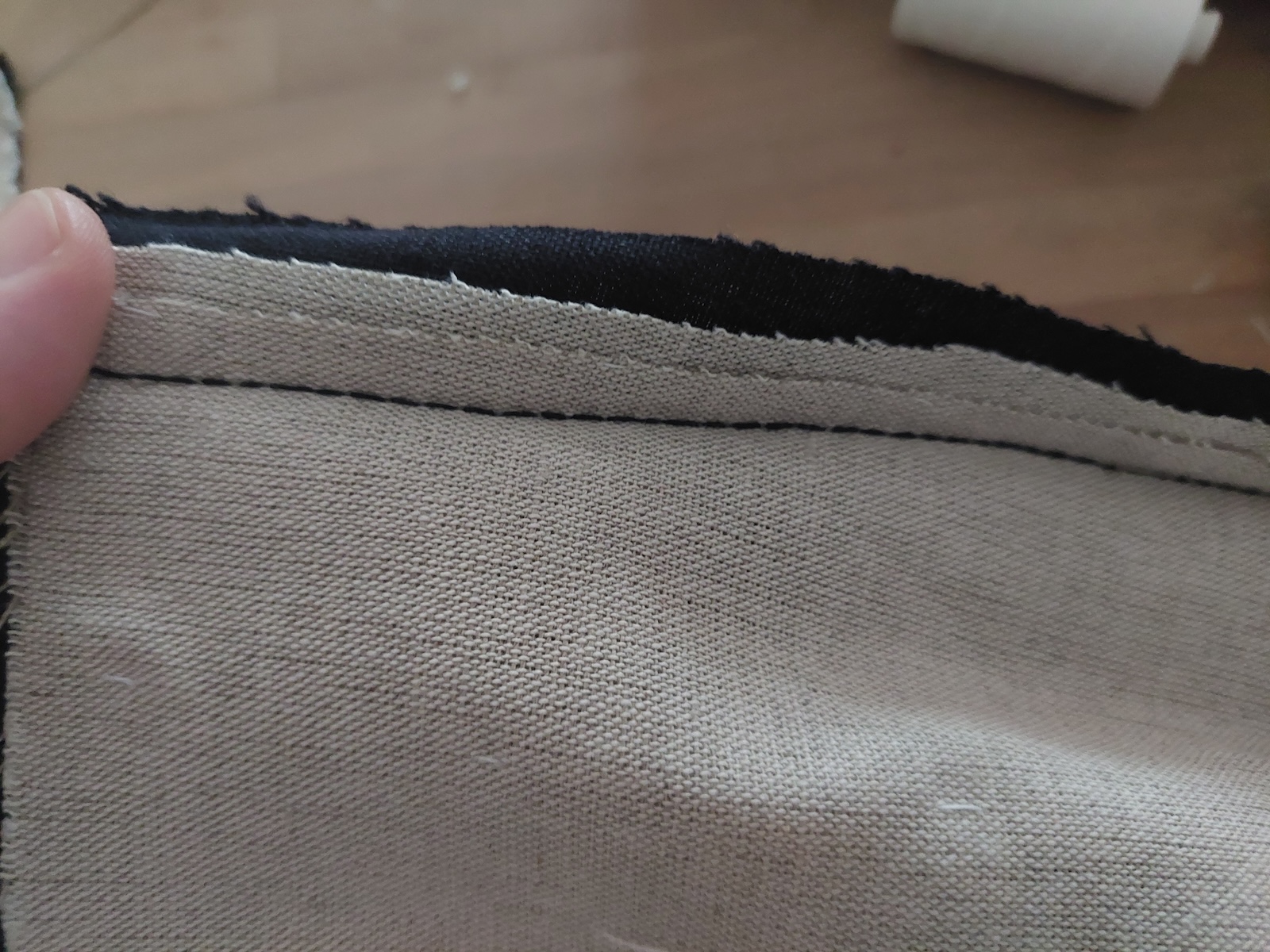
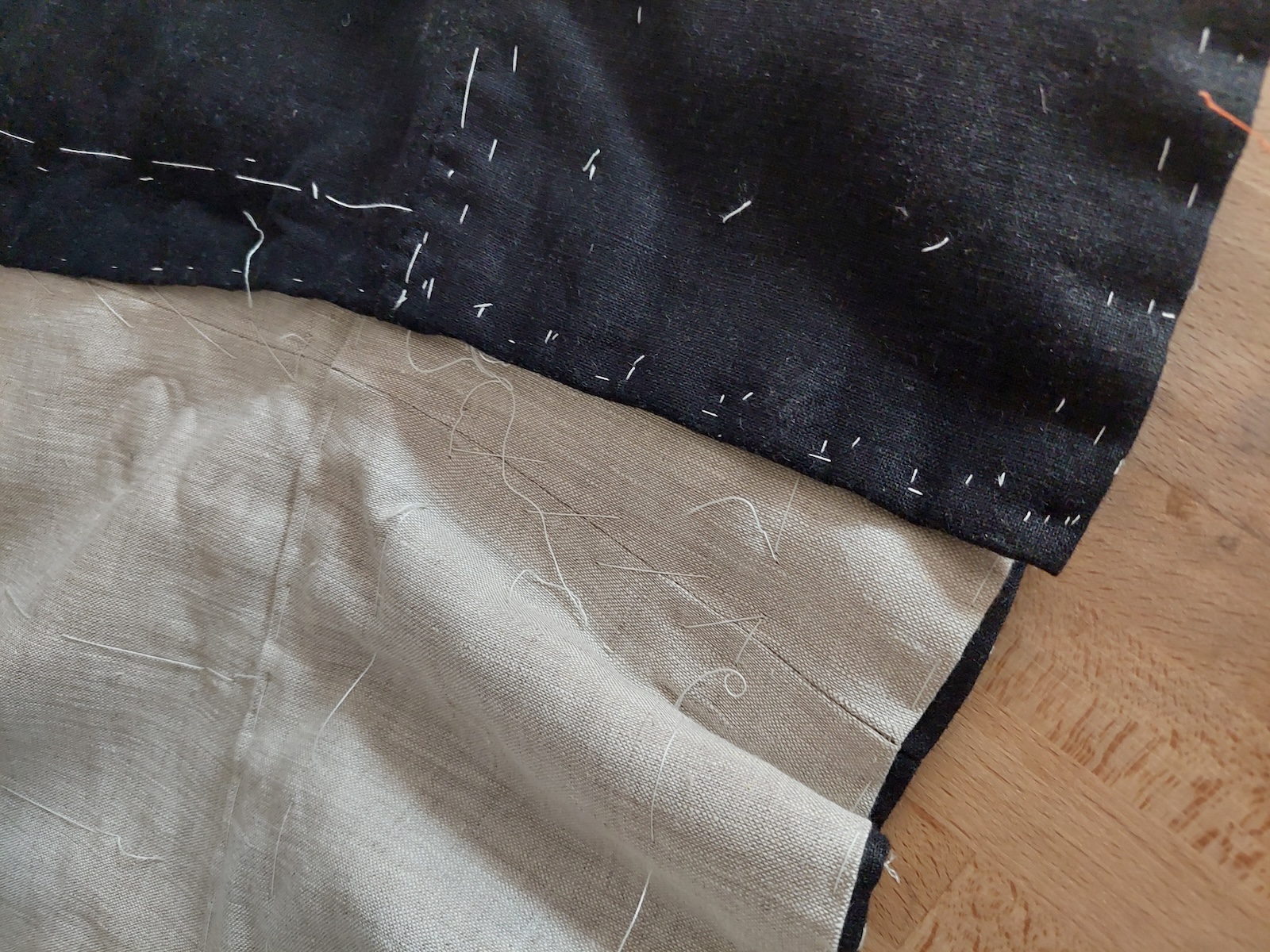
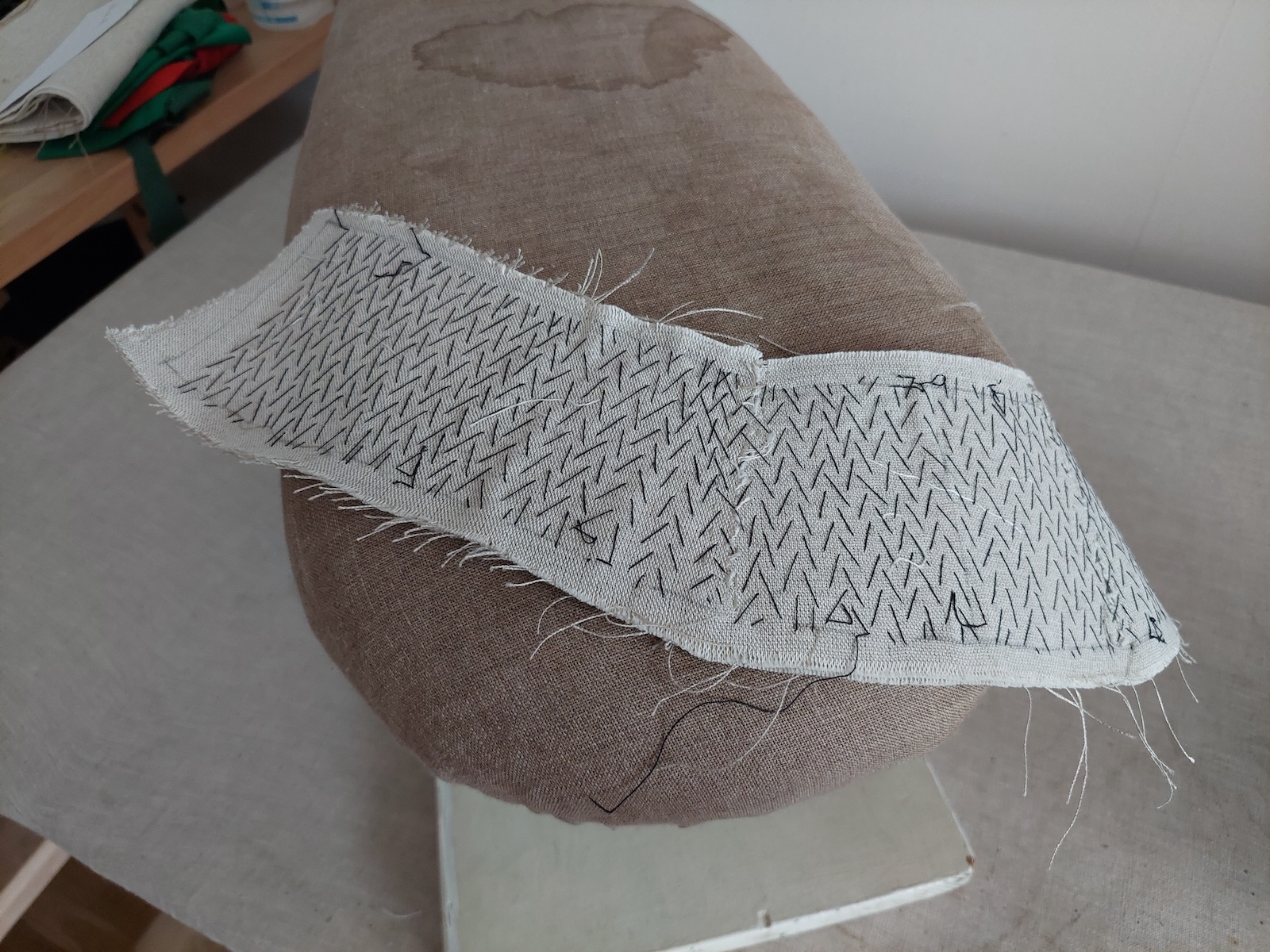
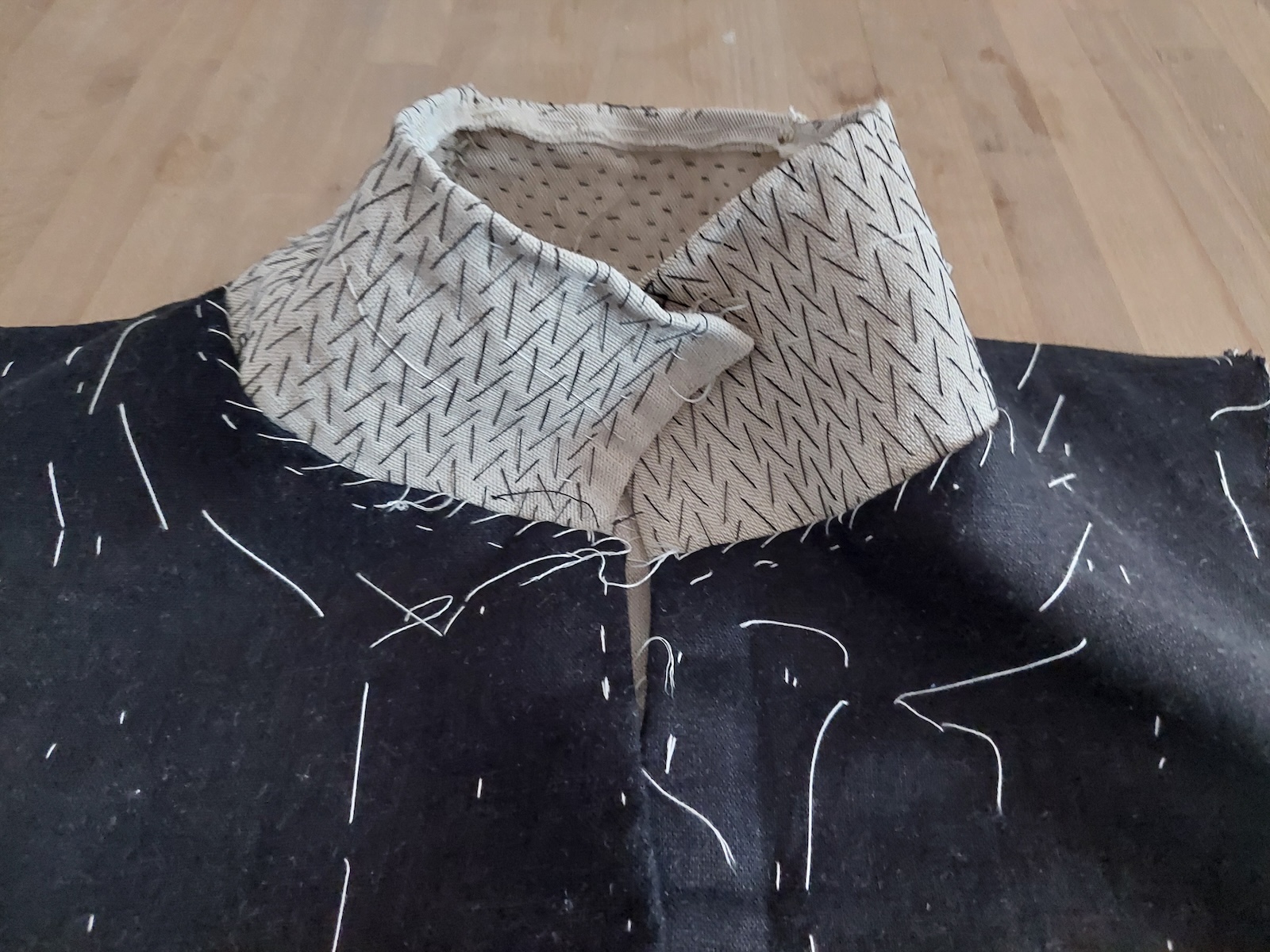
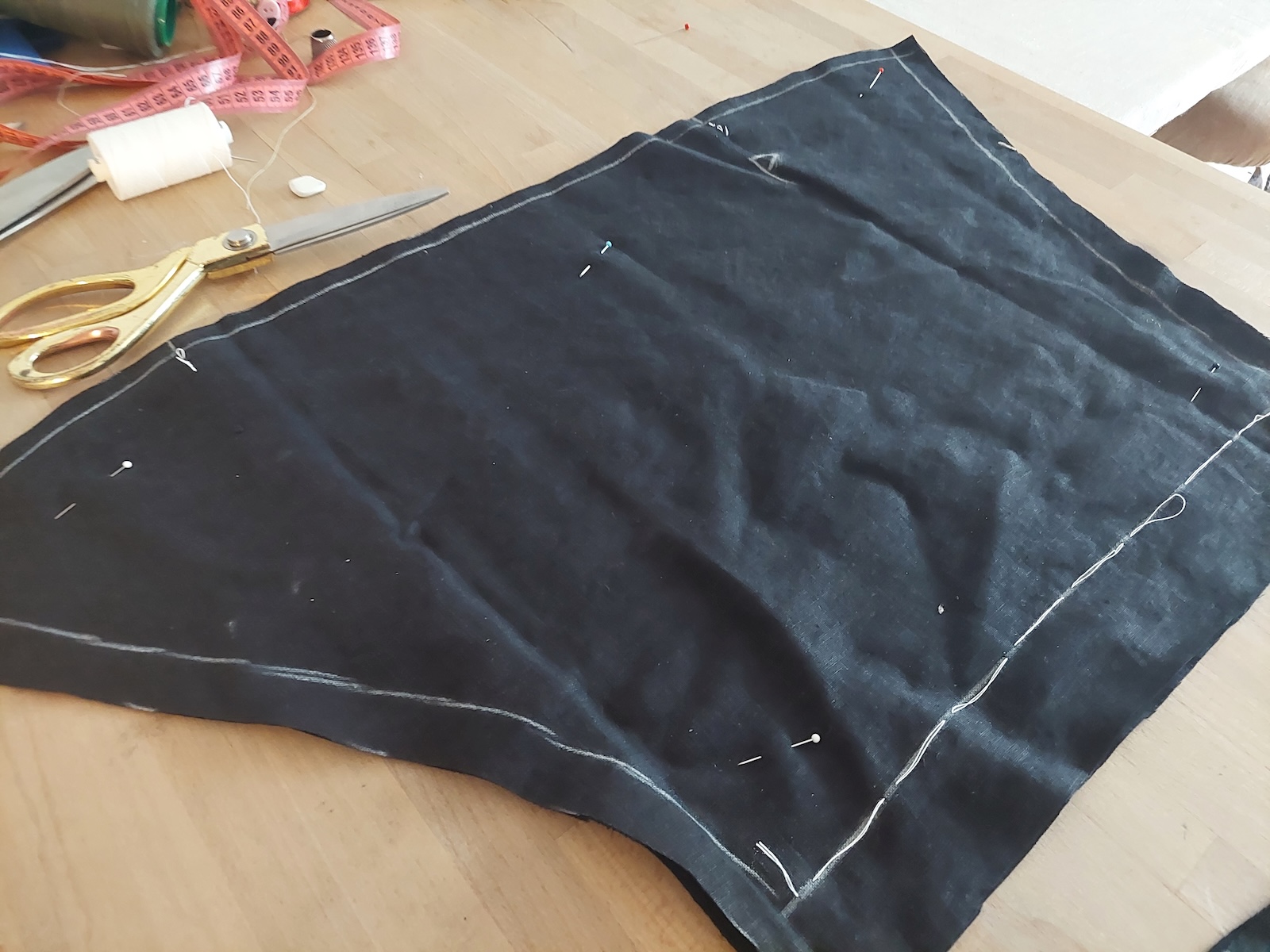
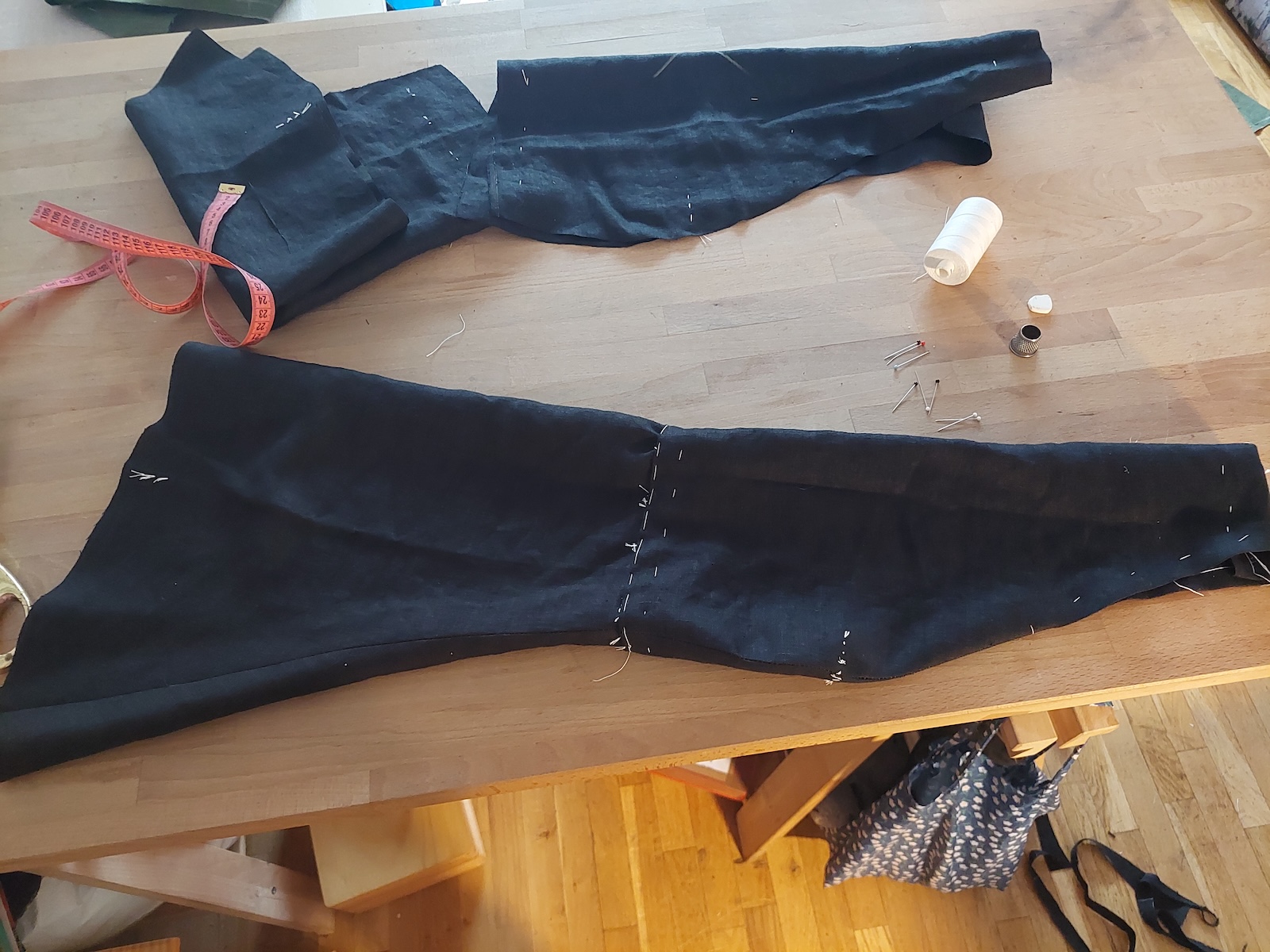
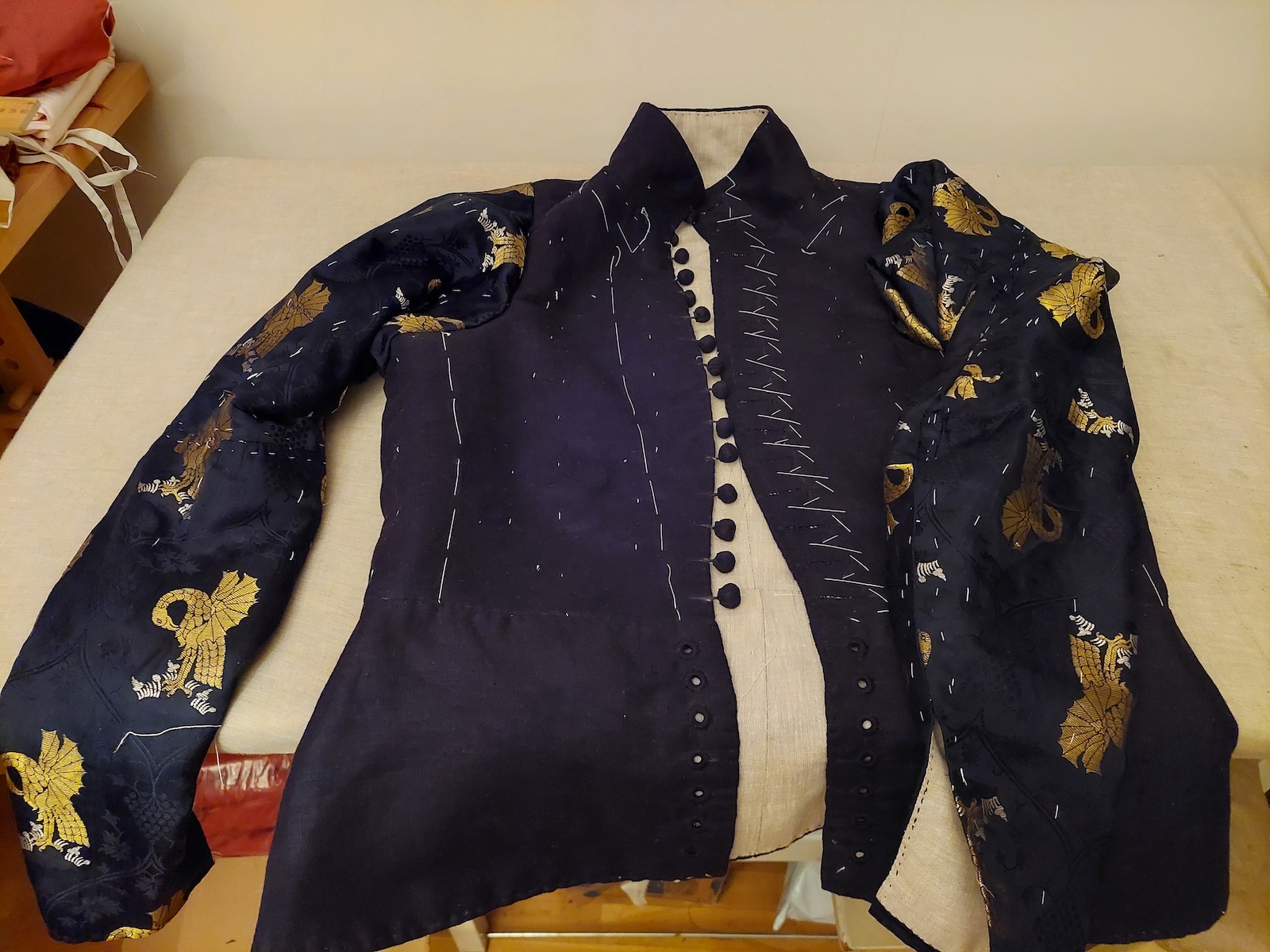
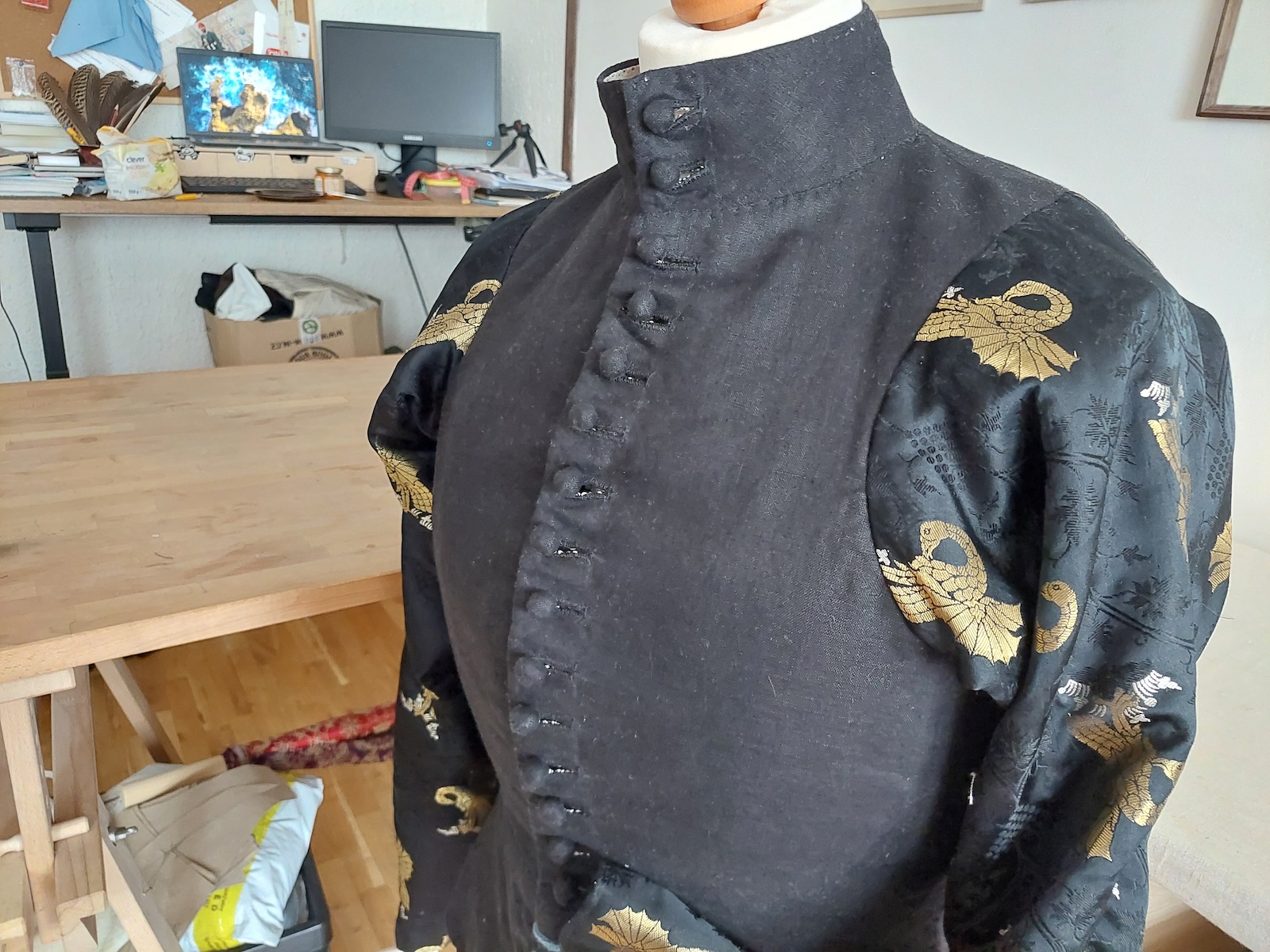
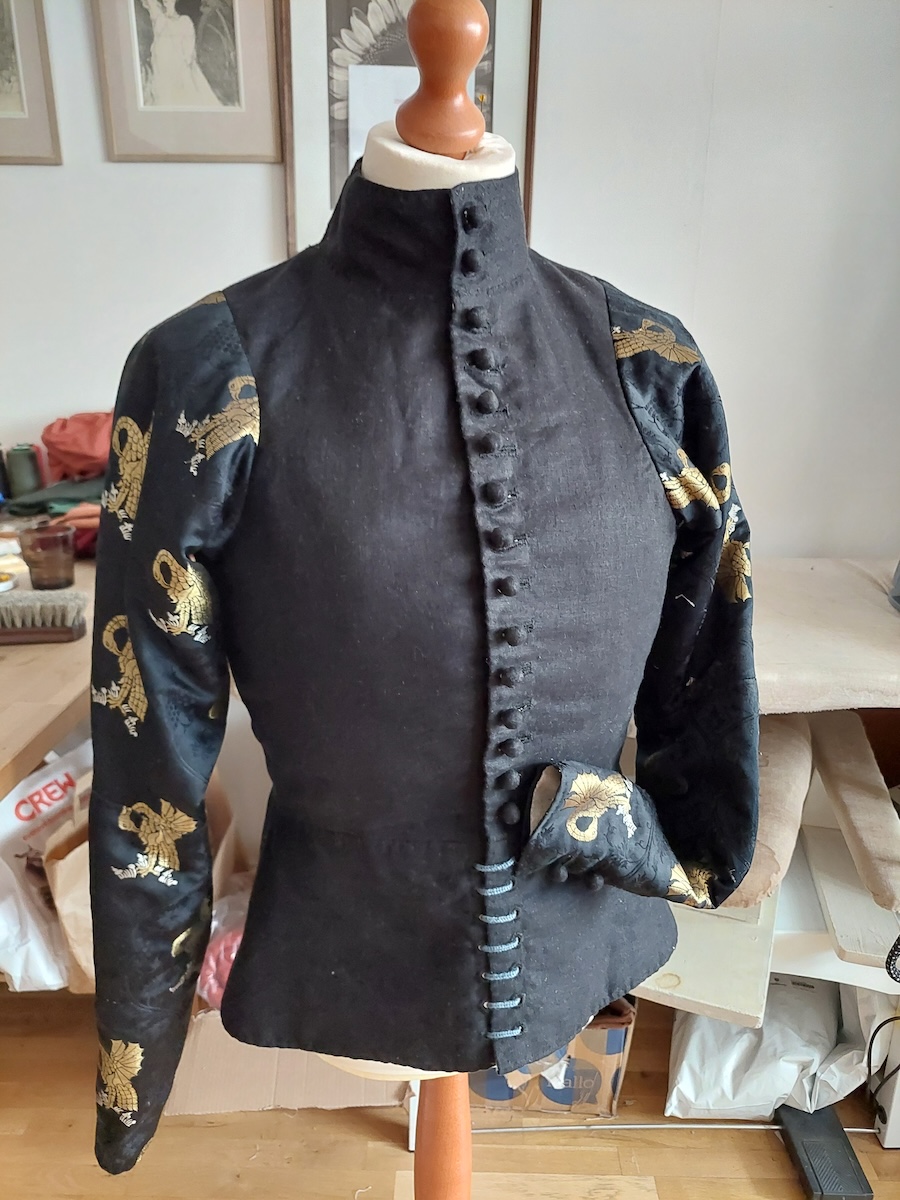
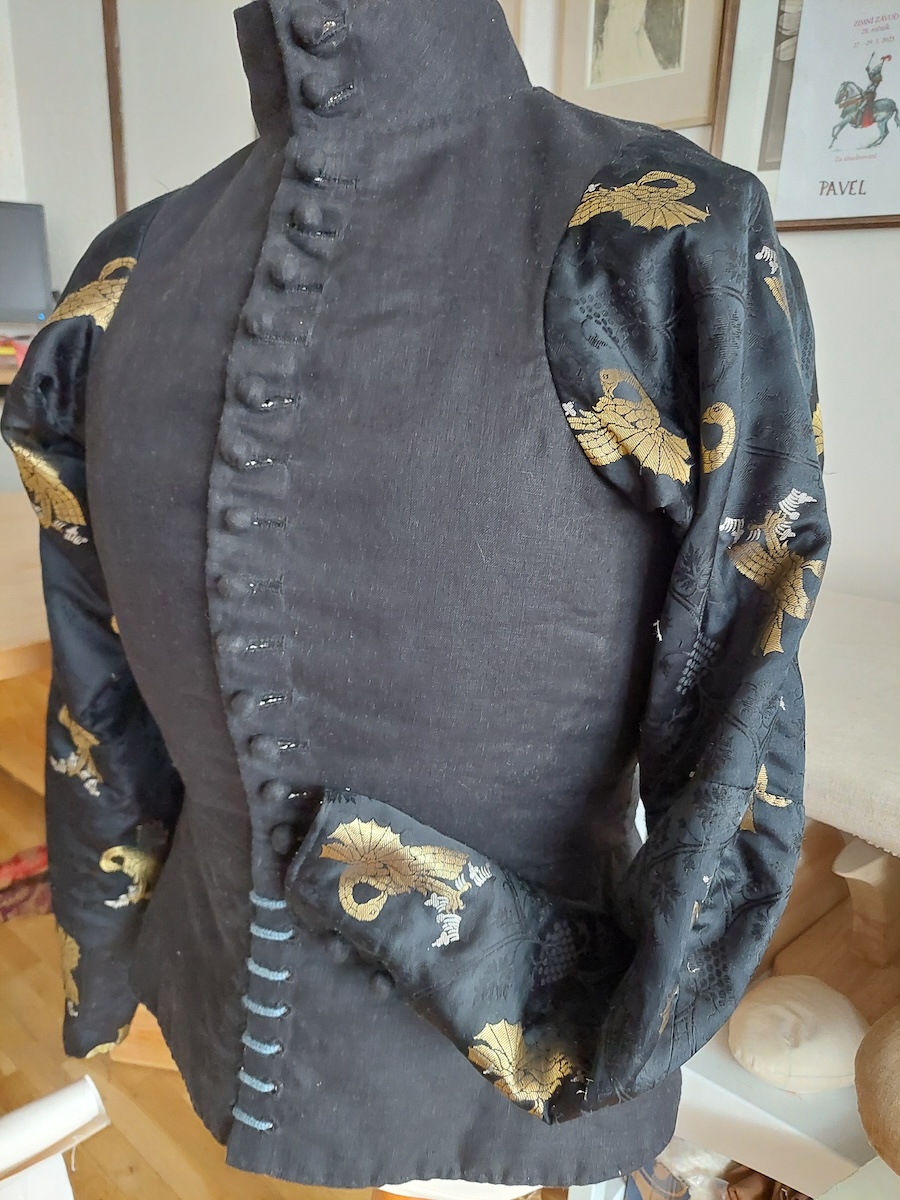
The free inspiration for this reconstruction was an illustration from the Bayerische Fürstengenealogie; at the same time, we sought to adhere to the articles of the New Town doubletmakers' guild. The body of the doublet is therefore made of black fustian (“… that fustian doublet shall be made”), and the chest is padded with raw cotton (“… and cotton shall be in the chest”). The cut, including the fastening, is based on the depiction of a doublet in the Coinmakers' Chapel of St. Barbara’s Cathedral in Kutná Hora.
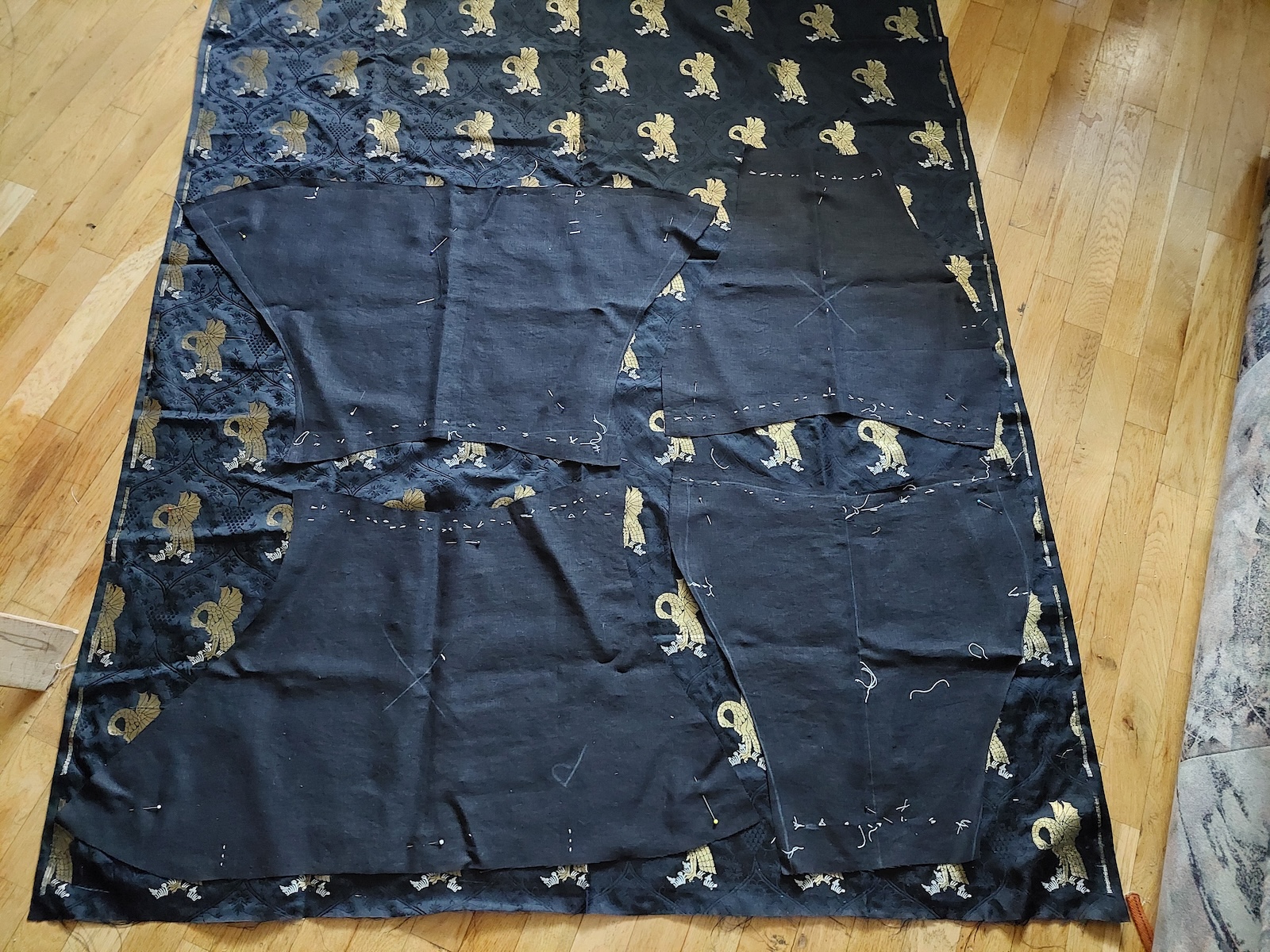
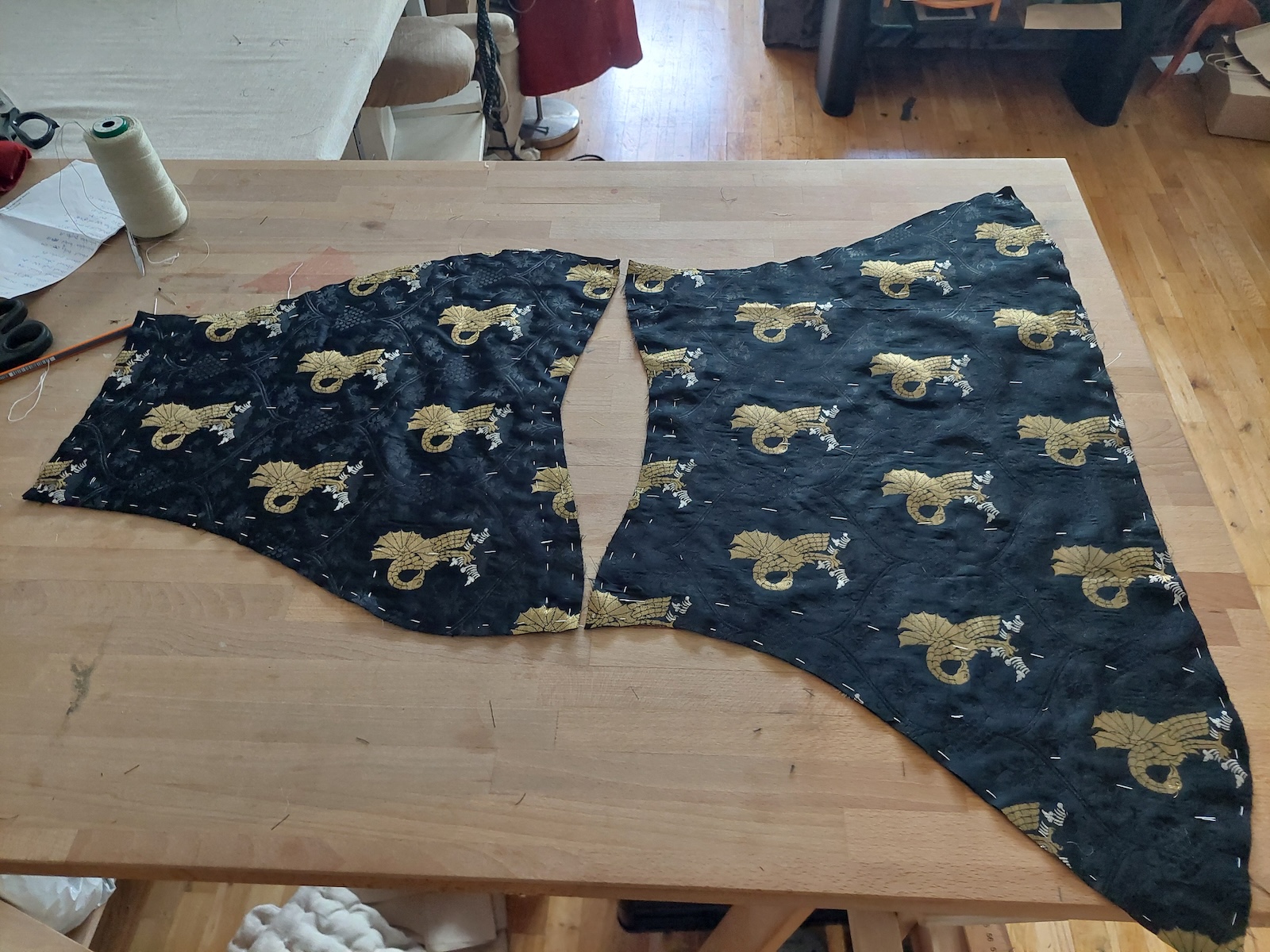
The sleeves are made from a markedly more expensive fabric, as can be seen in many contemporary depictions and as mentioned in the will of the cauldron-maker Martin from 1477: “two velvet sleeves of the doublet.” In place of the mentioned silk velvet, we used a hand-woven silk brocade interwoven with gold, featuring a Pelican motif, based on a fragment of textile found in Germany.
The entire doublet is sewn completely by hand. The reconstruction was carried out by Pavel Houfek.
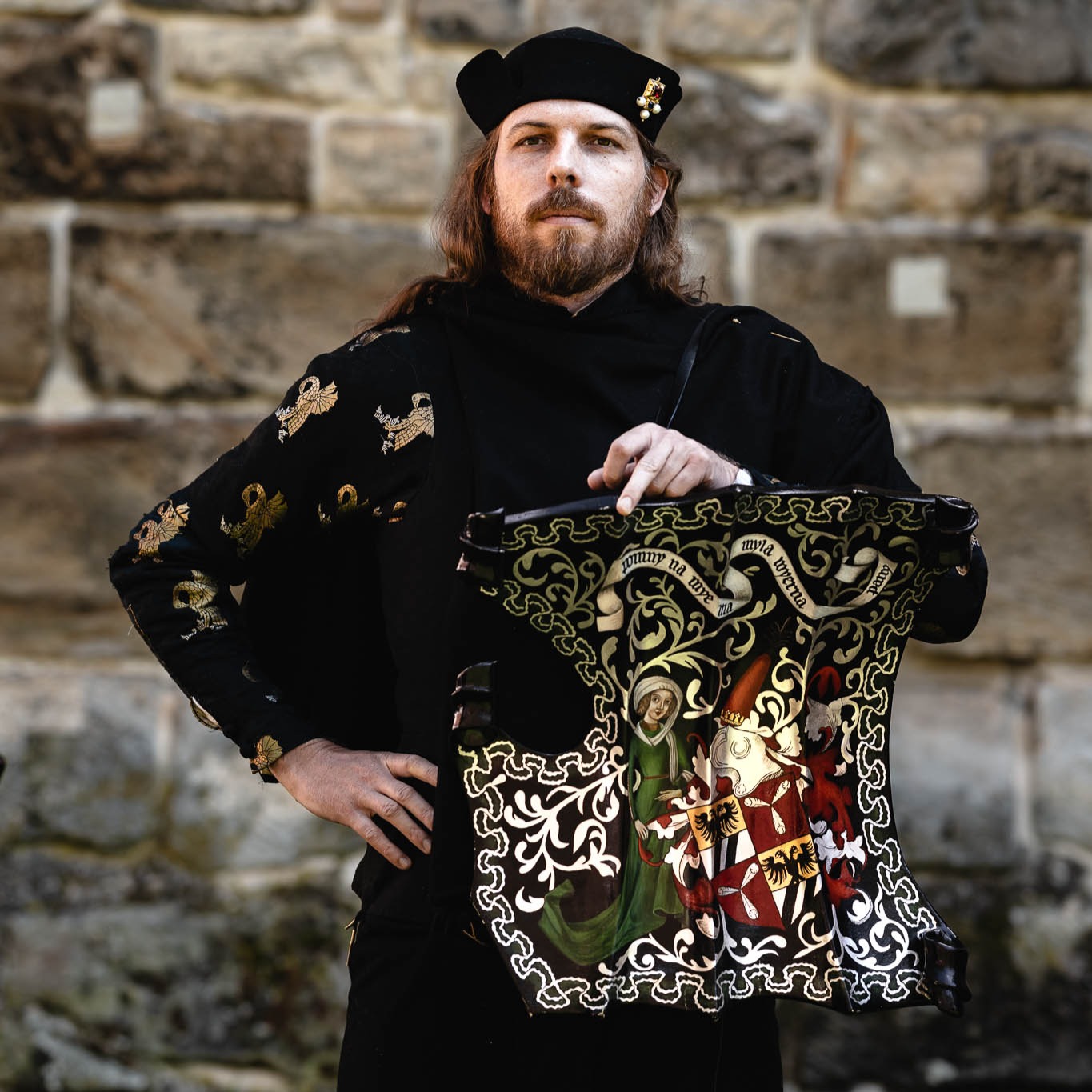
Gown
The gown was a fundamental type of outer garment. It was most commonly made of woolen fabric, which is called sukno in Czech so this type of garment was called sukně in Old Czech, which means skirt in contemporary Czech. It could come in various lengths. The long version probably could have been called reverenda, as indicated by a record from 1478 stating that Prague maltster Rameš used to wear a “reverendě nové barvy” (reverenda of a new color). The gowns could be lined with fabric, fur, or left unlined. This is referred to in the year 1425 by Tomášek of Hlohovice to his brother“sukni s beránčím kožichem” (The gown with lamb fur) and “sukni parvířku s liščím kožichem” (The gown “parvířka” with fox fur). The same Tomášek, however, also had a “sukni modrú nepodšitú” (blue gown without lining). Plzeň citizen Jan Chudoba bequeathed from his wardrobe in 1432 a“knězi Šimanovi sukni černú svú s liščím kožichem” (black gown with fox fur to the priest Šiman). Master Petr, also from Plzeň, mentions in 1492 a “harasovú suknici krátkú podšitú” (short gown lined made from haras). Prague maltster Duchek, who died in 1437, had, among other things, three gowns, one “šerú s beránčím kožichem črným” (gray with black lamb fur), another “s liškami” (with foxes), and another “s plátnem” (with canvas), that is, lined with linen fabric (canvas at that time does not necessarily mean canvas weave but refers to linen fabric).
At the end of the 15th and the beginning of the 16th century, we find in written sources gowns trimmed with fur. For example, in the Jindřichův Hradec books in 1496, there is mention of a “červená, lasicí opremovaná” (red, trimmed with marten), which cost 2 schocks of groschen. In 1503, a servant also stole from the noble lady Barbora of Vrchlabí a “sukni atlasovou zelenou, kožichem podšitou a lasičkami opremovanou” (green velvet gown, lined with fur and trimmed with marten) .
In the Czech lands, we can trace three most common variants:
Simple Gown
A gown with a more or less shirt-like cut of various lengths, either with narrow or wide sleeves. The term “simple” does not refer to the material, which could indeed be luxurious, but to the relative simplicity of the cut. It could be decorated with then-fashionable pleats or draping. In Czech iconography, more dignified figures (e.g., elders, saints, angels, etc.) typically have very simple, but also very long gowns.
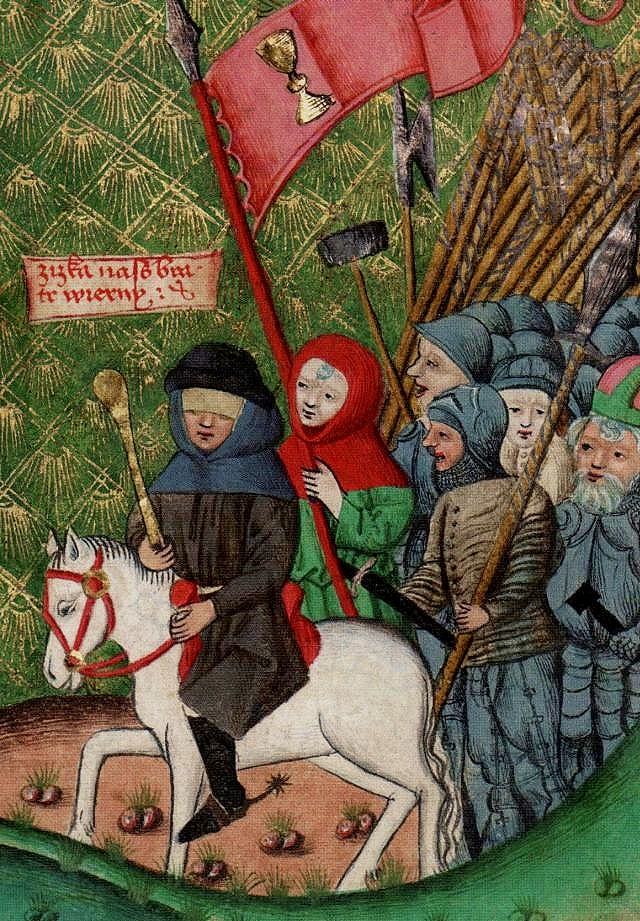
Jan Žižka in a simple gown with narrow sleeves and a standard-bearer in a simple gown with wide sleeves. Excerpt from the Codex of Jena (1490-1510).
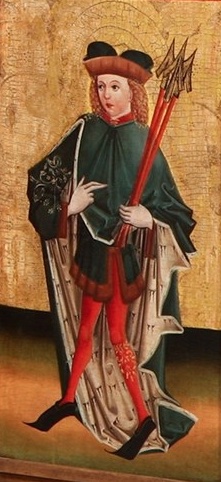
St. Sebastian in a fashionable short green gown lined with brown fur, featuring wide sleeves, side slits on the shorts, and draping on the altar panel from Jeníkov, around 1460.
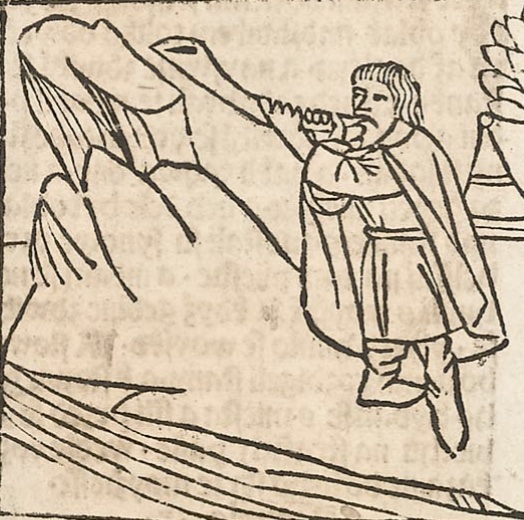
A man in a simple gown and cloak, excerpt from the Kutná Hora Bible, 1489.
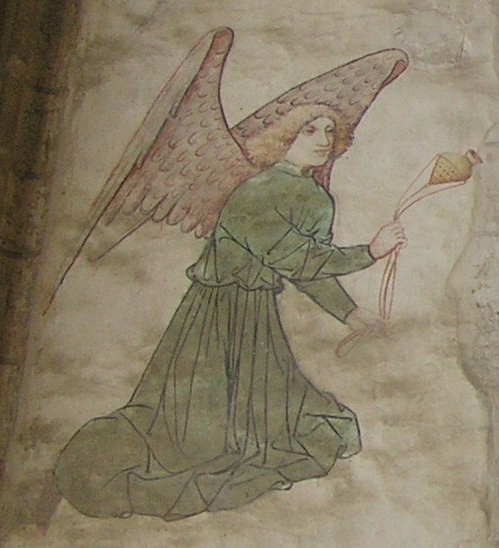
An angel in a long simple gown with tapering sleeves and a stand-up collar on the fresco from the Mintmaster's Chapel, St. Barbara's Church, Kutná Hora (1460-1470)
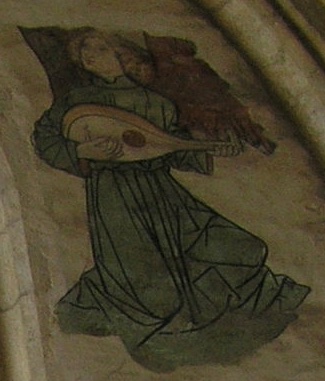
An angel in a long, plain gown with tapered sleeves and a stand-up collar on a fresco from the Mintmaster's Chapel, St. Barbara's Church, Kutná Hora (1460-1470).
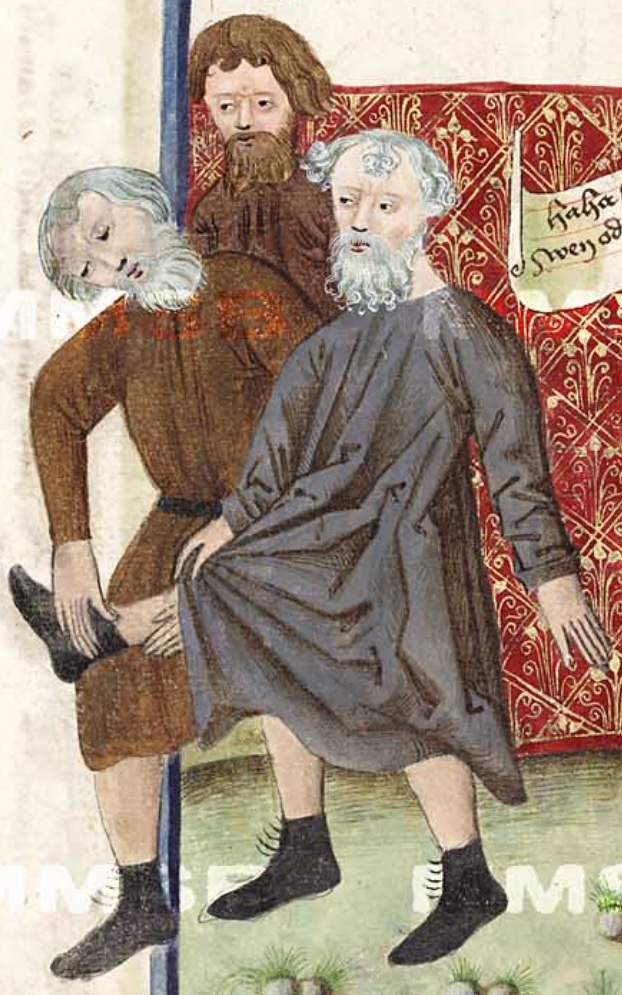
Apostles in simple gowns in an excerpt from the Codex of Jena (1490-1510).
Gown type vestina
Gown, called “vestina” by the Italians, is characterized by a fitted bodice, which was fastened, and more or less draped shorts of various lengths, usually not longer than just below the knees.
Pregéř (the coin maker) dressed in an old pink gown of type vestina. Detail from the fresco in the Mincířská Chapel of St. Barbara's Cathedral in Kutná Hora (1460-1470).
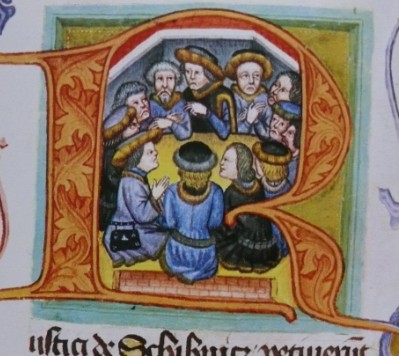
A meeting of the city council depicted in the initial from the Brno Legal Book of Václav of Jihlava (1446). Councillors, facing away from the observer, one in blue and the other in black, are wearing gowns of the type vestina.
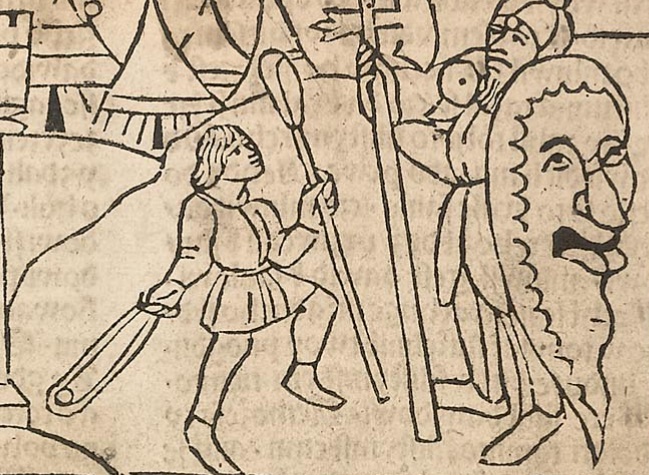
David, wearing a gown of the type vestina, slays Goliath. Woodcut from the Kutná Hora Bible (1489).
Ruched Gown with Baggy Sleeves
This type of gown is characterized by baggy sleeves and rich ruching along its entire length. The Czech version differs from its Western European counterparts, particularly in the construction of the sleeves. It seems that in Bohemia, a deep sleeve head, the so-called grande assiette, was maintained, giving Czech gowns of this type a somewhat flattened appearance, in contrast to the more square shape typical in Western Europe. This becomes especially evident when combined with coats that lack padded shoulders, as was common in Burgundy and France. In the West, this type of sleeve usually had two openings for inserting the hand—one at the wrist, as is usual for normal sleeves, and the other roughly at the elbow. Although depictions of such sleeves can be found, for example, in the Kutná Hora Bible, other Czech contemporary depictions suggest that Czech sleeves were typically more square and had only one opening for the hand, around the elbow level. This sleeve construction can be indirectly confirmed by some written sources. For example, in one Rakovník court book from 1486, there is an entry:“Poručil jsem, aby kladl peníze do truhly, a on kladl do rukáva sukně své.” (I ordered him to put money in the chest, and he put it in the sleeve of his gown.) Elsewhere, you can read: “Vyňal peníze s měchýřem, dosti pěkný uzlík, a vložil je do rukáva.” (He pulled out the money, really nice sack, and put it in his sleeve.)
This type of gown was most often lined with fur.
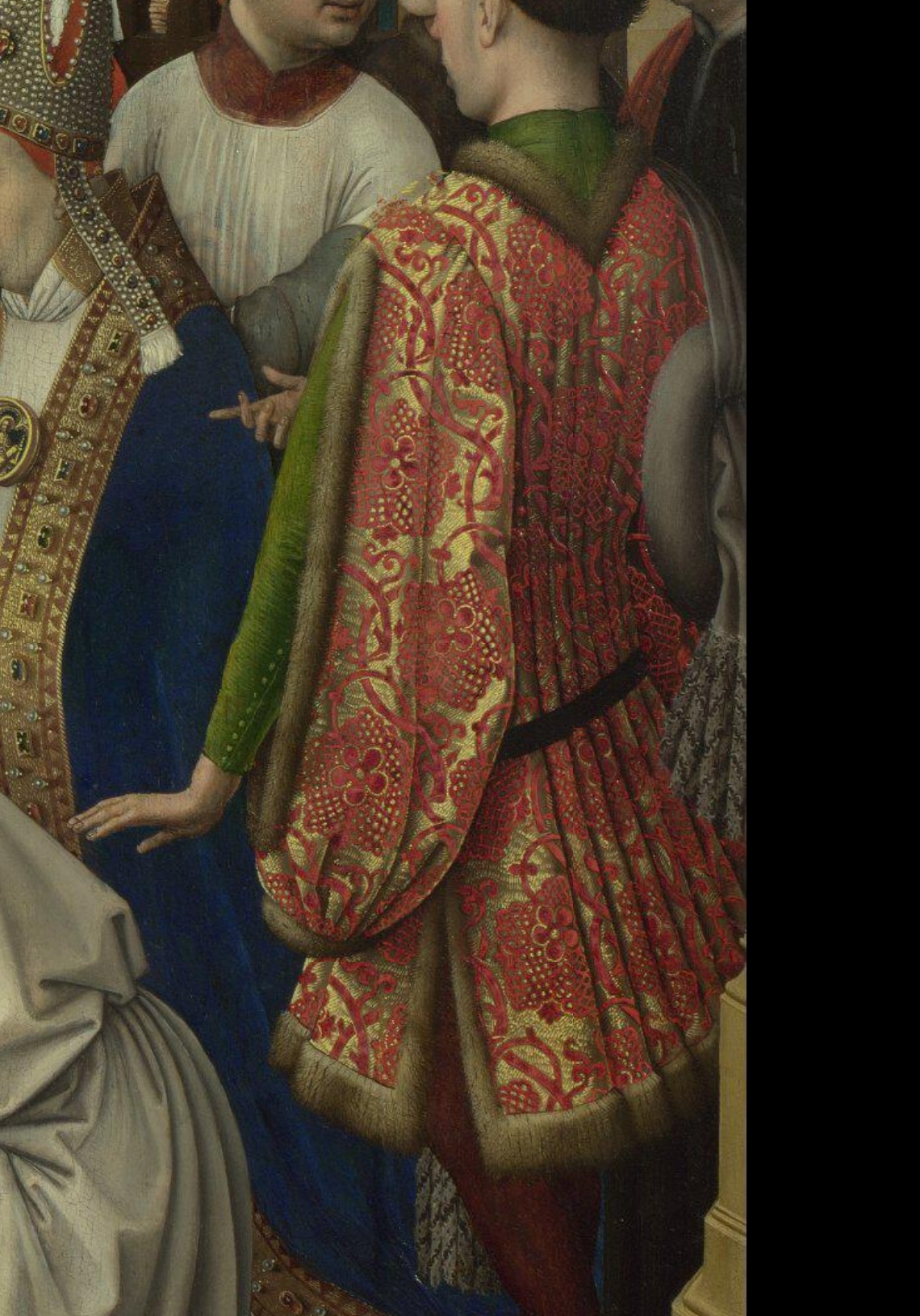
A typical example of a Western European gown with baggy sleeves, depicted in the excerpt from the painting Exhumation of St. Hubert by Rogier van der Weyden, 1430.
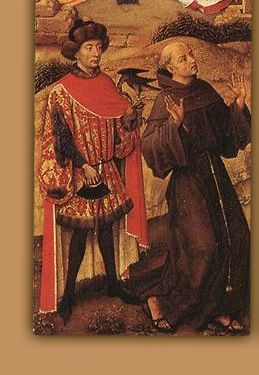
Another typical example of a Western European gown with baggy sleeves, depicted in the excerpt from the triptych for Alessandro Sforza, again by Rogier van der Weyden, 1460.
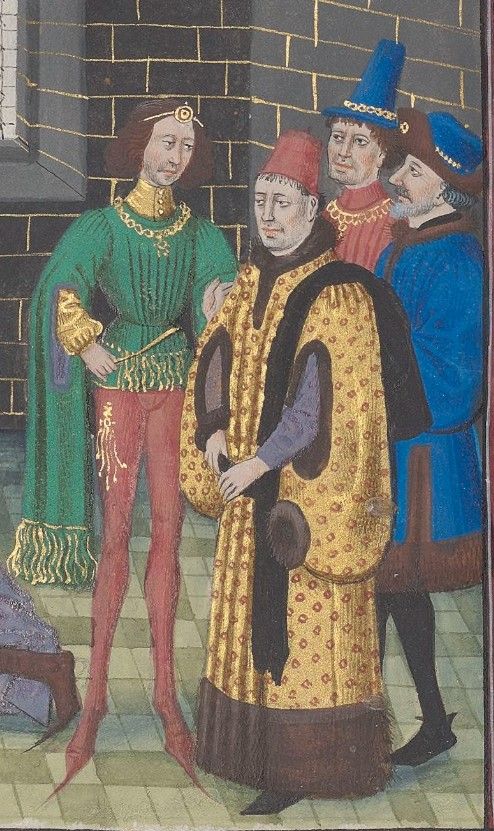
Two gowns with baggy sleeves depicted in the Croniques abregies by David Aubert, 1471. Particularly interesting is the green gown, whose sleeve does not narrow towards the wrist and remains loose. A similar gown can be found in the illustrations from the Memorial Book of Olomouc
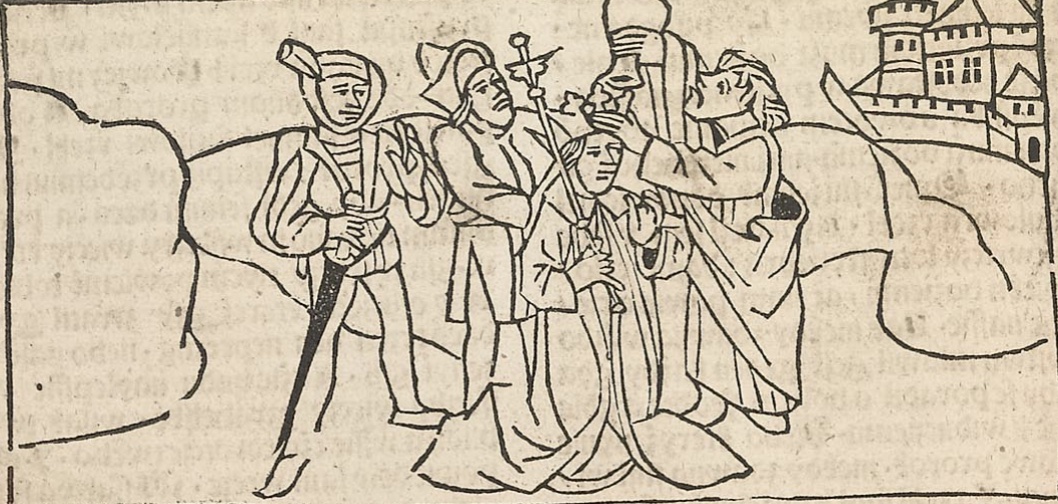
The man on the left is wearing a gown with baggy sleeves and two hand openings, as is customary in Western Europe, in the woodcut depicting the anointing of King Saul, Kutná Hora Bible (1489).
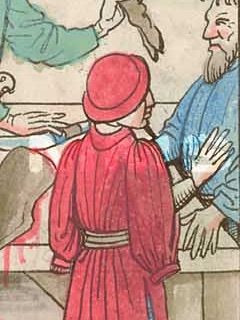
Man in a gown with baggy sleeves and two hand openings in the excerpt from the Richental Chronicle (1470-1480).
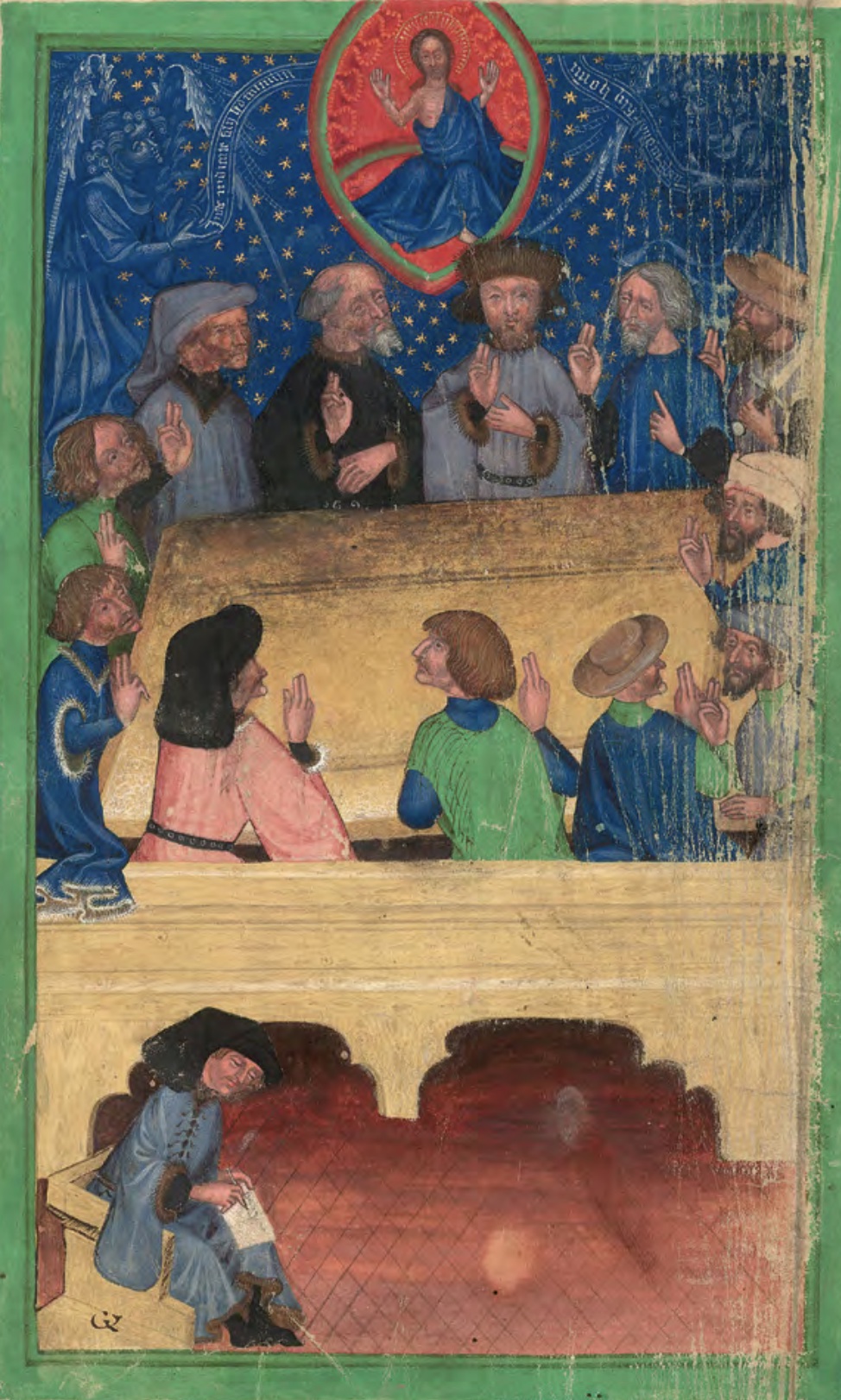
Meeting of the municipal council in the depiction from the Memorial Book of Olomouc (1430-1492). Scribe Václav from Jihlava (bottom left) wears a blue gown, lined with fur, with a square baggy sleeve and only one opening for the hand. The councilor in blue above him has a gown with a baggy sleeve, but with a free end, similarly to the man in green from the illumination in the Shortened Chronicles by David Aubert. It also shows how Czech gowns appear somewhat flattened compared to their Western counterparts.
Václav of Jihlava in a purple gown lined with fur and baggy sleeves. Excerpt from the Brno Legal Book of Václav of Jihlava (1446).
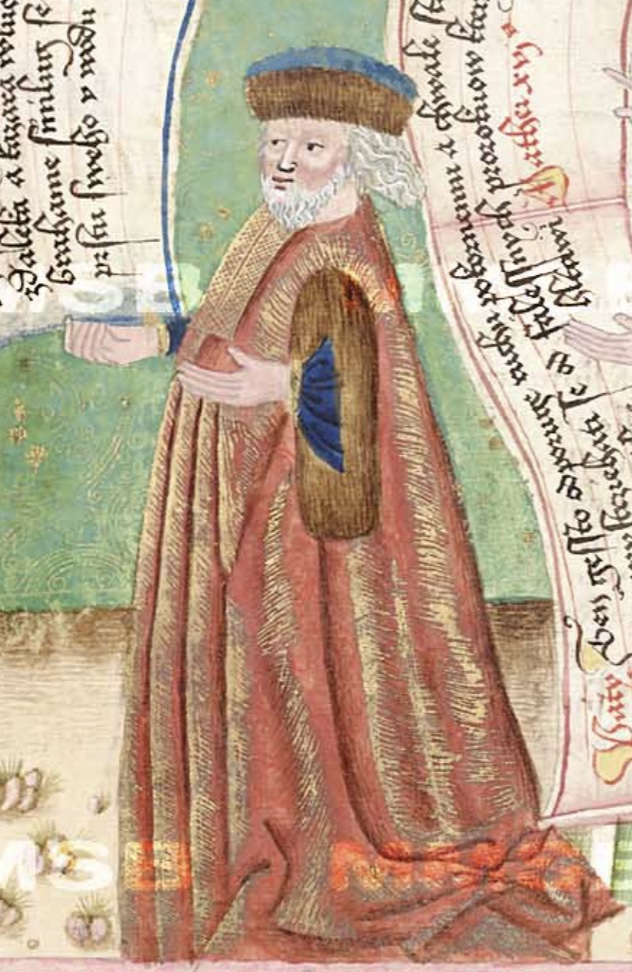
Wealthy man in a long fur-lined gown with a square baggy sleeve, on a page from the Codex of Jena (1490-1510).
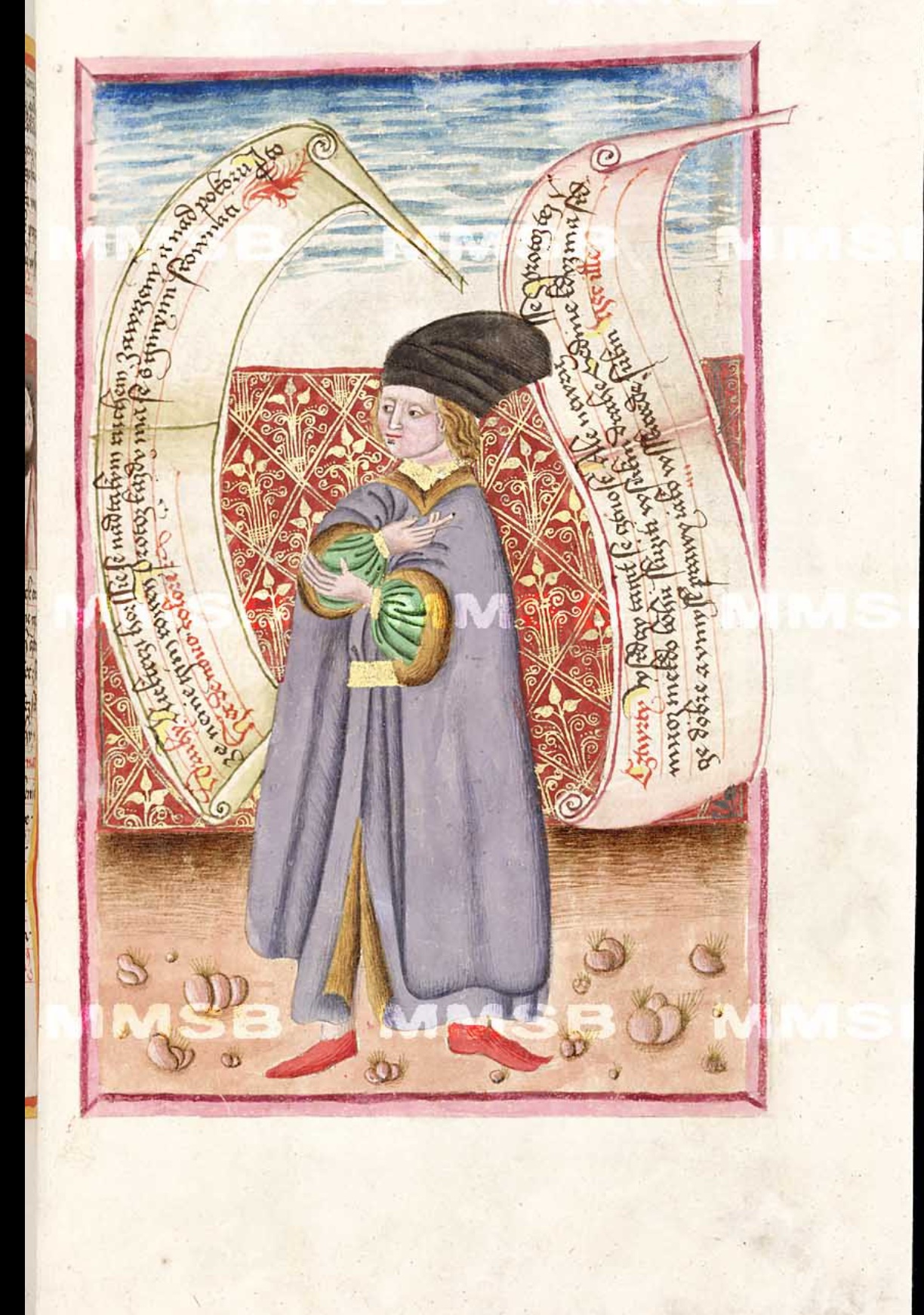
Priest in a long, fur-lined gown with a square baggy sleeve, on a cutout from the Codex of Jena (1490-1510).
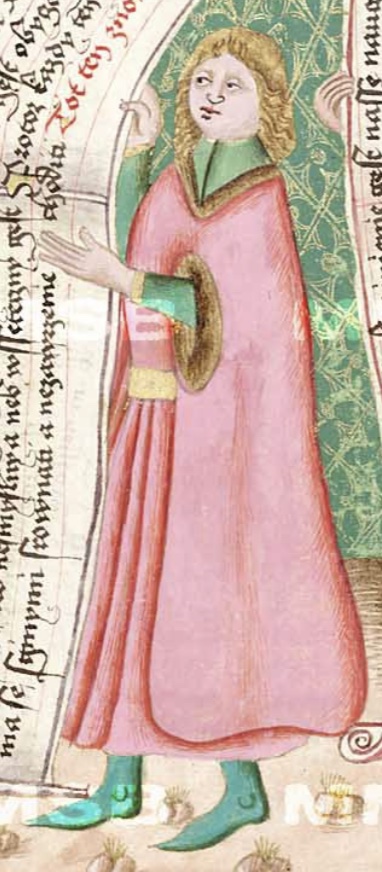
Wealthy man in a long, fur-lined gown with a square baggy sleeve, on a cutout from the Codex of Jena (1490-1510).
Cloak
The cloak was a very popular type of men's and women's outer garment. Its cut varied greatly and the names of individual types of cuts considerably overlapped, making it quite difficult today to distinguish which specific type of garment was meant. We can encounter terms such as plášček, pláščík; in the Luxembourg period it began to be called klok, kloček, from the French form cloque, Latin clanis, further Latin pelicio, German tasselmantel, mantl and mantlík. Most commonly, we encounter cloaks of a semi-circular cut, but a three-quarter circle cut was also worn. The length of the cloak varied and it could come in a whole palette of colours, but blue, green, pink and grey clearly predominated.
The cloak was most often fastened at the chest under the chin. An ornamental brooch called an agrafa could serve this purpose; its shape, colour and decoration had religious significance, which is why we often encounter a lozenge-shaped agrafa decorated with precious stones arranged in the shape of a cross, or its vertices could be finished with pearls resembling a lily. A semi-circular cloak fastened with an agrafa is most frequently found in depictions of the Virgin Mary. Furthermore, cloaks were fastened with a cord or strap, or with a decorative band placed across, or also, especially for shorter cloaks, with three buttons under the chin or more often on the shoulder.
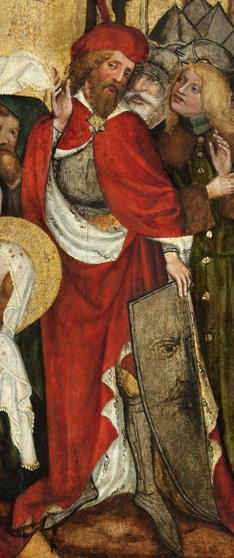
A long cloak fastened with an agrafa in an excerpt from the Crucifixion from Nové Sady, 1440.
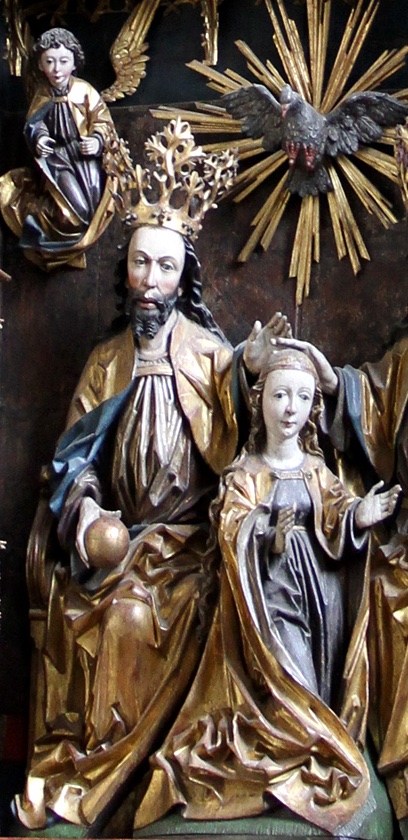
Long cloaks fastened with a band of fabric, Křivoklát Altarpiece, probably 1483.
A shorter cloak fastened with three buttons at the front on the painting of St. Roch of Italian provenance, 1480.
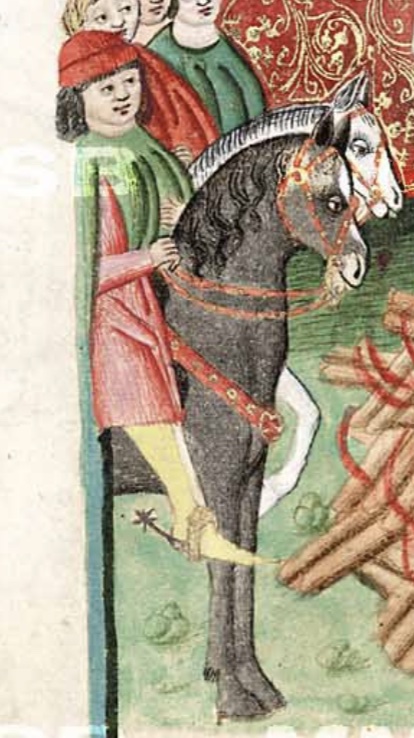
A shorter cloak fastened at the shoulder, excerpt from the Codex of Jena (1490-1510).
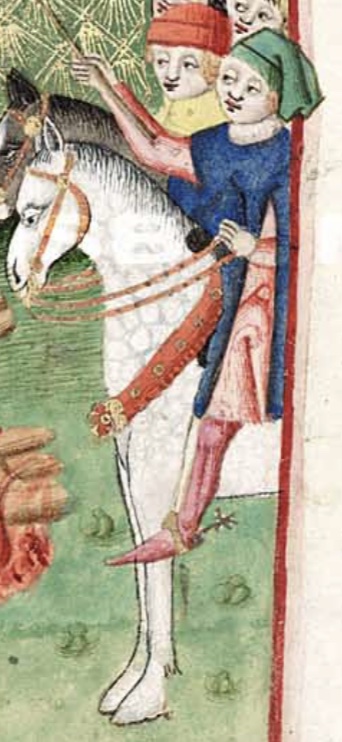
A shorter cloak fastened at the shoulder, excerpt from the Codex of Jena (1490-1510).
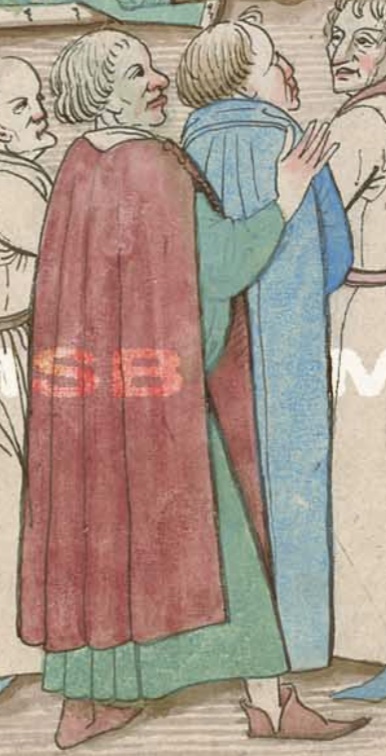
A cloak fastened with buttons at the shoulder, excerpt from the Richental Chronicle (1470-1480).
Another group of cloaks comprises cloaks that some scholars today refer to by the artificial term cloak-tunic. Two types of cloaks fall into this category: the first, called a huque, and the second, which has slits for the hands and is closer to a gown or the Western European houppelande.
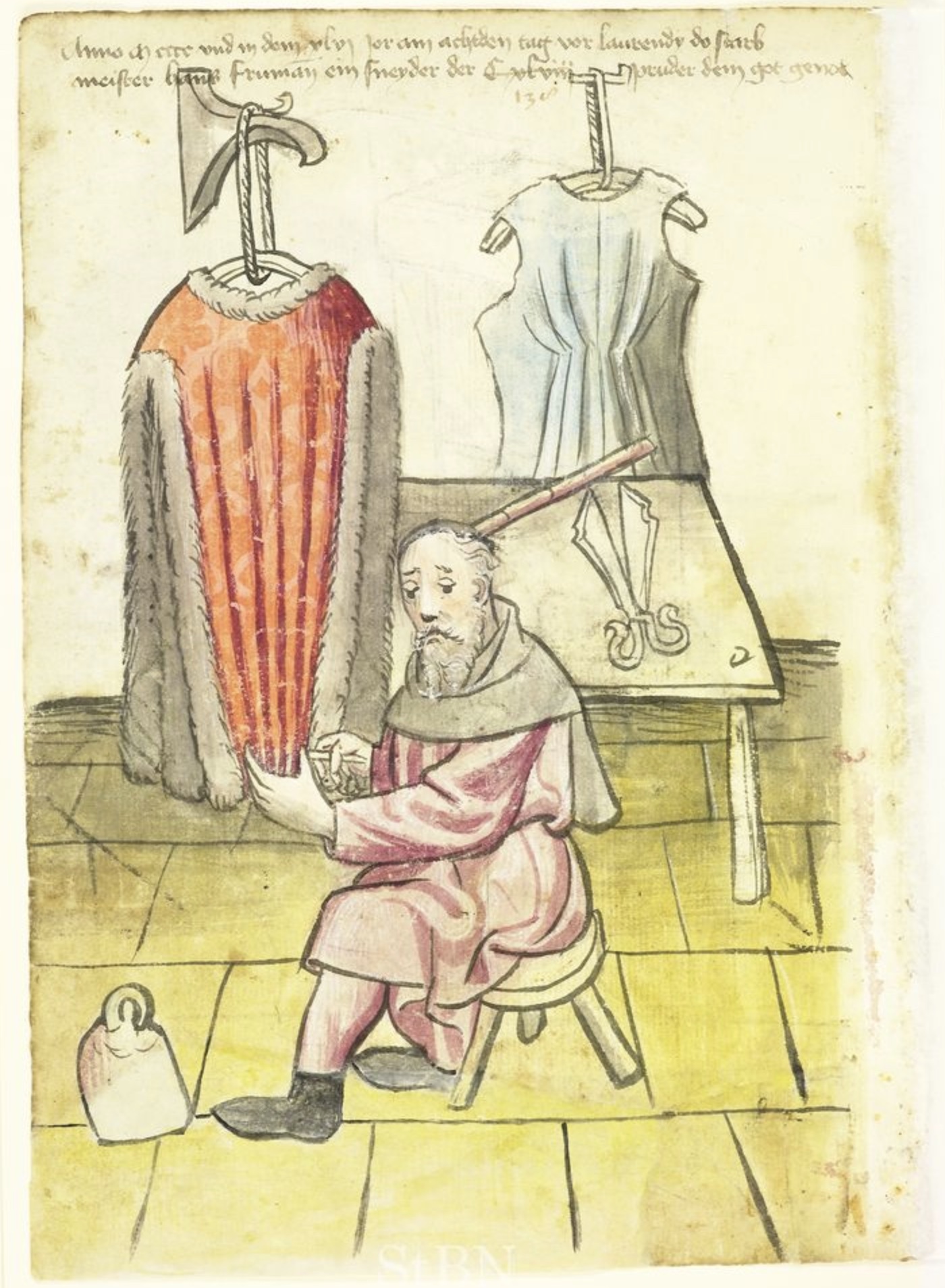
Nuremberg tailor Hans Frumann creates pleats on a cloak-tunic, a page from the House Book of the Nuremberg Twelve Brothers Foundation, 1446.
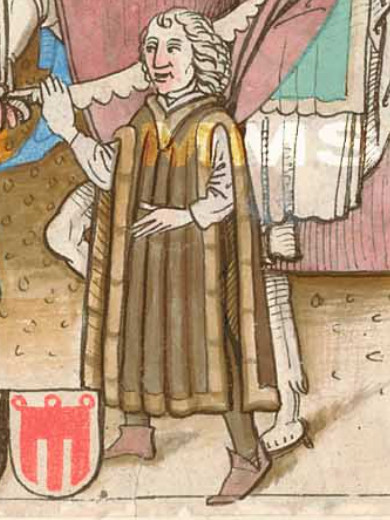
A cloak of the huque type, excerpt from the Richental Chronicle (1470-1480).
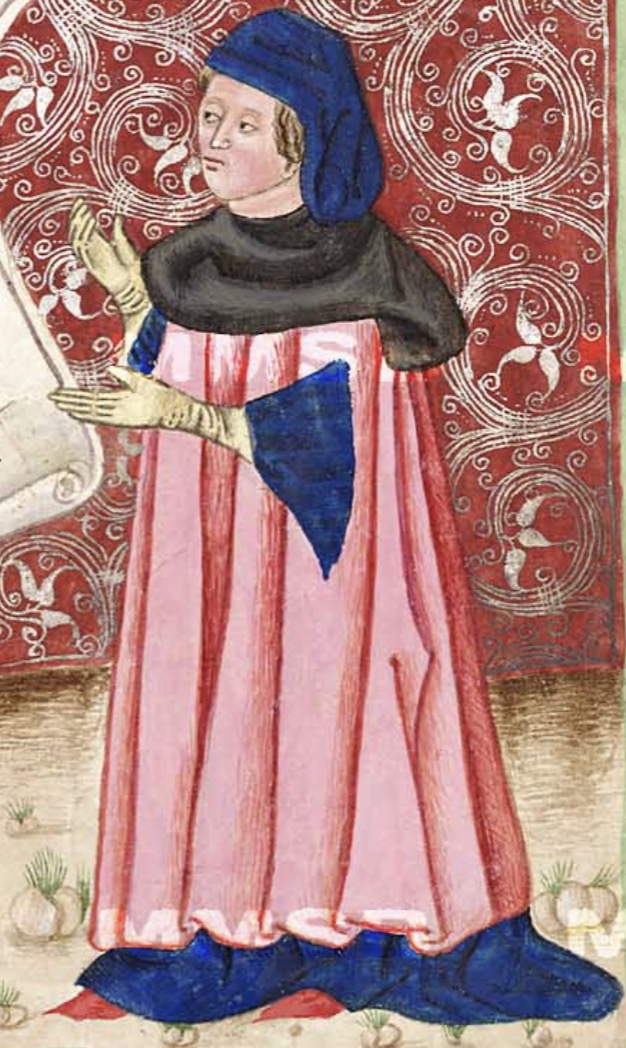
A cloak with slits for the hands, excerpt from the Codex of Jena (1490-1510).
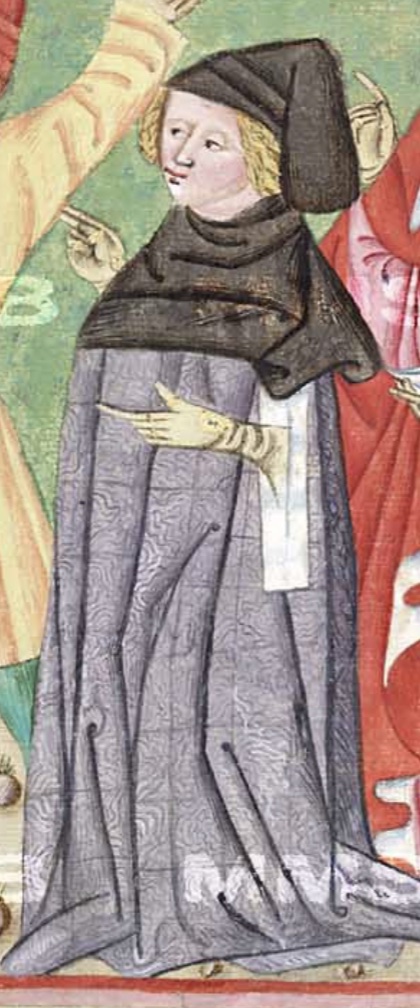
A cloak with slits for the hands, excerpt from the Codex of Jena (1490-1510).
Footwear
Footwear in Bohemia in the second half of the 15th century can be divided into low, mid-height and tall. Shoes were most commonly made of leather by sewing the sole to the upper and then turning the shoe inside out (so-called turnshoe construction). A strip of leather, called a welt, was inserted between the sole and the upper. The aim of constructing a medieval shoe was to hide all important seams inside. While in Germany the fashion for round-toed shoes was already beginning — a trend that would culminate in the first half of the 16th century with shoes called "cow's mouth" — in Bohemia, a conservative moderate pointed toe was still maintained at the beginning of the 16th century.
Alongside this moderate point, the long beaks once worn a century earlier on shoes of the poulaine type reappeared in Prague in the 1460s. On 2 September 1464 George of Poděbrady ordered the burgomasters and councils of all three Prague towns: “Přikazujem vám, abyste všem ševcuom přikázali, aby špicuov u třevíc i u škoren nedělali, a také žádnému svému nedopúštějte v špici choditi; v tom naši vuoli naplníte.”(We command you to order all shoemakers not to make points on shoes or boots, and not to allow any of your people to walk about in points; in this you will fulfil our will.) Tomek adds from the Prague town books that “za času krále Jiřího smyslili si ševci Pražští dělati zase střevíce a škorně špičaté jako kdysi o sto let předtím” (in the time of King George the Prague shoemakers took it into their heads to make pointed shoes and boots again, as a hundred years before), and judges that the ban “nejspíš mělo svůj účinek” (most likely had its effect) . The long beaks thus returned to Bohemia only briefly; thirteen years later, in 1477, the Old Town councillors, settling a dispute among the shoemakers, already describe a different trend – “obuv dělala nižší a škorně jezdecké ostřejší než jindy” (footwear was being made lower and riding boots sharper than before).
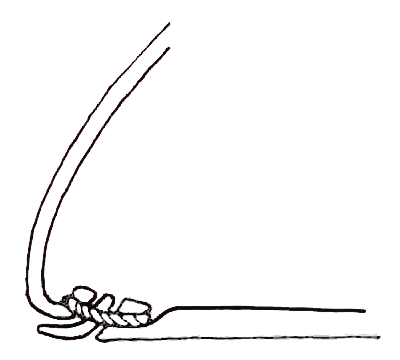
Method of sewing the upper to the sole in the 15th century (Goubitz).
In addition to the upper, the sole and the welt, a shoe generally contained several more parts — a heel stiffener, a binding, and some variant of fastening or lacing.
In the Prague towns the shoemaker's trade was divided in two: the novinníci, who made new footwear, and the vetešníci, who repaired it. Where exactly the line ran was pronounced on 12 July 1441 by the councillors of all three towns: the repairers “nové nártie a podešvy nové k starým ochozeným holenom budú moci přišívati a dvoje škorně dobře ochozené do krámu na prodaj každý trh vykládati, jakož jich práva svědčie, ale červených ani bielých šáróv k vetché obuvi nemají okládati”(may sew new vamps and new soles onto old worn-down boot legs and put out two pairs of well-worn boots for sale in the shop every market day, as their rights attest, but they must not fit red or white šáry onto old footwear). This shows what wore out first on a boot – the vamp and the sole – and what a customer had made only new: the coloured šáry, that is the boot legs. The New Town councillors renewed the ruling in 1456 and added the condition that whoever wished to settle as a master in either trade must agree with the community “ve věcech slavné svátosti těla a krve pána našeho Jhesu Crista pod obojím způsobem” (in matters of the glorious sacrament of the body and blood of our Lord Jesus Christ under both kinds).
The shoemakers greased and blackened the leather themselves. When they quarrelled in 1453 with the tanners of Podskalí and Vyšehrad, the tanner Jakub Kavka testified that “obojí koželuzi nemazali … ale byli štumfaři; potom se srotili ševci, a tak počali mazati, a tak štumfařské řemeslo sešlo” (neither group of tanners greased … they were štumfaři; then the shoemakers banded together and began to grease, and so the trade of the štumfaři died out), and the shoemakers Beneš and Mařík Lichva confirmed that the tanners had “naučili mazati od tovařišuov ševcovských zlehka od čtyřidceti let” (learned to grease from shoemakers' journeymen some forty years ago).
Overlap Fastening
Overlap fastening means that a part of the leather on the upper overlaps the open section of the shoe and is fastened at the side with a button or buckle. Its function is very similar to flap fastening; however, the main difference is that the flap is sewn onto the shoe separately. Nevertheless, it is not easy to distinguish these two types in finds and depictions, and they often merge together. This type of fastening was most popular between the 8th and 13th centuries; by the 15th century it appeared only very sporadically (e.g. a find from Fribourg in Switzerland, where the overlap is fitted with two straps that fasten at the ankles using two buckles).
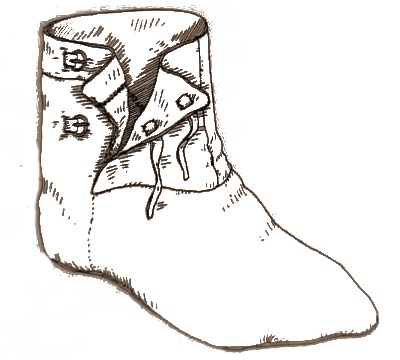
Criblet, Fribourg, Switzerland. A shoe with overlap fastening and buckles. 14th–15th century (Volken & Bourgarel 2001).
Fold Fastening
The principle of fastening is very similar to overlap fastening, but the shoe completely lacks an open section on the instep. Instead, there is a large fold that is fastened at the side using buttons, buckles or hooks. This type of fastening was very popular in the 14th, 15th and 16th centuries, especially for tall boots.
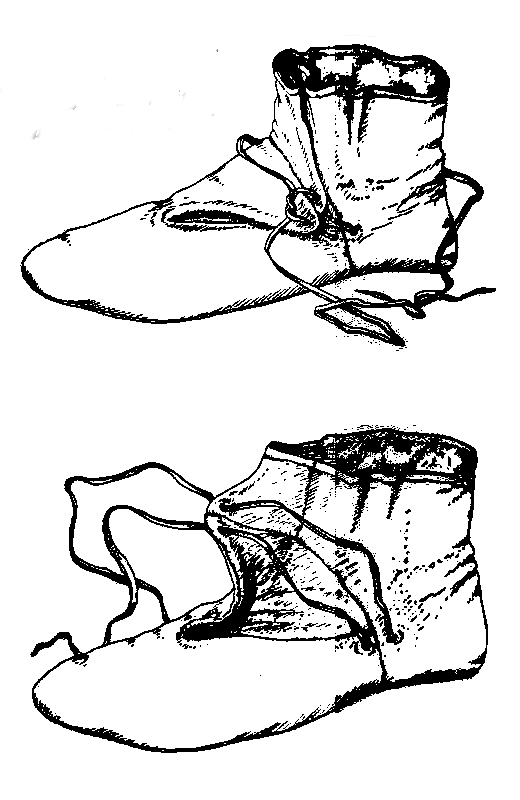
Dordrecht, Netherlands. An ankle boot with a fold fastening, shown unfastened and fastened. 15th century. (Goubitz)
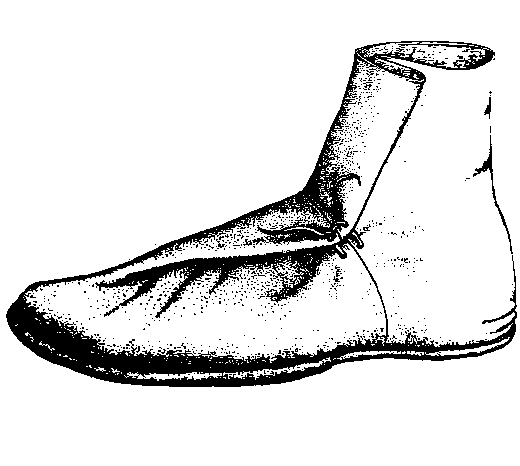
Vevey, Switzerland. A boot with fold fastening. 14th–15th century. (Goubitz)
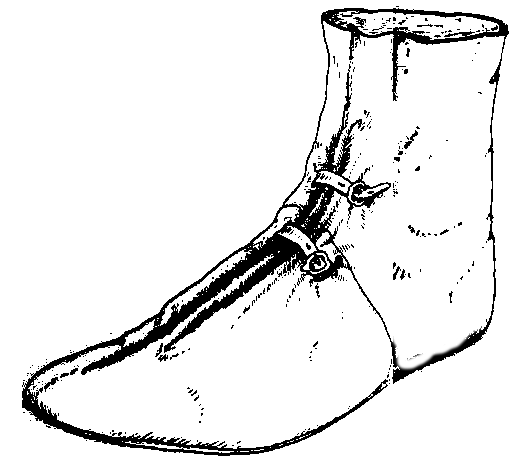
Coventry, England, 15th century. (Goubitz)
A tall riding boot with fold fastening, excerpt from the Codex of Jena (1490-1510).
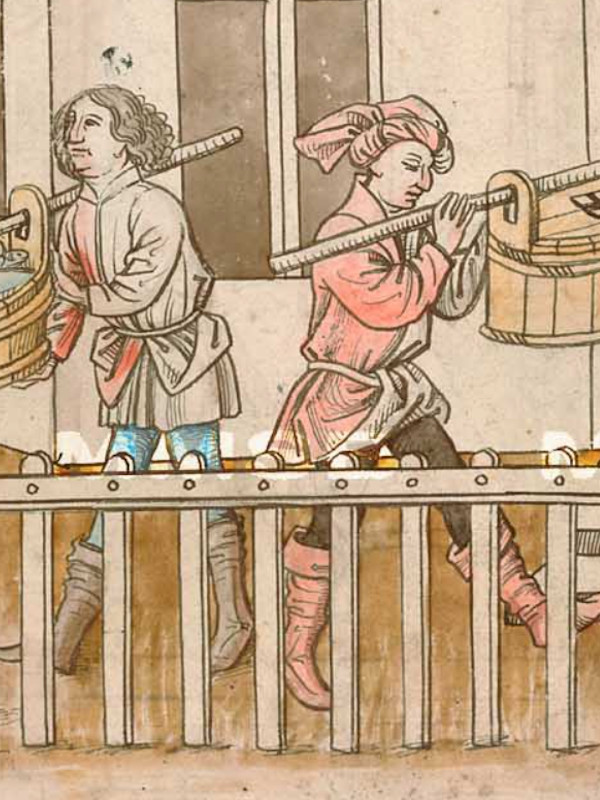
A tall riding boot with fold fastening, excerpt from the Richental Chronicle (1470-1480).
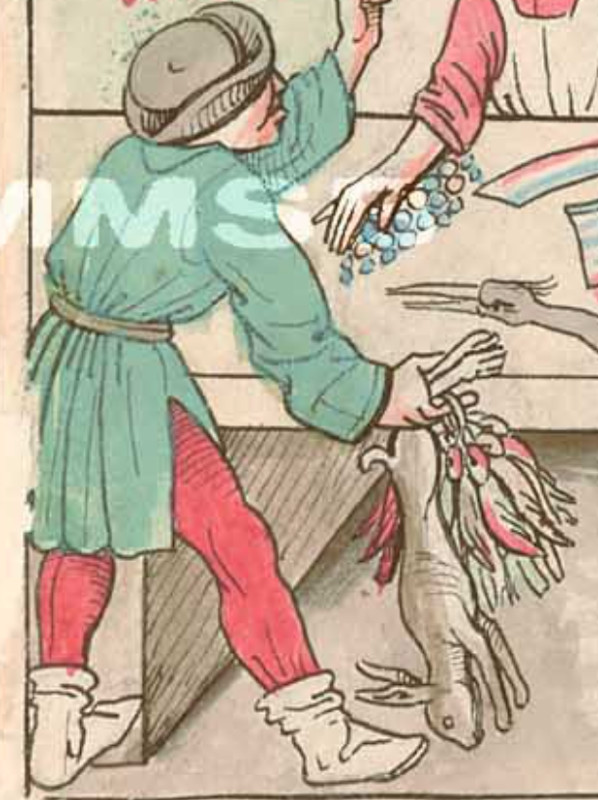
An ankle boot with fold fastening, excerpt from the Richental Chronicle (1470-1480).
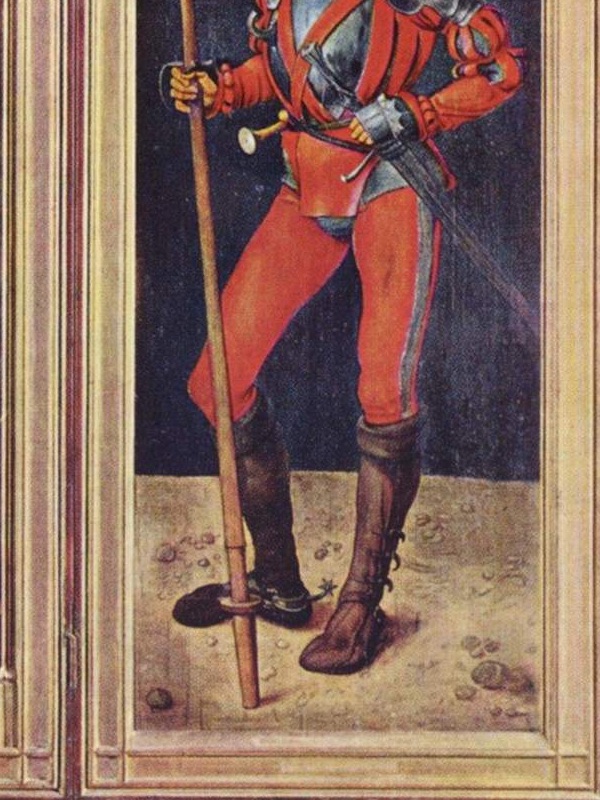
A tall riding boot with fold fastening, excerpt from the Paumgartner Altarpiece (1500).
Instep Strap Fastening on Open Shoes
This type of fastening is found on low, open shoes from the 14th to the 16th century. It is characterised by a strap that runs across the instep and is fastened with a button, buckle, or tied in a knot.
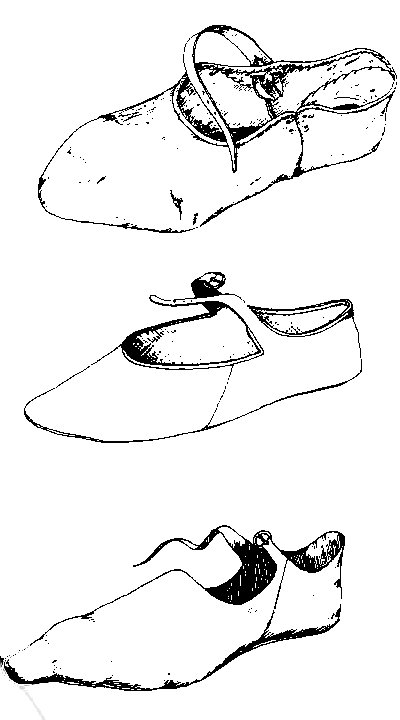
Three examples of shoes with an instep strap fastened with a buckle from the 15th century.
Top: Dordrecht, Netherlands. (Goubitz, 2001)
Middle: Schleswig, Germany. (Schnack, 1992)
Bottom: London, England. (Grew & De Neergaard, 1988)
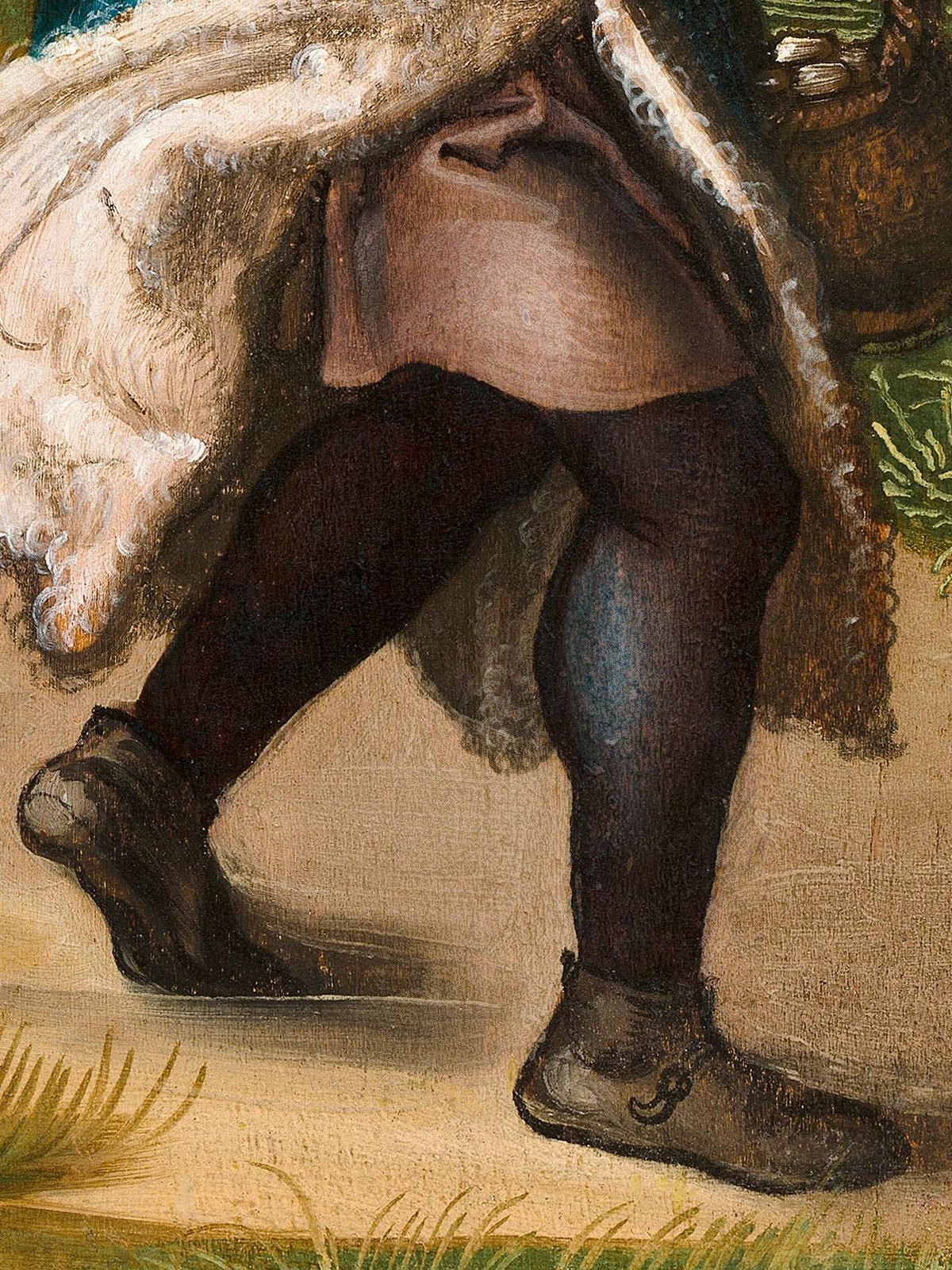
This ankle boot does not exactly correspond to the described type, as it is not an open shoe, but the principle of fastening with an instep strap with a buckle is clearly visible here. The excerpt comes from Albrecht Dürer's painting Lot and His Daughters (1496-1499).
Side Lacing
This type has a slit on the side of the shoe, which is laced using a cord or leather strap. It is found on low and ankle-height shoes from the 13th to the 15th century. It can be combined with instep strap fastening.
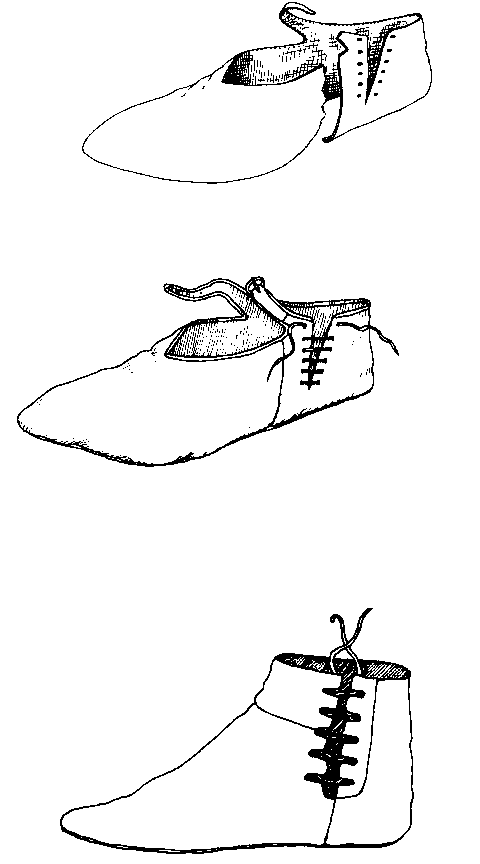
Top: Dordrecht, Netherlands. A very unusual model with side lacing and an instep strap with a buckle. Late Middle Ages. (Goubitz)
Bottom: Oslo, Norway. A boot with lacing loops. Late Middle Ages. (Schia, 1977)
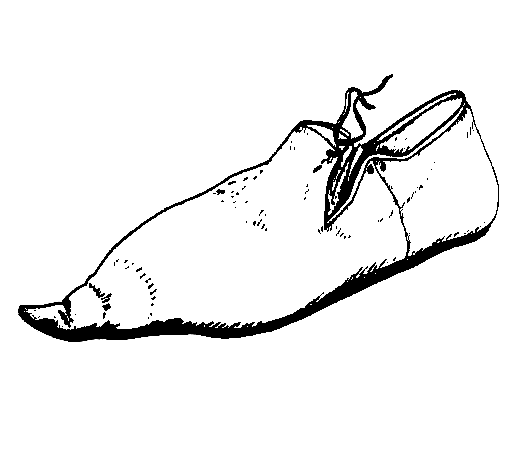
Oud-Turnhout, Belgium. A shoe with diagonal side lacing. 15th century. (Goubitz)
A shoe with side lacing in an excerpt from the Richental Chronicle (1470-1480).
Laces
This type of footwear has one, two or three pairs of holes on the front, through which a lace was threaded, similarly to a doublet. Some pieces, however, may have been laced with a single long lace, which is similar to modern footwear. The finds are generally dated between 1350 and 1530.
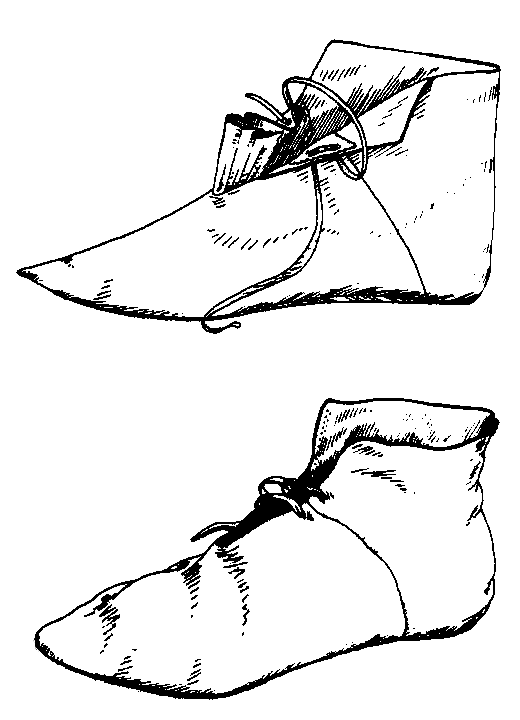
Top: Dordrecht, Netherlands. A boot with a tongue, through which laces pass on both sides. 14th century. (Goubitz)
Bottom: Delft, Netherlands. A boot with two side seams and one rear seam. The tongue is missing. 15th century. (Goubitz)
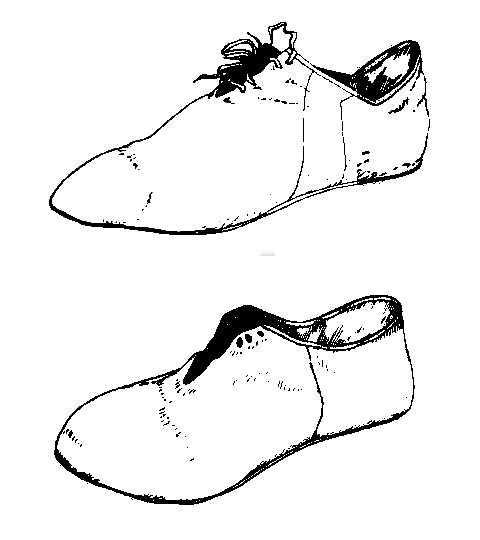
Top: Dordrecht, Netherlands. A shoe with pairs of laces. Late Middle Ages. (Goubitz)
Bottom: Dordrecht, Netherlands. A shoe with three pairs of holes for a single through-lace, as we know it today. Late Middle Ages. (Goubitz)
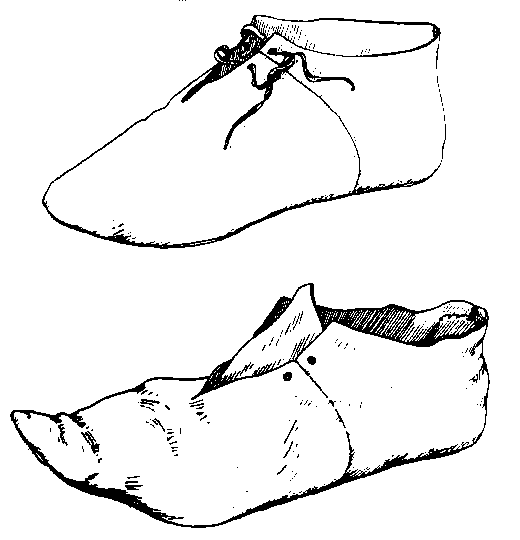
Top: Tiel, Netherlands. An ankle boot with curved side seams. Late Middle Ages. (Goubitz)
Bottom: Delft, Netherlands. A shoe with a fashionable pointed toe and a diagonal heel seam. Late Middle Ages. (Goubitz)
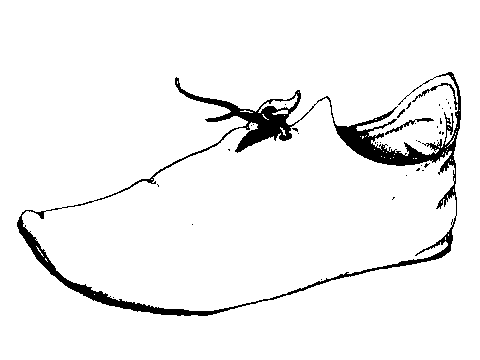
Bolsward, Netherlands. A fashionably cut shoe with one pair of lace holes. Late Middle Ages. (Goubitz)
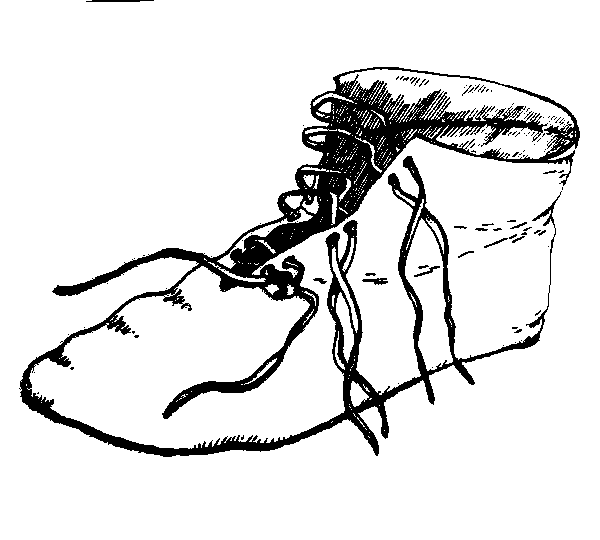
Leiden, Netherlands. A boot with laces tied in pairs, similarly to doublets. 15th century. (Goubitz)
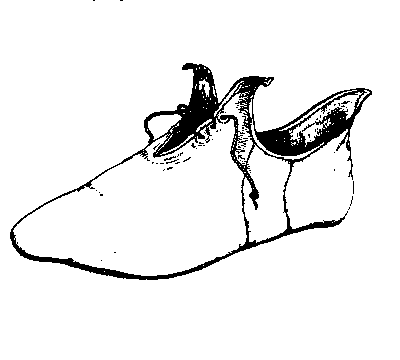
Dokkum, Netherlands. A very fashionably cut shoe with three pairs of lace holes. Late Middle Ages. (Goubitz)
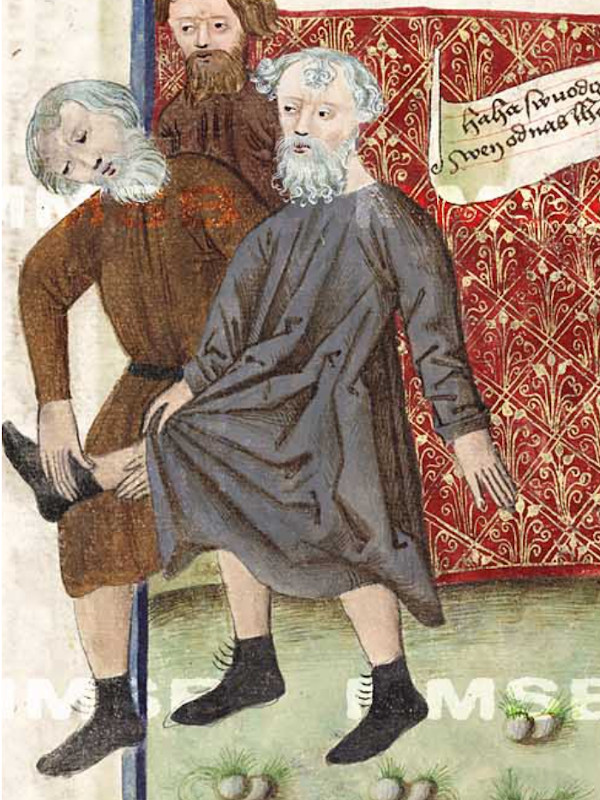
An ankle boot with lace fastening or toggle buttons, excerpt from the Codex of Jena (1490-1510).
An ankle boot with lace fastening or toggle buttons, excerpt from the Codex of Jena (1490-1510).
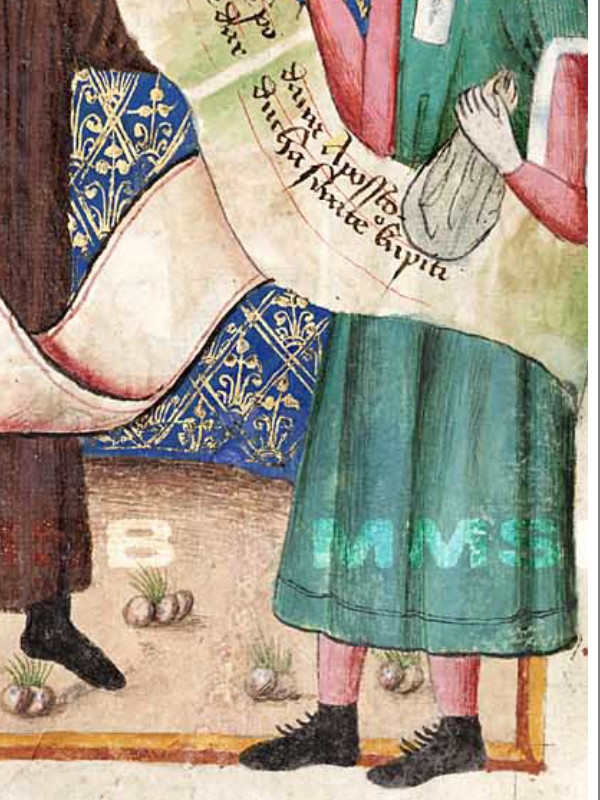
An ankle boot with lace fastening or toggle buttons, excerpt from the Codex of Jena (1490-1510).
Reconstruction
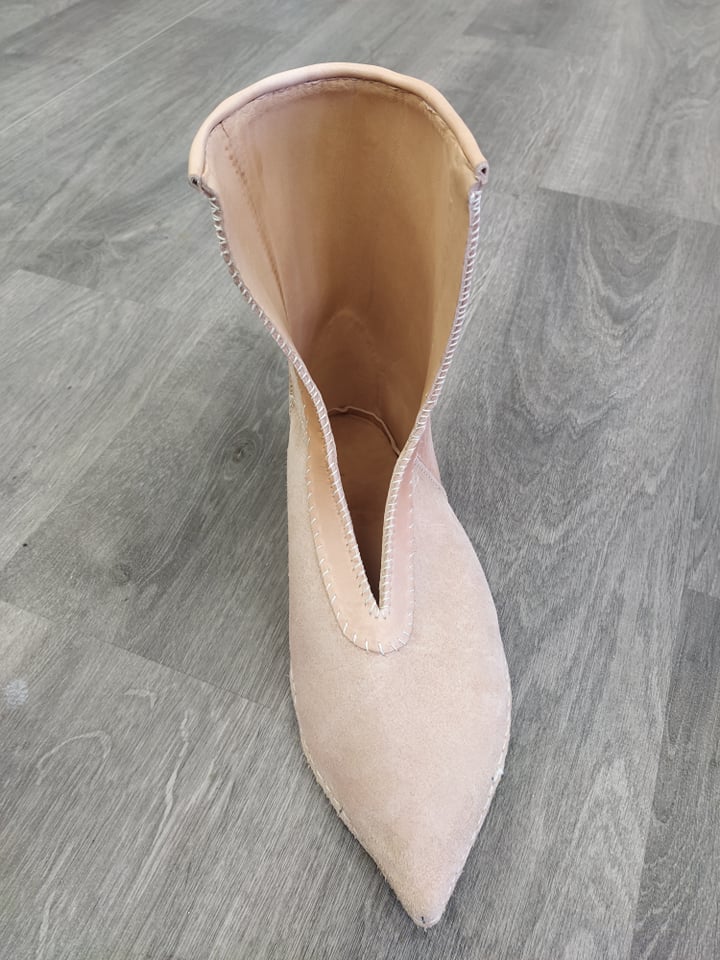
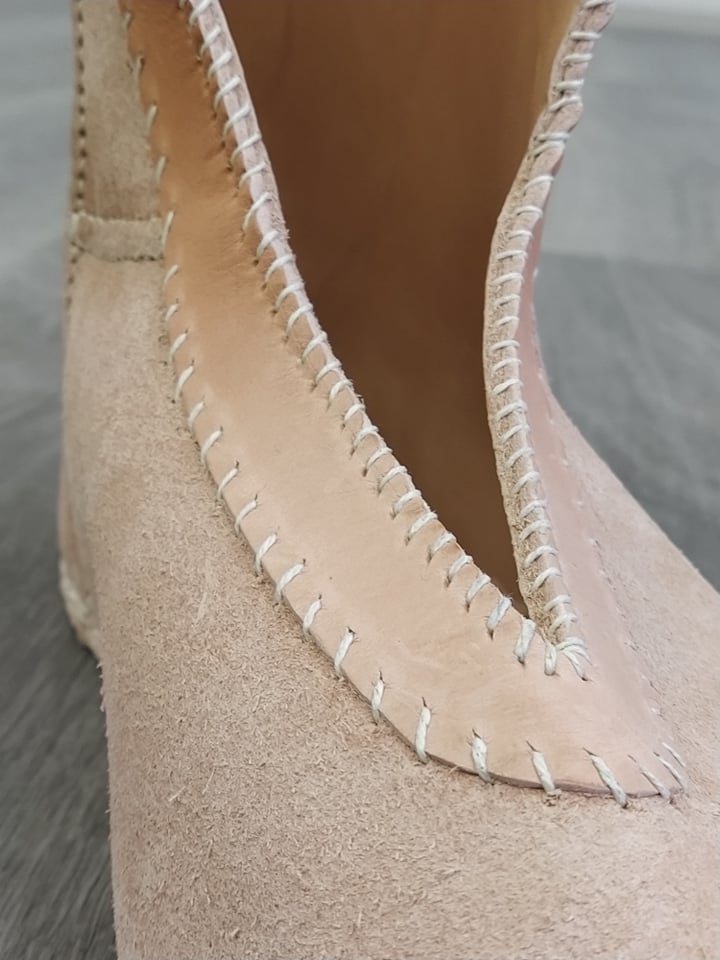
For the reconstruction, ankle boots with a single-lace fastening were chosen, similar to modern shoes, because the requirement was for a robust boot that the owner could wear with plate leg armour (i.e. the part from the ankle upward would be covered by the plate greave) and at the same time undertake long marches in. This type of boot is widely represented in Czech period depictions, see below.
What an ordinary Bohemian shoemaker had to be able to do is stated by the earliest surviving description of a masterpiece, the guild ordinance of the Pardubice shoemakers of 17 December 1515: the candidate “aby vokázal nejprv škorni příční, druhú škorni telecí, od té škorně střevíc zadní, a k tomu také punčoch veliký” (is to show first a příčná boot, secondly a calfskin boot, from that boot a rear shoe, and also a large punčoch) – that is, two kinds of high boots, a low shoe and a leather legging. For that he paid “čtyři groše bílé a libru vosku” (four white groschen and a pound of wax) and laid on a meal for the guild “každý podle svěj možnosti” (each according to his means).
The coin maker. The type of fastening cannot be determined here, but it is evident that the footwear is ankle-height. Excerpt from the fresco in the Mintmaster's Chapel of St. Barbara's Cathedral in Kutná Hora (1460-1470).
The scribe wears dark ankle boots. The type of fastening cannot be determined. Excerpt from the Brno Legal Book of Václav of Jihlava (1446).
An ankle boot with lace fastening or toggle buttons, excerpt from the Codex of Jena (1490-1510).
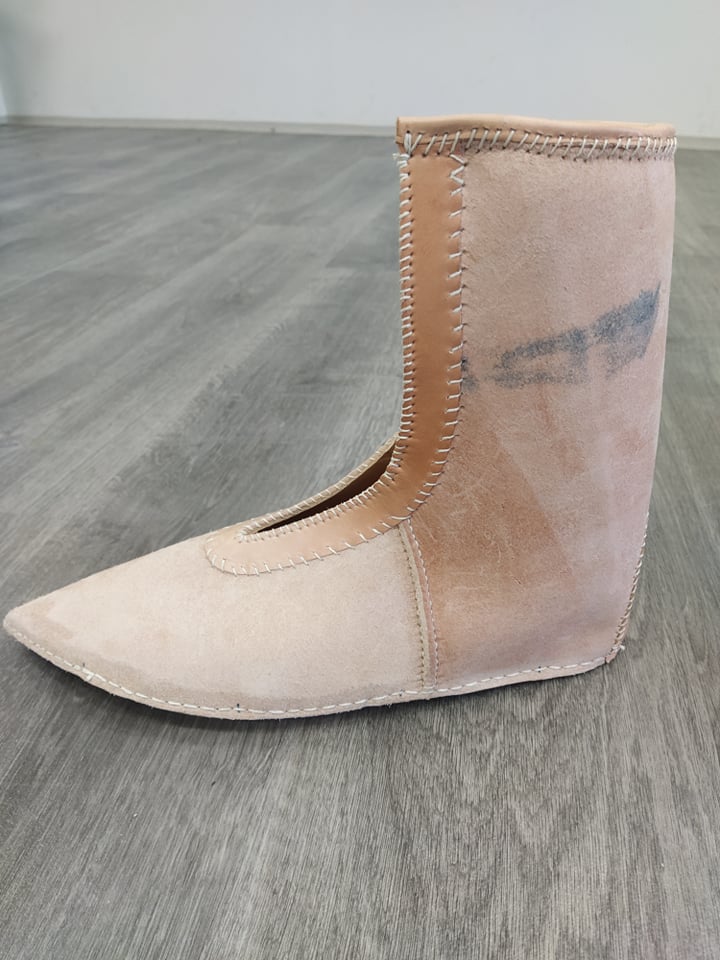
In the construction of the replica, all elements that were used in the construction of shoes in the 15th century were applied, i.e. a binding, a welt and a heel stiffener. The shoe is hand-sewn and subsequently turned so that all stitches are hidden inside. The reconstruction was made by Josef „Halflung“ Novák.
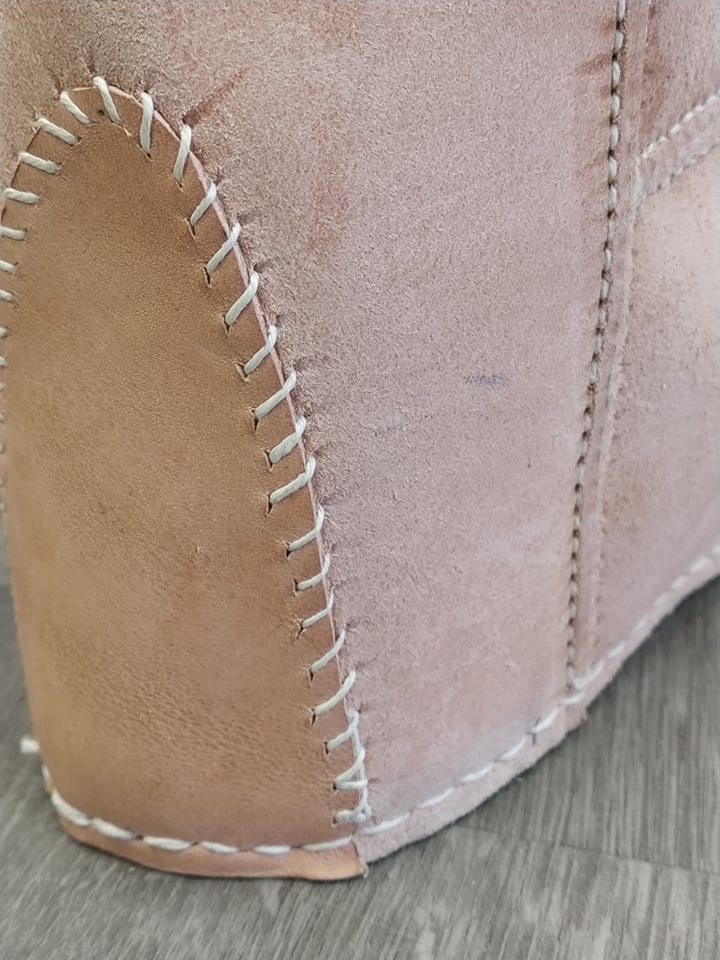
The sewn-on heel stiffener
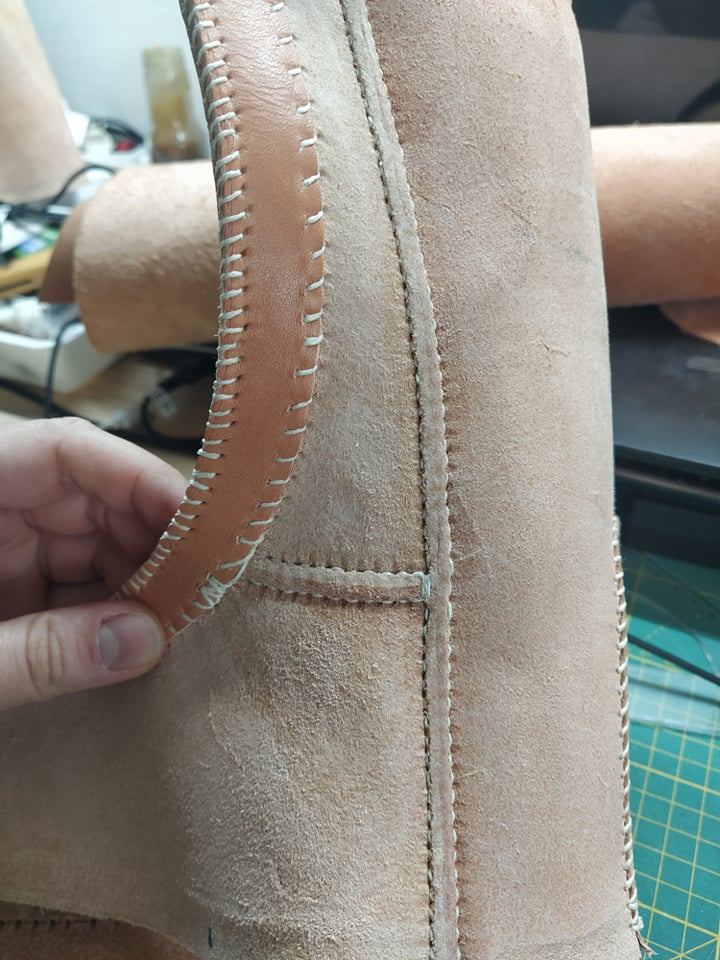
The sewn-on binding
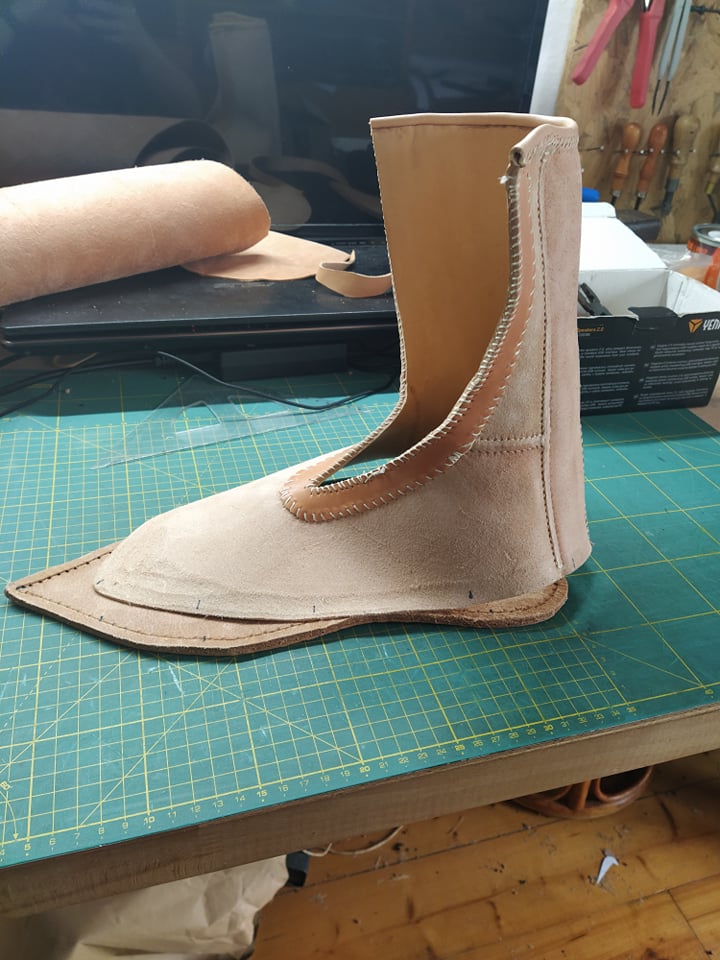
The upper and sole are prepared for sewing
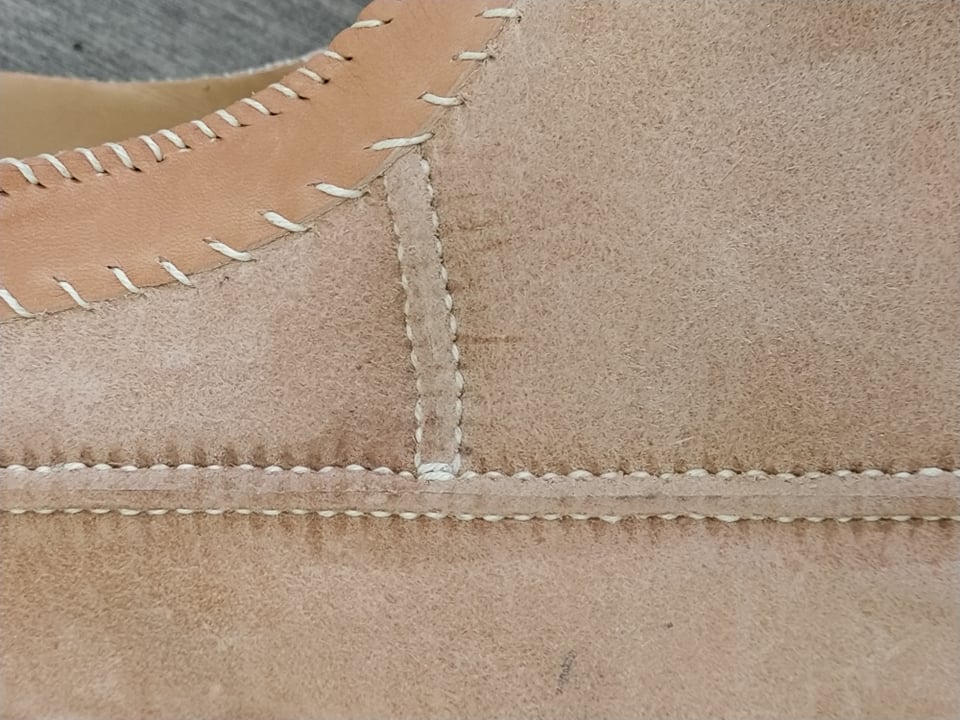
Sewing the upper parts of the boot
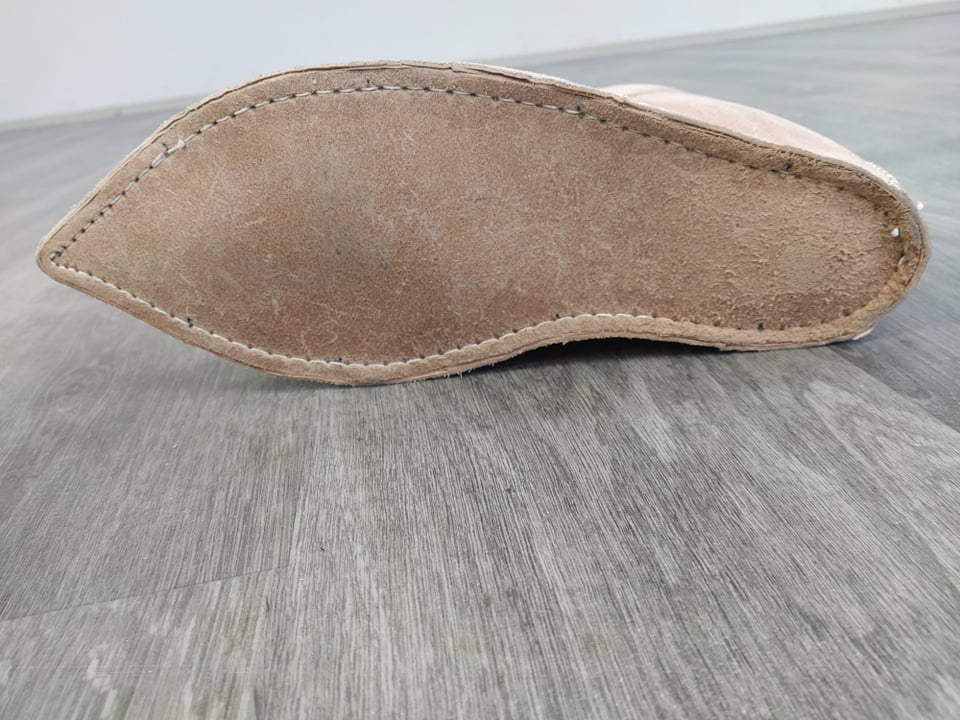
Sewing the sole to the upper
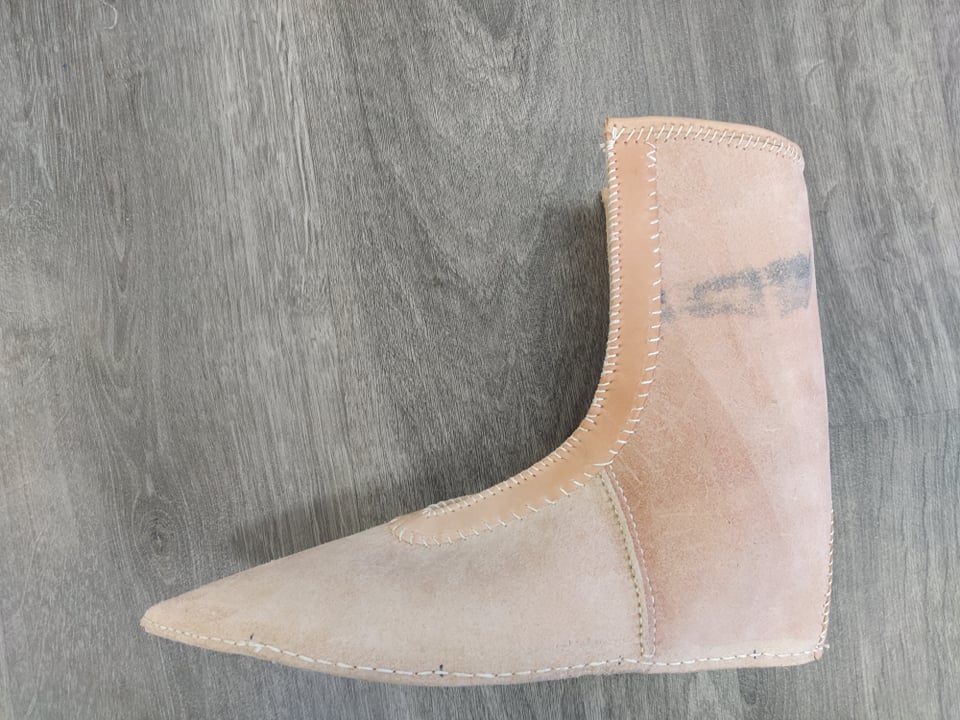
The completely sewn boot
Toggle Buttons
In this type, the fastening slit is at the front on the instep. On one side there are so-called toggle buttons. These are created by tying a knot in a leather lace. This knot then serves as a button and is threaded through the opposing holes. This type of fastening was used in the 14th and 15th centuries and reached its peak between 1350 and 1450.
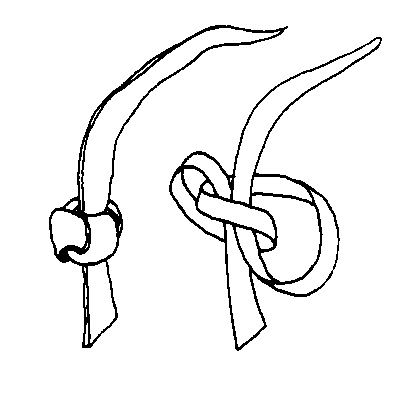
Construction of a toggle button. (Goubitz)
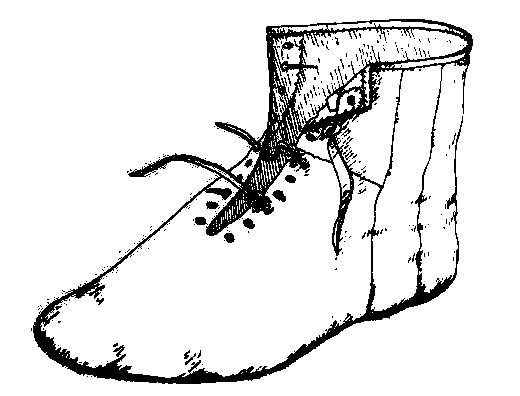
Dordrecht, Netherlands. An ankle boot in which the lace fastening was replaced by three toggle buttons. 14th–15th century. (Goubitz)

Dordrecht, Netherlands. An ankle boot. 14th–15th century. (Goubitz)
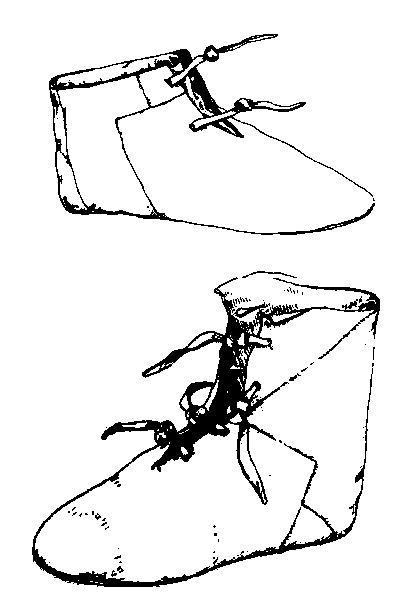
Top: Ghent, Belgium. A boot with two toggle buttons and a tongue. 14th–15th century. (Goubitz)
Bottom: Dordrecht, Netherlands. A children's boot with four toggle buttons. 14th–15th century. (Goubitz)
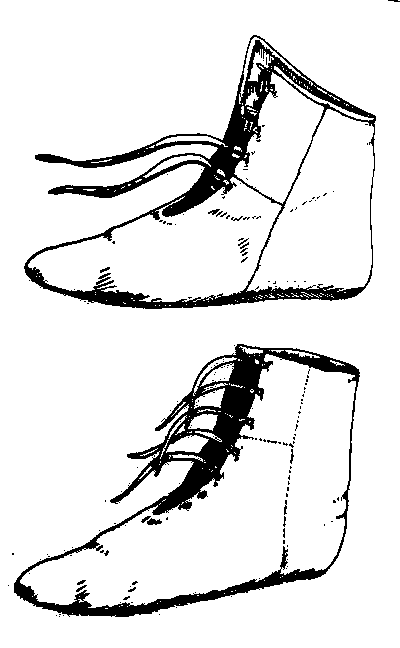
Top: Dordrecht, Netherlands. A boot with two toggle buttons and two rolled buttons. 14th–15th century. (Goubitz)
Bottom: A boot with combined fastening — the first two holes on the instep are tied with a lace, the rest fastened with toggle buttons. 14th–15th century. (Goubitz)
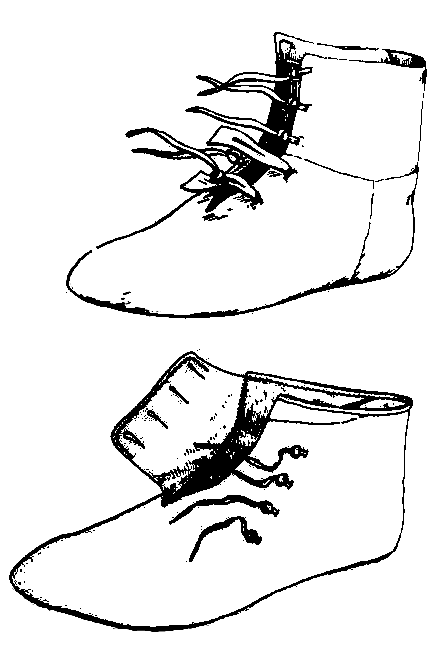
Top: Dordrecht, Netherlands. A boot with straps, one end of which is tied into a toggle button and the other end has a hole for fastening this button. 14th–15th century. (Goubitz)
Bottom: Nijkerk, Netherlands. A boot with a flap fastened with toggle buttons. 14th–15th century. (Goubitz)
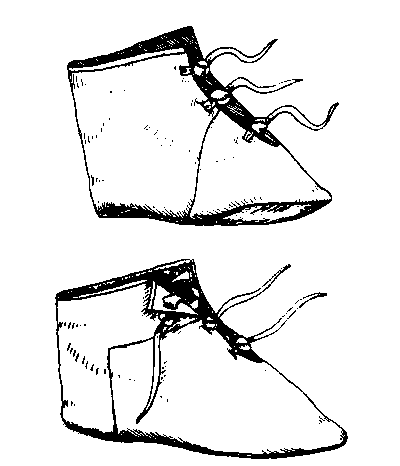
Dordrecht, Netherlands. Children's shoes from the 14th–15th century. (Goubitz)
Top: A child's shoe.
Bottom: A toddler's shoe.
Flap Fastening
It is principally the same as the overlap fastening described above, but the flap is not an integral part of the shoe; rather, it is sewn on additionally. This type of fastening is most commonly found on footwear from the 14th and 15th centuries.

Nijkerk, Netherlands. A boot with a flap fastened with toggle buttons. 14th–15th century. (Goubitz)
Collar Shoes
These shoes have a leather collar instead of a binding. After putting the shoe on, the collar is folded down, which slightly closes the shoe around the ankle. This type of shoe was popular at the turn of the 15th and 16th centuries.
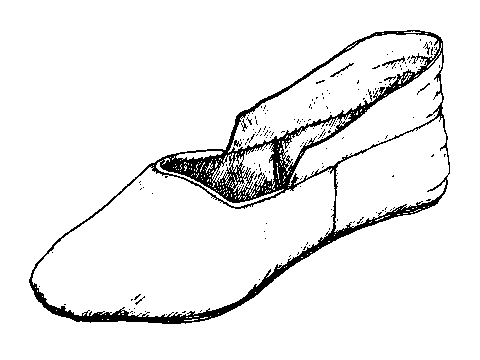
Edam, Netherlands. A shoe with a collar. Around 1480. (Van Heeringen & Meffert 1996)
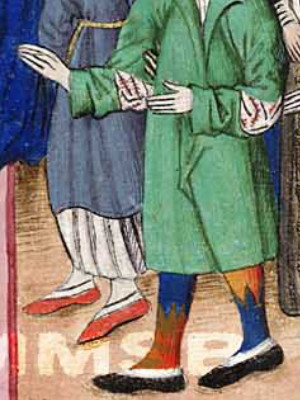
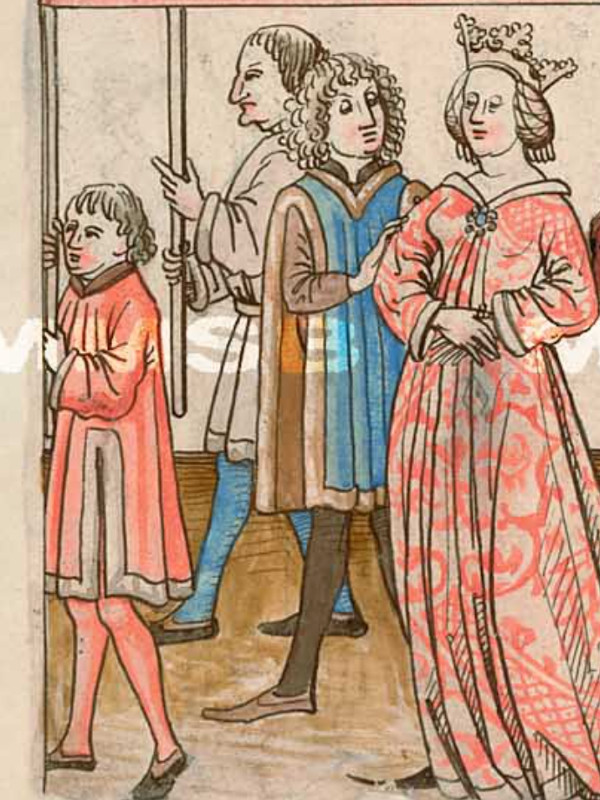
Collar shoes, excerpt from the Codex of Jena (1490-1510).
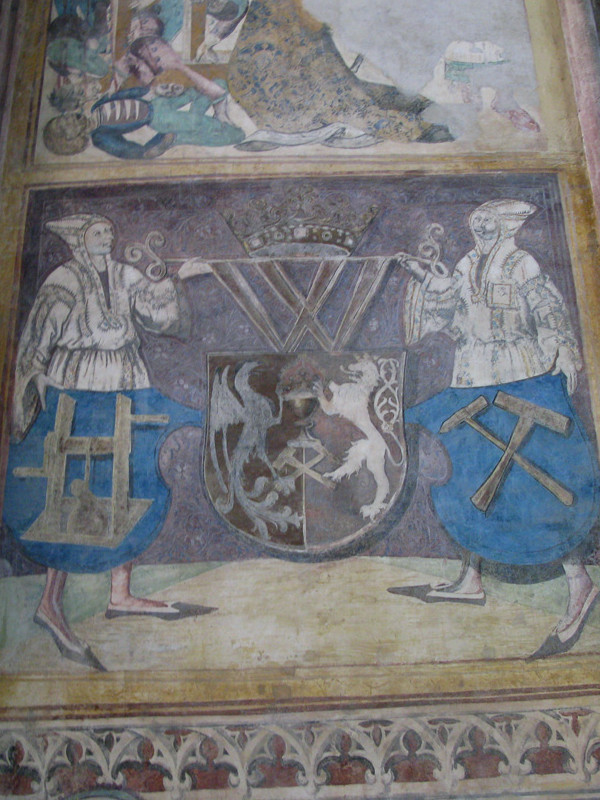
Collar shoes, fresco in the Hašplíř Chapel of St. Barbara's Cathedral in Kutná Hora. (late 15th century)
Collar shoes in an excerpt from the Richental Chronicle (1470-1480).
Strap Fastening
A very archaic type of fastening, where the foot above the ankle was wrapped all around with one or more straps. This type can be divided into two subtypes:
- The strap wrapping around the foot runs horizontally and is threaded through several pairs of vertical slits made directly in the upper of the shoe. Used primarily between 600 and 1000 AD.
- The strap wrapping around the foot runs horizontally and is threaded through loops that are created by threading another strap vertically through pairs of horizontal slits in the upper of the shoe. Used primarily between 1000 and 1300 AD.
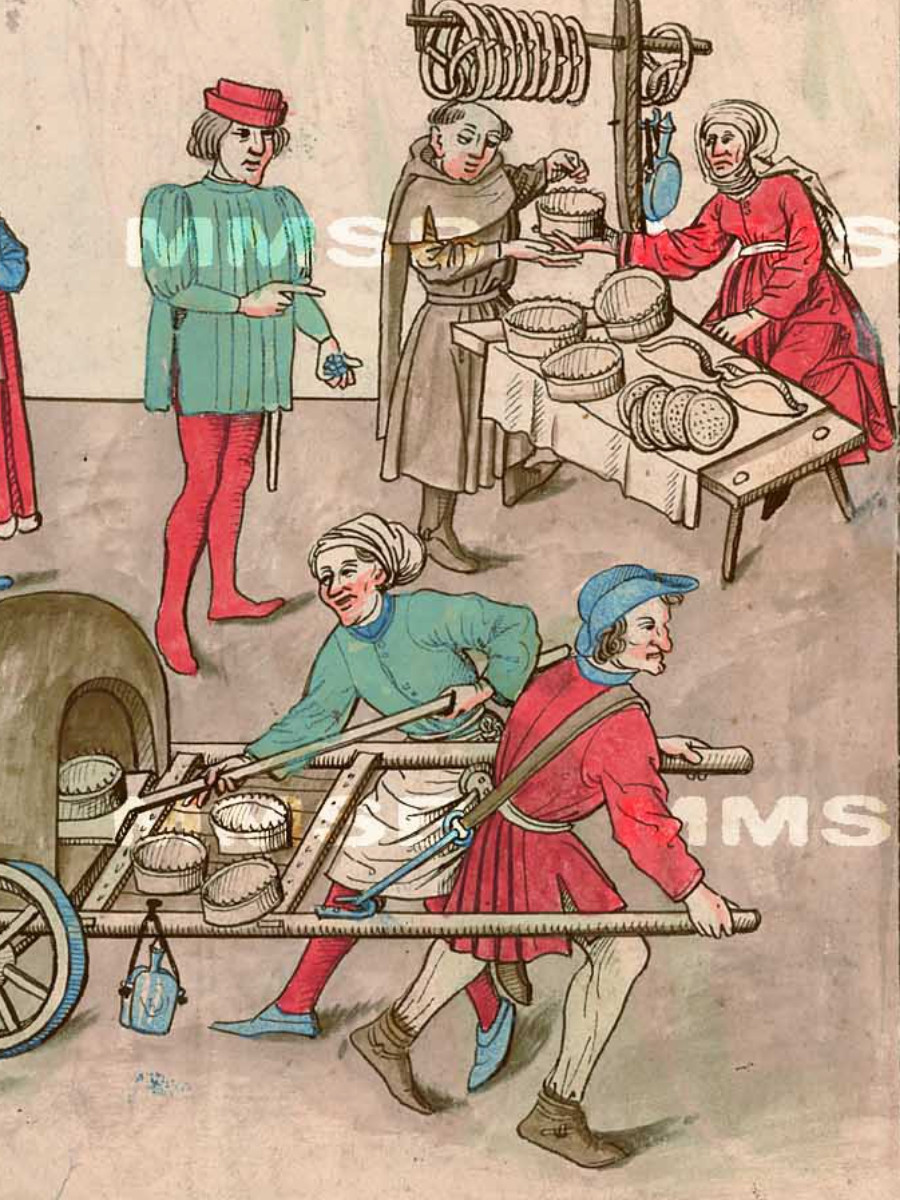
Several types of footwear. From foreground to background:
- Boots with strap fastening wrapped above the ankles.
- Shoes with a fold-down collar.
- Hose with a leather sole.
- Tall riding boots with fold fastening.
Headwear
Hood
Kápě, kapicě, kapicze derives, just like čepice (cap), from the Medieval Latin word capa, cappa. It was also called kukla or kuklička, which originated from the Latin cucalla, and in written sources it is further referred to as capucium, chuchla, cucala, capye. The hood could be worn in various ways — normally on the shoulders, where it could be complemented by a hat or a helmet, or it could be placed on the head with the face opening turned up, worn like a cap. For post-Hussite Bohemia, we can trace three main types of hoods: with a tail, without a tail, and a tasseled hood, which was also popular in German lands.
Hood with a Tail
These hoods were popular especially before the Hussite Wars, as can be seen in the Gelnhausen Codex (1400–1408) or the Olomouc Bible (1417). Given that a longer tail is primarily seen on luxuriously dressed individuals, it may have represented the good standing of its owner. This would also correspond to the event recorded in the chronicle of Vavřinec of Březová, when the Taborites cut the long tails of hoods belonging to Prague craftsmen and burghers, which thus symbolized the intemperance and luxury they condemned. Likewise, in the Codex of Jena (1490–1510), a priest is depicted in a magnificent fur coat, with many rings and shoes with long pointed toes, wearing a hood with a long, massive tail.
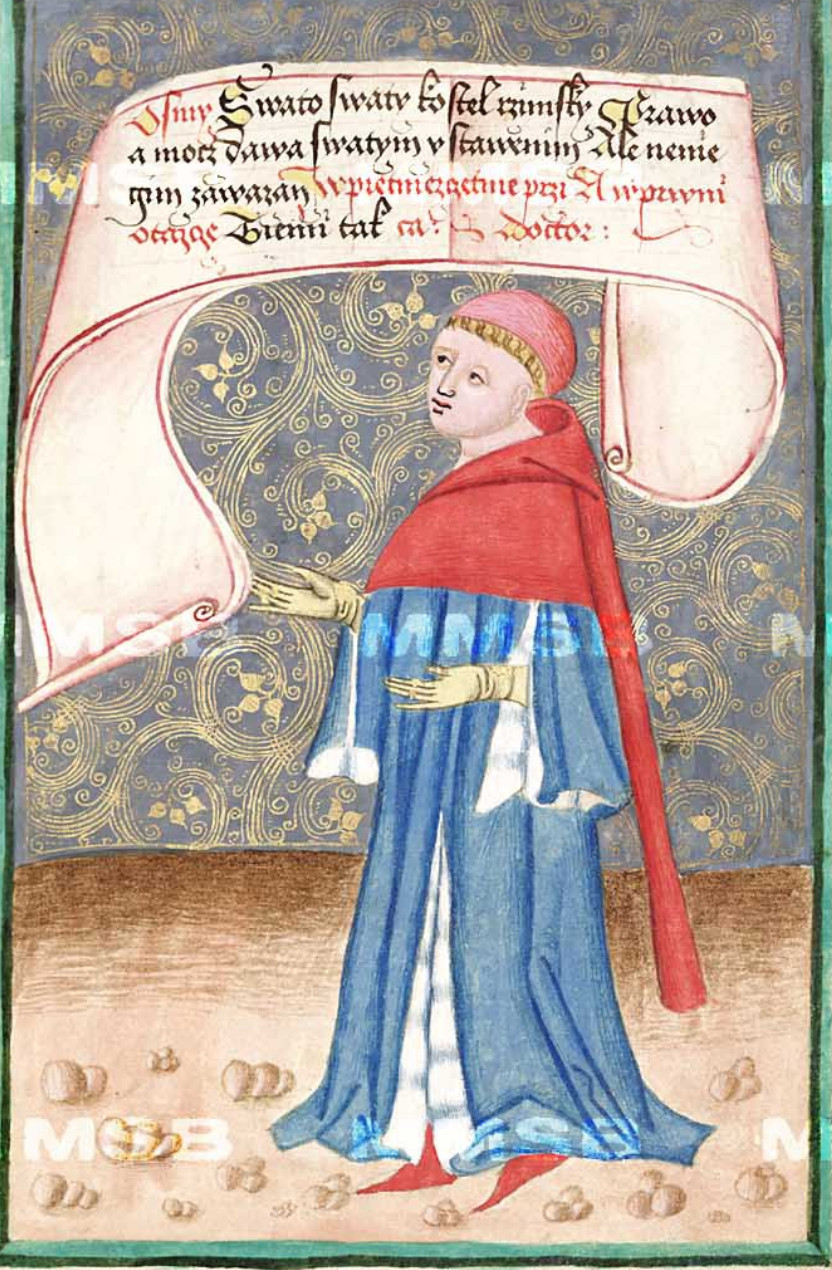
A priest in a hood with a massive tail. Excerpt from the Codex of Jena (1490-1510).

A hood with a tail placed on the head through the face opening. Excerpt from the Codex of Jena (1490-1510).
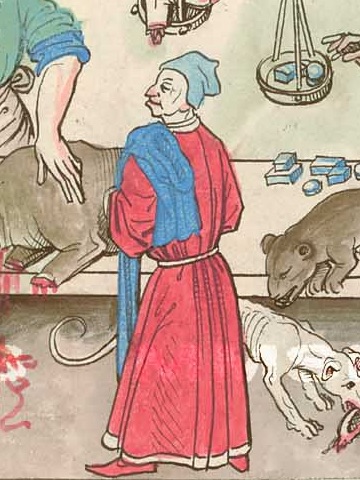
A hood with a tail draped over the shoulder. Excerpt from the Richental Chronicle (1470-1480).
Hood without a Tail
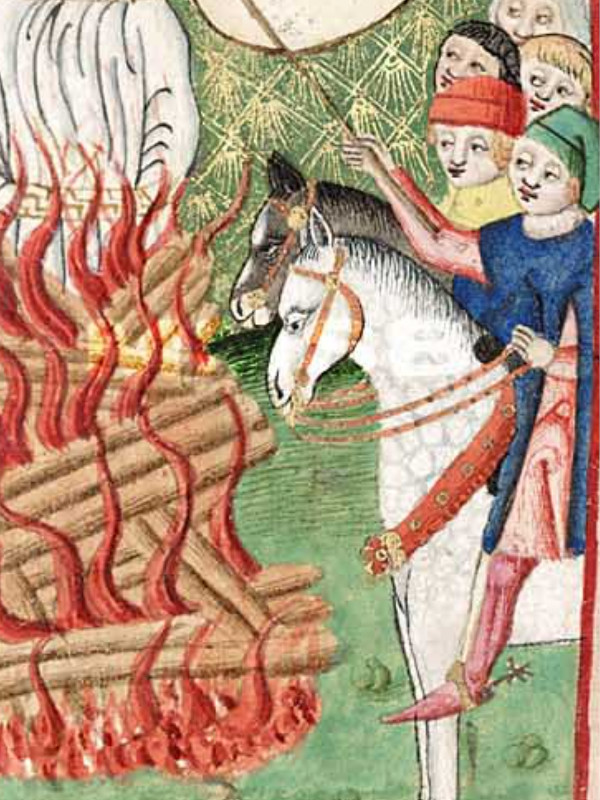
The simple hood without a tail was the most widespread type of hood in post-Hussite Bohemia. It could be worn under a helmet or together with a hat. One such “kuklu modrou, kterou míval do vojny” (blue hood, which he used to take to war) was left behind by Zikmund Jirconis of Poříč in 1455. There are very many depictions of these hoods from both Czech and German sources.
Simple hoods can be seen on Jan Žižka at the head of the army and on the standard-bearer in the depiction from the Codex of Jena. Jan Žižka's hood is complemented with a hat.
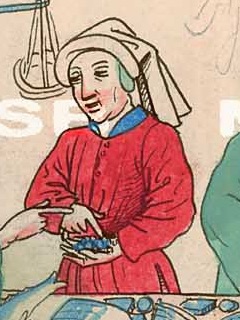
A simple hood placed on the head through the face opening in an excerpt from the Richental Chronicle (1470-1480).
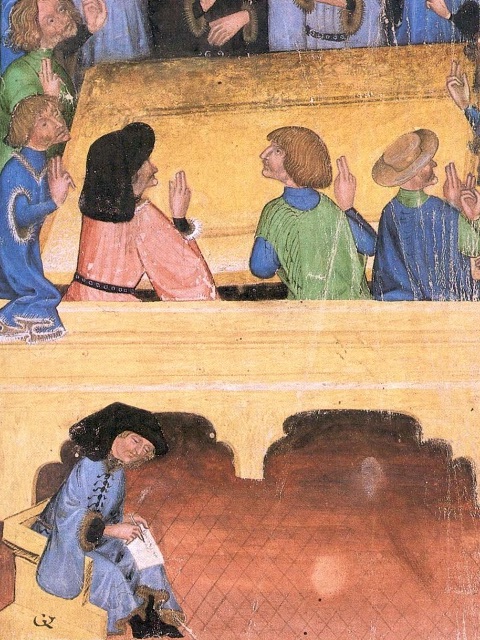
Simple black hoods placed on the head through the face opening are worn by one of the councillors and the scribe in the excerpt from the Memorial Book of Olomouc (1430-1492).
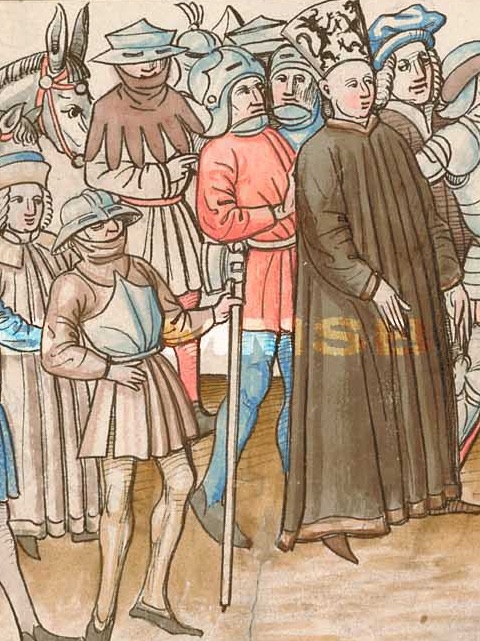
Two of the armed men leading Jan Hus to the stake wear hoods without tails under their iron hats. The soldier in front has a very small hood, while the soldier behind has one with decorative scalloping. Excerpt from the Richental Chronicle (1470-1480).
Tasseled Hood
This type was popular in German lands, including Bohemia at that time. It could also be worn under a helmet, as shown in drawings and paintings by the famous painter Albrecht Dürer (1471–1528). At the neck, it could be fastened with buttons to achieve a more anatomical shape. Its tassels could also be decoratively cut, as can be seen, for example, in the portrait of the Kutná Hora mint master Hans Harsdorfer from 1484. It is worth noting that Albrecht Dürer and Hans Harsdorfer were friends.
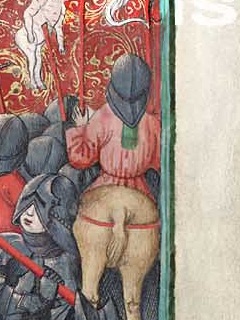
A tasseled hood worn by a light cavalryman. These hoods are frequently encountered in German depictions of light horsemen. Excerpt from the Codex of Jena (1490-1510).
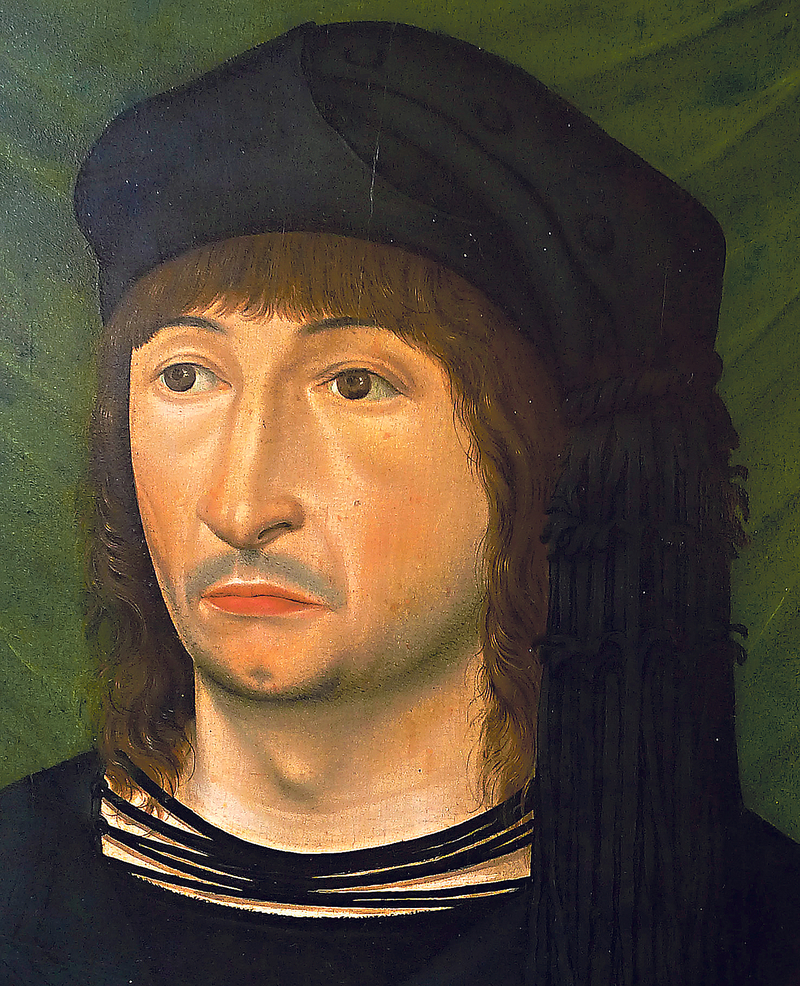
A luxurious hood with buttons and decoratively cut tassels, placed on the head through the face opening. Portrait of Hans Harsdorfer, Nuremberg, 1484.
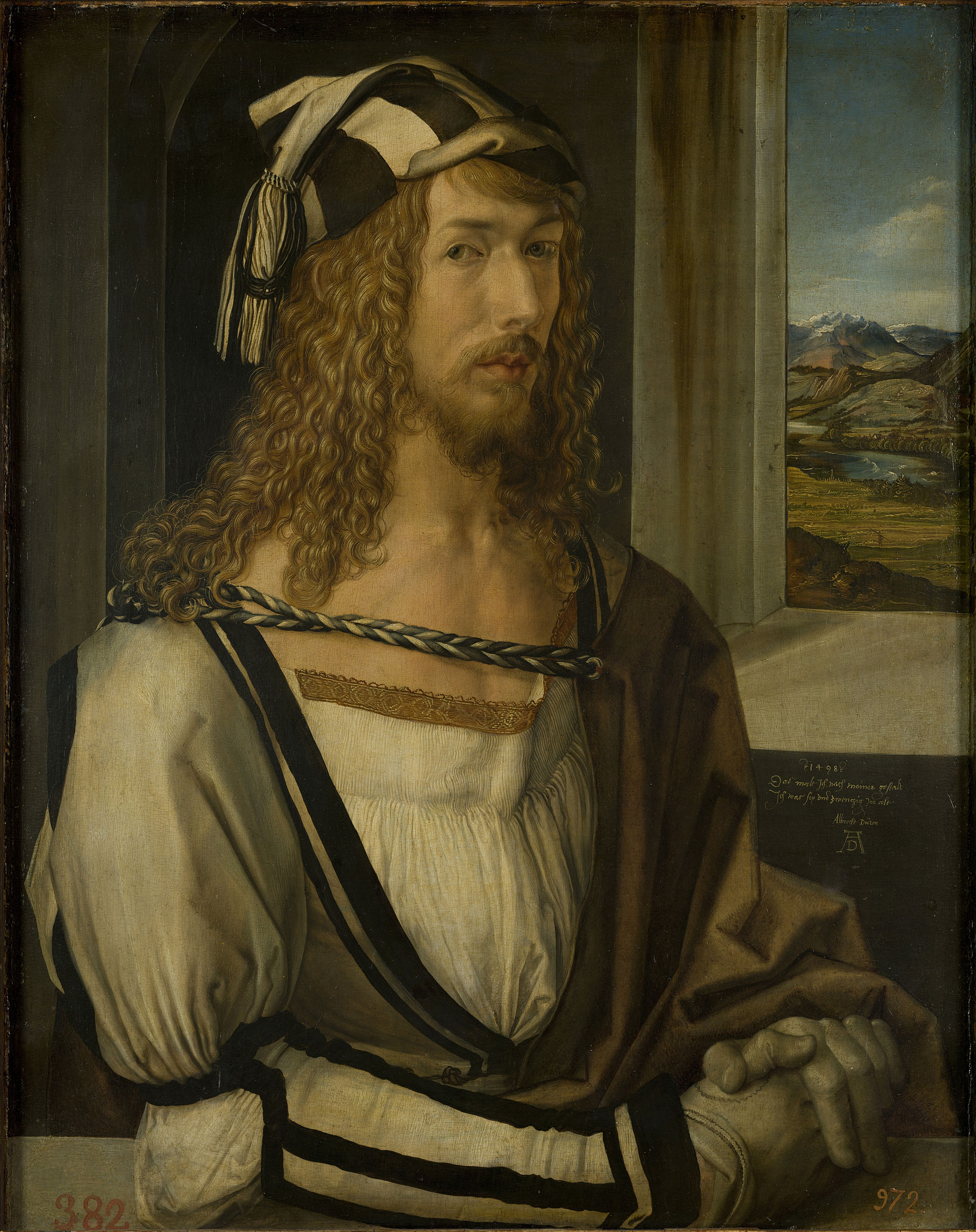
A tasseled hood placed on the head through the face opening in Albrecht Dürer's self-portrait from 1498.
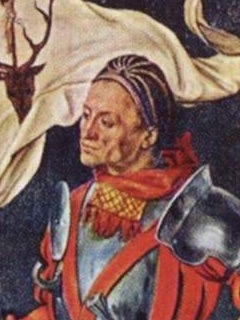
St. Eustace wears a decorative tasseled hood around his neck. Excerpt from the Paumgartner Altarpiece, 1500.
Hat
Klobúk, klouček, koblúček, kobek, kobek, klouček, koláče. Besides denoting headwear, the term also referred to a helmet. The most common shape was one where the crown naturally followed the head and the brim was bent or rolled upward. Depictions of such a hat can be found, for example, in the Krumlov Anthology (1420) as well as 70 years later in the Codex of Jena (1490–1510), and archaeologically confirmed by a find from Ireland. The crown could also be flattened, conically shaped, or pointed. Likewise, the brim could be variously shaped: flat and round, like contemporary hats, rolled up as mentioned above, bent upward with one or more slits, or completely absent. Unlike hoods, it seems that hats were often lined with different fabric or fur.
An independent hatmakers' guild was established in Prague's New Town on 2 April 1446. From their statutes, one can discern that they produced hats made of beaver fur and felt. From the confirmation of the hatmakers' guild articles in the Old Town on 11 August 1489, one can learn that besides beaver hats, a master also had to be able to produce a hare-fur hat “obú stranú vlasitý” (furry on both sides), a curly hat, and in addition to hats also cobbler's felt and a boot, presumably felted in the manner of valenki.
Hat with a Rounded Crown and Rolled Brim
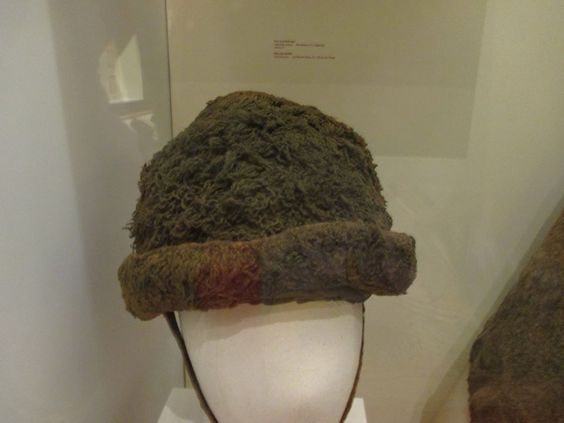
A hat find from Ireland, dated to the 14th–15th century.
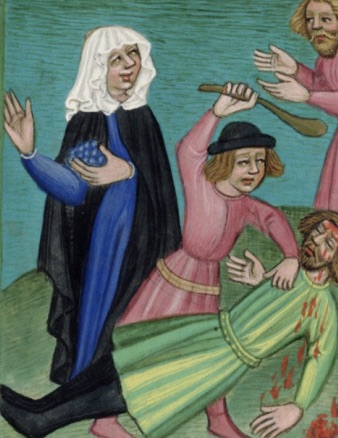
A hat with a rounded crown and rolled brim in the Krumlov Anthology, around 1420.
A hat with a rounded crown and rolled brim on the head of Jan Žižka, Codex of Jena (1490-1510).
A hat with a rounded crown and rolled brim. Excerpt from the Richental Chronicle (1470-1480).
A hat with a rounded crown and rolled brim, lined with fur. Excerpt from the Brno Legal Book of Václav of Jihlava (1446).
Meeting of the city council depicted in the initial from the Brno Legal Book of Václav of Jihlava (1446). On the councillors' heads, we can see hats with both rounded and flat crowns, lined with fur.
Hat with an Upturned Brim without Slits
Most of these hats have flat crowns in the iconography, though exceptions can be found, such as the one in the Codex of Jena, see image below.
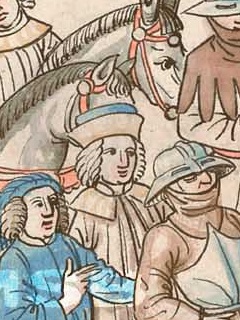
A hat with a flat crown and upturned brim without slits, excerpt from the Richental Chronicle (1470-1480).
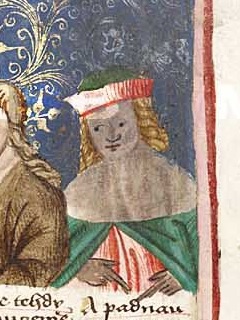
A hat with a rounded crown and upturned brim without slits, excerpt from the Codex of Jena (1490-1510).
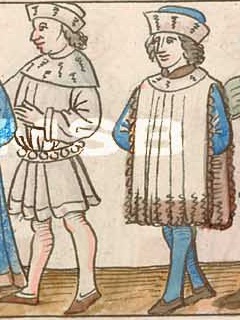
Hats with a flat crown and upturned brim without slits, lined with fur, excerpt from the Richental Chronicle (1470-1480).

A hat with a flat crown and upturned brim, lined with fur, excerpt from the Codex of Jena (1490-1510).
Hat with an Upturned Brim with Slits
It is worth noting that even when a hat has only one slit, this slit is never in the centre of the forehead, but rather to the side of the head.
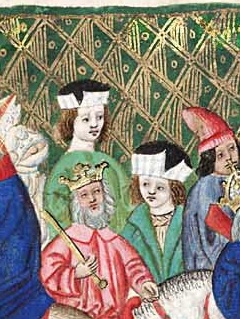
Fur-lined hats with an upturned brim with a single slit in an excerpt from the Codex of Jena (1490-1510).
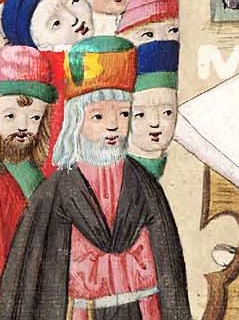
A hat with an upturned brim with two slits in an excerpt from the Codex of Jena (1490-1510).
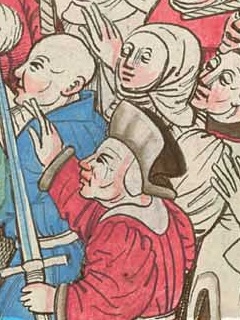
A hat with an upturned brim with two slits in an excerpt from the Richental Chronicle (1470-1480).
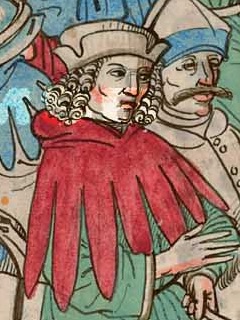
A hat with an upturned brim with multiple slits in an excerpt from the Richental Chronicle (1470-1480).
Other Types of Hats
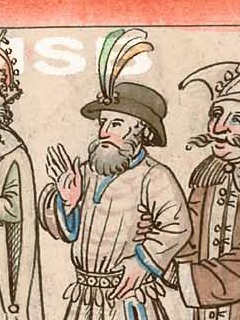
A hat with a slightly downturned brim, a jewel and a feather ornament in an excerpt from the Richental Chronicle (1470-1480).
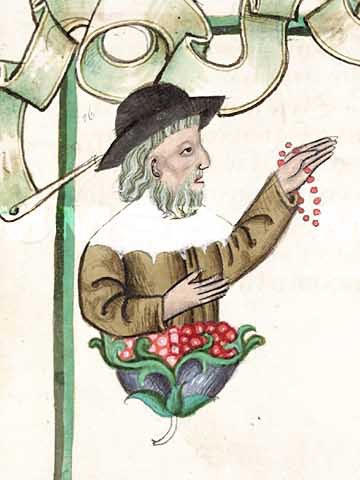
A hat with a slightly upturned brim in an excerpt from the Codex of Jena (1490-1510).
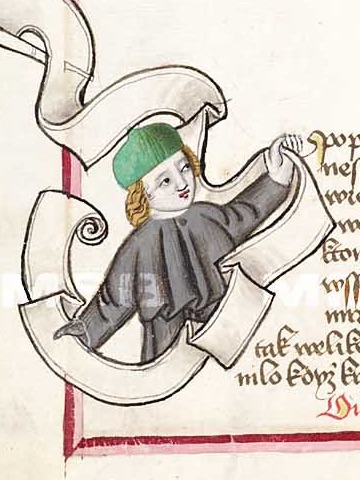
A hat without a brim in an excerpt from the Codex of Jena (1490-1510).
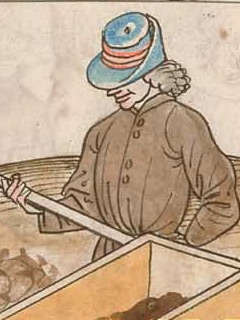
A hat with a flat crown and an upturned rear section of the brim, decorated with a ribbon. Excerpt from the Richental Chronicle (1470-1480).
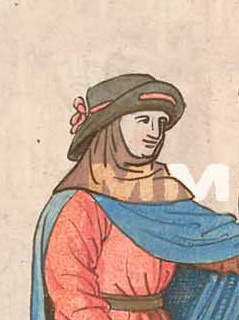
A hat with a flat crown and an upturned front section of the brim, held in position by a ribbon. Such hats very frequently appear in depictions of St. James, where they are additionally decorated with a St. James's scallop shell. Excerpt from the Richental Chronicle (1470-1480).
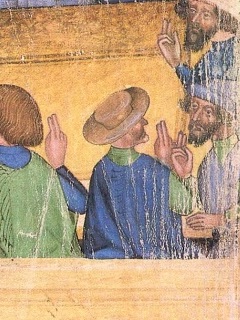
A hat with a flat crown and a flat brim in an excerpt from the Memorial Book of Olomouc (1430).
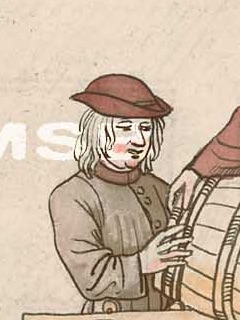
A hat in an excerpt from the Richental Chronicle (1470-1480).
Berets
One of the most common types of headwear was the beret, which constituted approximately a quarter of all headwear and is probably hidden under the period name čepice (cap).
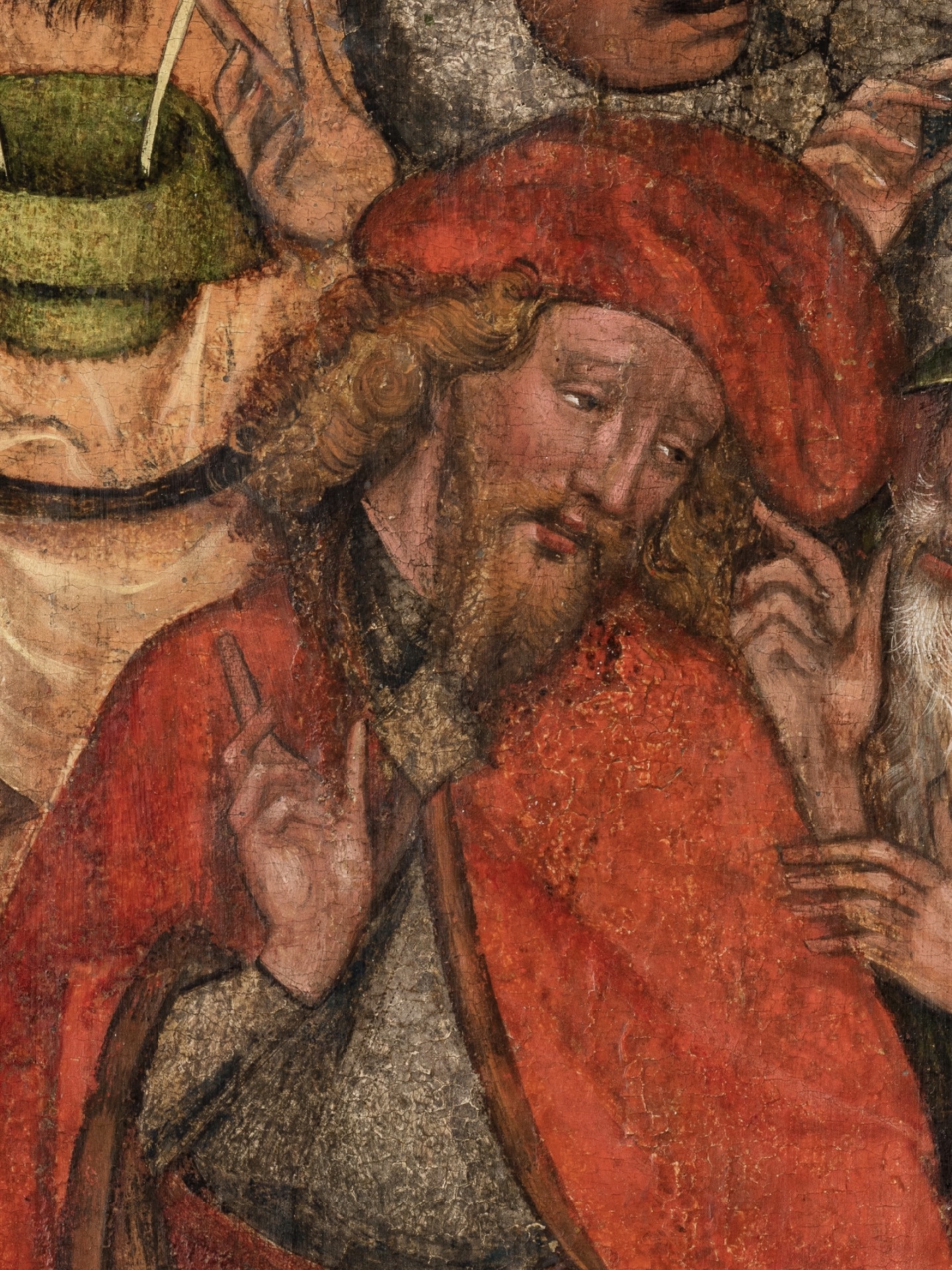
A man with a red beret in an excerpt from the Zátoň Altarpiece (after 1440).
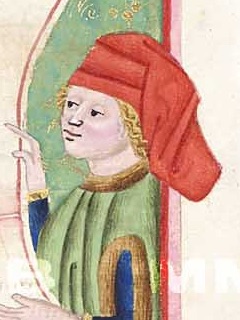
A man with a red beret in an excerpt from the Codex of Jena (1490-1510).
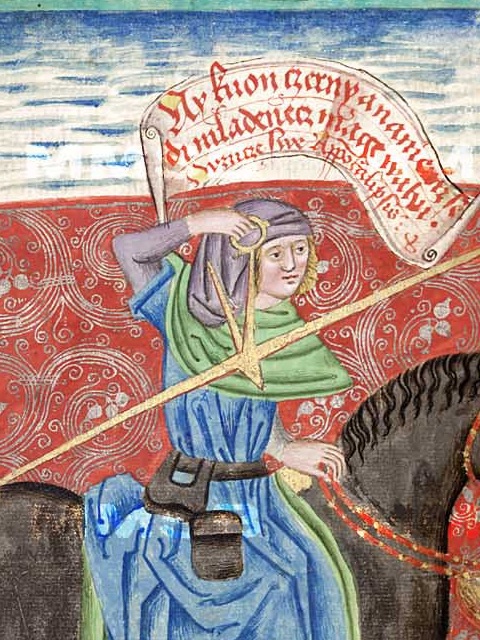
A merchant in a beret in an excerpt from the Codex of Jena (1490-1510).
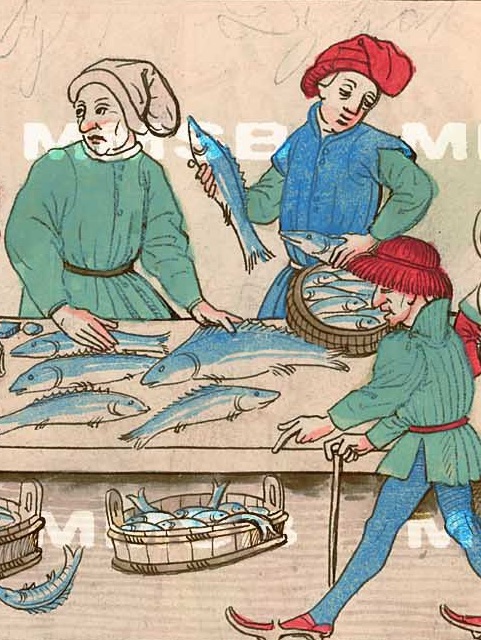
Two men with berets in an excerpt from the Richental Chronicle (1470-1480).
Sources:
If you enjoyed this article, please consider making a small financial contribution. Writing articles is very time consuming and we do it in our free time.
IBAN: CZ39 2010 0000 0028 0346 2929
BIC/SWIFT: FIOBCZPPXXX