


Doublet
In medieval Czech, the term kabát was used for doublet. This term has been used since the 14th century to denote a shorter and fitted garment and as a synonym for the German wams, jacke, schecke, or rock, the French pourpoint, rochet, roquette, or the English jacket, rocket and doublet, from the Italian giubbetta.
The words kabát, rock (waffenrock), doublet (arming doublet), and pourpoint also denoted a type of quilted garment, and in Czech, the first use of the word kabát at the turn of the 13th and 14th centuries is associated specifically with the term for a quilted garment in the Alexandreida and it remained at least throughout the entire 15th century, as we can read in the Very Nice Chronicle about Jan Žižka: “Tiem jest polniem vojskem vládl kněz Prokop Holý. Pak ten jest býval k bitvě na špici v tlustém kabátě.” (Thereby the field army was led by Priest Prokop the Holy. Then he used to be at the front in battle in a thick doublet.) It is a question whether the Czech word kabát originated from the Old German gewæte or is also derived from the Italian giubbetta.
Although doublets were used to attach hose earlier, as evident from the hose ties on the pourpoint of Charles de Blois, the combination of a doublet and attached hose became widely popular in Bohemia around the mid-15th century, making the doublet a functional part of clothing that straddles the line between undergarment and outerwear, which also corresponds to the establishment of a separate doubletmakers' guild in 1441. As hose gradually become pants and their waistline is raised, doublets also become shorter and by the end of the 15th century, they once again become a full-fledged outer garment. A brief outline of the evolution of the doublet can be seen in the following images.
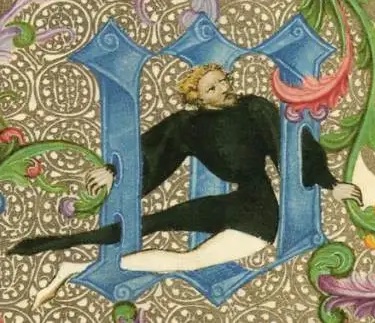
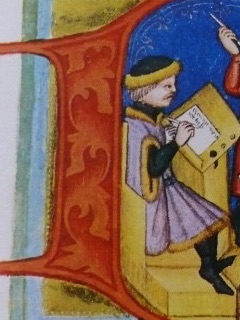
Early doublet with wide sleeves, worn as an outer garment, on a cut-out from the Bible of Wenceslaus IV (1389-1395).
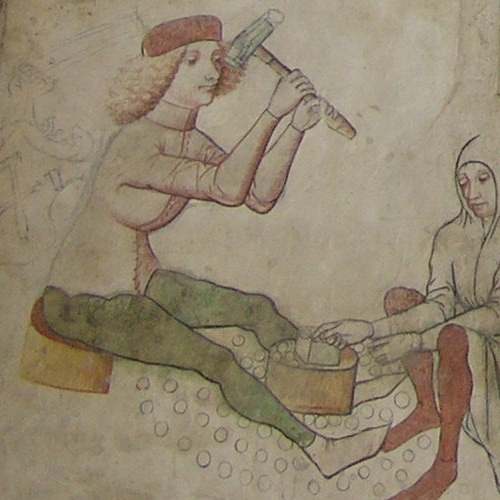
A coinmaker who is stripped down to just his hose and doublet when working. The second coinmaker in the same fresco is wearing a vestina-type skirt over his doublet. Cutout from a fresco in the Coinmakers' Chapel of the Cathedral of St. Barbara in Kutná Hora (1460-1470).
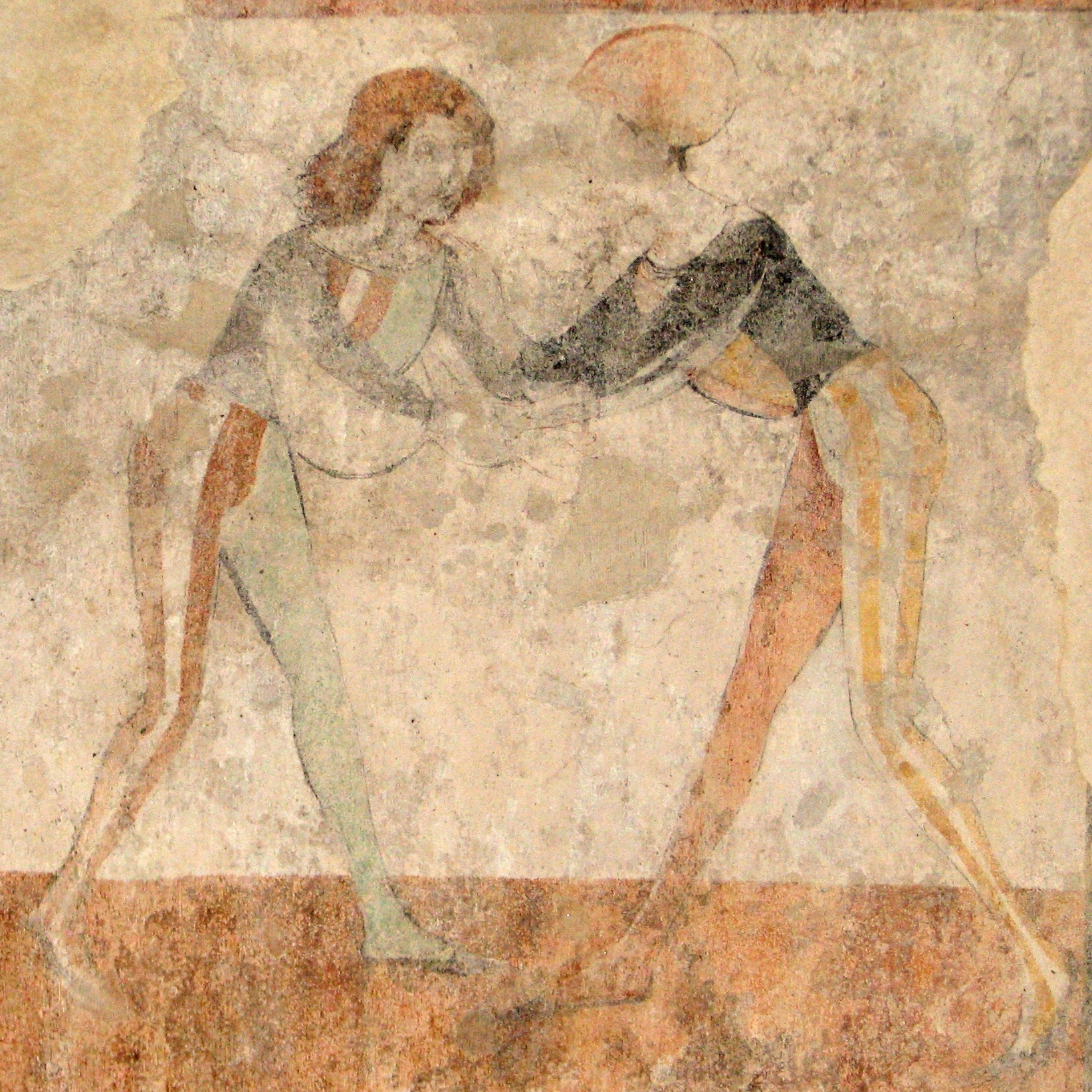
Wrestlers in short doublets of fashionable cut and colour on a fresco from the Red Bastion at Švihov Castle, around 1500.
As previously mentioned, during King George of Poděbrady's era, the doublet was somewhat of an intermediate stage between undergarment and outerwear, not only in Bohemia. Therefore, the body of the doublet could be made from cheaper, for example, undyed fabric. This is also reflected in the will of the kettle-maker Martin from what is now Spálená Street in Prague, who in 1477 left “dva rukávy aksamitové od kabáta” (two velvet sleeves from a doublet). Given that the doublet formed a single entity with hose, it was fashionable to have hose and a doublet, or at least their visible parts, in the same color, ideally contrasting with the outer skirt or cloak.
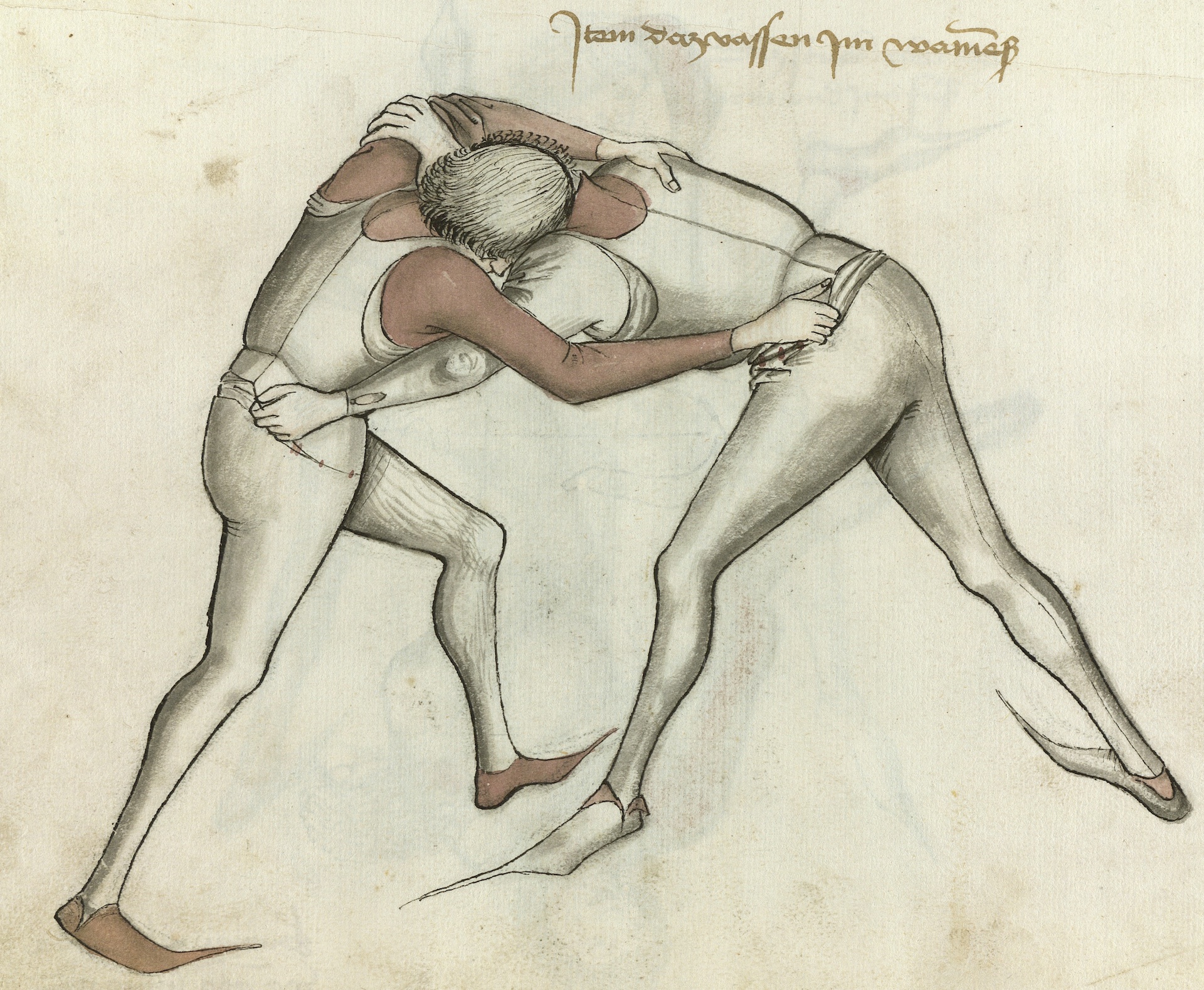
A doublet with undyed body on illumination from Hans Talhofer's fechtbuch, Germany, 1459.
A doublet and hose in the same (black) colour. Cutout from the Brno Law Book of Václav of Jihlava (1446).
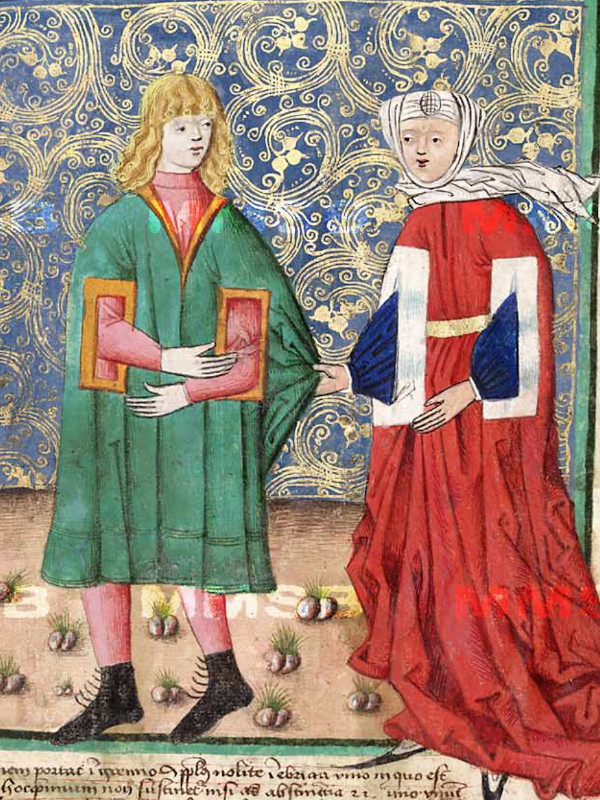
A doublet and hose in the same (red) colour. Cutout from the Codex of Jena (1490-1510).
The lack of Czech pictorial sources and the fact that during King George of Poděbrady's era the doublet was an intermediate layer between the undergarment and the outerwear greatly complicates research efforts. Nevertheless, some details and differences compared to other regions can be traced. The sleeves of Czech doublets are either narrow or wide, tightened with a short cuff at the wrist. In contrast, shoulder padding according to Burgundian fashion or gathering of the upper half of the sleeve as in Italian fashion is not found.
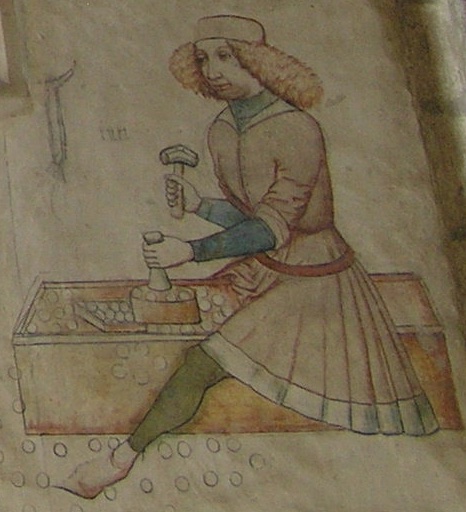
A coinmaker in a doublet with narrow sleeves. Cutout from a fresco in the Coinmakers' Chapel of the Cathedral of St. Barbara in Kutná Hora (1460-1470).
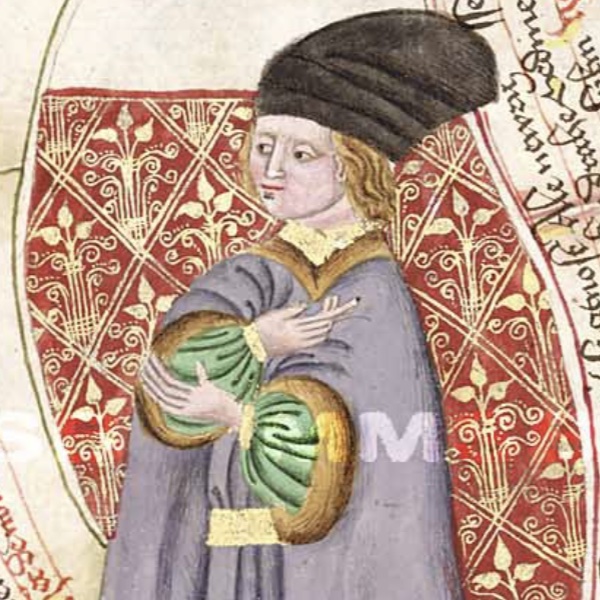
A priest wearing a doublet with wide sleeves, cuffed at the wrist. Cutout from the Codex of Jena (1490-1510).
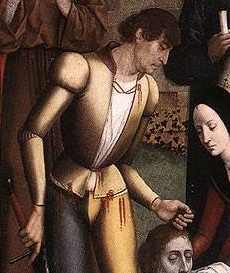
A doublet with padded shoulders according to Burgundian fashion. Detail from the painting The Execution of the Innocent Count by the painter Dieric Bouts, Netherlands, 1460.
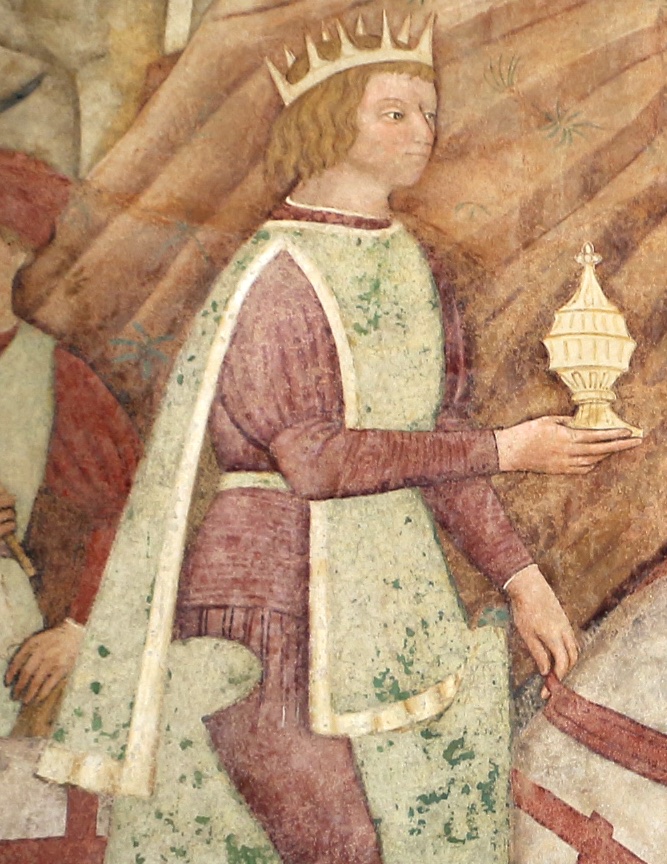
A doublet with ruffled upper half of sleeves, cut-out from a fresco by Paolo di Stefano Badaloni, Florence, 1460
Comparing the doublet from the fresco in the Coinmakers' Chapel of St. Barbara's Church in Kutná Hora with contemporary German patterns, it seems that Czech doublets were somewhat more archaic in style, i.e., with a long part tightly wrapping around the belly and tied with a single lace, and a very arched, likely padded chest, which however may not be as tightly fastened as the abdominal part and thus either fastened with buttons or several laces passing through opposing pairs of holes.
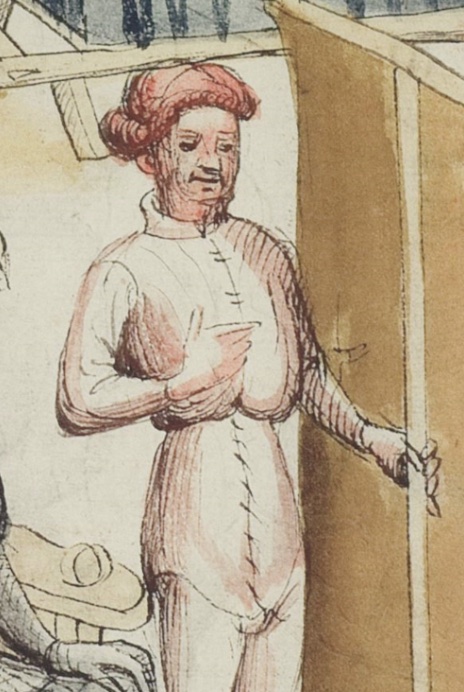
A doublet with a long belly-hugging part tightened tightly on one lace. The chest no longer needs to be so tightly cinched and is fastened with several laces passing through opposing pairs of holes. Cut from Königsegg Treatise, Germany, (1446-1459).
Although this doublet should be similar in date to the German doublet in the following picture, it retains its archaic shape with a tightly tightened single-laced belly-hugging part and a looser buttoned chest. Cutout from a fresco in the Coinmakers' Chapel of St Barbara's Cathedral in Kutná Hora(1460-1470).
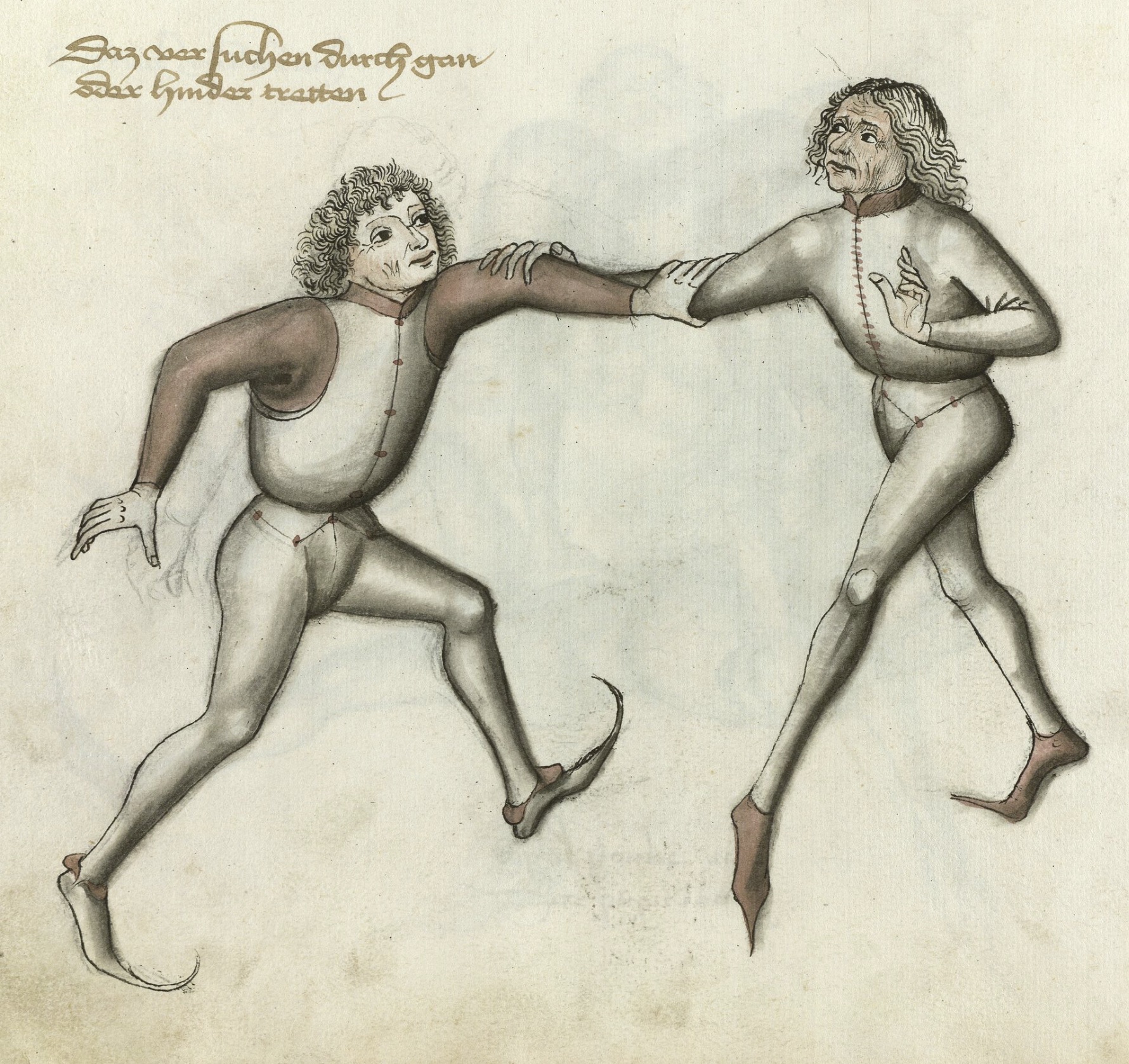
A younger type of short belly part doublets, worn in Germany at that time. Page from Hans Talhofer's Fechtbuch, Germany, (1459).
Some insights into the construction of doublets can be gleaned from certain articles of the New Town doubletmakers' guild, which were confirmed on August 16, 1448:
“Třetie, aby byly dělány barchanové kabáty v prostředku plátnem novým, a bavlna aby byla v prsy, a vespod aby bylo plátno nové nebo cvilink bez přimiešenie vetchého; a v kožené kabáty aby bylo vetché plátno v prostředek, a vespod nové bez přimiešenie vetchého. Také aby vetché plátno nebylo děláno pod barchanové kabáty ani kožené ani cvilinkové, nebo pod rukávy aby žádného vetchého mandlovaného na trh nedělali.” (Thirdly, that fustian doublets be made with new linen in the middle, and a raw cotton should be in the chest, and below there should be new linen or coarse linen fabric without the addition of old material; and in leather doublets, there should be old linen in the middle, and new at the bottom without the addition of old. Also, old linen should not be used under fustian doublets nor leather nor coarse linen doublets, nor should any old quilted material be made for the market under the sleeves.)
“Desáté a poslednie, v harasové kabáty aby bylo děláno dvuoje plátno v prsy svrchnie, a v pokošinové též, pod pokutami svrchupsanými.” (Tenth and last, in woolen doublets there should be two layers of fabric in the upper chest, and in the (another) woolen ones as well, under the penalties mentioned above.)
While in Western Europe the laces used to tie hose to the doublet were visibly tied to a single loop, in Central Europe it was customary to wear these laces hidden, as evident from the following images.
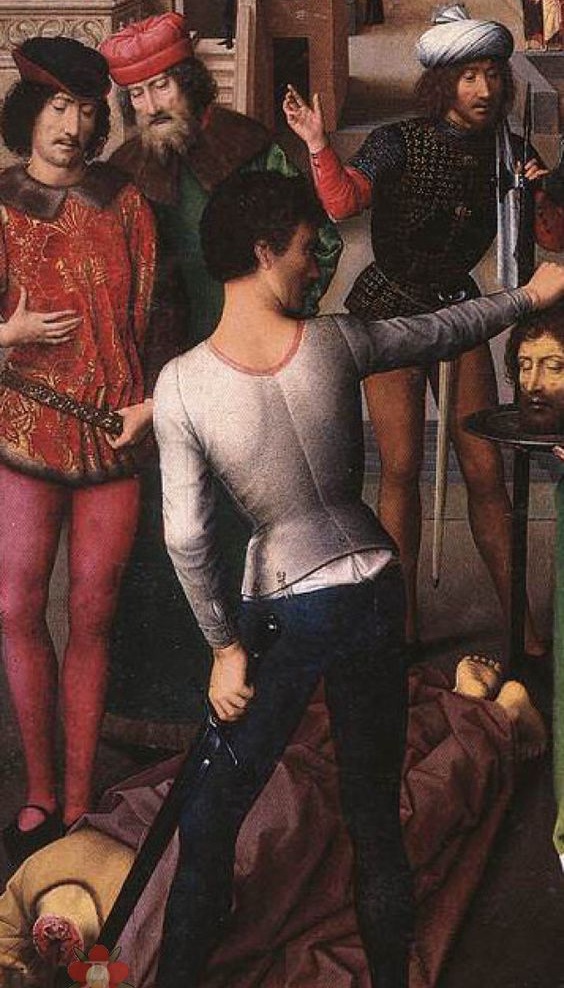
A doublet tied to hose with visible knots on the laces. Cutout from the altar of St. John by Hans Memling, 1479.
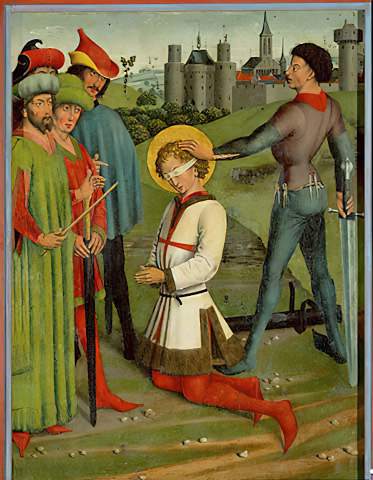
A doublet tied to hose with visible knots on the laces. St. George's Centenary, Friedrich Herlin, 1462 - 1465.

The laces between the hose and the doublet are only hinted at here, as the knot is hidden on the inside. Page from Hans Talhofer's Fechtbuch, Germany, (1459).
In the Czech environment, the laces that connect the doublet to the hose are so hidden that they are not even hinted at, unlike the laces on the belly. A cut-out from a fresco in the Coinmakers' Chapel of St. Barbara's Cathedral in Kutná Hora (1460-1470).
Reconstruction
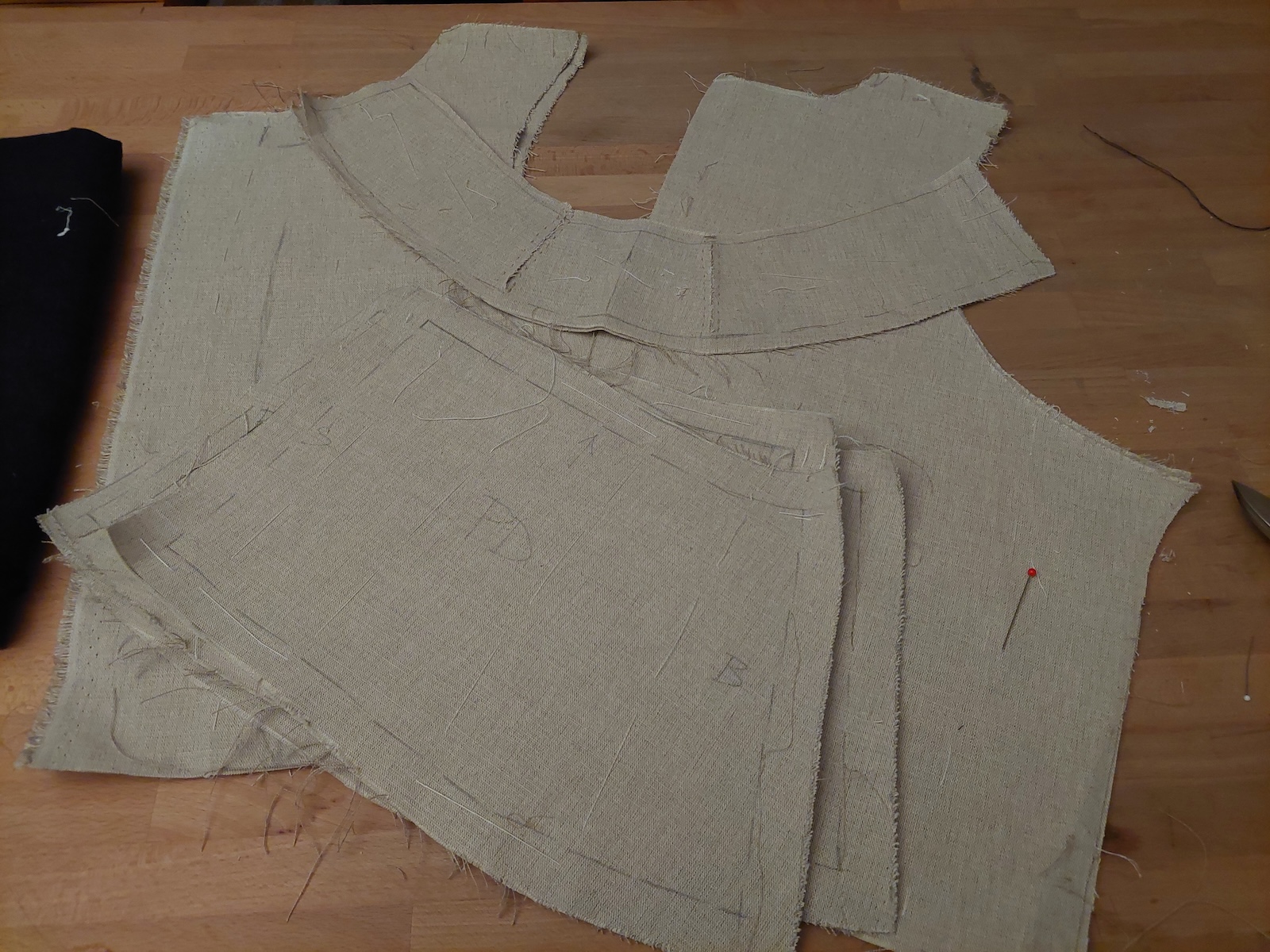
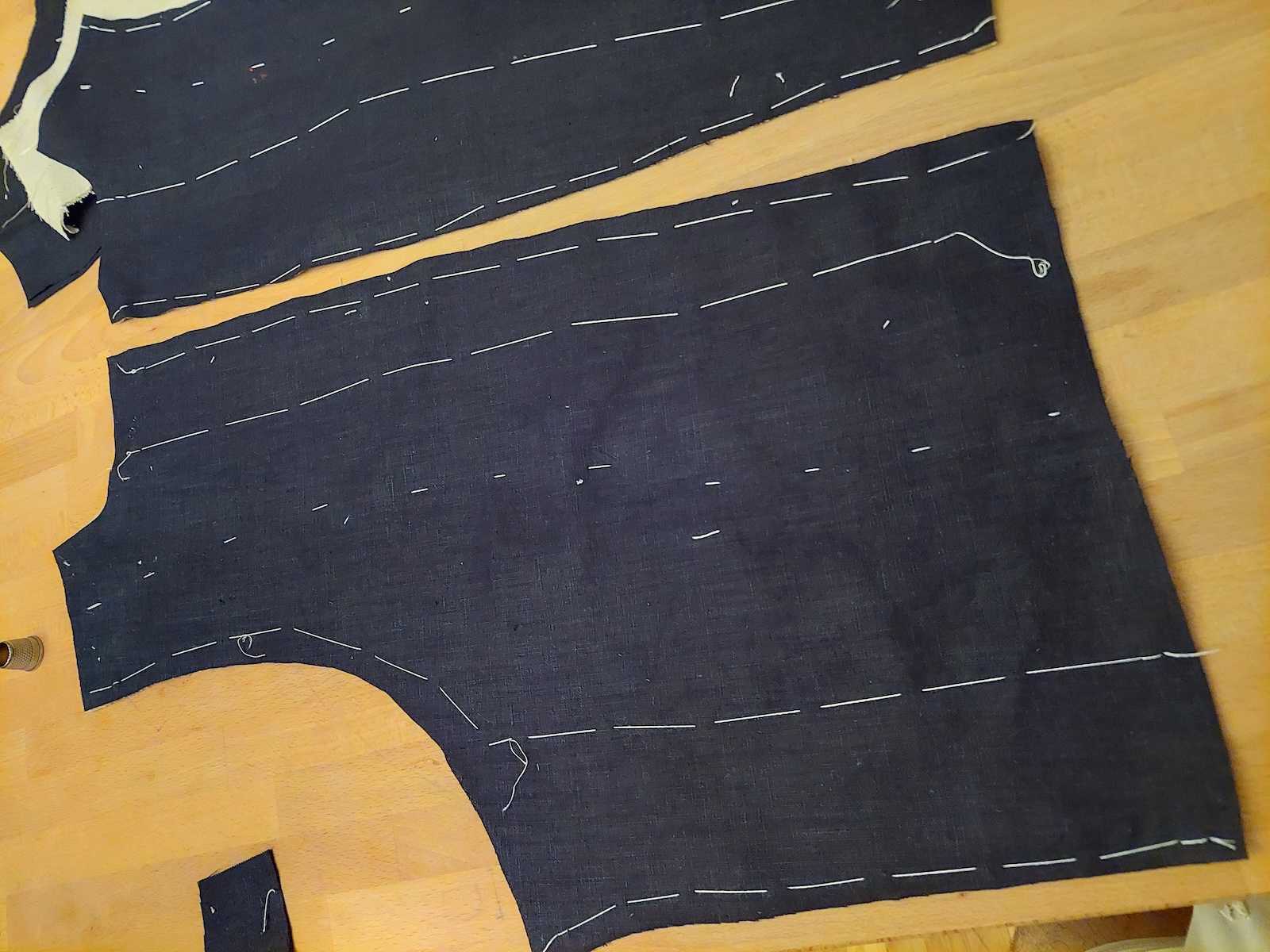
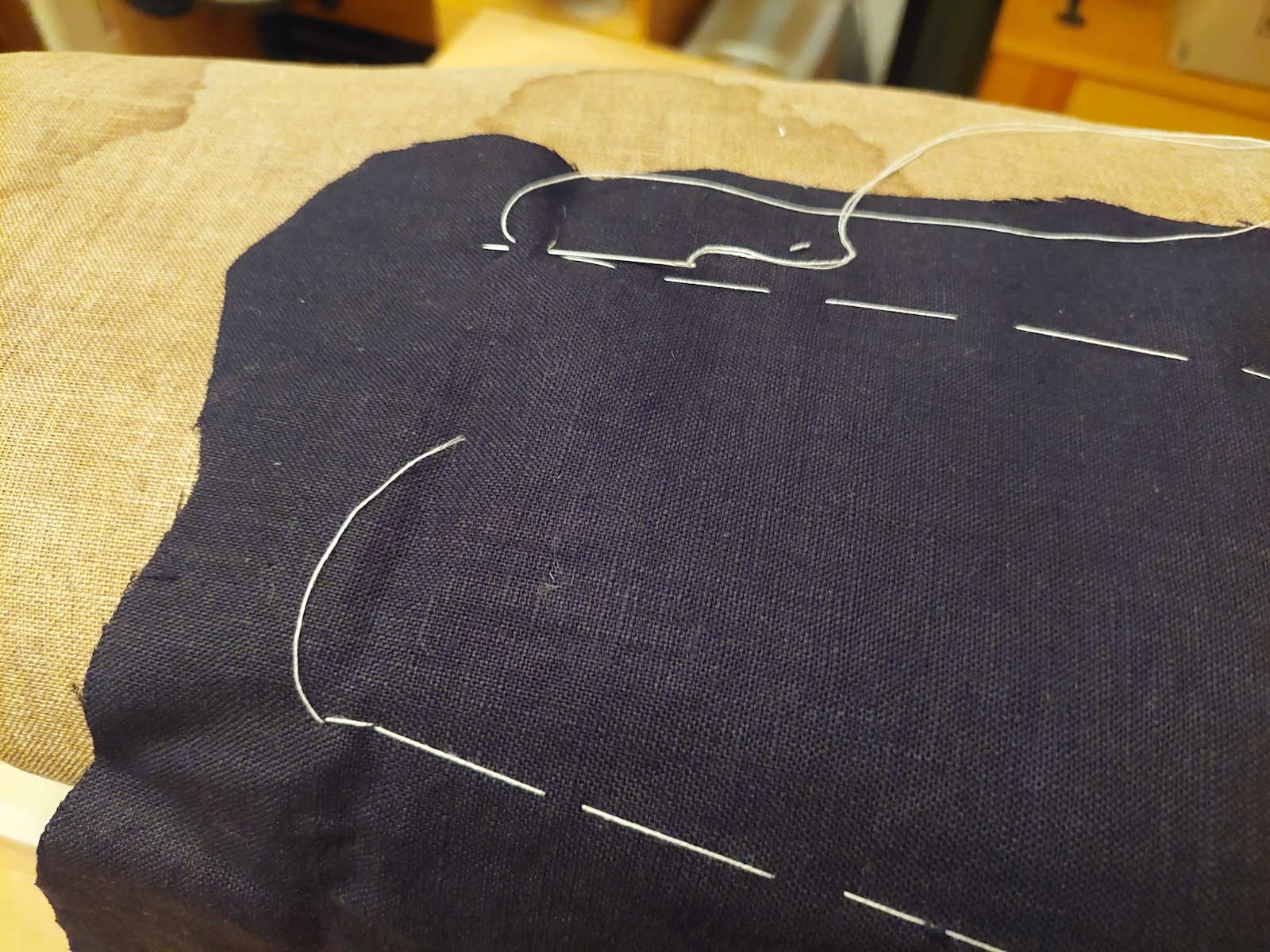
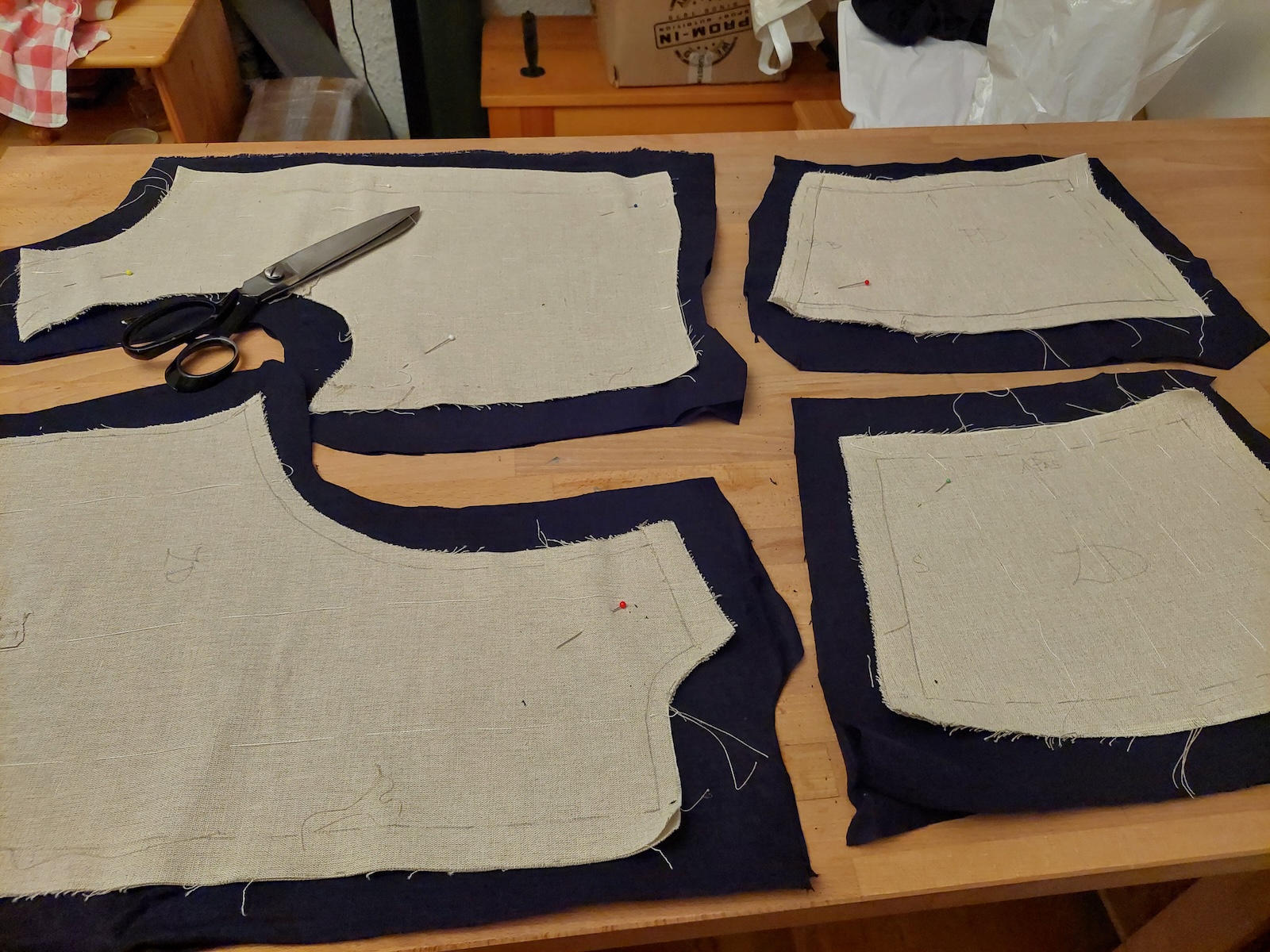
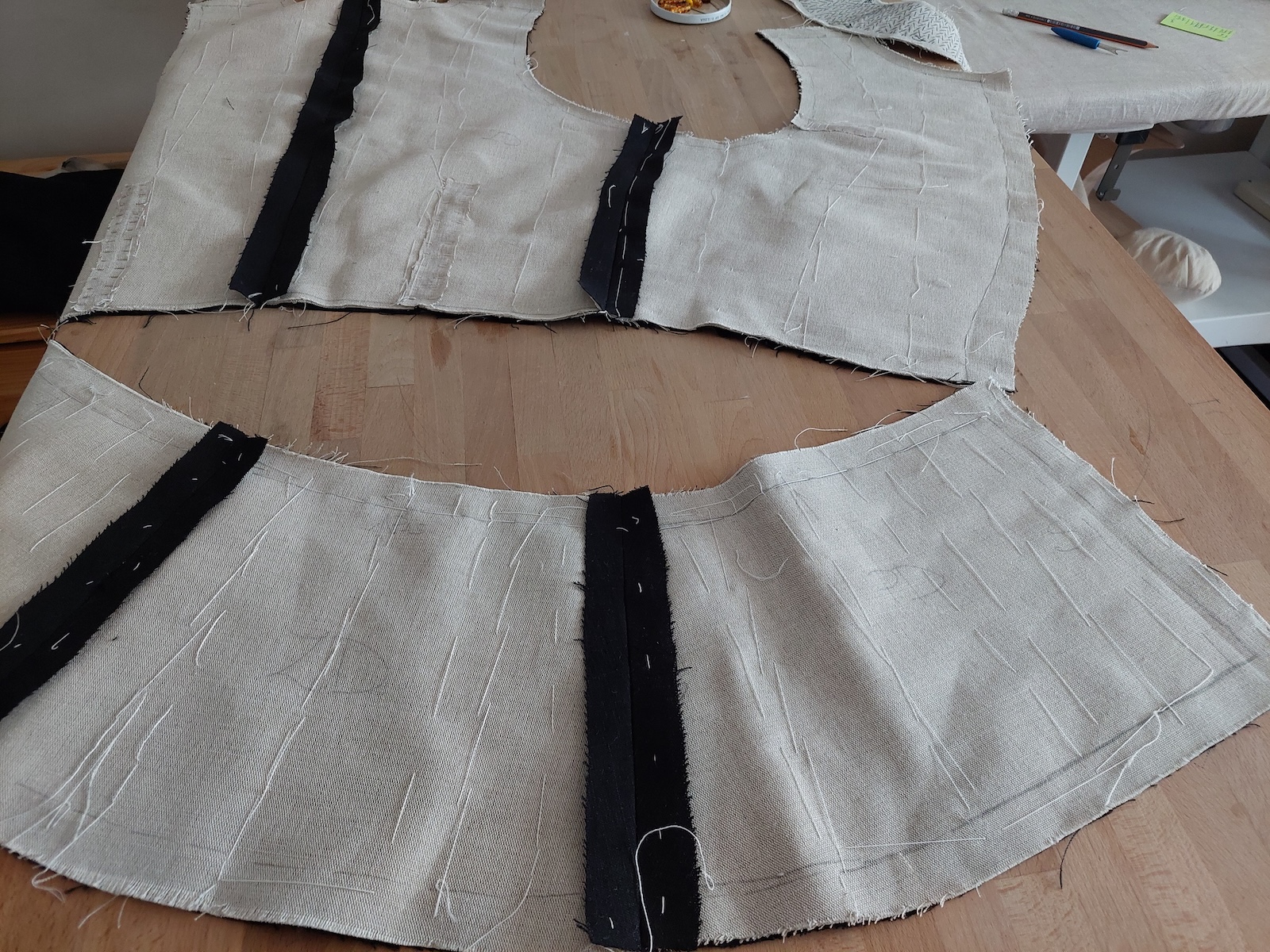
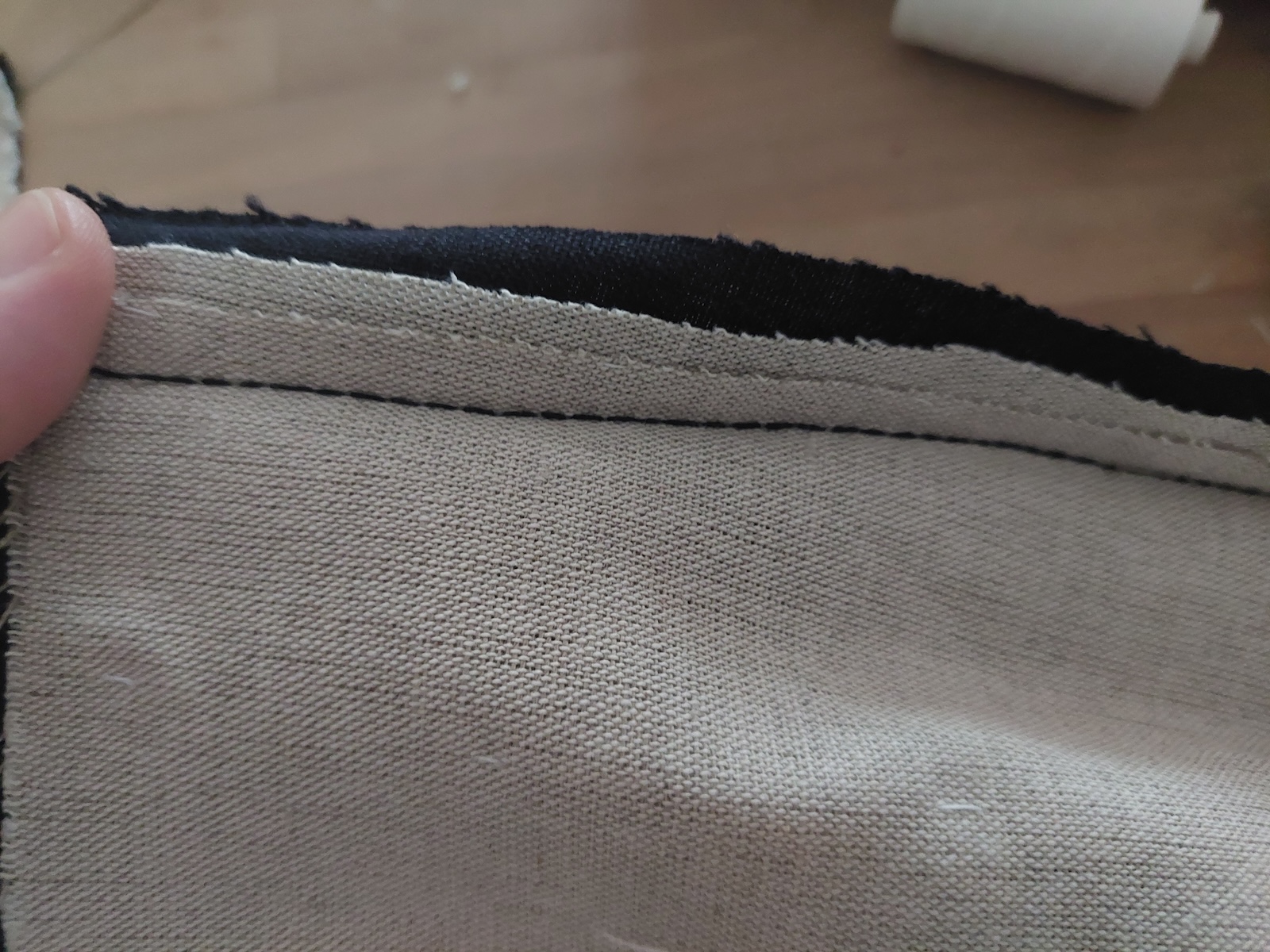
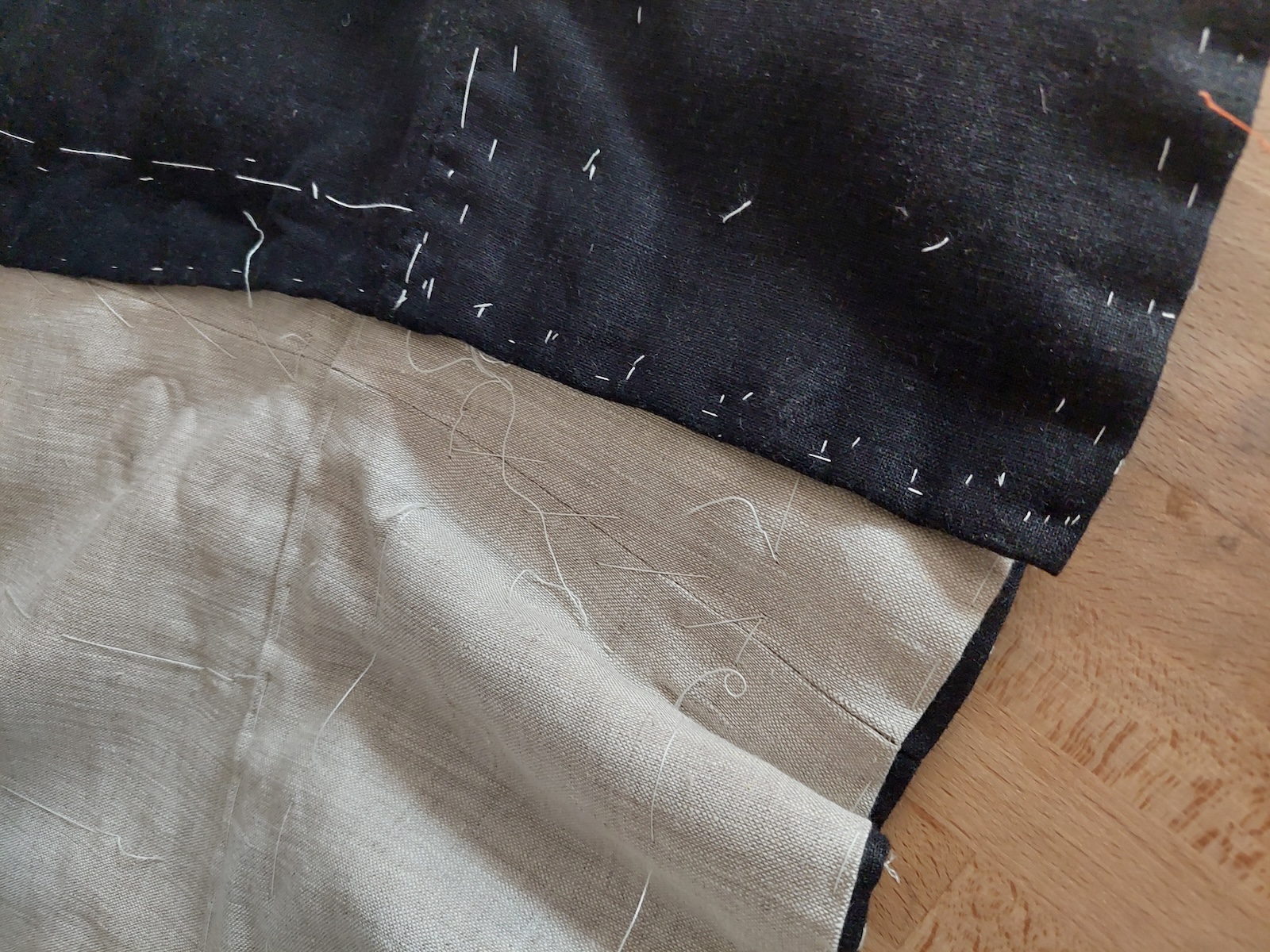
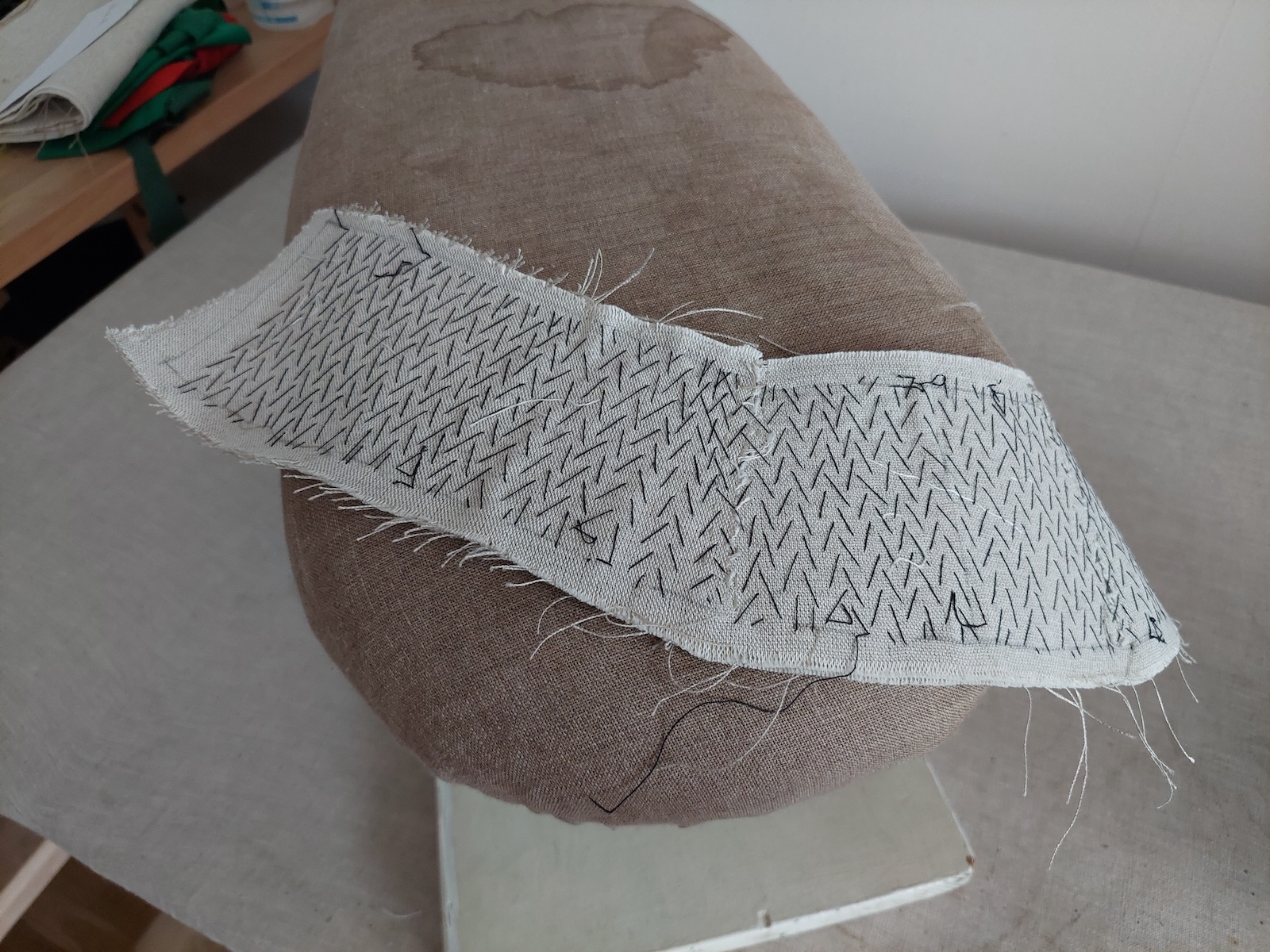
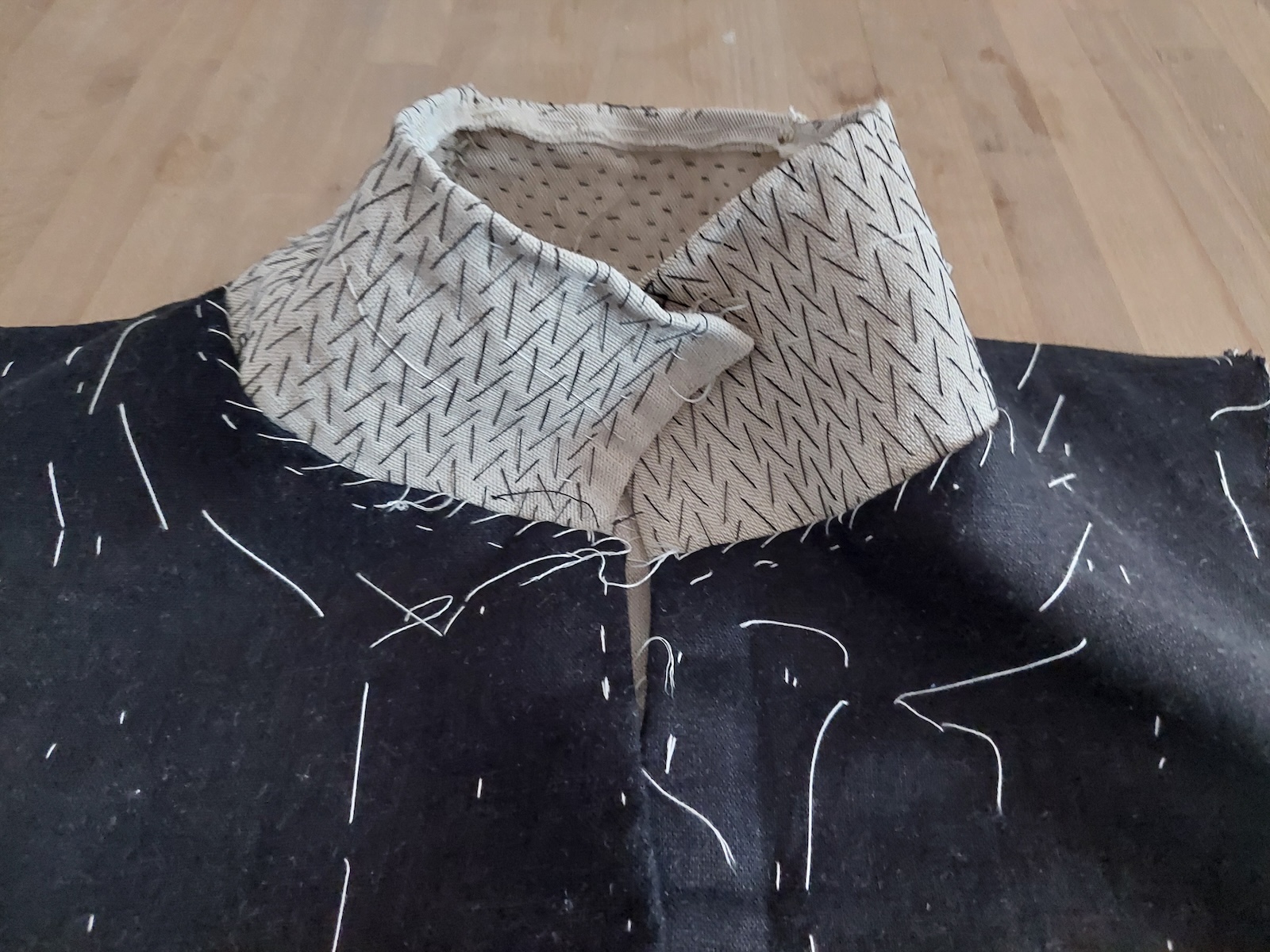
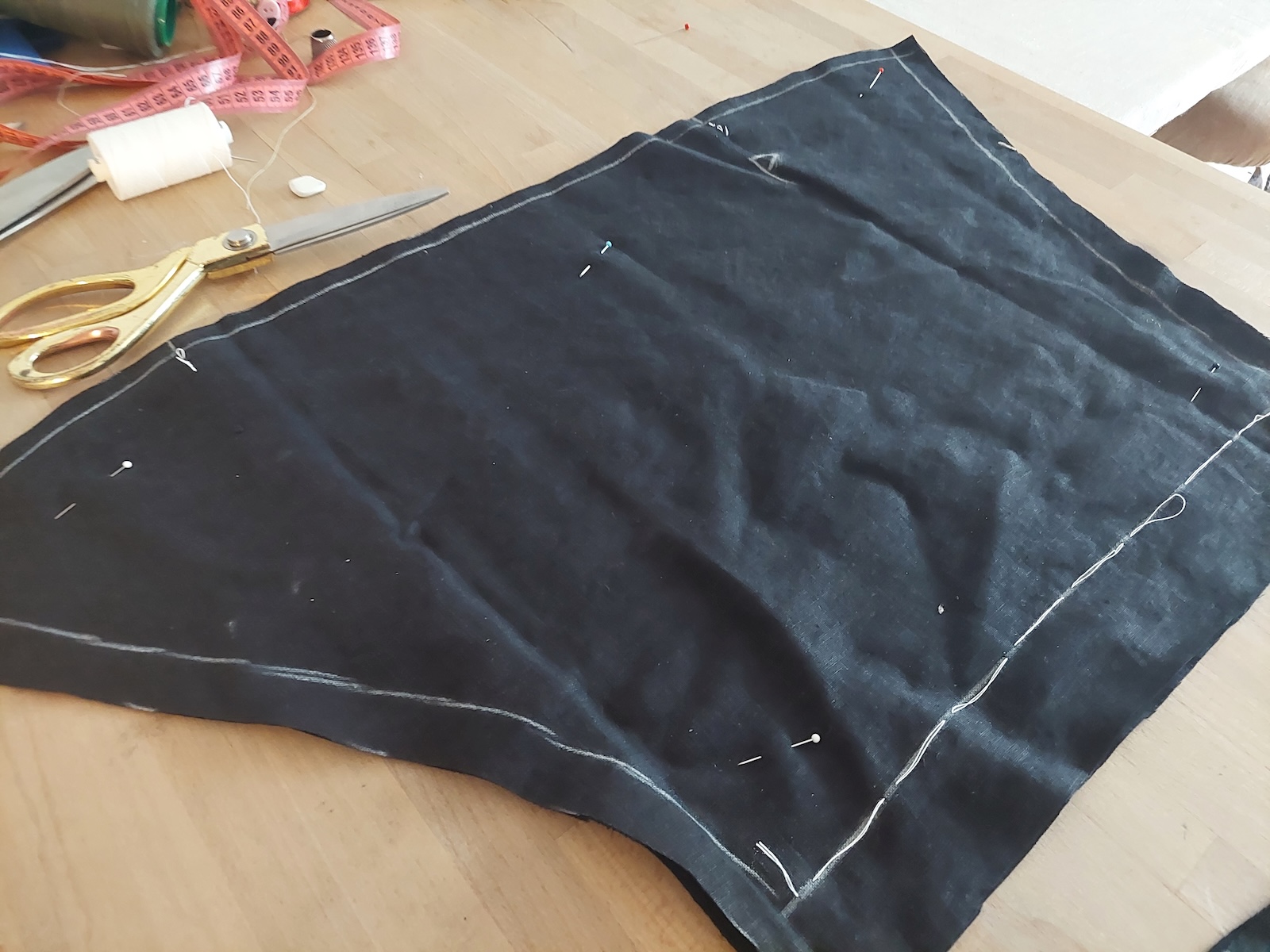
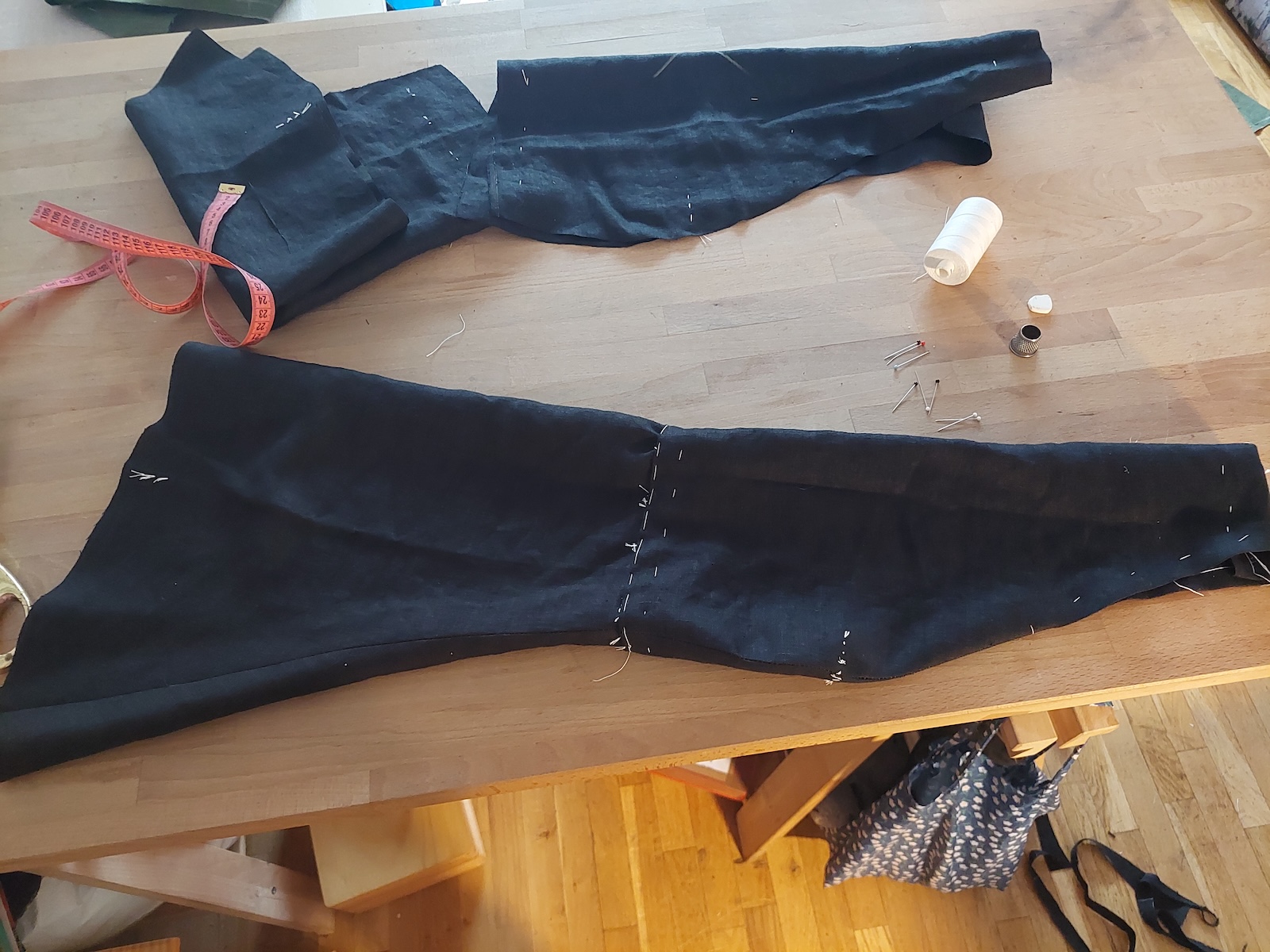
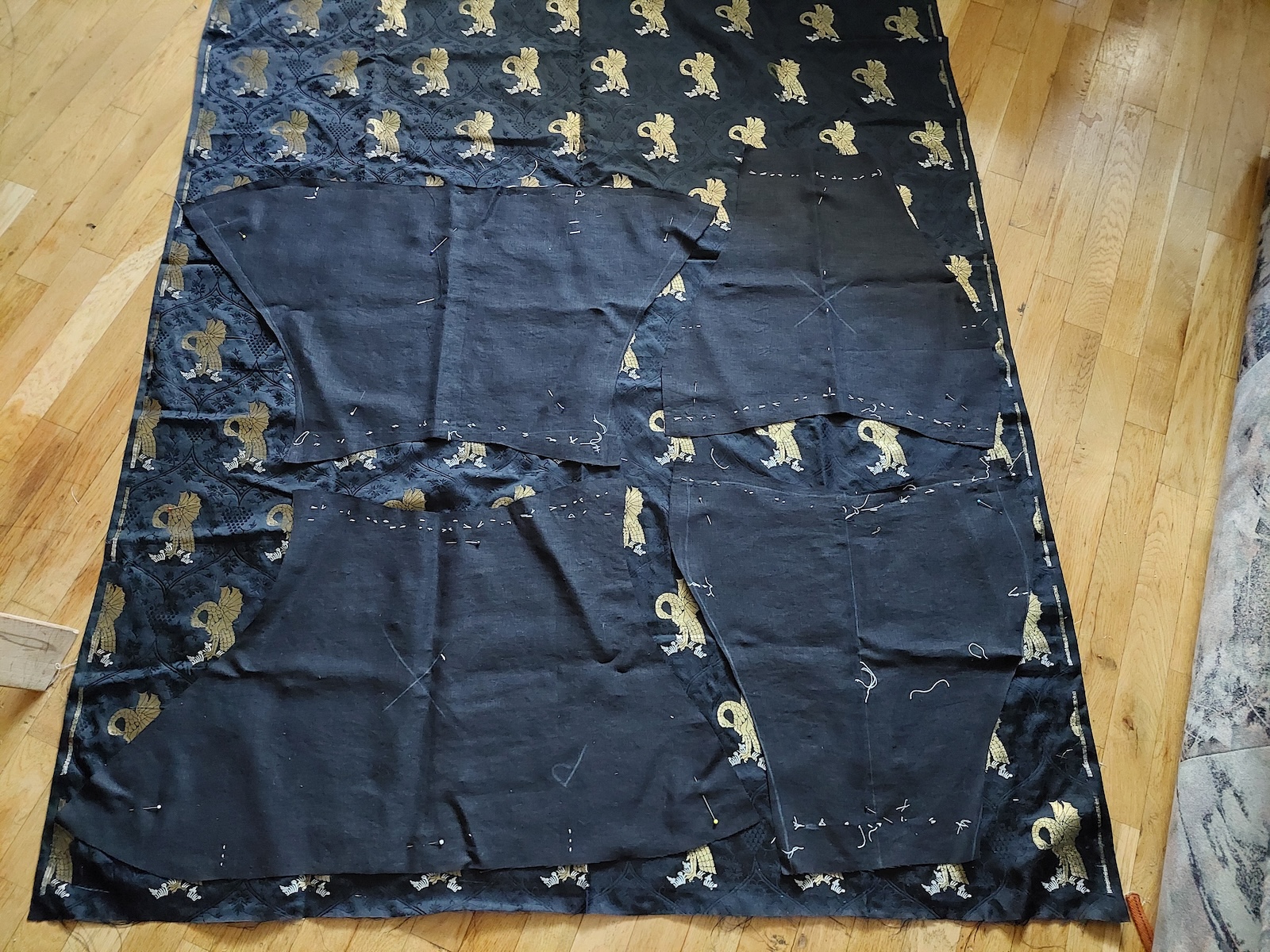
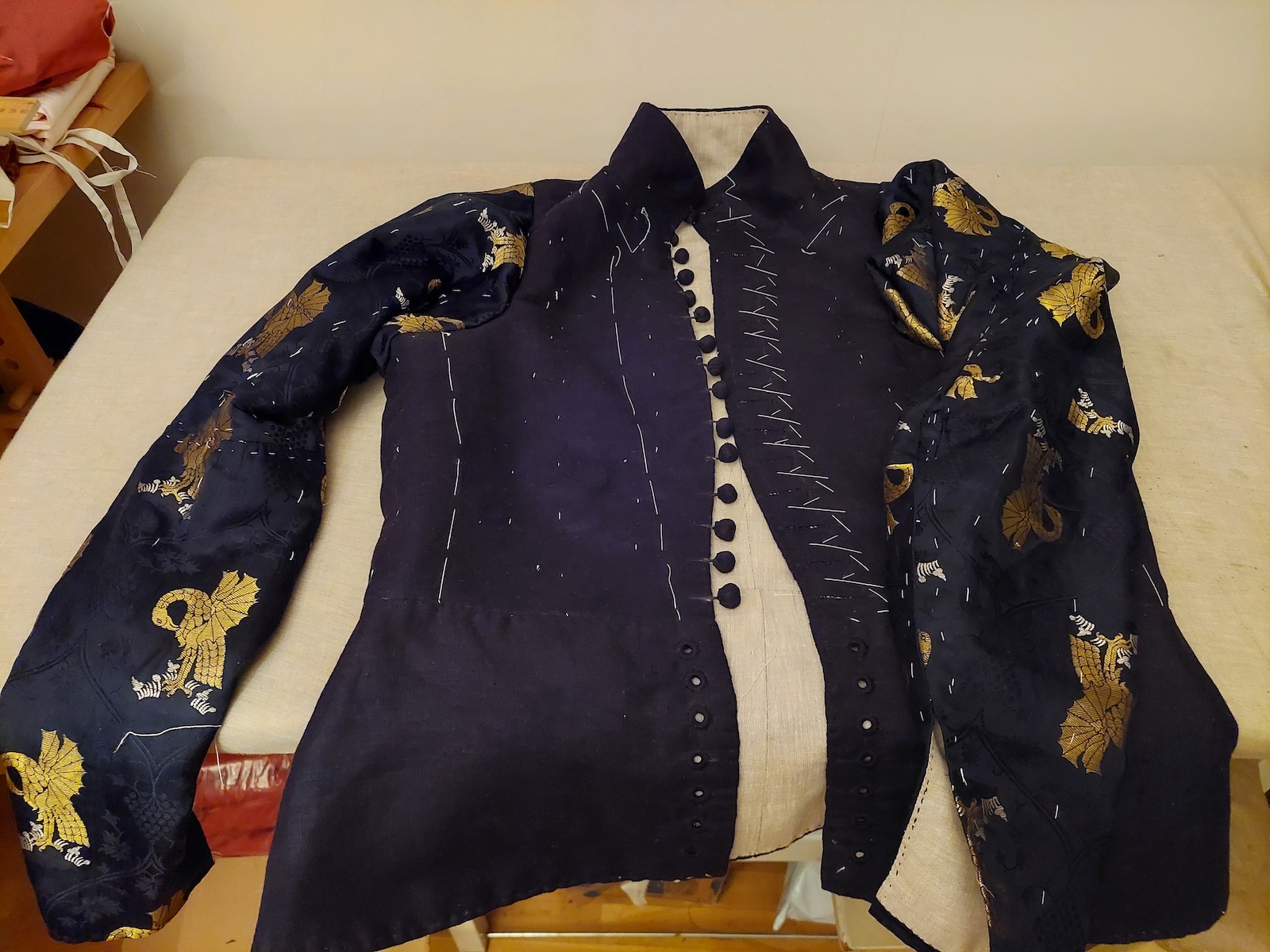
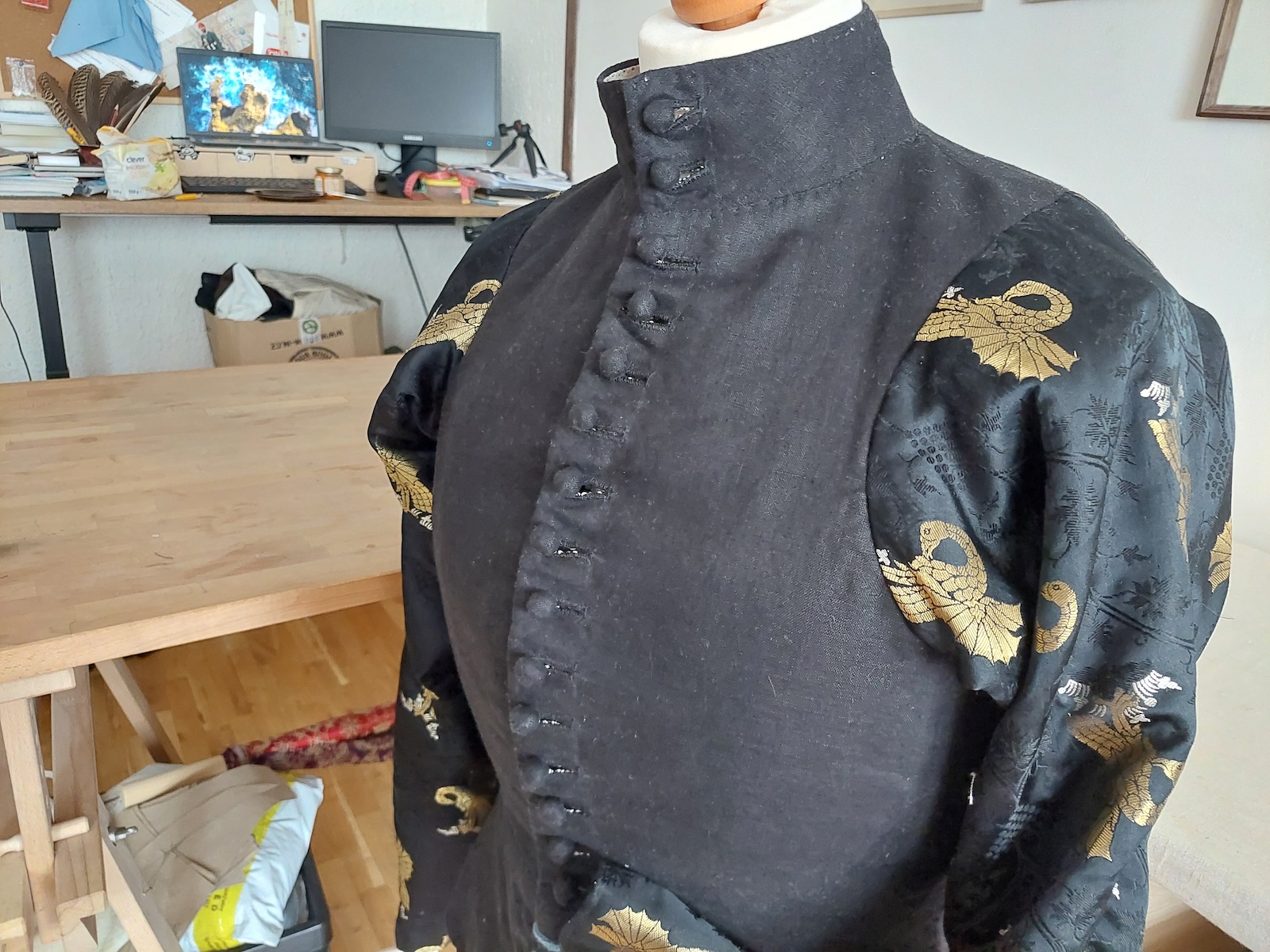
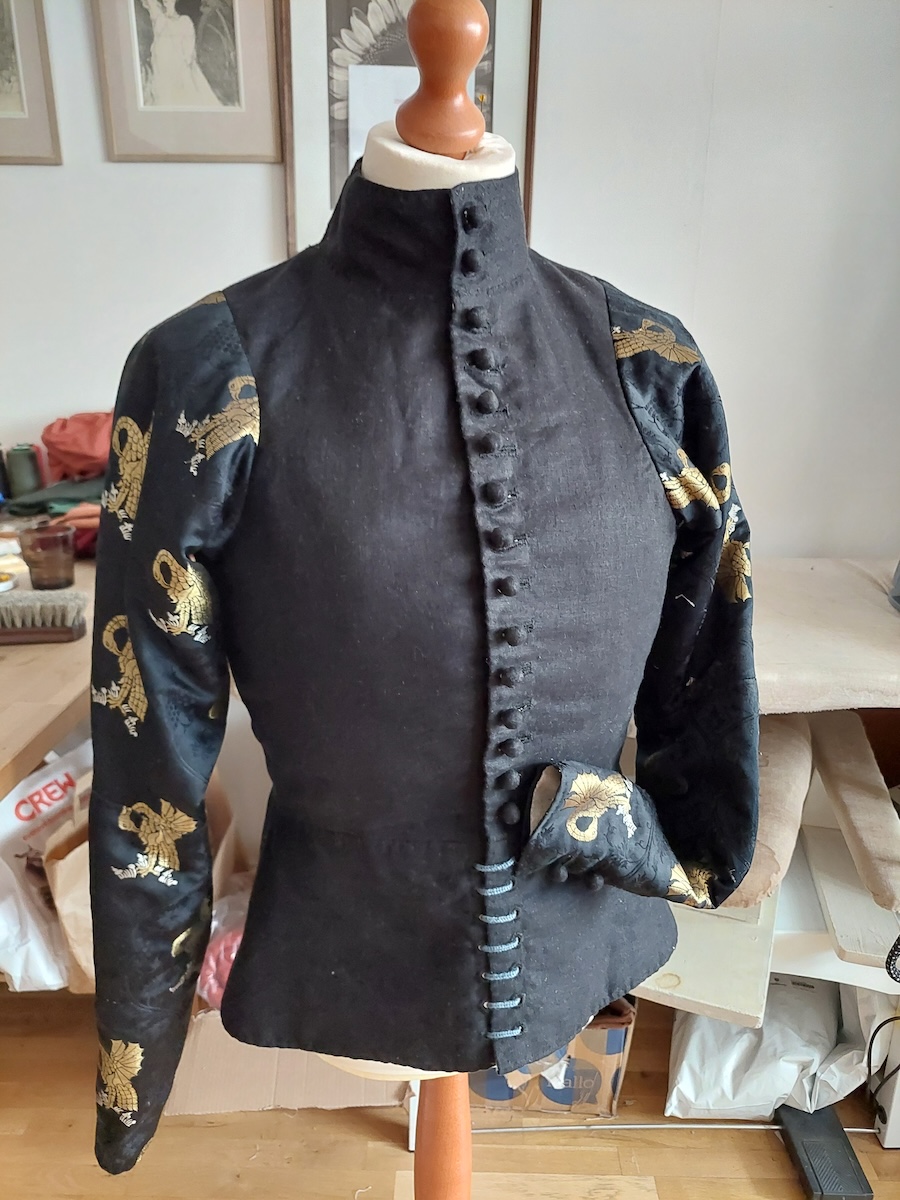
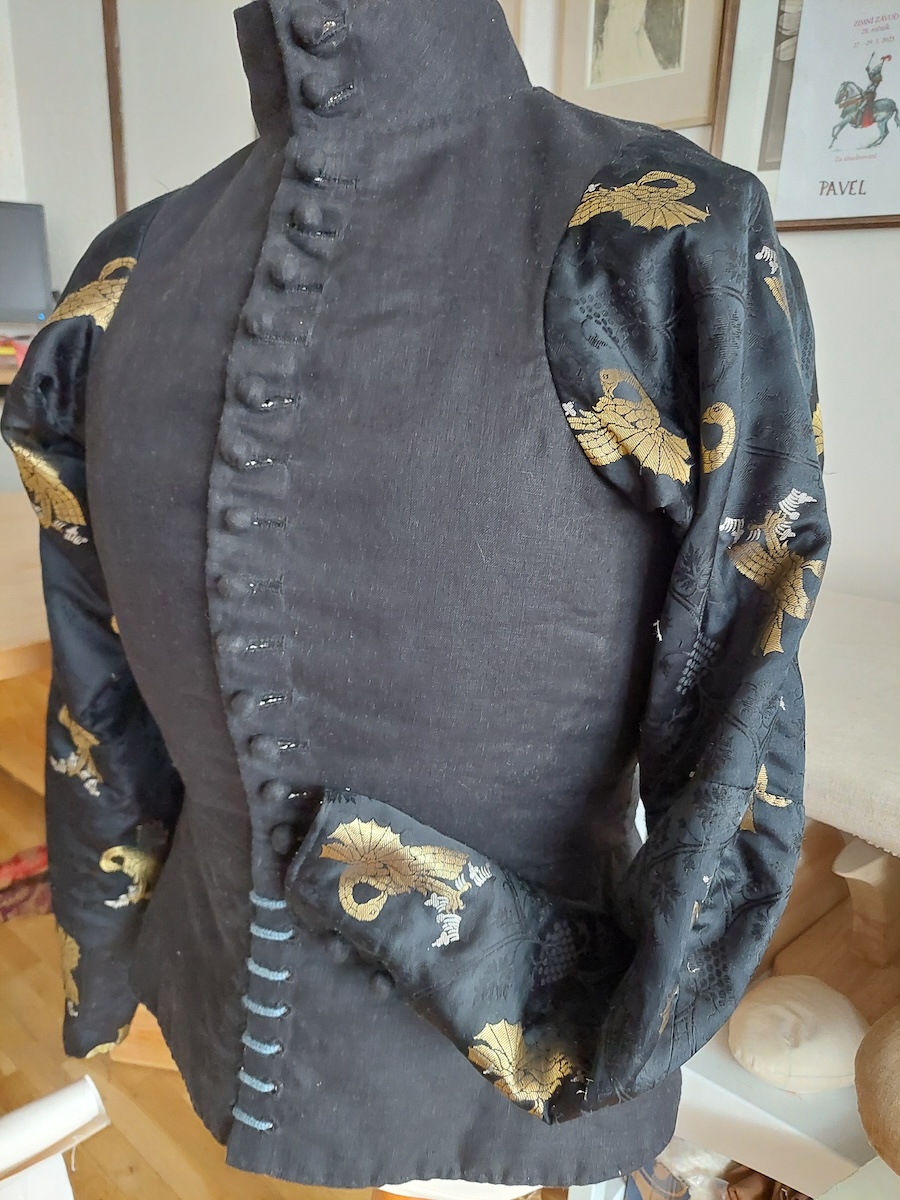
The free inspiration for this reconstruction was an illustration from the Bayerische Fürstengenealogie; at the same time, we sought to adhere to the articles of the New Town doubletmakers' guild. The body of the doublet is therefore made of black fustian (“… that fustian doublet shall be made”), and the chest is padded with raw cotton (“… and cotton shall be in the chest”). The cut, including the fastening, is based on the depiction of a doublet in the Coinmakers' Chapel of St. Barbara’s Cathedral in Kutná Hora.
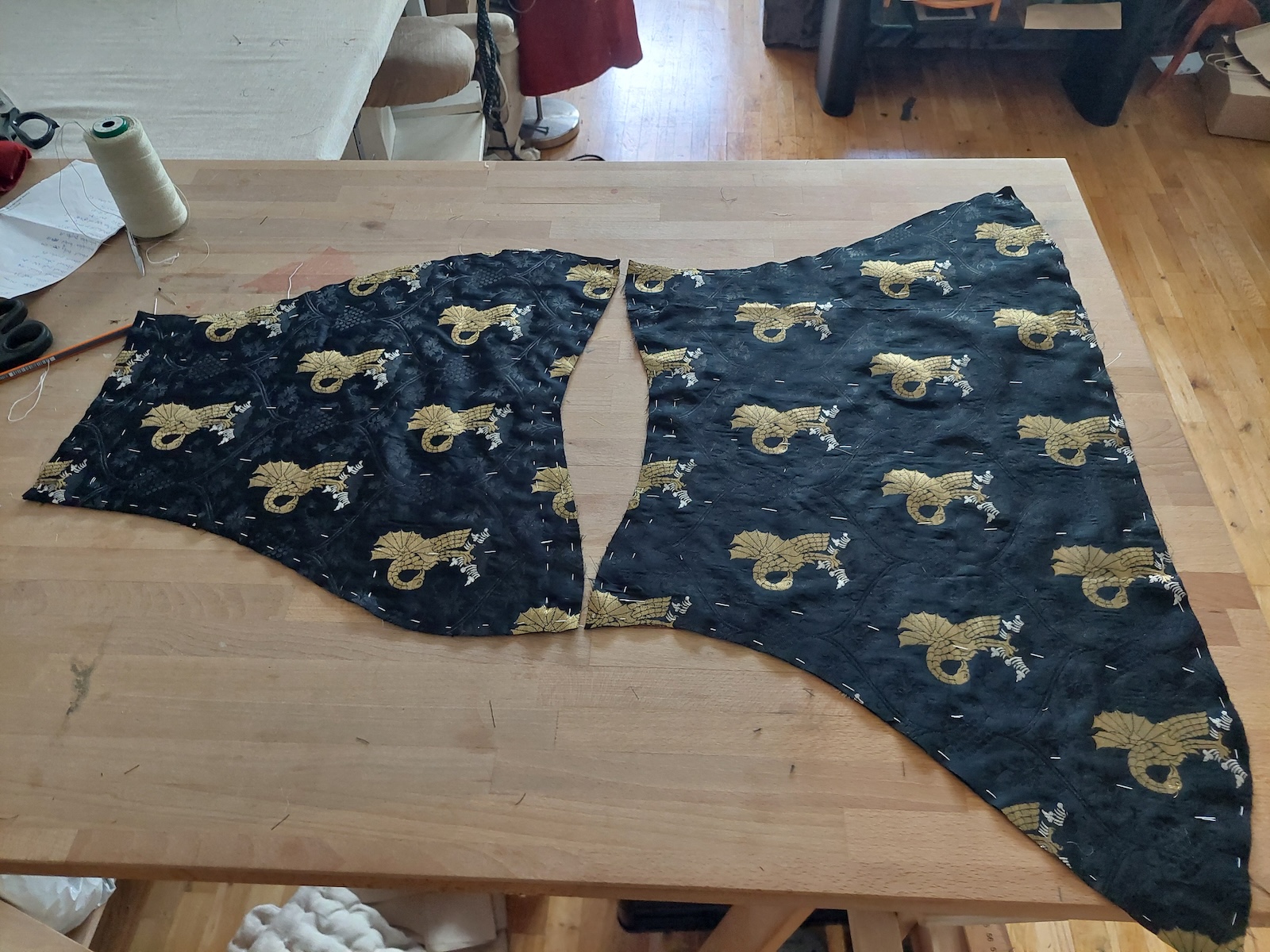
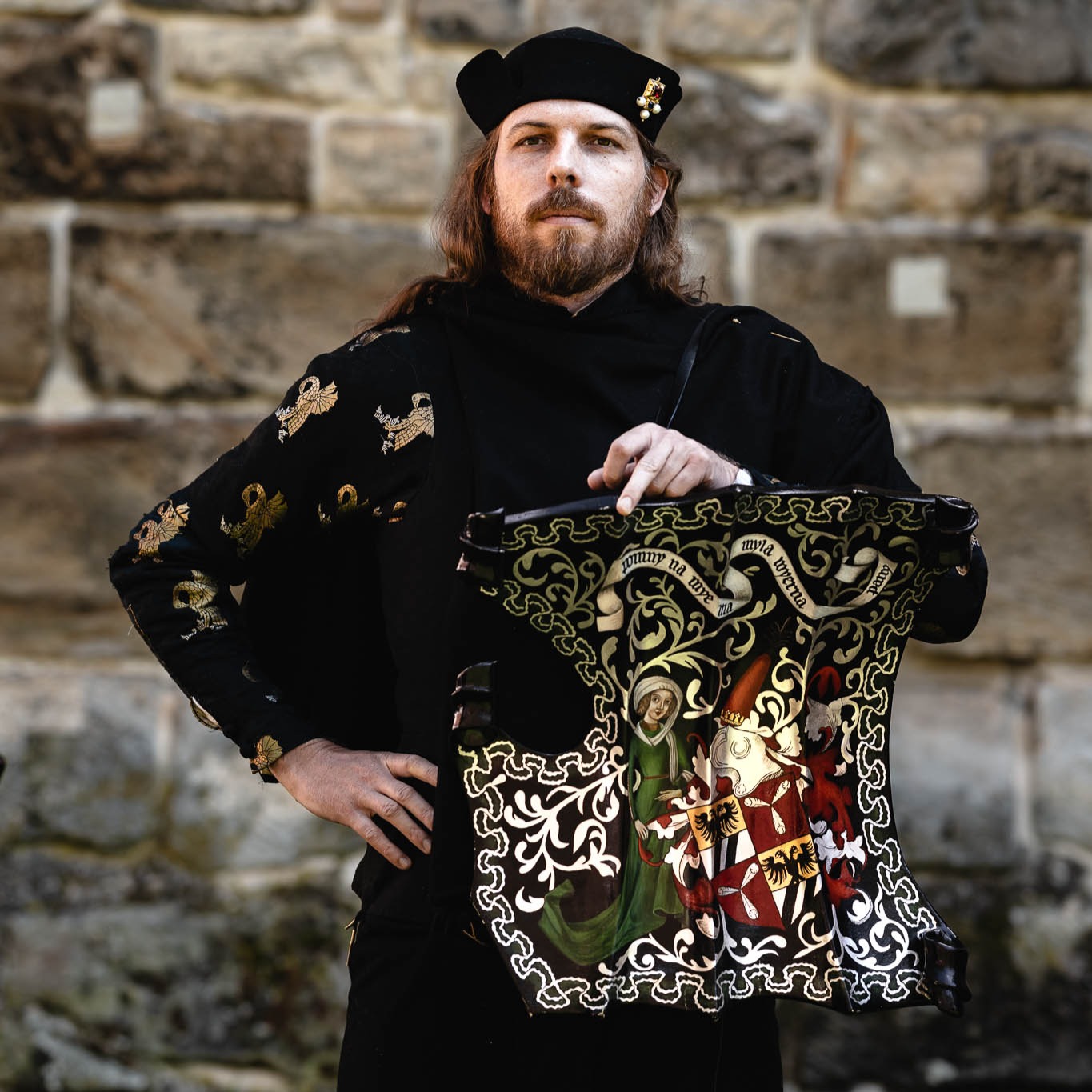
The sleeves are made from a markedly more expensive fabric, as can be seen in many contemporary depictions and as mentioned in the will of the cauldron-maker Martin from 1477: “two velvet sleeves of the doublet.” In place of the mentioned silk velvet, we used a hand-woven silk brocade interwoven with gold, featuring a Pelican motif, based on a fragment of textile found in Germany.
The entire doublet is sewn completely by hand. The reconstruction was carried out by Pavel Houfek.
Sources:
If you enjoyed this article, please consider making a small financial contribution. Writing articles is very time consuming and we do it in our free time.
IBAN: CZ39 2010 0000 0028 0346 2929
BIC/SWIFT: FIOBCZPPXXX