


Gown
The gown was a fundamental type of outer garment. It was most commonly made of woolen fabric, which is called sukno in Czech so this type of garment was called sukně in Old Czech, which means skirt in contemporary Czech. It could come in various lengths. The long version probably could have been called reverenda, as indicated by a record from 1478 stating that Prague maltster Rameš used to wear a “reverendě nové barvy” (reverenda of a new color). The gowns could be lined with fabric, fur, or left unlined. This is referred to in the year 1425 by Tomášek of Hlohovice to his brother“sukni s beránčím kožichem” (The gown with lamb fur) and “sukni parvířku s liščím kožichem” (The gown “parvířka” with fox fur). The same Tomášek, however, also had a “sukni modrú nepodšitú” (blue gown without lining). Plzeň citizen Jan Chudoba bequeathed from his wardrobe in 1432 a“knězi Šimanovi sukni černú svú s liščím kožichem” (black gown with fox fur to the priest Šiman). Master Petr, also from Plzeň, mentions in 1492 a “harasovú suknici krátkú podšitú” (short gown lined made from haras). Prague maltster Duchek, who died in 1437, had, among other things, three gowns, one “šerú s beránčím kožichem črným” (gray with black lamb fur), another “s liškami” (with foxes), and another “s plátnem” (with canvas), that is, lined with linen fabric (canvas at that time does not necessarily mean canvas weave but refers to linen fabric).
At the end of the 15th and the beginning of the 16th century, we find in written sources gowns trimmed with fur. For example, in the Jindřichův Hradec books in 1496, there is mention of a “červená, lasicí opremovaná” (red, trimmed with marten), which cost 2 schocks of groschen. In 1503, a servant also stole from the noble lady Barbora of Vrchlabí a “sukni atlasovou zelenou, kožichem podšitou a lasičkami opremovanou” (green velvet gown, lined with fur and trimmed with marten) .
In the Czech lands, we can trace three most common variants:
Simple Gown
A gown with a more or less shirt-like cut of various lengths, either with narrow or wide sleeves. The term “simple” does not refer to the material, which could indeed be luxurious, but to the relative simplicity of the cut. It could be decorated with then-fashionable pleats or draping. In Czech iconography, more dignified figures (e.g., elders, saints, angels, etc.) typically have very simple, but also very long gowns.
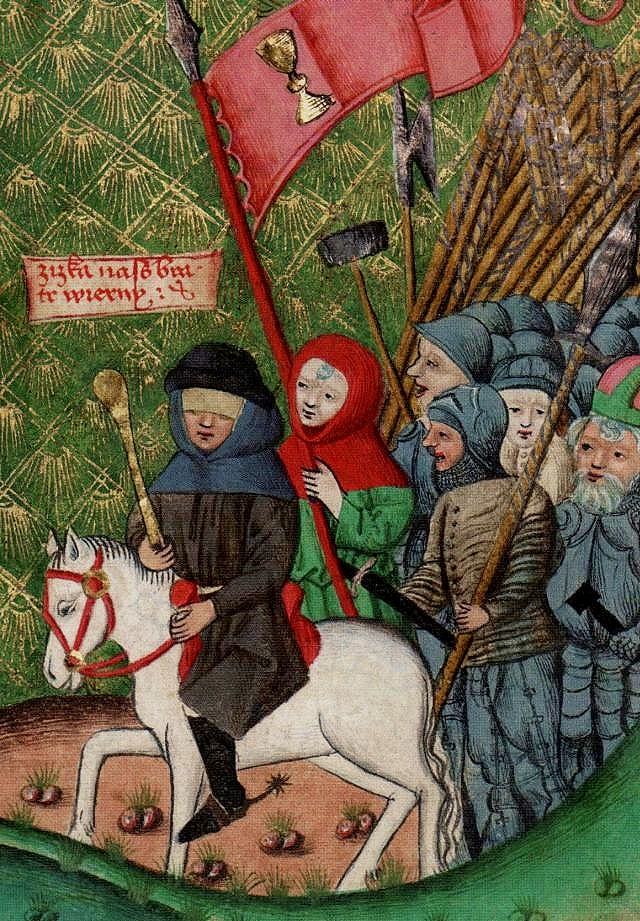
Jan Žižka in a simple gown with narrow sleeves and a standard-bearer in a simple gown with wide sleeves. Excerpt from the Codex of Jena (1490-1510).
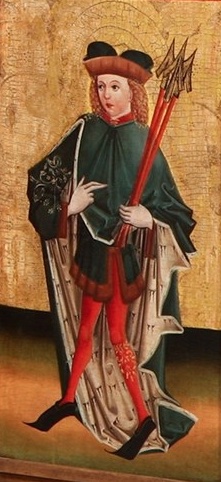
St. Sebastian in a fashionable short green gown lined with brown fur, featuring wide sleeves, side slits on the shorts, and draping on the altar panel from Jeníkov, around 1460.
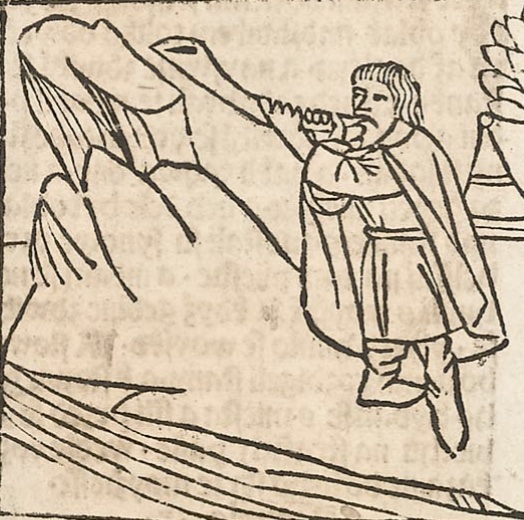
A man in a simple gown and cloak, excerpt from the Kutná Hora Bible, 1489.
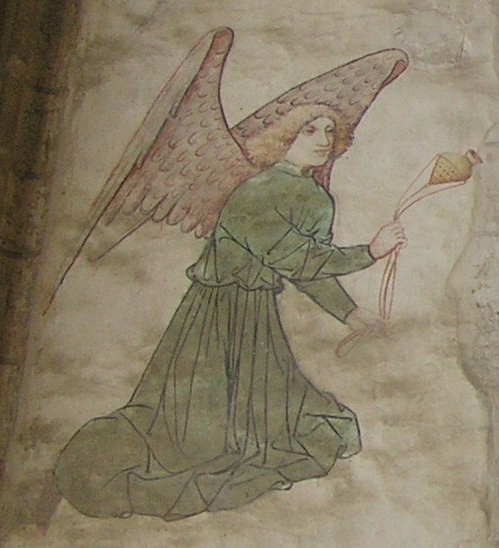
An angel in a long simple gown with tapering sleeves and a stand-up collar on the fresco from the Mintmaster's Chapel, St. Barbara's Church, Kutná Hora (1460-1470)
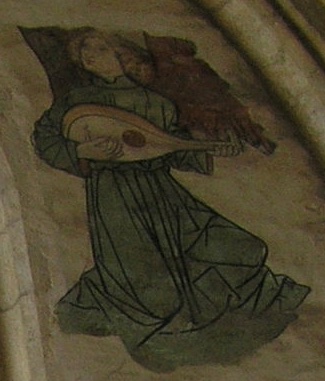
An angel in a long, plain gown with tapered sleeves and a stand-up collar on a fresco from the Mintmaster's Chapel, St. Barbara's Church, Kutná Hora (1460-1470).
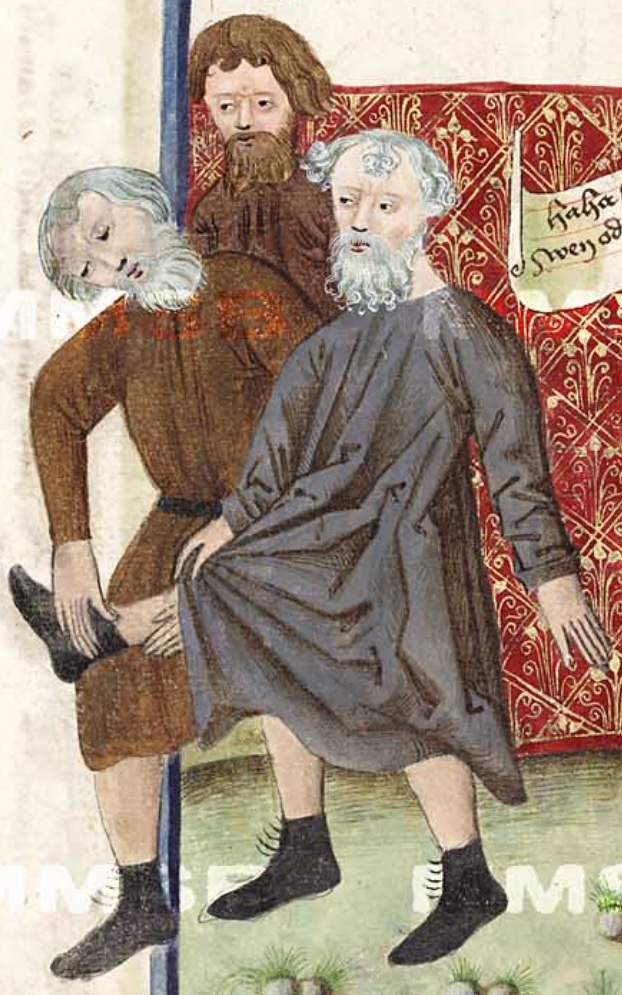
Apostles in simple gowns in an excerpt from the Codex of Jena (1490-1510).
Gown type vestina
Gown, called “vestina” by the Italians, is characterized by a fitted bodice, which was fastened, and more or less draped shorts of various lengths, usually not longer than just below the knees.
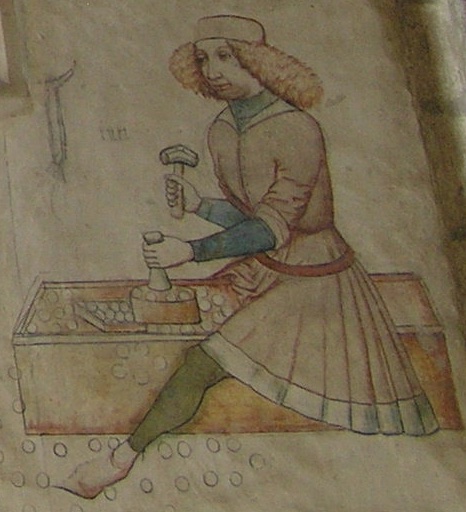
Pregéř (the coin maker) dressed in an old pink gown of type vestina. Detail from the fresco in the Mincířská Chapel of St. Barbara's Cathedral in Kutná Hora (1460-1470).
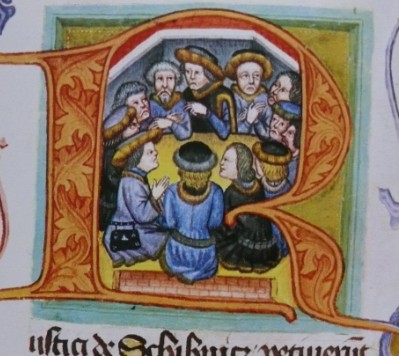
A meeting of the city council depicted in the initial from the Brno Legal Book of Václav of Jihlava (1446). Councillors, facing away from the observer, one in blue and the other in black, are wearing gowns of the type vestina.
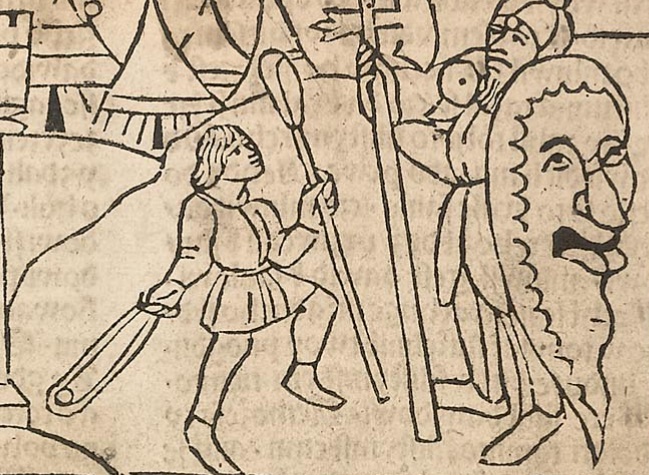
David, wearing a gown of the type vestina, slays Goliath. Woodcut from the Kutná Hora Bible (1489).
Ruched Gown with Baggy Sleeves
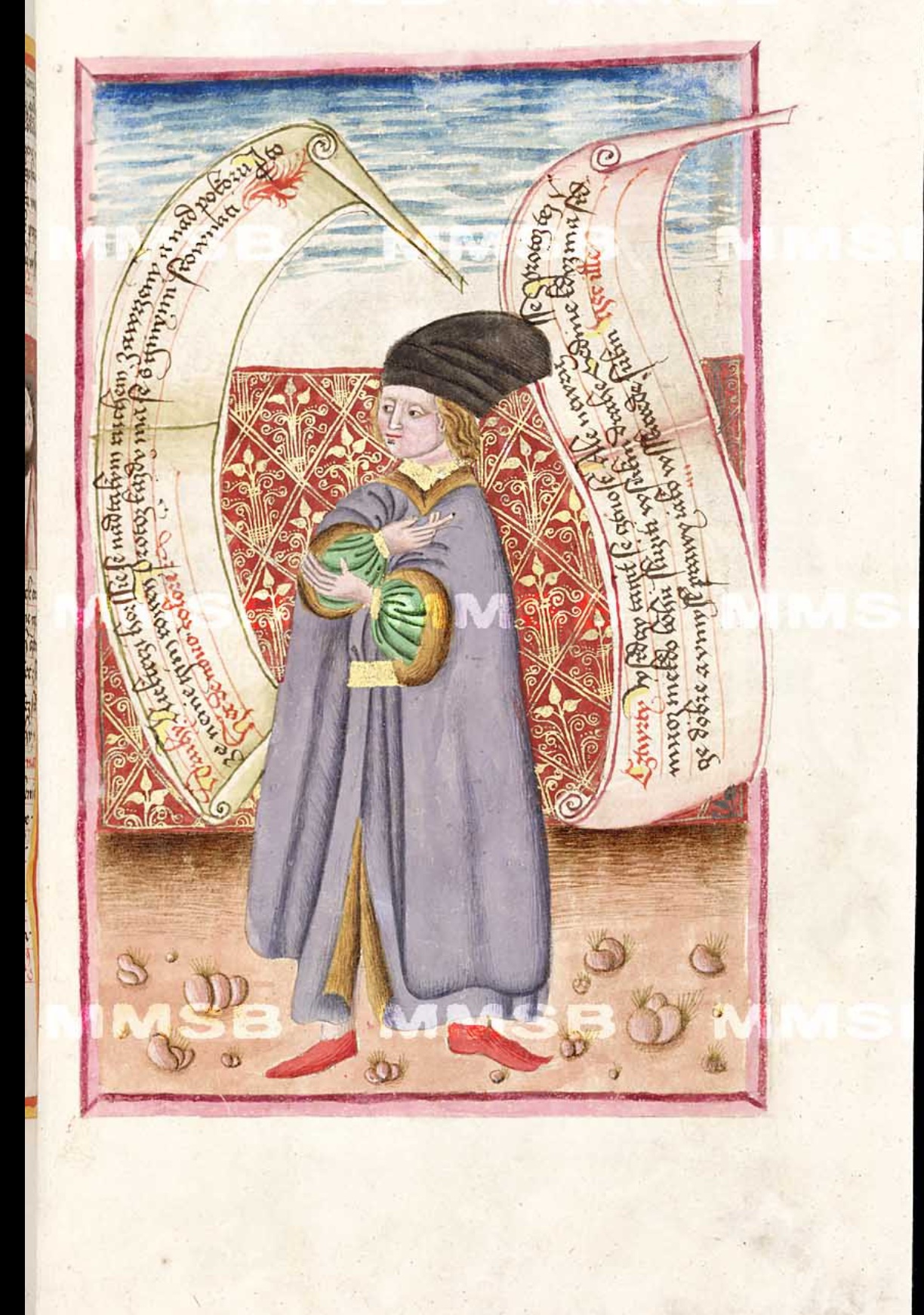
This type of gown is characterized by baggy sleeves and rich ruching along its entire length. The Czech version differs from its Western European counterparts, particularly in the construction of the sleeves. It seems that in Bohemia, a deep sleeve head, the so-called grande assiette, was maintained, giving Czech gowns of this type a somewhat flattened appearance, in contrast to the more square shape typical in Western Europe. This becomes especially evident when combined with coats that lack padded shoulders, as was common in Burgundy and France. In the West, this type of sleeve usually had two openings for inserting the hand—one at the wrist, as is usual for normal sleeves, and the other roughly at the elbow. Although depictions of such sleeves can be found, for example, in the Kutná Hora Bible, other Czech contemporary depictions suggest that Czech sleeves were typically more square and had only one opening for the hand, around the elbow level. This sleeve construction can be indirectly confirmed by some written sources. For example, in one Rakovník court book from 1486, there is an entry:“Poručil jsem, aby kladl peníze do truhly, a on kladl do rukáva sukně své.” (I ordered him to put money in the chest, and he put it in the sleeve of his gown.) Elsewhere, you can read: “Vyňal peníze s měchýřem, dosti pěkný uzlík, a vložil je do rukáva.” (He pulled out the money, really nice sack, and put it in his sleeve.)
This type of gown was most often lined with fur.
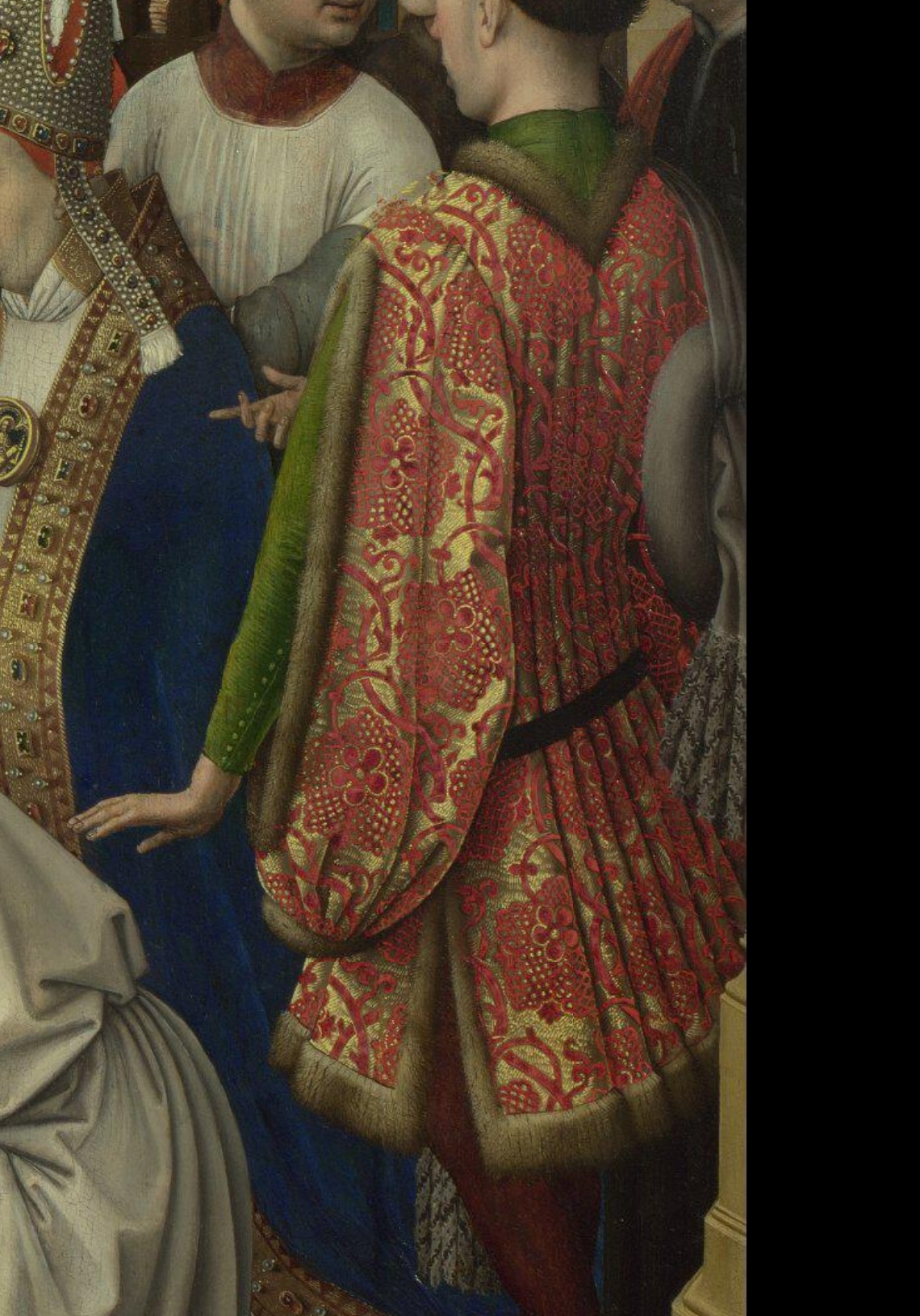
A typical example of a Western European gown with baggy sleeves, depicted in the excerpt from the painting Exhumation of St. Hubert by Rogier van der Weyden, 1430.
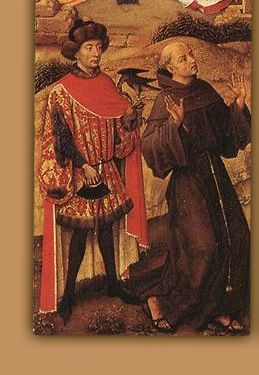
Another typical example of a Western European gown with baggy sleeves, depicted in the excerpt from the triptych for Alessandro Sforza, again by Rogier van der Weyden, 1460.
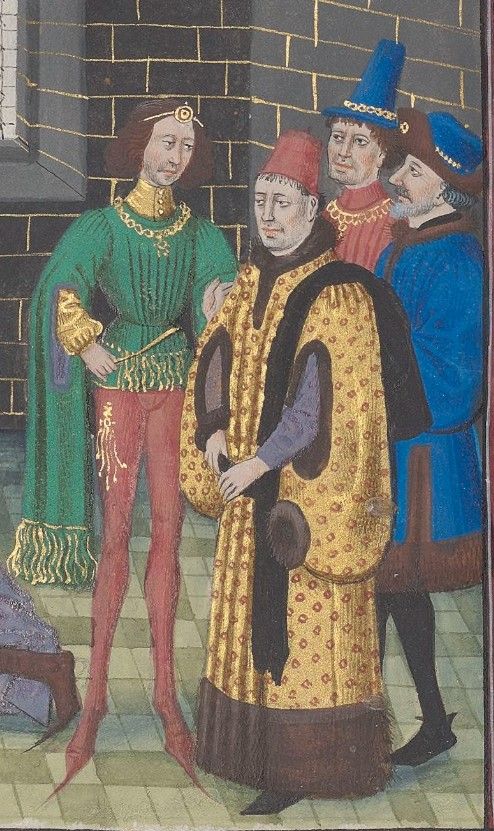
Two gowns with baggy sleeves depicted in the Croniques abregies by David Aubert, 1471. Particularly interesting is the green gown, whose sleeve does not narrow towards the wrist and remains loose. A similar gown can be found in the illustrations from the Memorial Book of Olomouc
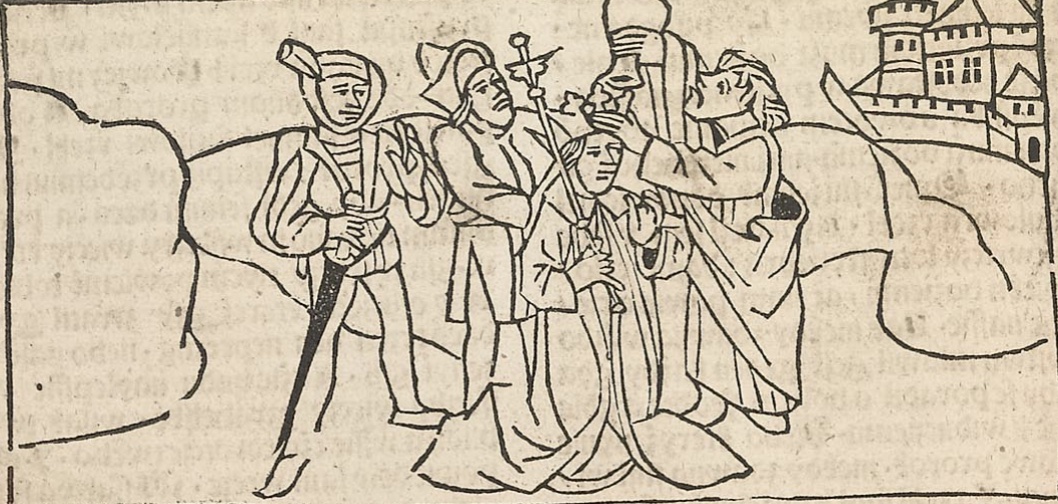
The man on the left is wearing a gown with baggy sleeves and two hand openings, as is customary in Western Europe, in the woodcut depicting the anointing of King Saul, Kutná Hora Bible (1489).
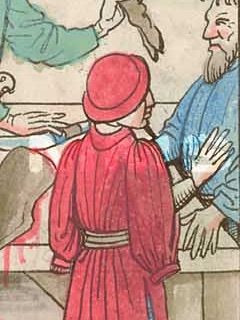
Man in a gown with baggy sleeves and two hand openings in the excerpt from the Richental Chronicle (1470-1480).
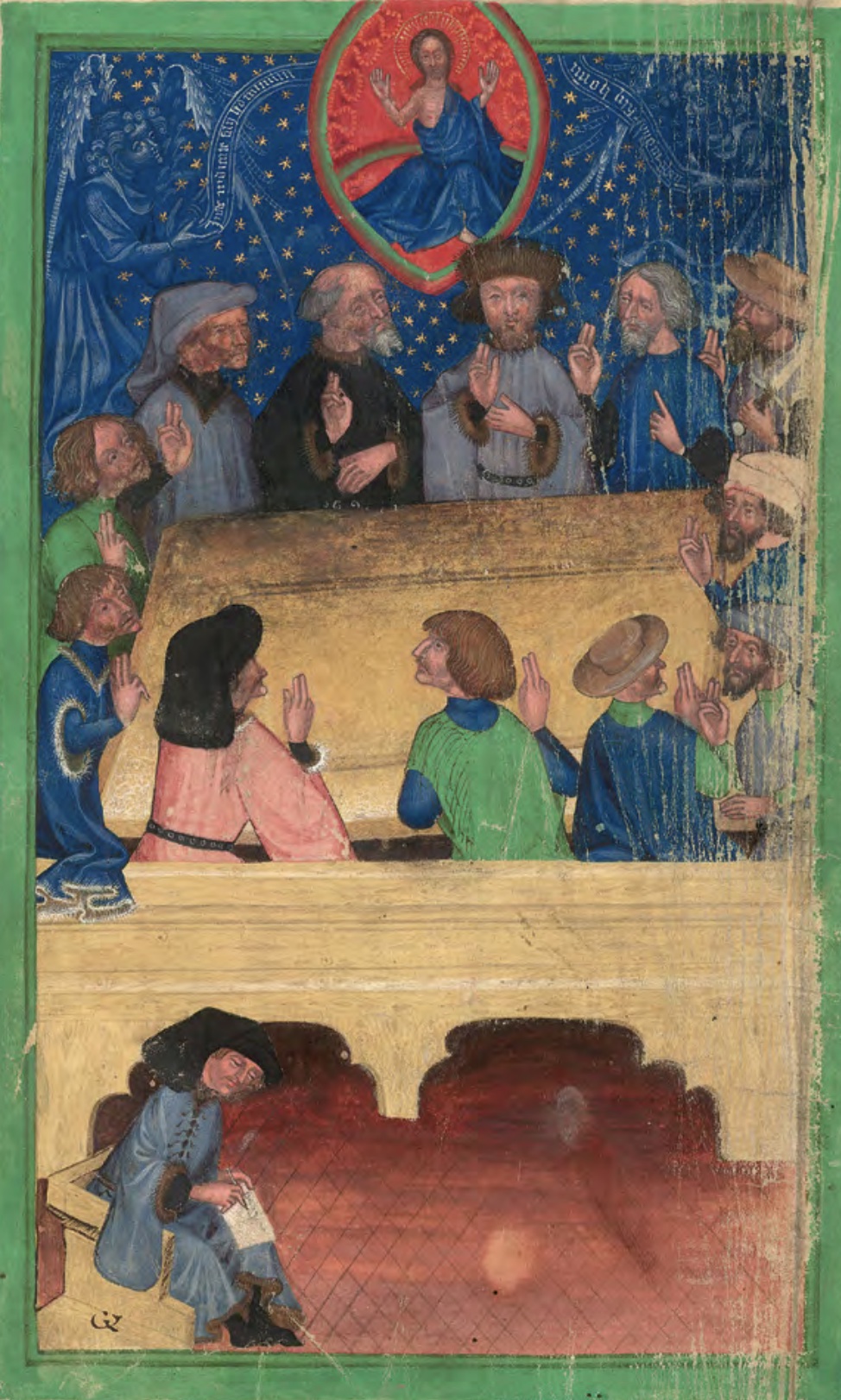
Meeting of the municipal council in the depiction from the Memorial Book of Olomouc (1430-1492). Scribe Václav from Jihlava (bottom left) wears a blue gown, lined with fur, with a square baggy sleeve and only one opening for the hand. The councilor in blue above him has a gown with a baggy sleeve, but with a free end, similarly to the man in green from the illumination in the Shortened Chronicles by David Aubert. It also shows how Czech gowns appear somewhat flattened compared to their Western counterparts.
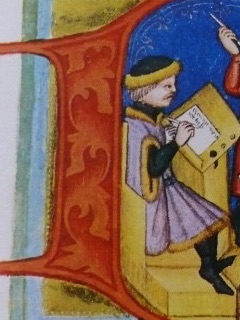
Václav of Jihlava in a purple gown lined with fur and baggy sleeves. Excerpt from the Brno Legal Book of Václav of Jihlava (1446).
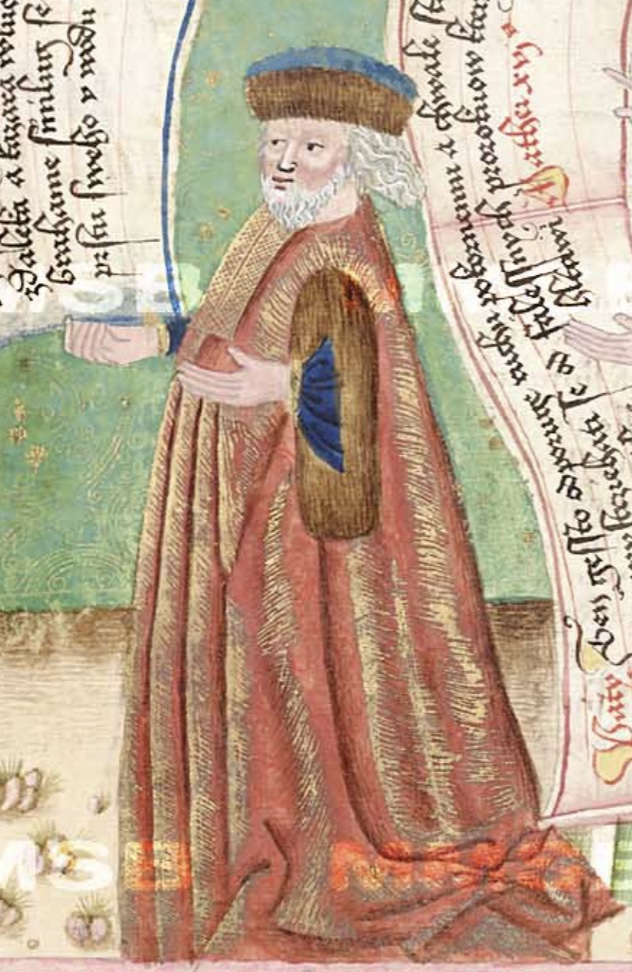
Wealthy man in a long fur-lined gown with a square baggy sleeve, on a page from the Codex of Jena (1490-1510).
Priest in a long, fur-lined gown with a square baggy sleeve, on a cutout from the Codex of Jena (1490-1510).
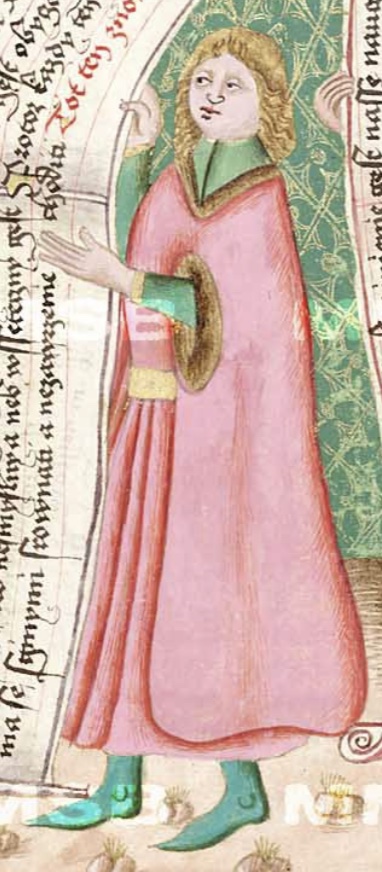
Wealthy man in a long, fur-lined gown with a square baggy sleeve, on a cutout from the Codex of Jena (1490-1510).
Sources:
If you enjoyed this article, please consider making a small financial contribution. Writing articles is very time consuming and we do it in our free time.
IBAN: CZ39 2010 0000 0028 0346 2929
BIC/SWIFT: FIOBCZPPXXX