


Overview of Military Campaigns 1434–1525
The Bavarian War
The Bavarian War of 1459 to 1463, also known as the Princes' War, was a consequence of the expansionist efforts of the principalities. The Margrave of Brandenburg, Albert III Achilles of the House of Hohenzollern, who had by then already unified the Principalities of Bayreuth and Ansbach, stood against the Duke of Bavaria-Landshut, Louis IX, known as the Rich. The so-called Mainz Diocesan Feud, also known as the Baden-Palatinate War, a military conflict over the seat of the Archbishop of Mainz, is sometimes considered part of this conflict.
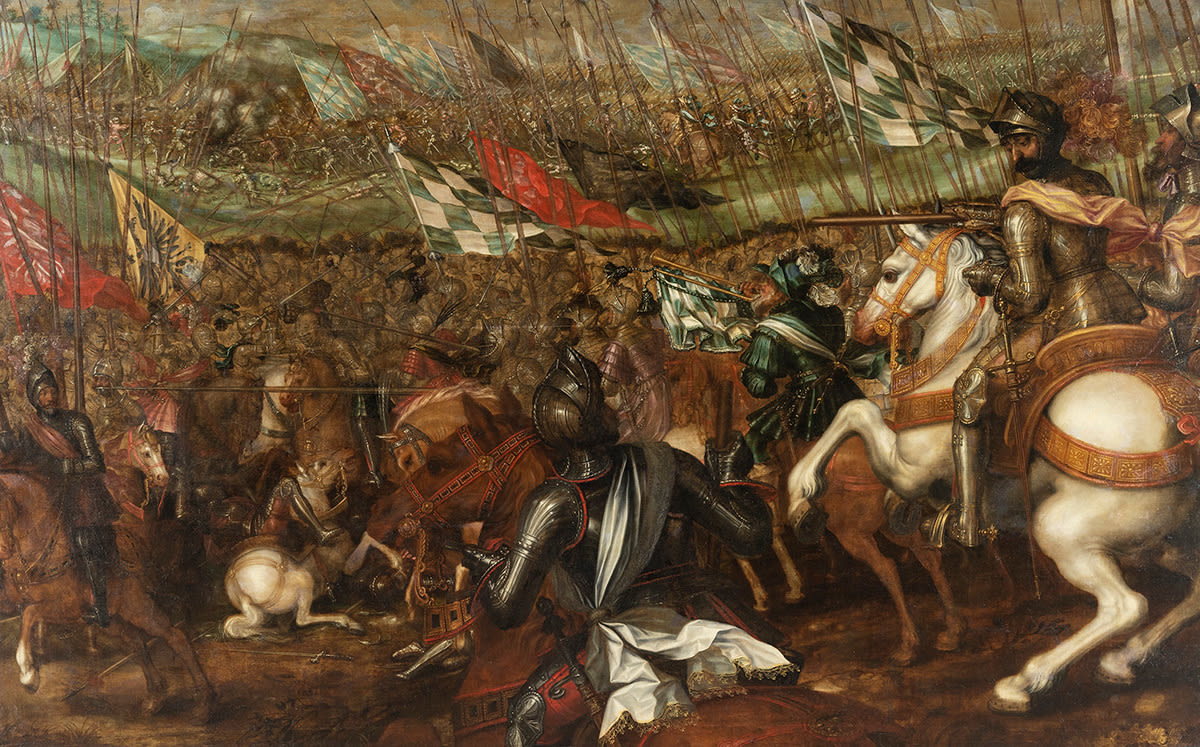
Victory at the Battle of Giengen 1462, painting by Hans Werl, circa 1603
Prelude
The Duke of Bavaria-Landshut, Louis IX the Rich (1450–1479), was, alongside Elector Frederick I of the Palatinate, known as the Victorious (1425–1476), and the Margrave of Brandenburg, Albert III Achilles (1414–1486), one of the most prominent figures among the German princes in the second half of the 15th century. His financial strength, which was based on a rich paternal inheritance and a well-functioning territorial administration, as well as his generosity and magnificent presentation, earned him a reputation for legendary wealth. In the field of imperial politics, he relied fundamentally on the Wittelsbach alliance system created jointly with Elector Frederick I of the Palatinate (both were Wittelsbachs). In particular, the Landfrieden alliance with Duke Albert III of Bavaria-Munich (also a Wittelsbach) and Count Palatine Frederick of 17 December 1451 held strong attraction for the princes, nobility, and cities in southern Germany. After the Swabian imperial cities, Duke Sigismund of Tyrol (1455) and the Bohemian King Ladislaus the Posthumous (1457) later also joined the Wittelsbach alliance system. In 1458, Duke Louis and Count Palatine Frederick renewed and strengthened their coalition through a lifelong alliance.
,_Herzog_von_Bayern-Landshut_-_4541_-_Bavarian_State_Painting_Collections.jpg)
Louis IX of Bavaria, painting by the German painter Julius Zimmermann (1824–1906)
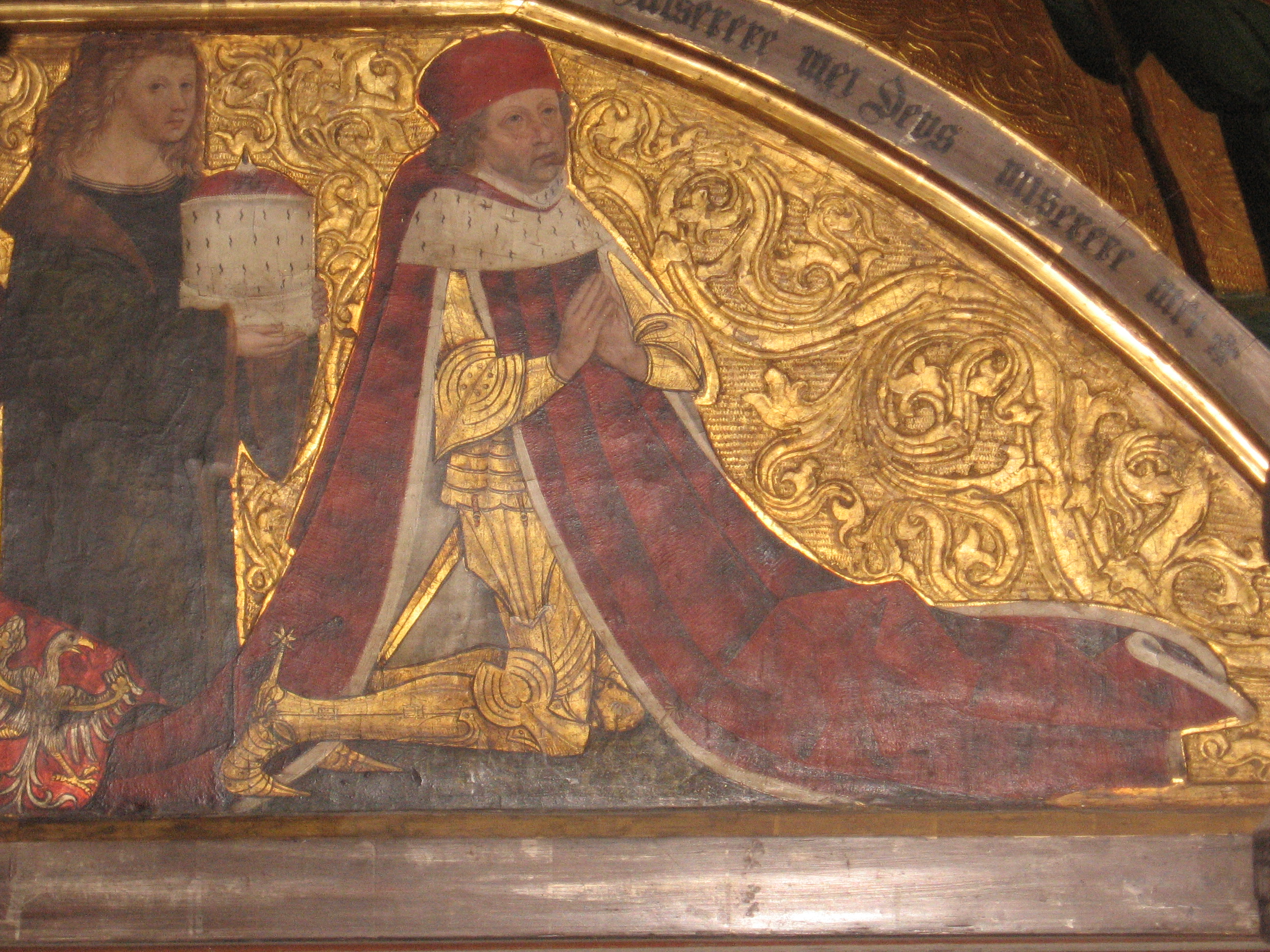
Depiction of Albert Achilles on the predella of the Swan Order altar he donated (1484) in St. Gumbertus Church.
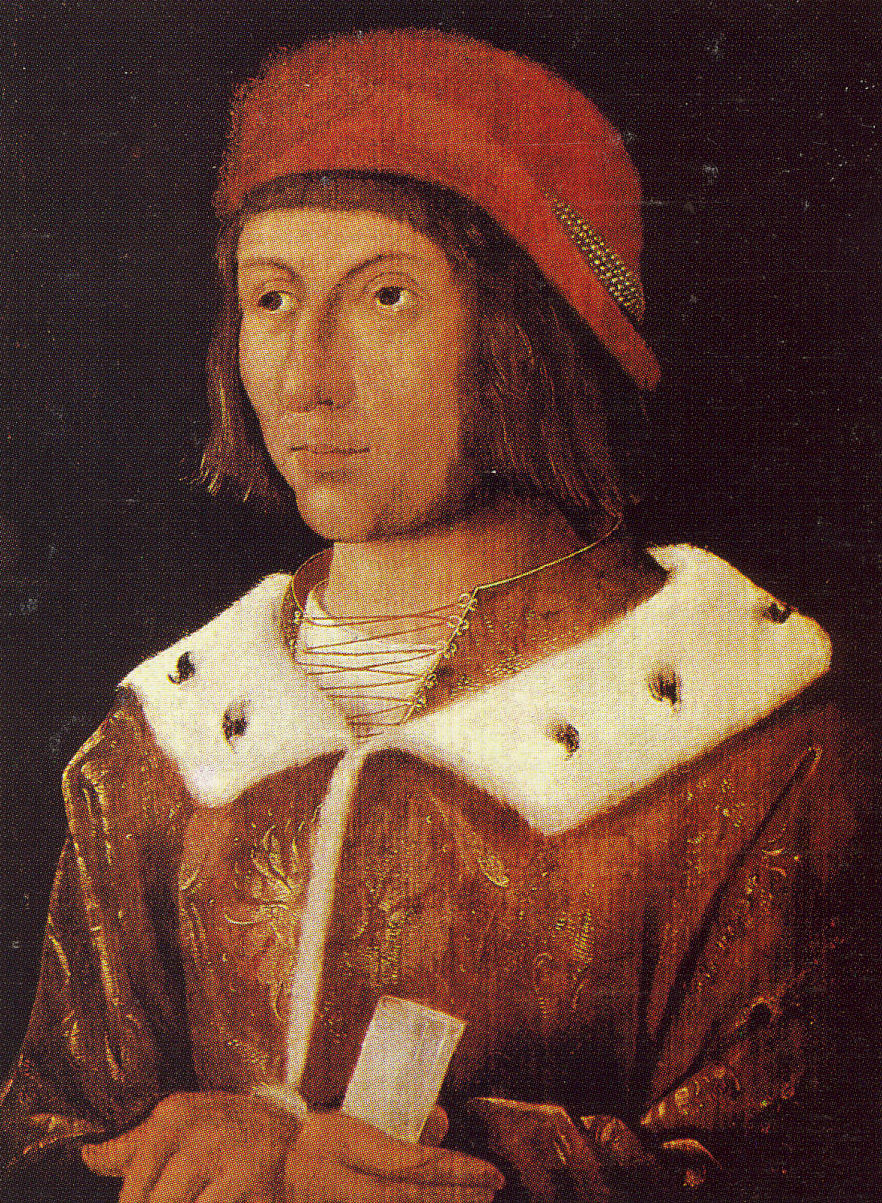
Frederick I of the Palatinate, painting by Albrecht Altdorfer (1480–1538)
But in particular, the relationship between Elector Frederick I of the Palatinate and Emperor Frederick III harboured a high potential for conflict, because the emperor never recognised the rule of the Count Palatine, which he had appropriated against the inheritance law of the Golden Bull. In addition, rivalry also arose between the Count Palatine and Margrave Albert III Achilles.Albert Achilles attempted to expand his jurisdiction and thereby his influence over neighbouring territories. For this reason, he elevated the Landgericht in Nuremberg, where he held the office of burgrave and thus had this court subordinate to him, to an imperial court. In this way, he asserted his claim to unlimited jurisdiction through the Nuremberg court for the entire Empire and, in the name of the emperor as supreme judge, claimed the right to take over court proceedings from all regions. This would have meant that he could influence the jurisprudence of neighbouring principalities and, as a higher court, could overturn decisions of subordinate courts. Behind Albert Achilles' efforts was also the idea of restoring the Franks under Hohenzollern dominion. In combination with ducal dignity, this idea remained alive for a long time in the Prince-Bishopric of Würzburg, without ever becoming reality again.Albert III thus inevitably came into conflict with the Count Palatine of the Rhine and in Mosbach, with the Franconian bishoprics, and finally also with Duke Louis IX.
On the other hand, princes in south-western Germany, who also felt threatened by the expansionist territorial policy of Count Palatine Frederick I the Victorious, joined the margrave's policy. The so-called anti-Palatinate alliance between the Margrave of Brandenburg, Duke William of Saxony, Margrave Charles of Baden, Count Ulrich of Württemberg-Stuttgart, and the Archbishop of Mainz, Diether von Isenburg, was, like the renewed Wittelsbach alliance, concluded in 1458. This prepared the ground for a decisive confrontation. And the appropriate trigger for the outbreak of conflicts indeed did not take long to appear.
Although the Duchy of Bavaria-Landshut was also affected by the interventions of the Nuremberg court, the good personal relationship between Margrave Albert III Achilles and Duke Louis IX prevented the territorial rivalry from escalating into open hostility until 1458. On the other hand, Margrave Albert remained a loyal defender of imperial interests in the Empire throughout his life. Rarely, however, could he gain any benefit from this for his own goals. It was precisely in the emerging confrontation between the Wittelsbachs and the Empire that he saw an opportunity to combine imperial interests with his plans regarding the Nuremberg Landgericht by acting as the emperor's representative while still primarily defending his own interests against his territorial neighbours in Franconia and Bavaria.
This became clearly apparent when the conflict with the Wittelsbachs actually materialised. After Duke Louis IX – initially still with the help of Margrave Albert – occupied the free imperial city of Donauwörth, strategically important for controlling the Danube, in October 1458, in order to incorporate it into his duchy on the basis of old legal claims, Emperor Frederick III pronounced the imperial ban over him on 4 June 1459. As its executor, he appointed – at his own request – alongside Duke William of Saxony, also Margrave Albert. Thanks to his alliance with the Habsburgs, Archduke Albert of Austria and with Duke Sigismund of Tyrol at his back, and with the beginning recruitment of mercenaries in Bohemia, Louis IX felt strong enough to wage war against the Empire. Open conflict between the Landshut duke and Albert of Brandenburg now seemed to be only a matter of time. Suddenly, however, Duke Louis was unexpectedly deprived of the prospect of numerous mercenaries from Bohemia and thus his hope for a decisive military striking force. Following the intervention of Pope Pius II and due to as yet unresolved disputed territorial points with Bavaria, the Bohemian King George of Poděbrady forbade his countrymen from serving as mercenaries for Duke Louis. On 16 July 1459 Louis had to surrender Donauwörth to the emperor and appear before the princely arbitration court.
The so-called “blind verdicts” of the arbitration court, which sat in July 1459 in Nuremberg, were a one-sided success of the diplomacy of the Margrave of Brandenburg (127). In the essential points, the decision went against the interests of the Wittelsbachs, and also in the important question of the jurisdiction of the Nuremberg court, the vague formulation of the arbitration court allowed an interpretation in the sense of Margrave Albert. The tension between the parties in the Empire thus continued, so that a new outbreak of open hostilities remained only a matter of time.
To prevent a situation similar to the dispute over Donauwörth, the Wittelsbachs jointly sought to improve relations between Duke Louis IX and Bohemia. Between the autumn of 1459 and the autumn of 1460, they actually succeeded in progressing from cautious rapprochement to a firm bond, which was even underpinned by the betrothal between King George's daughter Ludmila and Duke Louis IX's son George. The background was the plan of the Wittelsbach adviser Martin Mair to make the Bohemian king German king against the emperor's will and thereby increase the Empire's capacity for action. A plan for which the Bohemian king was absolutely enthusiastic, but which ultimately failed due to the lack of support from the princes around Margrave Albert III of Brandenburg loyal to Emperor Frederick III. This rejection finally brought King George definitively to the side of the Wittelsbachs, with whom he concluded an alliance primarily against Margrave Albert, but thereby ultimately also against the emperor.
On the basis of these changing relations with George of Poděbrady, Bavarian war preparations took shape rapidly in the spring of 1460. Duke Louis again relied primarily on mercenaries from Bohemia, of whom at least 5,000 entered his service that year. Some Czech condottieri stand out particularly for the size of their mercenary contingents: Dobrohost of Ronsperg and Horšovský Týn brought more than 1,300 mercenaries into the service of Duke Louis, Racek of Janovice and Rýzmberk about 1,000, and Mikuláš Kaplíř of Sulevice and Vimperk was represented in the ducal army by about 900 men. In addition, several other condottieri and mercenary commanders had strong contingents of up to several hundred men.
Course of the War
In March 1460, open armed conflict broke out, conducted according to the traditional forms of feud. When Count Ulrich V of Württemberg (ruled 1433–1480) and Count Palatine Louis of the Palatinate-Zweibrücken, allies of Albert III Achilles, attacked the Electorate of the Palatinate as part of the Baden-Palatinate War, Louis the Rich took the side of Elector Frederick of the Palatinate and, under the pretext of implementing the alliance treaty, had his long-prepared troops march against Margrave Albert into Hohenzollern Franconia. The ducal army had a clear superiority over the margrave's army and achieved some rapid successes. First, the main direction of the Bavarian attack turned against the Bishopric of Eichstätt, because Bishop Johann von Eich was an ally of Margrave Albert. After a short siege, the city of Eichstätt fell on 7 to 11 April 1460 into the hands of the duke, and Bishop Johann was forced to sign a treaty that permanently severely restricted the independence of his bishopric vis-à-vis Bavaria. In mid-April, Duke Louis continued his campaign in Franconia and marched through Heideck and Hilpoltstein to the small margravial town of Roth, which he began to besiege on 27 April 1460. With a short interruption between 30 April and 3 May, caused by supply difficulties, the army, by then probably about 20,000 men strong, now set up a fortified camp at Roth, from which reconnaissance raids by individual mercenary contingents were repeatedly launched into margravial territory. Among other things, the town of Windsbach was set ablaze and the duke's Czech mercenaries plundered the Augustinian monastery in Pillenreuth near Nuremberg.
On 5 May 1460, Margrave Albert appeared before Roth with an army of about 10,000 men and encamped with it at a “cannon shot's distance” from the Bavarian military camp. During the following seven weeks, no major battles that might have been decisive for the course of the war took place, even though the opponents lay so close to each other. Instead, there were almost daily smaller skirmishes between the camps or mutual shelling from the Wagenburg. At the same time, further reinforcements arrived before Roth, so the armies continued to grow. Duke Louis is said to have eventually had about 30,000 men in his army, the margrave several thousand fewer. Given the dramatically tense situation before the besieged Roth, in which neither side was willing to yield, a decisive battle could have broken out at any moment. Meanwhile, however, diplomatic efforts for a peaceful resolution of the conflict were again increasing on both sides and soon brought their first successes, even though both main opponents were hardly inclined towards peace. Duke Louis considered himself the military victor of the war, while Margrave Albert demanded the withdrawal of the Bavarian army before he was willing to negotiate at all. Only the threatened disintegration of his army through the departure of Saxon allies finally forced Margrave Albert to yield. The result of the conciliation negotiations was the so-called Roth Directive of 24 June 1460, which appears as a complete success of Wittelsbach policy. The “blind verdicts” from Nuremberg were annulled, the jurisdiction of the Nuremberg court was considerably restricted, the Bishopric of Eichstätt remained under Bavarian influence, and Duke Louis did not have to evacuate the occupied margravial territories. Regarding further disputed issues, such as compensation for war costs or the evacuation of occupied areas, the Bohemian King George of Poděbrady was to serve as arbitrator. When on 4 July 1460 Count Palatine Frederick also defeated his opponents at the Battle of Pfeddersheim, it seemed that the Wittelsbachs and their allies were triumphing all along the line.
The fragile peace, however, was once again not to last. In the following months, Margrave Albert of Brandenburg repeatedly sought to repudiate his recent recognition of the Roth Directive. In contrast, Louis of Bavaria-Landshut insisted on his acquired territorial positions in Franconia without accommodating the mediators' efforts at compromise. Meanwhile, he knew that the Bohemian King George, who had definitively turned away from Margrave Albert due to the rejection of the proposal regarding the election of a German king, was more than ever on his side.
Besides King George, another important link in the Wittelsbach alliance system was Archduke Albert VI of Austria, brother and dynastic rival of the emperor. When he launched open war against the emperor in the summer of 1461 in the dispute over the Austrian inheritance of Ladislaus the Posthumous, who had died in 1457, this also triggered another round of disputes between the Wittelsbachs and Margrave Albert of Brandenburg with their respective allies. Duke Louis's military alliance aid to Archduke Albert provided Emperor Frederick with a pretext to declare war on him in July 1461. As Imperial Captains, he appointed alongside Margrave Charles of Baden and Count Ulrich of Württemberg also Margrave Albert III Achilles, who saw in this an opportunity to revise the Roth Directive. Just as in 1459 in the dispute over Donauwörth, Albert here combined imperial policy with his hegemonic policy in southern Germany and Austria.
Similar to the previous year, Duke Louis was better prepared for the approaching conflict than his opponent. Already in the early summer of 1461, he began war preparations, which again included successful recruitment of mercenaries in Bohemia. At least 2,000 Czechs entered his service from August, strengthening the ducal army, which with a total of 16,000 men far exceeded the army of Margrave Albert. Racek of Janovice and Rýzmberk sent about 500 mercenaries, Přibík Šatava arrived with more than 400 men from southern Bohemia, Jan Jenec of Janovice and Petršpurk with about 250 men from western Bohemia, these being the largest contingents. In addition, active military support from the Bohemian king, who declared feud against the margrave and had a strong army march against the Upper Franconian territories of the Hohenzollerns, was also provided. Even though the military success of this deployment remained limited, it nevertheless tied down important forces of the margrave that he urgently needed on the main theatre of war in Central Franconia.
This time, Duke Louis advanced with his army even deeper into margravial territory than the year before. Neustadt an der Aisch and Uffenheim were conquered, Windsbach, Heilsbronn, and other places severely damaged. In total, at the very beginning of the campaign, 18 margravial towns, places, and castles are said to have fallen into the hands of the Bavarian duke, who, together with the contingents of the allied Franconian bishops and Count Palatine Frederick, dominated the battlefield. Margrave Albert, who waited in vain for the promised reinforcements from his allies, had to limit himself to holding Ansbach and Schwabach and from there launching occasional raids against the ducal army. Only when in October the allies left Duke Louis's army for various reasons and the strained supply situation, which worsened further with the onset of adverse weather, showed the necessity of splitting the army, did the situation gradually change. Decisive, however, was the behaviour of the Bohemian king, who accepted the role of mediator offered by the emperor, withdrew the Czech contingents from Upper Franconia, and called upon Duke Louis to also release the Czech mercenaries serving under him. Margrave Albert immediately exploited the ensuing Bavarian retreat by recapturing in rapid succession almost all the places occupied by the Bavarians.
When the disputing parties finally met in November 1461 in Prague to discuss the possibilities of concluding peace through King George, the chances of reaching an agreement were thus scarcely better than before the start of the war. While Duke Louis was unwilling to go back beyond the provisions of the Roth Directive and instead made ever more extravagant demands for war compensation, the margrave, after his recent successes, no longer felt like the defeated party and therefore showed little willingness to even participate in negotiations. He ignored the ceasefire concluded in December with the argument that it had no validity for the as yet unfinished imperial war against Duke Louis. And when Margrave Albert was certain that the emperor had his back, he indeed renewed the war against the Wittelsbachs in January 1462.
In 1462, however, unlike the previous year, Emperor Frederick's appeals to the imperial cities to fight against Duke Louis took effect. The balance of power thus developed differently this time than in the campaigns of 1460 and 1461. The Swabian cities, led by Augsburg and Ulm, now actively participated in the war against Duke Louis, which this time also shifted the centre of gravity of military operations more into the Swabian area. However, the imperial army was unable to exploit its initial superiority. Duke Louis managed relatively quickly to assemble a strong army again – once more with strong participation of mercenaries from Bohemia, whose number, however, cannot be determined for this year. In addition, the Bohemian king also resumed war against the margravial areas around Wunsiedel. With two great successes in the summer, it then seemed that the decision was finally falling in favour of the Wittelsbachs. On 30 June 1462, Count Palatine Frederick managed to win a crushing victory over his opponents from south-western Germany at the Battle of Seckenheim, in which Margrave Charles of Baden and Count Ulrich of Württemberg were taken prisoner by the Palatinate. A similar success was also achieved by Duke Louis of Bavaria-Landshut with his victory over the imperial army led by Margrave Albert on 19 July 1462 at Giengen.
The Baden-Palatinate War and the Battle of Seckenheim
It was part of the archiepiscopal dispute over the occupation of the Mainz archdiocese, also known as the Baden-Palatinate War. In 1459, the cathedral administrator Diether von Isenburg was elected new Archbishop of Mainz by a narrow majority over Adolf von Nassau. The price for this election was joining the anti-Palatinate alliance, and Diether was thus forced to march against Count Palatine Frederick I, but on 4 July 1460 he lost the decisive Battle of Pfeddersheim. In 1461, Diether convened a princely diet in Nuremberg, where he advocated for imperial and ecclesiastical reforms. He emphatically demanded the abolition of papal annate requirements through a general council. His critical stance towards Pope Pius II and Emperor Frederick III led to his deposition and excommunication by the pope on 21 August 1461. The pope then installed his rival Adolf von Nassau on the archiepiscopal throne in Mainz on 1 October 1461. Diether, however, refused to relinquish the archbishopric, supported by the city of Mainz, his brother Louis, and now also his former enemy Frederick I of the Palatinate, who in return for his help received the towns of Lorsch, Heppenheim, and Bensheim. Adolf allied himself with the Archbishop of Trier, John II of Baden, Bishop George of Metz, Bishop John II von Hoheneck of Speyer, and Count Ulrich V of Württemberg. Margrave Charles I of Baden initially attempted to mediate between the warring factions, but then took Adolf's side alongside his brother, Bishop George of Metz, which led to the Baden-Palatinate War, an attempt at the forcible conquest of the diocese.
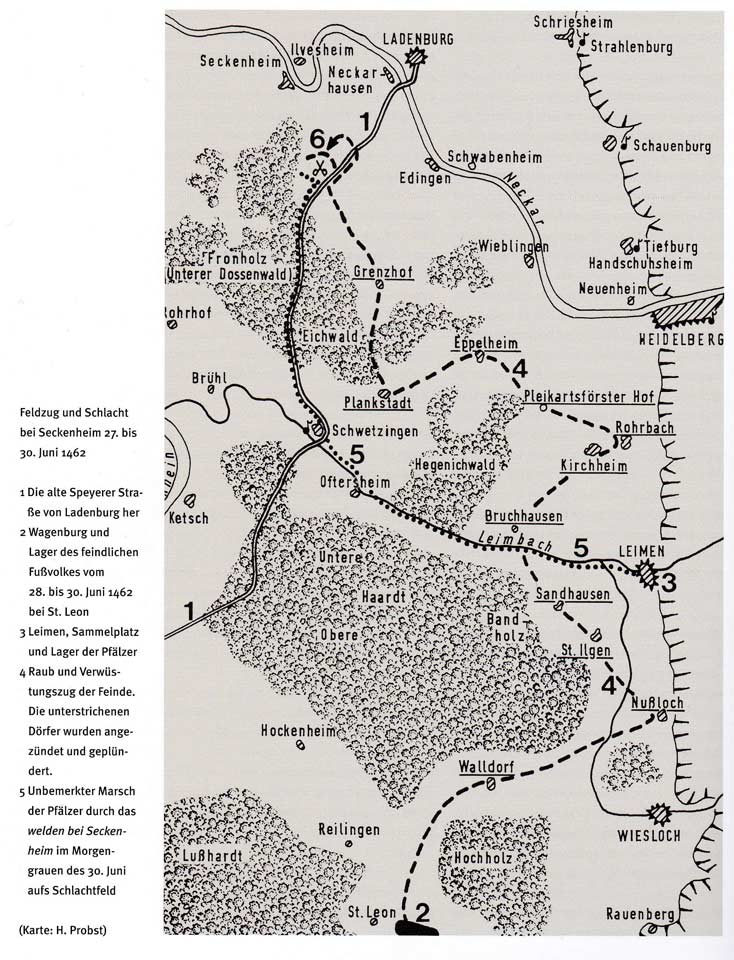
The opponents of Frederick I intended to invade the Palatinate from the south, as they believed the elector was with his troops in Bavaria to help Duke Louis IX against Albert III Achilles, and therefore assembled an army of 10,000 men near Pforzheim. A military camp was set up between Roth and St. Leon, and cavalry composed of princes and knights burned the surrounding fields and villages and massacred the inhabitants. Frederick I ordered his vassals and their men-at-arms to assemble at Leimen, where he could unobtrusively gather his forces. He himself did not arrive until 29 June and from there observed the nocturnal activities of his enemies. Couriers were sent to the Archbishop of Mainz, Diether von Isenburg, the Counts of Leiningen and Katzenelnbogen, who were on the left bank of the Rhine and were ready to march through Altrip to Lower Dossenwald. The number of fighters who pinned walnut leaves to their garments – the identifying marks of the Palatinate forces – increased due to the great influx of peasants from the region. The Baden forces, on the other hand, pinned tufts of oats to their garments.
On the night of 30 June, he marched with about 300 horsemen and additional infantry through the Schwetzingen Forest to “Frohnholz” (today's Dossenwald) south of Seckenheim, which the imperial forces intended to burn down the following day. During the march, the Palatinate forces were reinforced by a further approximately 300 horsemen and additional infantry from the contingents of the Archbishop of Mainz, Diether von Isenburg, and Count Philipp von Katzenelnbogen.
When the imperial attackers set out from their fortified camp the following morning and advanced on Seckenheim with 700 to 800 horsemen to burn it down, they were unexpectedly attacked from behind by 600 horsemen of the Palatinate side, with the battle cry of the Count Palatine: “Hut Palatzgraff oder nimmer mee!” (Hold on, Count Palatine, or never more!), while the infantry of about 2,000 men was kept by Frederick I out of sight in a nearby forest. Frederick's less numerous cavalry adopted an echelon formation with men-at-arms in the centre and two rows of mounted archers on the flanks. After a brief initial exchange of fire, the heavy cavalry of both armies charged at each other, and Frederick's knights only barely prevented the allied men-at-arms from breaking through. While the horsemen fought each other, Frederick's infantry emerged from its hiding place and encircled the imperial allies. A group of about 300 allied horsemen did manage to break out and then attacked the Palatinate grooms who were waiting for their men-at-arms and killed them, but this no longer changed the outcome of the battle.Ulrich of Württemberg refused to accept defeat but was challenged to a duel by Hans von Gemmingen, who cried: “Zkusím štěstí s Vaší Milostí!” (I shall try my luck with Your Grace!) and was defeated. 45 allied knights were killed and approximately 400 more horsemen captured. The rest scattered across the surrounding area and brought the terrible news to the camp at St. Leon. There they set off on the return journey in panic, fearing the vengeance of the Count Palatine and his enraged subjects. The Palatinate army achieved a decisive victory, killing 45 knights and capturing 124 nobles and 204 squires, while losing 12 of its own knights killed. Among the prisoners were three enemy leaders: Margrave Charles I of Baden with 40 nobles and 79 squires, Count Ulrich of Württemberg with 45 nobles and 71 squires, and Bishop George of Metz with 39 nobles and 53 squires. Only Louis of Zweibrücken escaped capture. By the following year, the princes were ransomed for large sums and significant territories.
The diocesan feud, however, was not yet over. Further fighting claimed many victims and caused devastation everywhere, and the city of Mainz itself suffered serious damage. On the night of 28 October 1462, Adolf von Nassau managed to penetrate the city with 500 men through the Gautor by the treachery of Mainz citizens, and after 12 hours of street fighting, he seized control. 400 people lost their lives and Adolf's men plundered and burned the city, including the Dominican monastery. As “punishment” for supporting Diether, Adolf stripped the city of its freedom privileges and thereby its status as a free city; the city came under the administration of a Vicedominus appointed by the archbishop. The following day, the citizens were summoned to the Dietmarkt. All 800 citizens who appeared were expelled from the city; about 400 of them were readmitted somewhat later and allowed to remain in Mainz.
Even these Wittelsbach successes, however, did not end the war. Instead, the heavy burden on Bavarian finances from conducting the war, primarily through the large mercenary army, became apparent. The resources of Duke Louis the Rich were exhausted. Shortly after his triumph at Giengen, he therefore felt compelled to dismiss the greatest part of his mercenaries, which once again changed the military situation. From now on, the scene in southern Germany was shaped by ongoing petty warfare with alternating successes.
In addition, meetings for negotiations took place again to finally settle the conflicts. After the ceasefire concluded at the end of August 1462 in Nuremberg, further arduous negotiations followed. Only a year later, in July 1463, a peace congress was held in Prague under the leadership of the Bohemian King George of Poděbrady, who had in the meantime reconciled with Emperor Frederick III. With this initiative, the Utraquist king hoped to avert the excommunication threatened by Pope Pius II. After complex negotiations, a peace agreement consisting of several individual treaties was concluded on 22 and 23 August 1463. The so-called Peace of Prague did not resolve all disputed issues, but it nevertheless proved lasting. Both sides had to make concessions. While Margrave Albert III Achilles had to definitively abandon his plans for the domination of Franconia, which he had sought to achieve by strengthening the Nuremberg Landgericht, Duke Louis IX was obliged to evacuate the still-occupied margravial territories and settle all compensation claims with the margrave. Nevertheless, he did manage to defend himself, which can be evaluated as a success in his case. A success for which he owed primarily to his strong mercenary army, which was to a large extent – probably even in the majority – composed of Czech mercenaries.
The Black Army of Matthias Corvinus
The Black Army (Hungarian Fekete sereg), also called the Black Band, is the name posterity gave to the mercenary army of King Matthias Corvinus of Hungary. The name was not used in Matthias's lifetime; it appears only after his death in 1490, and its origin is unclear – perhaps it came from the army's last commander, the "black" John Haugwitz, or from the black sashes the mercenaries wore in mourning for the king. At the beginning of his reign (1458) Matthias had to rely on the banderia of the prelates and barons and on an ineffective noble levy. He hired mercenaries gradually, as his finances allowed, began to incorporate them systematically into the royal army in the mid-1460s, and their numbers rose sharply during the Bohemian–Hungarian wars (1468–1478). The army broke up after Matthias's death, and its last remnants perished in 1492–1493.
The main strength of the army remained its cavalry, above all the heavy cavalry, which decided great battles; the light cavalry (hussars) and the infantry complemented it, and Matthias also had plenty of artillery. According to Péter E. Kovács, heavy cavalry, light cavalry and infantry each made up roughly a third of the army. Firearms played only a supporting role: in his letter of 1481 (see below) Matthias himself writes that handgunners made up a fifth of the infantry, and he considered them less capable than the other foot soldiers. By comparison, even at the turn of the 15th and 16th centuries only about 10% of the infantry in Western European armies used firearms. There were initially 6,000 to 8,000 mercenaries; in the 1480s their number may have reached 15,000 to 20,000, but the king hired most of them only for limited periods, and the permanent mercenaries may have numbered around 10,000 to 12,000. The famous review of 20,000 horsemen and 8,000 foot soldiers with at least 9,000 wagons, described by the eyewitness Antonio Bonfini, was held by Matthias on 17 August 1487 on the plain before the captured town of Wiener Neustadt. Besides the mercenaries, however, it included the banderia of Hungarian prelates and barons and town mercenaries hired for a few months, so it does not show the strength of the Black Army alone. The mercenaries were chiefly Czechs and Poles, later also Germans and, in the 1480s, more and more Hungarians; Swiss soldiers served as well, such as the captain Hans von Hallwyl. The hussars were largely Rascians (Serbs).
In 1458 Matthias asked his future father-in-law, George of Poděbrady, for 500 heavy horsemen whom he would have had to pay – itself a sign of how little he could rely on the noble levy. The real core of the mercenary army, however, came from the Czech mercenaries who controlled northern Hungary: John Jiskra of Brandýs entered Matthias's service in the spring of 1462, and after the defeat of the Bratříci ("Brethren") at Veľké Kostoľany in 1467 many of them also entered royal service. The Czech share of the army remained high throughout its existence, and in the infantry it even predominated.
Arms of Service and Organisation
Heavy cavalry. The most important arm, the one that decided great battles, was still the heavy cavalry. It was divided into sub-units called legions, which corresponded to the later cavalry companies and consisted of 25-man detachments, called turmae in the Latin of the day. With the advent of artillery and the growing role of light cavalry, the strategic importance of heavy cavalry declined, but the great battles – although they became less and less frequent – were still decided by this arm (the Battle of the Valová River 1470, the Battle of Breadfield 1479, Leitzersdorf 1484, Thomaswaldau 1488).
Light cavalry. The hussars appeared on the South Slavic frontier at the end of the 14th century, but they became an important part of the Hungarian cavalry only under Matthias. They excelled above all in irregular warfare, raids, ambushes, screening and reconnaissance, but they also proved themselves in open battle. In Matthias's reign an older type of light cavalry still existed. Bonfini writes of the camp at Győr in 1477 that the king had three kinds of cavalry – Czech, Rascian (Serbian) and Hungarian. The distinction here does not mean only nationality but above all the type of horseman: the Czech horsemen were heavy cavalry, the Rascian horsemen were hussars, and the Hungarian horsemen were a transitional light cavalry close to the older type. By the end of the 15th century, however, the term hussars clearly meant the Hungarian light cavalry.
The light cavalry was organised in the same way as the heavy cavalry, in legions and turmae. Its importance also grew because, in line with Matthias's strategy, larger clashes with the Turks were rare, whereas small-scale fighting and raids multiplied on the frontiers, and in these the hussars were indispensable.
Infantry. According to the report of the Venetian envoy of 1479, Matthias's infantry consisted of 6,000 Hungarians and 10,000 Czechs. Matthias described the organisation and fighting style of this infantry in March 1481, when he was sending an auxiliary force under Blaise Magyar to his father-in-law, King Ferdinand I of Naples, against the Turks who had seized Otranto. He asked Cardinal Gabriele Rangoni, Bishop of Eger, who was then staying in Naples, to explain to the king how his troops were organised:
“In tertio ordine pedites sunt, et hi quidem diversis ordinibus distincti, horum enim alii gregarii sunt, alii armigeri, nonnulli clipeati. Gregarii milites seu pedites pro qualibet angaria ad unam personam habere volunt 8 aureos. Armati vero seu clipeati, cum sine pueris et servitoribus arma et clipeos ferre nequeant, et quia hos pueros opus est illis in hunc usum pro necessitate conservare, volunt eos unusquisque ad arma singula et ad clipeos habere simul cum duorum hominum stipendio. Sunt preterea magistri pixidum, qui sciunt trahere ex sclopetis et huiusmodi minoribus instrumentis, verum non ita strenui et utiles sunt, uti pedites ad trahendum ex pixidibus; sed post clipeatos in initio conflictuum, antequam scilicet manus conferant, item ad expugnationes castrorum et defensiones maxime utiles sunt; itaque volunt et isti habere tantum, quantum pedites gregarii. Apud nos vero ista consvetudo observatur, quod quantacumque peditum summa sit, quinta pars ex pixidariis constituatur. […] Armigeri apud nos muri loco habentur, qui nunquam se loco movent, etiamsi ad unum in sua statione trucidentur. Gentes vero levis armature secundum opportunitatem excurrunt, et postquam fessi sunt vel graviora pericula sentiunt, post armatos se recipiunt, atque ibi restauratis viribus et resumpto spiritu consistunt, donec captata commoditate sursum ad pugnas excurrant; peditatumque denique omnem et pixidarios armati clipeatique milites circumsistunt, non aliter, quam si in munitione consistant; clipei namque maiores ad invicem positi per circuitum formant effigiem castelli, et parietes representant, quibus protecti gregarii pedites et omnes qui in medio sunt, velut ex propugnaculis et munitionibus pugnant, et data opportunitate erumpunt […]
(The third class are the foot soldiers, and they in turn are divided into several kinds: some are common foot soldiers, others armoured men, some shield-bearers. The common soldiers, that is the foot soldiers, want 8 gold florins per person for each quarter of a year (angaria). The armoured men and shield-bearers, since they cannot carry their armour and shields without boys and servants, and since they have to keep these boys for this purpose out of necessity, each want to have them for every armour and every shield, together with the pay of two men. There are also gun masters who know how to shoot with handguns and similar smaller weapons; with their guns they are not as hardy and useful as the other foot soldiers, but behind the shield-bearers at the beginning of an engagement, before it comes to hand-to-hand fighting, and likewise in storming and defending castles they are most useful; therefore they too want as much as the common foot soldiers. With us this custom is observed: however large the number of foot soldiers, a fifth of them are gunners. […] With us the armoured men are regarded as a wall that never moves from its place, even if they are cut down to the last man where they stand. The light-armed troops sally out as opportunity offers, and when they grow tired or sense greater danger, they withdraw behind the armoured men and stay there, recovering their strength and catching their breath, until they seize a favourable moment and run out to fight again. And finally the armoured men and the shield-bearers surround all the foot soldiers and the gunners, just as if they stood in a fortification; for the larger shields, set side by side in a circle, form the likeness of a castle and represent walls, and protected by them the common foot soldiers and all who are in the middle fight as if from bulwarks and fortifications, and when the opportunity arises they break out […])”
- Matthias Corvinus in a letter to Cardinal Gabriele Rangoni, Zagreb, 10 March 1481
Major Battles and Campaigns
Fighting John Jiskra of Brandýs and the Bratříci (1458–1467). When Matthias came to the throne in January 1458, much of Upper Hungary (today's Slovakia) was controlled by Czech mercenary captains. John Jiskra of Brandýs had held the mining towns, Košice and Zvolen there since 1440, first in the name of Queen Elizabeth and her son Ladislaus the Posthumous, and in 1459–1461 on the side of Emperor Frederick III, who laid claim to the Hungarian crown. Besides him there were more or less independent bands of Bratříci, whose castles and fortified camps threatened the mining towns and the collection of taxes. Matthias led several campaigns against them. After a preliminary agreement between Matthias and Frederick III, Jiskra submitted in April 1462, handed over his castles and entered royal service; in compensation he received 25,000 florins and the castles of Şoimuş (Solymos) and Lipova in Transylvania. The peace treaty concluded at Wiener Neustadt on 19 July 1463 also granted him an amnesty. Matthias finally defeated the Bratříci at the end of January 1467 at Veľké Kostoľany (Kosztolány), where he took the fortified camp of Jan Švehla; Švehla was hanged, but many of the survivors entered royal service.
The Bosnian campaign (1463–1464). In the summer of 1463 Sultan Mehmed II conquered the Kingdom of Bosnia, and the last Bosnian king, Stephen Tomašević, was executed. Although the sultan's army withdrew, it left Ottoman garrisons in the key fortresses. In the autumn of 1463 Matthias marched south with the Hungarian army and in December 1463, after a siege of several weeks, took Jajce, the key fortress on the middle course of the Vrbas. Together with dozens of other places occupied during the campaign, Jajce formed the core of the new Banate of Jajce, which held out until 1527; in 1464 the Banate of Srebrenik was added, but the siege of Zvornik that year failed. At that time the Hungarian army still consisted mainly of the nobles' banderia – Janus Pannonius, who was present at the siege of Jajce, does not mention mercenaries.
The Moldavian campaign (1467). In August 1467 the Transylvanian estates formed a league against Matthias, but the revolt collapsed without a fight in September, and the king punished its leaders with executions and confiscations. Suspecting Prince Stephen III the Great of Moldavia of supporting the rebels (Stephen had also taken the border fortress of Chilia from him in 1465), he crossed the Carpathians into Moldavia in the autumn, accompanied by the Moldavian pretender Peter Aron. The campaign ended on the night of 14–15 December 1467 with a surprise attack on the Hungarian army at the Battle of Baia: Stephen's men set fire to the small town in which Matthias was quartered and inflicted heavy losses on the Hungarians. The king himself was badly wounded and had to withdraw with his army to Transylvania. The campaign was a failure: in 1468–1471 Stephen raided Transylvania (in 1469 he caught and executed Peter Aron), and he was reconciled with Matthias only in 1475.
The Bohemian–Hungarian War (1468–1478). In December 1466 Pope Paul II declared George of Poděbrady a deposed heretic. When George's son Victor invaded Austria in early 1468, Emperor Frederick III asked Matthias for help, and on 31 March 1468 Matthias declared war on George. After driving Victor out of Austria he invaded Moravia. The Catholic towns of Brno, Olomouc, Jihlava and Znojmo were on his side; he had to take Třebíč (May 1468), the fortified monastery of Hradisko near Olomouc and, after a six-month siege, Špilberk Castle (February 1469). Uherské Hradiště, however, held out until 1474, and Matthias controlled only part of Moravia. In Olomouc on 3 May 1469 the Catholic nobility elected him King of Bohemia. The fighting spread to Silesia and both Lusatias, which mostly sided with Matthias. After George of Poděbrady's death on 22 March 1471 the war continued against his successor, Vladislaus II Jagiellon, with varying success in Moravia, Silesia and Hungary (the invasion of Casimir Jagiellon). It was ended only by the peace treaties negotiated at the end of 1478 and confirmed in Olomouc on 21 July 1479: Matthias kept Moravia, Silesia and both Lusatias, which could be redeemed for 400,000 florins after his death, Vladislaus kept Bohemia, and both rulers used the title of King of Bohemia. For the mercenary army the war was a period of rapid growth – it was then that its relatively permanent core formed around the Czech captain Franc of Háj.
The Battle of the Valová River (12 July 1470). When George of Poděbrady marched with his main army from Bohemia into Moravia in the summer of 1470, the field army of captain Václav Vlček of Čenov, advancing from Hodonín, was to join him near Prostějov. Matthias, informed of its movements, personally attacked it on 12 July with some 6,000 horsemen along the Valová River near Kralice in Haná. Taken by surprise, the Czechs could not deploy their wagon fort, yet they put up at least partial resistance, and Vlček withdrew with the rest of his force towards Tovačov. Reports of the losses differ: Hungarian chronicles give hundreds of dead and 1,500 captured wagons, Czech sources 150 dead, 13 prisoners and 10 wagons. Matthias did not pursue the Czechs and, with George approaching, withdrew to Brno. The battle prevented Vlček from joining George, but it was not a decisive engagement of the war.
Casimir Jagiellon's invasion of Hungary (1471). The younger son of the Polish king Casimir IV, invited by the conspirators around John Vitéz, Archbishop of Esztergom, entered Upper Hungary with a Polish army in October 1471 and occupied Nitra. The conspiracy, however, had collapsed before he arrived – at the diet in September most of the prelates and barons renewed their oath of loyalty to Matthias – and Casimir eventually withdrew to Poland without a battle.
Wars with the Habsburgs (1477–1488). Disputes with Emperor Frederick III led to two wars. The first, in 1477, ended with a peace treaty on 1 December 1477. The second broke out in 1482: the Hungarians took Hainburg and Kőszeg (1482), Bruck an der Leitha in the spring of 1484, and then besieged Korneuburg. The imperial army marching to relieve the town met them at Leitzersdorf on 11 May 1484: the imperial cavalry first routed the Hungarian heavy cavalry of István Dávidházy, but when the victors began plundering the Hungarian camp, Dobeš Černohorský of Boskovice rallied the Hungarian troops and defeated them with a counter-attack. Korneuburg surrendered in December 1484. Vienna, abandoned by the emperor, capitulated after a siege of several months at the end of May 1485, and on 1 June 1485 Matthias made his ceremonial entry; he resided there until his death. After an eighteen-month siege, Wiener Neustadt also fell on 17 August 1487, and on the plain before it Matthias held the great military review mentioned above. The truce concluded in December 1487 left the whole of Lower Austria and parts of Styria and Carinthia under Hungarian control.
The Battle of Breadfield (13 October 1479). The most famous Hungarian victory over the Ottomans in Matthias's reign was won in Transylvania near present-day Șibot (Hungarian Alkenyér) in the Mureș valley. The Ottoman raid was commanded by Isa Bey, son of Hasan Bey; Ali Bey Mihaloğlu and the Wallachian voivode Basarab Ţepeluş also took part. According to a modern estimate it numbered at most about 15,000 men (contemporary sources give 35,000 to 100,000). They faced the army of the Voivode of Transylvania Stephen Báthory, the ispán of Temes Pál Kinizsi and the Serbian despot Vuk Branković. Báthory's troops came under heavy pressure and the voivode himself was wounded several times (Bonfini says six). When Ali Bey withdrew from the field with his men, Kinizsi struck the Ottoman flank from the right wing; once Isa Bey was badly wounded, the Ottoman army collapsed. Stories in which Kinizsi arrives on the battlefield only at the decisive moment are a later dramatisation. The victory strengthened the defence of Transylvania, but it did not deter the Ottomans from further raids.
Silesia and the Battle of Thomaswaldau (1488). Silesia, which Matthias retained after the Peace of Olomouc, was governed in his name by supreme captains (Oberlandeshauptmann) – from 1474 Stephen Zápolya, later John Filipec, Georg von Stein and Duke Frederick of Legnica, among others. In 1488 the Black Army waged war on Duke John II of Głogów and Żagań, who wanted to secure Głogów for his sons-in-law of the Poděbrady family, although the estates had already done homage to Matthias as their future lord. The army was commanded by Wilhelm Tettauer (Vilém Tetour of Tetov) and Georg von Stein, while a second royal force was led by John Haugwitz. On 28 June 1488 at Thomaswaldau (today Tomaszów Bolesławiecki) it ran into Czech mercenaries marching to relieve Głogów. The hard fight, in which according to Péter E. Kovács Haugwitz's horsemen broke the Czech wagon fort, was inconclusive; the Czechs, however, fell back to Szprotawa and left the road to Głogów open. Głogów surrendered in November 1488.
Small war on the Ottoman frontier. Apart from the great campaigns, for most of Matthias's reign his army was engaged in small war on the southern frontier: it defended the banates of Jajce and Srebrenik, Šabac (taken in 1476 after a long siege) and other border fortresses, and retaliated against the raids of the Ottoman akıncı. Great field battles were the exception; raids, ambushes and the carrying off of captives were the rule. The hussars, largely of Serbian origin, excelled in this under commanders such as Vuk Branković or the Jakšić brothers. In the autumn of 1480 Hungarian forces raided Bosnia and Serbia, where they penetrated as far as Kruševac; the expedition was repeated in 1481, and according to contemporary, probably exaggerated, reports tens of thousands of Serbs were resettled in Hungary.
The death of Matthias Corvinus (6 April 1490). The king died suddenly in Vienna at the age of 47; judging by contemporary descriptions of his symptoms it was probably a stroke, although there were also rumours of poisoning. With his death the mercenary army lost its only real patron – it rested on the king's personal will and on the revenue of his extraordinary tax. Matthias's illegitimate son John Corvinus sought the throne without success, and the crown went to Vladislaus II Jagiellon, who promised the estates to abolish the extraordinary tax. Royal revenue fell to a fraction of its former level, and regular payment of wages became impossible.
Commanders and Captains
John Jiskra of Brandýs. A Czech soldier who from 1440 controlled Upper Hungary in the name of Ladislaus the Posthumous and in 1459–1461 sided with Emperor Frederick III. In April 1462 he submitted to Matthias, handed over his castles and received in compensation 25,000 florins and the castles of Şoimuş and Lipova in Transylvania. He then fought in Matthias's service, in Bosnia in 1463, and in 1468 he led a Hungarian embassy to the sultan.
Pál Kinizsi (c. 1432 – 1494). A Hungarian nobleman and commander, according to legend the son of a miller, but according to more recent research probably of petty noble origin. His strength and fearlessness made him a legend in his own lifetime; Bonfini writes that he fought with a sword in each hand, and tradition has it that he never lost a battle. From 1479 he was ispán of Temes and captain-general of Lower Hungary (capitaneus generalis partium inferiorum). He decided the Battle of Breadfield in 1479. After Matthias's death he remained loyal to Vladislaus II and in 1492 scattered the remnants of the Black Army. He died on 24 November 1494 during a campaign against Smederevo and was buried in the Pauline monastery he had founded at Nagyvázsony.
Imre Zápolya (died 1487). A member of the powerful Hungarian Zápolya family and a close confidant of Matthias. In 1486–1487 he held the office of Palatine of Hungary.
Stephen Zápolya (died 1499). Imre's younger brother. From 1474 he was supreme captain (Oberlandeshauptmann) of Silesia, in 1489–1490 governor of the Austrian lands conquered by Matthias, and in 1492–1499 Palatine of Hungary.
Stephen Báthory of Ecsed (died 1493). A Hungarian magnate, Judge Royal (iudex curiae regiae) and from 1479 Voivode of Transylvania. He commanded the Hungarian army at the Battle of Breadfield, where he was badly wounded. After Matthias's death he served Vladislaus II, but in 1493 he was removed from the office of voivode for his harsh rule over the Székelys and died shortly afterwards. The Polish king Stephen Báthory came from a different branch of the family, that of Somlyó.
Franc (František) of Háj (died 1475 or 1476). A Czech mercenary captain, also called "the terrible Franc", known in Hungarian sources as Hag. He probably took his name from the manor of Háj near Radonice in the Žatec region (Veszprémy considers him a native of Silesia). In 1466 he was captured as one of the leaders of the Bratříci in Upper Hungary and entered Matthias's service. In the Bohemian–Hungarian War he was one of Matthias's leading captains: in 1468 he won at Zvole, in 1469 he occupied Broumov, from 1470 he was captain of the duchies of Świdnica and Jawor, and later he held Trenčín in pledge. In these years the permanent core of Matthias's mercenary army formed around him. He fell at the siege of Šabac, and Matthias had him buried with honours at Székesfehérvár. His widow married Vilém Tetour of Tetov.
John (Hanuš) Haugwitz of Biskupice, called the Black. A mercenary captain probably of Silesian origin. He got the nickname "black" from his liege lord, Duke Konrad the Black, and the whole army may have been named after him. From an insignificant captain he rose during the Głogów war of 1488 to supreme commander of Matthias's mercenary army. After Matthias's death John Filipec won him over to Vladislaus II for 100,000 florins. At the end of 1492 he was defeated by Kinizsi at Halászfalva and went with the rest of the army to Austria, where his troops were destroyed in 1493.
Dobeš Černohorský of Boskovice (died 1493). A Moravian magnate and one of Matthias's most important commanders. In 1469 he took Špilberk; in the Austrian campaigns he occupied Mautern and St. Pölten (1481) and Klosterneuburg (1483), and his counter-attack decided the Battle of Leitzersdorf (1484). Matthias granted him Nový hrad near Brno in pledge. After the execution of his kinsman Jaroslav of Boskovice in December 1485 he went over to Frederick III and, as an imperial field captain, retook St. Pölten in 1490. He died in Vienna on 20 December 1493.
Vilém Tetour of Tetov (Wilhelm Tettauer, died 1498). A Moravian nobleman, lord of Zlín and Malenovice, who fought in Matthias's service against George of Poděbrady and against the Habsburgs. In the 1480s he was one of the supreme commanders of the Black Army; in 1488 he commanded in the Głogów war, and in 1490 he built a fortified line on the River Enns. His wife was the widow of Franc of Háj. After Matthias's death he served Vladislaus II.
Blaise Magyar (Magyar Balázs, died after 1490). A Hungarian captain, several times Ban of Croatia (1470–1472, 1473–1474, 1482–1483) and in 1472–1475 Voivode of Transylvania. In 1481 he led the auxiliary force that Matthias sent to King Ferdinand of Naples against the Turks at Otranto. After Matthias's death he supported the candidacy of the Polish prince John Albert.
Nicholas Csupor of Monoszló (died 1474). A Hungarian baron, Voivode of Transylvania in 1468–1472. In 1470 he commanded the royal army in the campaign against George of Poděbrady. He died of his wounds in early 1474.
Demeter Jakšić (died 1487). A member of the exiled Serbian Jakšić family in Hungarian service. He fought with his hussars at Breadfield in 1479 and was killed near Smederevo in June 1487. The Serbian light horse of the Jakšićs belonged to the southern border defence rather than to the mercenary army proper.
Nicholas of Ilok (c. 1410 – 1477). A powerful Hungarian magnate and from 1471 titular King of Bosnia. His offices and private troops formed an important part of Matthias's southern defence system against the Ottomans.
Melchior Löbel (Loebel). A mercenary captain mentioned in the sources at the defence of Wrocław in 1474 and at the siege of Šabac in 1475–1476. He may be identical with Melchior von Loeben (died 1479), commander of the Silesian estates' troops against the Poles and from 1476 administrator of Lower Lusatia.
The Break-up of the Army (1490–1493)
After Matthias's death John Filipec won the army's commander John Haugwitz over to the new king, Vladislaus II, for 100,000 florins. The mercenaries then helped Vladislaus keep his throne: they drove the troops of Maximilian of Habsburg out of Hungary and defeated the Polish prince John Albert, who also claimed the Hungarian crown. Because of his promise to abolish the extraordinary tax, however, Vladislaus had no money to pay them, and the barons did not want a standing army.
In 1492 the army was sent south against the Ottomans. The unpaid mercenaries lived by plundering the countryside, and so, on the barons' orders, Pál Kinizsi attacked them at the end of 1492 at Halászfalva on the Sava near the town of Szegedinc (today in Serbia) and scattered them in a bloody two-day battle. Of some 8,000 men, Haugwitz escaped with about 2,000 to Austria, where the remnants of the army were destroyed in the course of 1493.
The Waldshut War
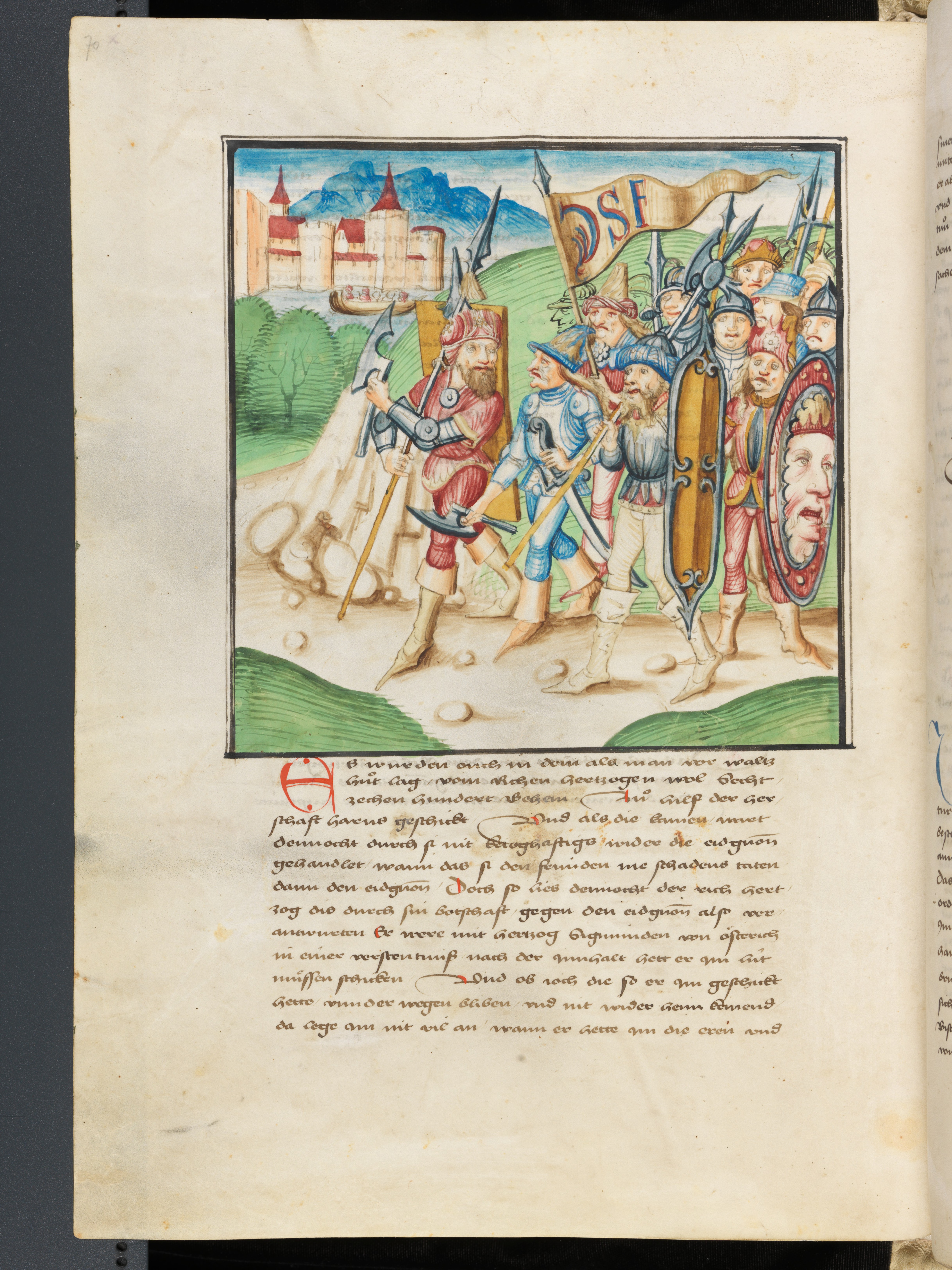
Bohemian troops arriving in 1468 to relieve the besieged Waldshut, Amtliche Berner Chronik (1478–1483)
The Waldshut War (also known as the Schaffhausen War) was part of the military conflicts in 1468 between the nobility in the Sundgau, Breisgau, Klettgau and Hegau regions and Further Austria under the leadership of Habsburg Duke Sigismund the Rich on one side, and eight cantons of the Old Swiss Confederacy together with several allied cities on the other. The main focus of the fighting was Waldshut, which was besieged and partially destroyed.
In the second half of the 15th century, clashes between the aristocratic supporters of the Habsburgs and cities in the southern German region became increasingly frequent. Nobles often descended to the level of robber knights, raiding urban merchants with growing frequency. The Swiss Confederates sought to exploit these disputes to expand their influence north of the Rhine. They concluded defensive alliances with the cities of Schaffhausen (1454), Rottweil (1463) and Mulhouse (1466). Two events led to the escalation of the conflict:
- The city of Schaffhausen concluded an alliance on 1 June 1454 for 25 years with the Confederate cantons of Zurich, Bern, Lucerne, Schwyz, Zug and Glarus after Bilgeri von Heudorf attempted to re-subject Schaffhausen to the Habsburgs. Bilgeri von Heudorf continued his hostility towards the city, and in 1467 the situation escalated when he captured the Schaffhausen mayor Hans Amstad near Anselfingen and released him only after payment of a ransom of 1,800 guilders. The Confederates sent troops to reinforce the city, and a detachment of men from Unterwalden under the command of Captain Kaspar Koller undertook a plundering raid into the Klettgau region.
- The city of Mulhouse concluded an alliance on 17 June 1466 for 25 years with Bern and Solothurn. Mulhouse, which was heavily oppressed by the nobility in an undeclared petty war, sought a military solution and, trusting in its alliance treaty, went on the offensive. In April 1468, Mulhouse units raided the villages of Rixheim and Sausheim, which belonged to the nobility. The estates of Further Austria wanted to punish this attack, and on 15 May 1468 they marched with 4,000 men before Mulhouse and devastated its surroundings. On 18 June 1468, Bern, Solothurn and Fribourg declared war on Duke Sigismund – and soon the other Confederate cities followed suit.
The Sundgau Campaign
On 25 June 1468, the Bernese and Solothurn forces invaded the Sundgau region from the direction of Basel, advancing through Blotzheim, Bartenheim and Habsheim towards Mulhouse, leaving devastation in their wake. This first echelon was followed by soldiers from Zurich and Schwyz. Units from the inner Swiss cantons then marched through villages on the left bank of the Rhine towards Mulhouse.
On 6 July 1468, the three Swiss echelons met between Thann and Mulhouse on the plain known as Ochsenfeld and expected the forces of Further Austria to engage them in open battle, which however did not occur.
After the Habsburgs and their allies refused to fight at Ochsenfeld, the Confederates attempted to take the town of Thann. At the same time, a detachment of 1,000 men was sent via Wehr and Tiengen to Schaffhausen.
On 16 July 1468, the Confederates withdrew from the Sundgau back through Basel, thus ending the so-called Sundgau campaign or Mulhouse War, and the theatre of war shifted further east.
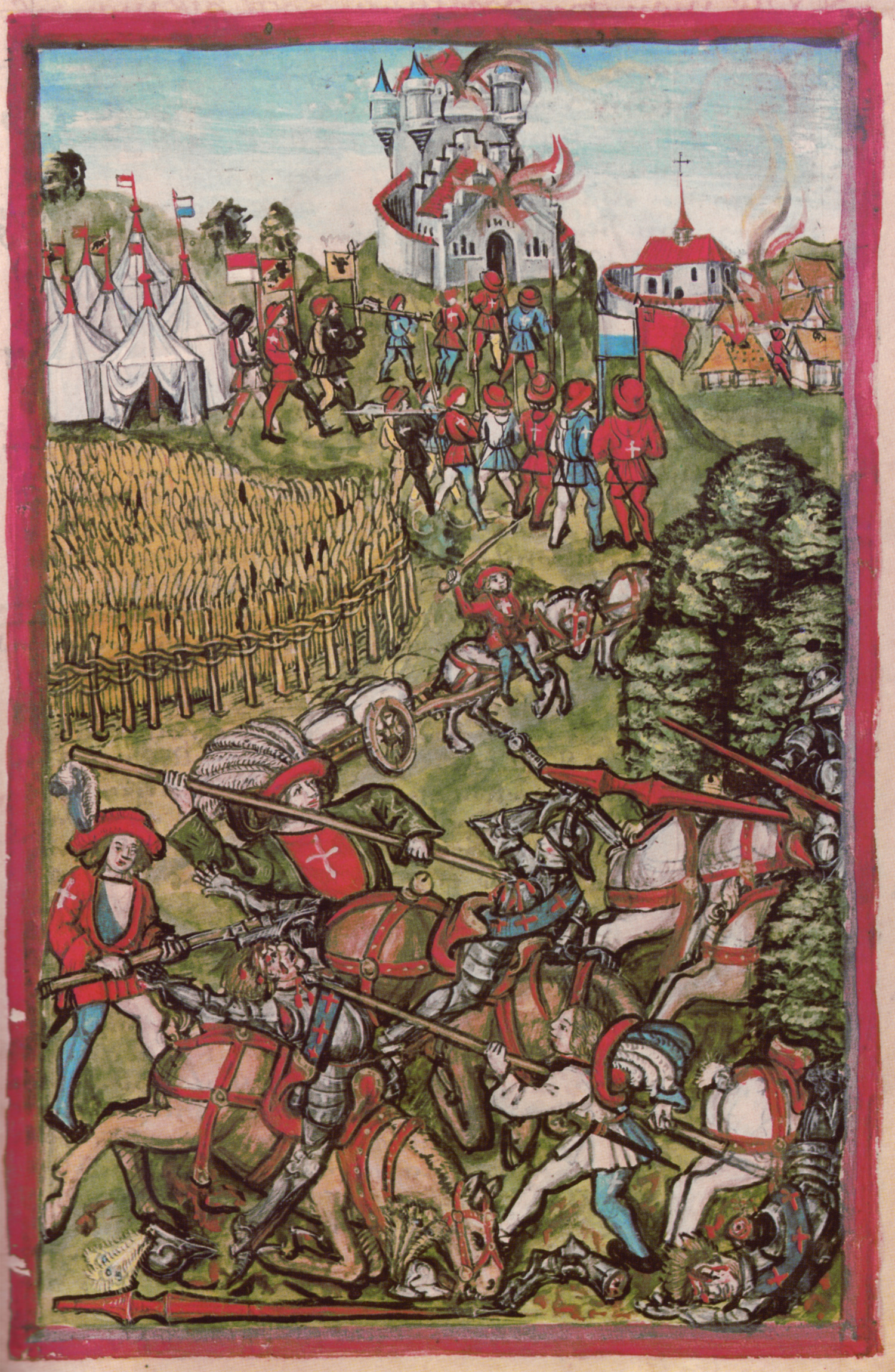
A Swiss (Eidgenossen) supply wagon is attacked by knights of Further Austria. Depiction, Luzerner Chronik (1513)
The Habsburgs, the Nobility and the Imperial Estates
Approximately 800 men were available for the defence of Waldshut. The command was held by Werner von Schienen (1410–1496). Among the defenders were also Wilhelm Herter von Hertneck and Bilgeri von Heudorf. The local nobility had already retreated into Waldshut during the first Confederate incursion into the Klettgau region. The Further Austrian cities of Breisach, Neuenburg am Rhein and Freiburg im Breisgau sent auxiliary detachments.
Waldshut was protected by a circular wall with five towers, fronted by a deep moat and in places also by the River Rhine.
The Breisgau knighthood occupied the section of the Upper Rhine between Rheinfelden and Laufenburg, and conscripts from Further Austrian Breisgau occupied the Black Forest to prevent its inhabitants from joining the Swiss. In this area, Duke Sigismund also deployed Bohemian troops. The exact number of forces that Sigismund deployed during the Waldshut War is not reliably known, but it considerably exceeded the number of the defenders inside Waldshut itself.
Margrave Charles I of Baden feared that the Confederates might attack the Margraviate of Baden-Hachberg from the Mulhouse area – it had returned to the main line of the House of Baden in 1415 – and therefore also sent troops to occupy the other so-called forest towns (Waldstädte). Count Ulrich V of Württemberg likewise began preparations after reports spread that the Confederates intended to besiege the city of Villingen. Duke Ludwig the Rich of Bavaria offered Duke Sigismund assistance and mediation.
A larger Confederate incursion and occupation of the Black Forest would probably have prompted the southern German princes to intervene, but in the case of the threatened border town of Waldshut, they showed little willingness to provide decisive help.
The Confederacy
Although the alliance treaties with Mulhouse and Schaffhausen had been concluded by only a few cantons of the old eight-member Swiss Confederacy (VIII Orte), all eight joined the war against Duke Sigismund, along with several so-called associated cantons (zugewandte Orte), and even the Abbot of the Monastery of St. Gall sent soldiers.
The Confederates had no supreme commander; decisions were made by a council of chief captains. These were also in written communication with their home cantons and often had to seek retroactive approval for further steps. The commander of the Zurich contingent was considered the first captain, who convened the councils.
The Zurich forces were commanded by Eberhard Ottikon. One of the chief commanders of the Zurich detachment was also the later mayor and military leader Hans Waldmann. Among the Lucerne units was the chronicler Petermann Etterlin. The Bernese were led by Petermann von Wabern, Niklaus von Scharnachthal and Niklaus von Diesbach.
The total size of the besieging army reached 16,000 men towards the end of the siege, when additional reinforcements arrived from the home cantons. Part of the forces was simultaneously tied up in plundering expeditions into the Black Forest and in securing the siege against a possible relief of the city.
On the River Rhine before Waldshut, the Bernese forces had two boats and Lucerne one, from which the city fortifications were bombarded.
Course of Events
While the main Confederate forces were still in the Sundgau region, they also sent 2,000 men as reinforcements to Schaffhausen. From there, from 27 June 1468, they marched under the command of Zurich captain Felix Keller on a devastating campaign through the Klettgau region and on 29 June captured the small town of Erzingen.
Incursion into the Black Forest
On 6 July 1468, the Confederates undertook another plundering campaign into the Black Forest, targeting the Monastery of St. Blasien, known for its loyalty to the Habsburgs. In the villages of Bürglen and Indlekofen, properties belonging to this monastery were looted. Near Remetschwiel, they encountered a fortification (Letze) defended by peasants from the Hauenstein area.
After overcoming this defensive line on 7 July 1468 with the help of two detachments, one from Schaffhausen and the other from Sundgau, the Confederates had a clear path to the Monastery of St. Blasien. Near the village of Häusern, Abbot Christoph von Greuth came to meet them and managed to persuade them to withdraw in exchange for a payment of 1,500 guilders.
On their return, the Confederates burned the town of Waldkirch, occupied Tiengen – a fief of the Bishopric of Constance that had been pledged to Bilgeri von Heudorf – and left 600 men there. The Austrian court marshal Jakob Trapp requested additional reinforcements from the city of Freiburg from the Monastery of St. Blasien and expressed his fear that the entire Black Forest wanted to become Swiss.
The Siege of Waldshut
On 19 July 1468, the main Confederate detachments that had participated in the Sundgau campaign assembled at the Rafzerfeld. On 20 July 1468, the Confederates at the diet in Lucerne – by the votes of the cantons of Uri, Schwyz, Unterwalden, Zug, Glarus and Schaffhausen – decided on a military campaign against Waldshut.
The first to arrive on 22 July 1468 were the Lucerne forces together with units from Glarus, Schwyz and Zug at the southern bank of the Rhine before Waldshut. The Zurich and Schaffhausen forces, who had been in Tiengen since 20 July 1468, set out towards the city. The remaining units – primarily the heavy bombards from Zurich and Bern intended for bombarding the city walls – arrived gradually, so the first cannonade on the city is estimated to have taken place on 29 July 1468.
During the siege, approximately 280 heavy stone balls and another 248 smaller mortar projectiles were reportedly fired at the city and its fortifications. The bombardment, among other things, destroyed the city mills, which the inhabitants replaced by building and using treadwheels. Since the besiegers also diverted the water supply to the city and drawing water from the Rhine was dangerous due to enemy fire, the defenders dug a well near the Rhine Gate.
The ducal court marshal Jakob Trapp organised two attempts to supply the city with ammunition and provisions:
- On the night of 3–4 August, a detachment of 1,200 men was assembled in Laufenburg and advanced along the left bank of the Rhine to the village of Full, from where they attempted to cross the river into the city. Although the Confederate siege ring was only weakly manned in this section, the attempt was largely unsuccessful – only about 200 men with a small quantity of supplies managed to get into the city.
- The second attempt, carried out on the night of 8–9 August, failed completely because the Swiss had meanwhile reinforced the defence of this area to 400 men.
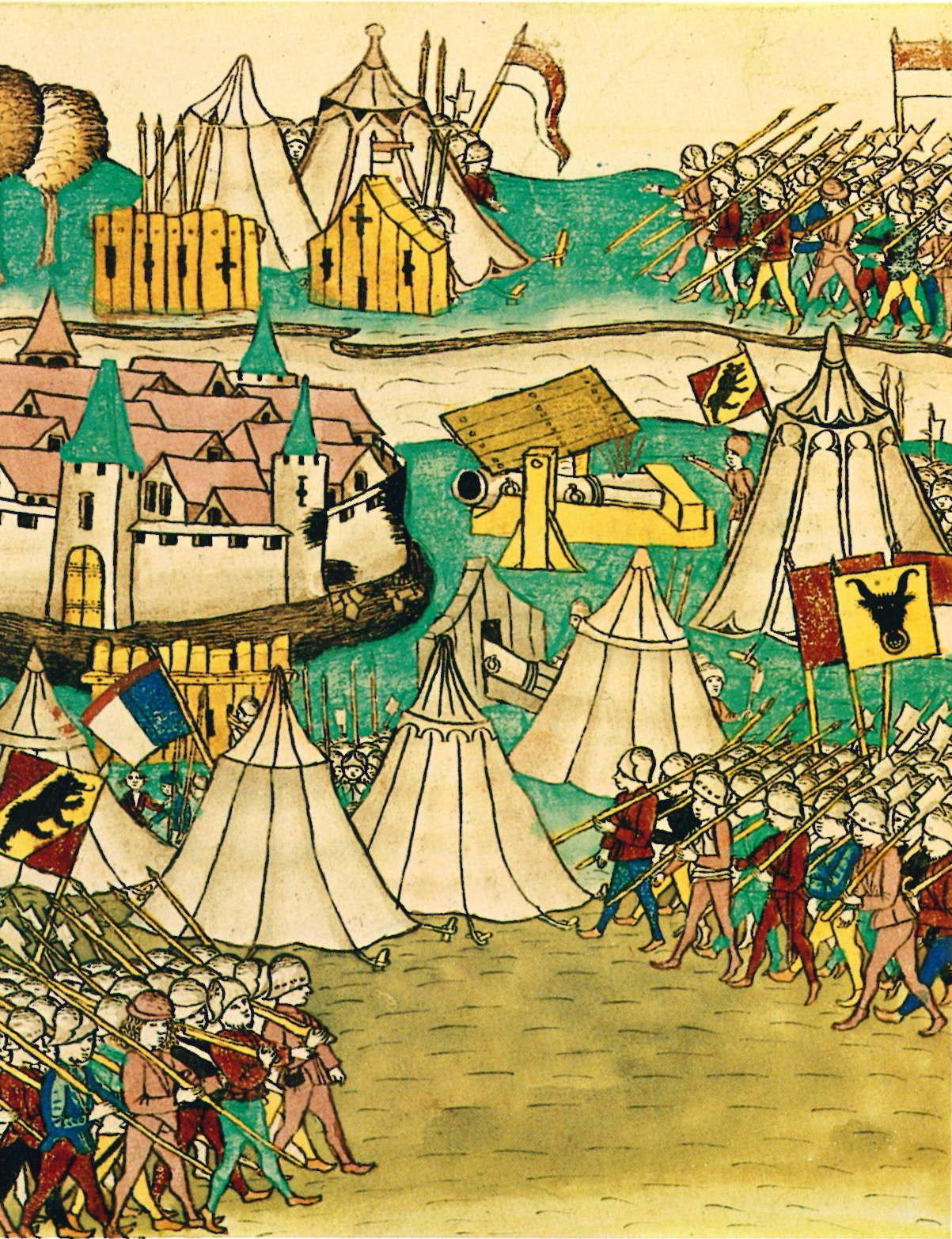
Arrival of reinforced Bernese units before the besieged city of Waldshut, Amtliche Berner Chronik (1478–1483)
The defenders of the city themselves did not remain passive either – they launched several sorties, inflicting losses on the besiegers.
The Landvogt Thüring III von Hallwyl established his headquarters in Laufenburg, and a fortified position with 1,300 men was set up between Albbruck and Dogern. In the St. Blasien area, Duke Sigismund assembled about 1,600 Bohemian mercenaries, who however never effectively engaged in the fighting.
Due to reports of Further Austrian units and rumours of impending reinforcements under the leadership of Duke Sigismund, the Confederates on 10 August 1468 requested additional soldiers from their home cantons. These indeed arrived and the total number of besiegers grew to 16,000 men.
The situation inside the city continued to deteriorate – supplies were collapsing, the city walls were severely damaged by constant bombardment, and the Habsburgs and the nobility were neither willing nor able to undertake a decisive attempt to relieve the city.
On 17 August 1468, the Confederates planned a direct assault on the city, to take place two days later. At the same time, however, peace negotiations were already underway, and the assault was therefore postponed. Moreover, serious disputes broke out in the Confederate camp between the cantons of Zurich and Bern.
On 21 August 1468, the Lucerne forces, supported by the cantons of Schwyz, Glarus and Appenzell, undertook a plundering raid on Bonndorf in the Black Forest, which was burned in the process. During the retreat, this detachment was attacked by Sigismund's units and managed to bring its spoils (including 400 head of cattle) to the camp only with the help of troops from Zurich and Zug. On 24 August, further fighting took place at the fortification near Albbruck.
The interests of Zurich merchants extended as far as Waldshut, and there were also family ties. Formally, the Zurich side argued that an assault on the city would only be possible at the cost of high casualties on their own side. Politically, however, Zurich had no interest in Bern securing influence in this area through a conquered Waldshut.
Zurich was supported by the eastern and inner Swiss cantons, while Bern had Solothurn and Lucerne on its side. These rivalries within the Confederate camp ultimately led to the end of the siege.
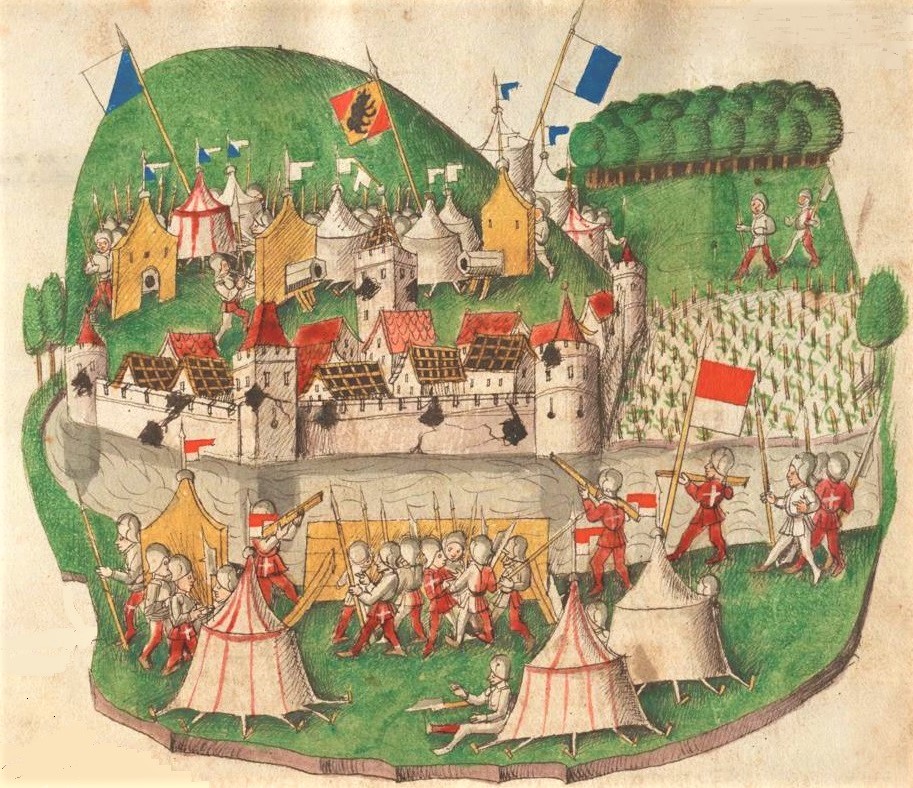
The Confederates besiege Waldshut, Tschachtlanchronik (1470)
Peace Treaty and Consequences
The city of Basel in particular, through its mayor Peter Rot, and the prince-bishops Johann V von Venningen (Bishop of Basel) and Hermann III von Breitenlandenberg (Bishop of Constance), sought to mediate a peaceful settlement between the Confederacy and the Habsburgs. The advisers of Duke Ludwig of Bavaria and Margrave Rudolf of Hachberg-Sausenberg also took part in the negotiations; Hans von Flachslanden represented the latter at the negotiating table. On 14 August 1468, the mediators established contact with the chief commanders of the Confederates, and on 16 August peace negotiations began in Dogern, which resulted on 27 August in the signing of the peace treaty known as the Waldshuter Richtung. According to this treaty, Duke Sigismund committed himself to paying war reparations of 10,000 guilders by 24 June 1469. As a guarantee, he provided the Confederates with the city of Waldshut and the Further Austrian part of the Black Forest. The Waldshut War led to only minimal territorial changes. The sole exception was the Lordship of Wessenberg south of the Rhine with the villages of Hottwil and Mandach, which Bern conquered and annexed to its territorial administration of Schenkenberg.
The siege of Waldshut was lifted on 28 August 1468. Duke Sigismund then borrowed 50,000 guilders from Duke Charles the Bold of Burgundy through the Treaty of Saint-Omer, pledging the Further Austrian territories in Breisgau and Upper Alsace in return. The administration of these pledged territories was initially taken over by a commission led by Margrave Rudolf of Hachberg-Sausenberg, which prepared a report on their condition. Subsequently, Charles the Bold appointed Peter von Hagenbach as Landvogt, who assumed his office in November 1468. Sigismund paid the Confederates the war reparations of 10,000 guilders on 23 June 1469. The mayor of Schaffhausen, however, had to wait until 1476 for the return of his ransom of 1,800 guilders, which was also due to him under the treaty. Emperor Frederick III, cousin of Duke Sigismund, declared the peace treaty void on 26 May 1469 and on 31 August imposed the imperial ban (Reichsacht) on the Confederacy. Neither of these decisions had any real consequences, however.
Although Waldshut suffered considerable damage during the siege, Emperor Frederick III renewed the city's privileges on 21 November 1468, and additionally on 24 February 1469 granted the city the right to collect a water toll on all imported goods on the rivers Aare, Reuss and Limmat. Duke Sigismund issued the city a “Schadlosbrief” (letter of indemnity) on 8 September 1468, in which he committed himself to compensating the damage caused by the siege. He fulfilled this obligation by pledging to the city the right to collect a road toll, thanks to which the city soon recovered economically.
French King Louis XI attempted to win both the Confederacy and Duke Sigismund as allies against Burgundy and mediated peace between them – the so-called Ewige Richtung (Perpetual Accord). After Charles the Bold fell in the Battle of Nancy in 1477, Duke Sigismund retook possession of the pledged Further Austria without returning the 50,000 guilders he had borrowed.
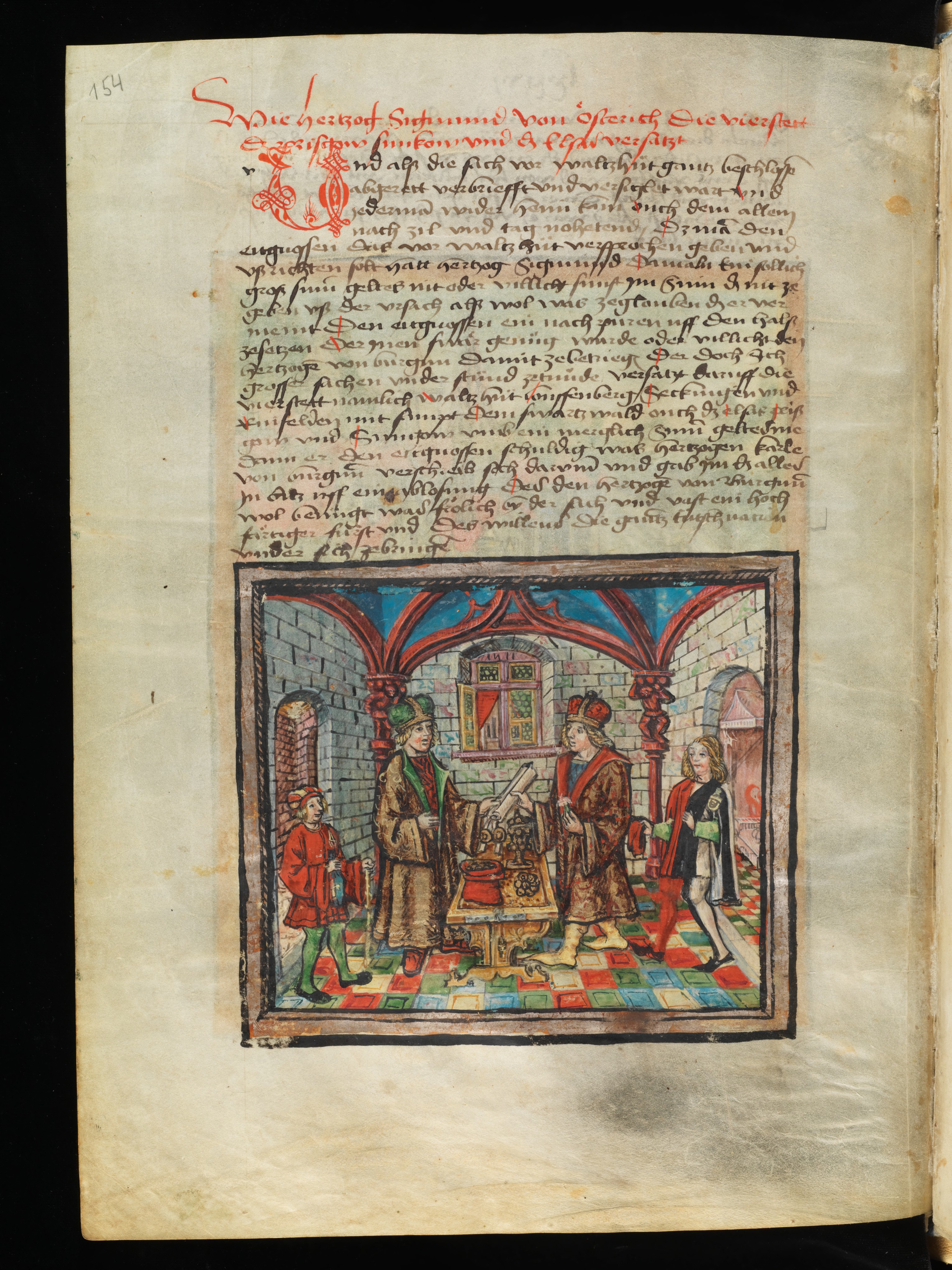
The pledging of Breisgau, Sundgau and Alsace by Austrian Duke Sigismund to Burgundian Duke Charles the Bold on 9 May 1469, Luzerner Chronik (1513)
Participation of Bohemian Mercenaries
Diebold Schilling writes in his Die Berner-Chronik about the participation of Bohemian mercenaries as follows:“It was then, when the camp was laid before Waldshut, that about sixteen hundred Bohemians were sent from the Empire by the duke to aid the lords; and when they came, no warlike action was taken on their part against the Confederacy, for they caused more harm to friends than to the Confederacy. Nevertheless, the Imperial Duke had it explained to the Confederacy through his envoys that he was in an agreement with Duke Sigismund of Austria, according to which he had to send him men, and even if those he sent him stayed somewhere along the way and did not return home, he cared little about it, for he had to send them to him for the sake of honour and on the basis of his earlier written agreement, which they had made together before this war; whatever else he could do and negotiate for peace and good in this matter, he wished to do so with good will, as he and his predecessors had done during those earlier fifteen-year truces and in other affairs.” This record is accompanied by a very peculiar depiction of Bohemian soldiers.
It appears that the Bohemian mercenaries were sent to Sigismund by Bavarian Duke Ludwig IX under the alliance treaty he had with Sigismund. Ludwig had long relied on Bohemian mercenaries, especially during the so-called Bavarian War (1459–1463). It is therefore no surprise that he also employed them in this conflict, about which he cared little, and thus provided only enough participation so as not to be accused of violating alliance treaties.
The Bohemians were probably preceded by their military reputation, since despite their low numbers, Schilling considered them not only worth mentioning, but also worth emphasising that their presence had no military effect. With the phrase that they “caused more harm to friends than to the Confederacy”, Schilling was most likely alluding to the widespread vice of Bohemian soldiers, who plundered more and more the further they were from Bohemia.
In the accompanying illumination, they are depicted as pagans and orientals with long hair, which is clearly an allusion to the public perception of the Bohemians as heretics.
Sources:
If you enjoyed this article, please consider making a small financial contribution. Writing articles is very time consuming and we do it in our free time.
IBAN: CZ39 2010 0000 0028 0346 2929
BIC/SWIFT: FIOBCZPPXXX