


Coat of Arms
I would like to thank Michal Kacl, Jan Škvrňák, Jan Boukal and Markéta Poskočilová for their help with the research.
According to Sedláček, Jobst of Einsiedl received his coat of arms “bezpochyby za krále Ladislava” (undoubtedly under King Ladislaus); its augmentation by King Frederick III of 23 November 1455 is recorded in Chmel's regesta (no. 3452), and Sedláček included it in his list of grants of arms from the years 1439–1456. Vojtěch Král of Dobrá Voda cites the Týřovský arms among the examples in which the eagle was granted “jakožto znamení zvláštní císařské milosti” (as a token of special imperial favour) – in the 1st and 4th fields of a “štípeného a dvakráte děleného štítu” (shield party per pale and twice per fess).
The description of the Týřovský coat of arms varies considerably among individual authors. August Sedláček in Českomoravská heraldika writes that “z Enzidle Týřovští měli štít křížem rozdělený v 1. a 4. poli napříč děleném nahoře černého orla v bílém, ve zpod v bílém tři pruhy pošikem, v 2. a 3. poli modrém tři duty bílé špičkami k sobě a na tři strany se rozbíhající, nad štítem dvě helmy s přikryvadly modrými a bílými s poprsím muže v modrém oděvu se zlatým lemováním, levou s přikr. červenými a bílými s vysokým červeným kloboukem s bílou ohnutou střechou a (černou) kytou.” (the Týřovskýs of Einsiedl had a shield quarterly divided, in the 1st and 4th fields per fess, in chief a black eagle in white, in base in white three bends, in the 2nd and 3rd azure fields three white ostrich feathers pointing towards each other and diverging in three directions, above the shield two helms with blue and white mantling with the bust of a man in blue dress with gold edging, on the left with red and white mantling with a tall red hat with a white curved brim and a (black) plume.)
Rudolf Jan Meraviglia-Crivelli in Der Böhmische Adel states:
“Wappen: Gespalten und zweimal geteilt; 1. u. 2. in Silber ein schwarzer Doppeladler; 2. u. 5. in Blau drei silberne, in Deichsel gestellte Straussenfedern; 3. u. 6. in Silber zwei rothe Schrägrechtsbalken. - Zwei Helme: I aus der Helmrone, eine schwarzgekleidete Jungfrau mit offenen goldenen Haar, welche sich mit beiden Händen eine goldene Krone auf das Haupt setzt; Decken: blau-silbern - II. hoher, rother Heidenhut mit weissem Stulp und oben mit sieben schwarzen Hahnenfedern besteckt; Decken: Roth-silbern.”
Arms: Party per pale and twice per fess; in the 1st and 2nd argent fields a sable double-headed eagle; in the 2nd and 5th azure fields three argent ostrich feathers arranged in pall; in the 3rd and 6th argent fields two gules bends. — Two helms: I. from the helm crown, a sable-clad maiden with flowing golden hair, placing upon her head a golden crown with both hands; mantling: azure-argent — II. a tall gules heathen hat with argent cuff and seven sable cock feathers on top; mantling: gules-argent.
From the seal of Jobst von Einsiedl and most of the surviving coats of arms of the Týřovský family, it is clear that the depiction of the bends in a separate field is rather the invention of whoever depicted the arms. It appears only on a single depiction of the Týřovský coat of arms, namely on the arms of Dorota Polyxena Kateřina Kokořovská, née Týřovská, and thereafter only on depictions created after the extinction of the family. Sedláček himself in his blazon states that the shield is divided into only 4 fields and at the same time that the 1st and 4th are secondarily divided per fess.
The eagles are never depicted in full, but rather than being intentional, this is a practical matter — a whole eagle simply does not fit in the field. Thus, the eagle is variously depicted either almost complete, just without claws (tombstone of Jindřich, seal and tombstone of Jakub Jindřich, relief of Dorota Polyxena Kateřina Kokořovská of Kokořov, née Týřovská) or only its bust (seal of Jobst von Einsiedl, armorial of Lucas Cranach the Younger, arms on the cartouche in the church in Milíčov).
Given the minimal number of surviving colour depictions directly from the time before the extinction of the Týřovský family, determining the colours of the arms is somewhat more complex. Let us begin with the left helm and its respective crest, which is a Tartar hat, whose colour is agreed upon by both the blazon from Sedláček and Meraviglia-Crivelli, as well as the depictions by Cranach the Younger and from the altar in Milíčov. From the depictions by Cranach, from the Milíčov altar and from the relief of Dorota Polyxena Kateřina Kokořovská, we can conclude that the hat was additionally divided per pale, with only one half being red while the other was argent, which would also correspond to the colour of the respective mantling, whose colours also agree in the blazons and the depictions. The blazons and Cranach's depiction also agree on the argent/white colour of the mantling on the right helm. Where, however, the blazons (and modern depictions of the arms) disagree with period depictions are the colours of the charges on the shield. It seems that the problem arose when matching the mantling colours with the charges on the shield, when the azure-argent scheme was probably incorrectly assigned to the feathers in the 2nd and 3rd fields and the gules-argent scheme to the bends (bars) in the 1st and 4th fields. I have deliberately not mentioned the crest on the right helm, which is a man in blue dress according to Sedláček, or a sable-clad maiden placing a crown on her head according to Meraviglia-Crivelli. From both colour and non-colour depictions, it is clear that the man can be immediately dismissed. Cranach the Younger correctly assigned the maiden to the bends, meaning his maiden, the bends and the corresponding mantling are of the same blue colour. It is possible that Cranach took the blue colour from the bends of the arms of Kožlany, which Jobst von Einsiedl obtained for the town in 1472, and which reportedly adopted its bends from the arms of its overlord. Sedláček too, in his entry on Kožlany, writes that in 1472 Vladislaus II augmented the arms of the town “o rodinný znak Týřovských z Ensidle” (with the family arms of the Týřovskýs of Einsiedl), and describes them: “štít na příč rozpůlený; v dolní polovici 2 pruhy stříbrné a 2 červené pošikem položené, v hor. polovici barvy modré vystupuje polovina kozla barvy stříbrné, držící sekeru” (a shield parted per fess; in the lower half 2 argent and 2 gules bends, in the upper azure half issues a demi-goat argent holding an axe).More correct, however, would be the variant from Milíčov, where the maiden, the corresponding mantling and the bends are all sable. It is interesting that this is also the only contemporary depiction where the maiden places a crown on her head.
A word on the armorial itself: it is the manuscript German MS 2 in the John Rylands Library in Manchester, commissioned in 1565 by Elector August of Saxony from Lucas Cranach the Younger in Wittenberg. Cranach's workshop did not compose it afresh, however – it copied an older Habsburg armorial of about 1500 dedicated to Bianca Maria Sforza. The depiction of the Týřovský arms thus goes back iconographically to a time only a quarter of a century after Jobst's death, and to the very court that had augmented the arms in 1455; it is probably their earliest coloured depiction. The arms are placed among the Bohemian and Austrian lords, immediately after the dukes of Poděbrady.
Two points need clarifying. First, the reversal of the quarters is not a systematic feature of the manuscript: the Saxon electoral shield, the Poděbrady arms and the Lamberg arms on the same page are all correctly oriented, whereas the Švamberk arms (the swan facing heraldic sinister) and those of the Hasištejn Lobkovices (quarters swapped just as with the Týřovský) are reversed too. The error thus most likely lay in the exemplar, which Cranach's workshop copied faithfully. Second, the bare label Einsiedell invites confusion with the Saxon lords of Einsiedel (Gnandstein, Scharfenstein), of whom Meraviglia-Crivelli writes that the family was “auch im Meissnischen ansässig” (also settled in the Meissen lands). Sedláček explicitly rejects this in Otto's Encyclopaedia – the family is “rozdílný od hrabat z Einsiedlu v Německu žijících i krví i erbem” (distinct from the counts of Einsiedel living in Germany both in blood and in arms) – and the armorial proves him right: the Saxon Einsiedels appear in it separately, on fol. 158 among the knights of Meissen, with their canting arms of a hermit in a habit with staff, hoe and rosary on a golden shield, which share not a single charge with the Týřovský arms.
The correct blazon therefore most likely reads:
A quartered shield where the 1st and 4th fields are per fess, with a sable eagle issuant or salient on an or background in chief and two sable bends on an argent background in base. In the 2nd and 3rd gules fields are three argent ostrich feathers pointing towards each other and diverging. Above the shield are two helms with crowns; the left with gules-argent mantling, from which rises a per pale tall Tartar hat with a sable or argent plume, its sinister half argent and dexter half gules. The right helm has sable-or mantling and in the crest a sable-clad maiden, either crowned or placing a golden crown on her head.
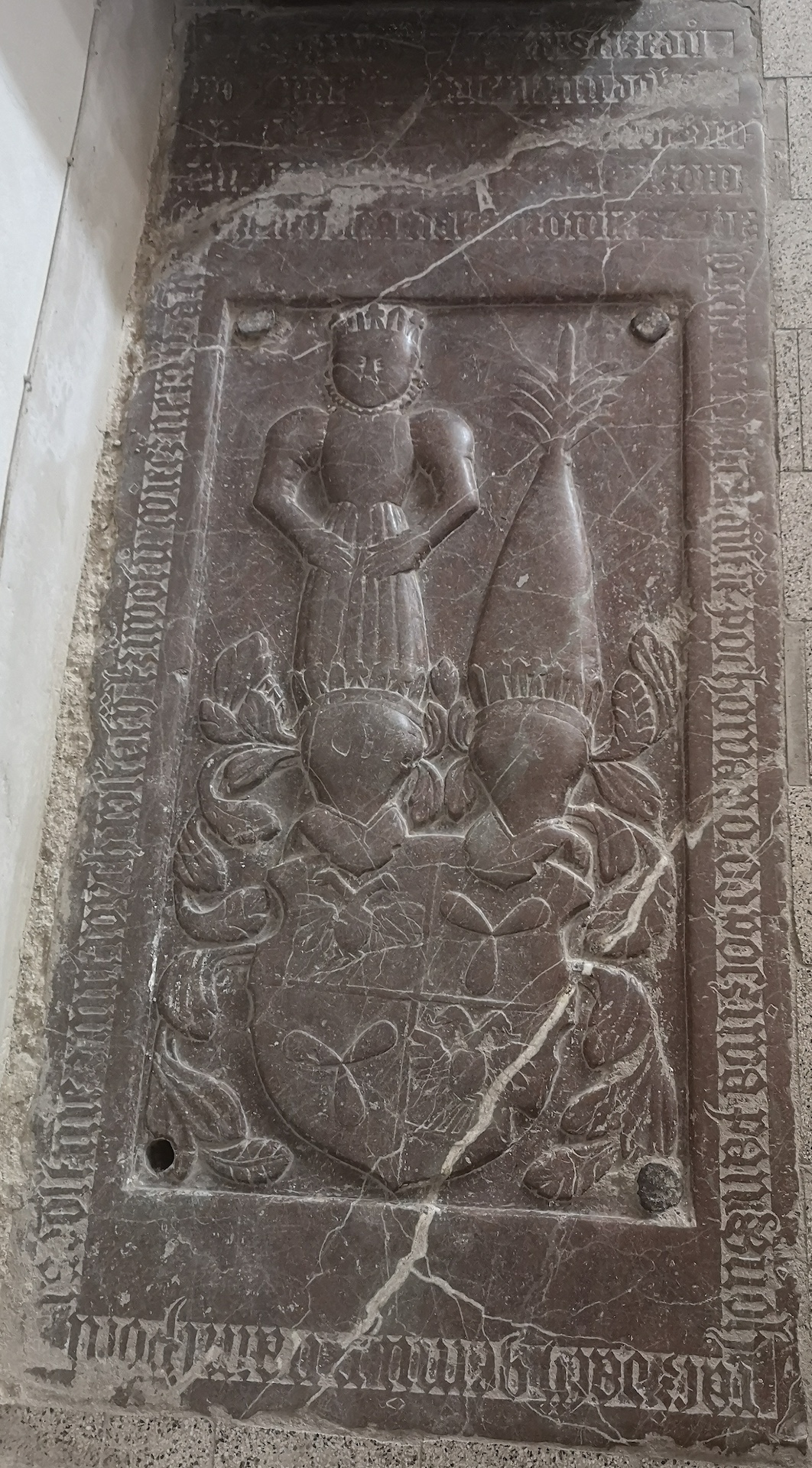
The depiction of the Týřovský coat of arms from 1556 on the tombstone of Jindřich Týřovský in the Church of St. Nicholas in Jince.
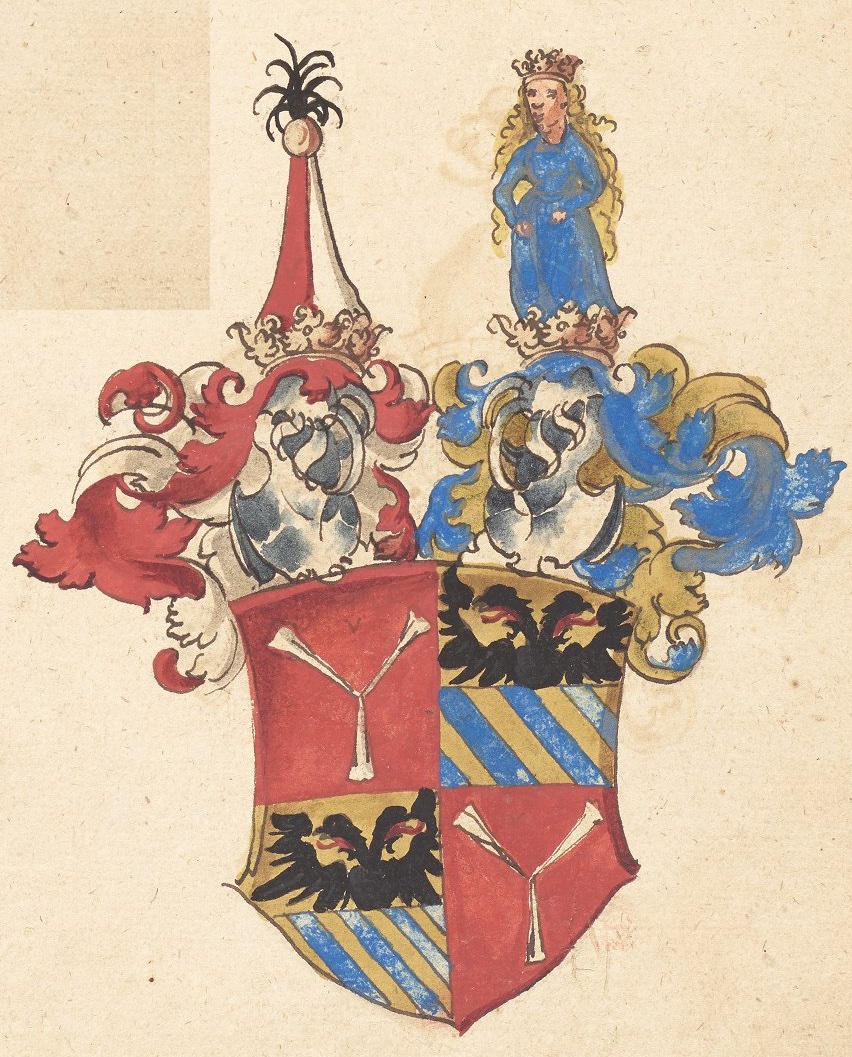
The Týřovský arms (labelled merely Einsiedell) in the armorial from the workshop of Lucas Cranach the Younger, Wittenberg 1565 (Manchester, John Rylands Library, German MS 2, fol. 173), copied from an older Habsburg armorial of about 1500. The quarters are reversed compared with all other depictions, probably already in the exemplar.
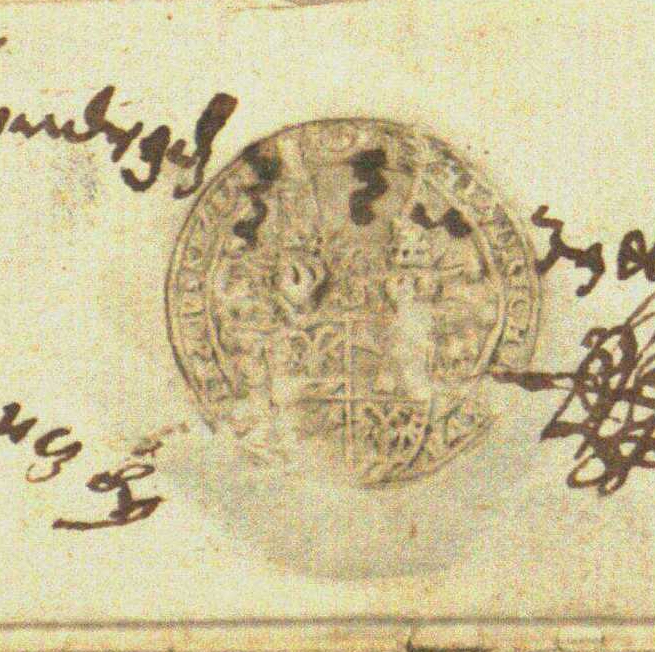
The Týřovský coat of arms on the seal of Jakub (Jindřich) Týřovský from 25 April 1616.
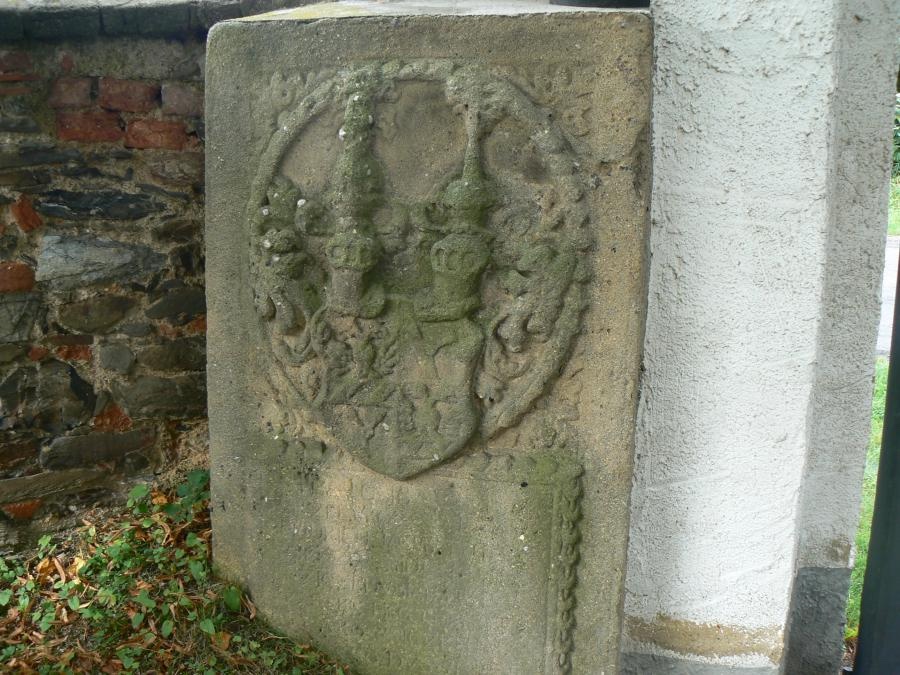
The Týřovský coat of arms on the tombstone of Jakub Jindřich Týřovský of Einsiedl from 1618.

The coat of arms of Dorota Polyxena Kateřina Kokořovská of Kokořov, née Týřovská of Einsiedl, on the relief at the Church of St. Adalbert in Šťáhlavy, between 1637 and 1640.
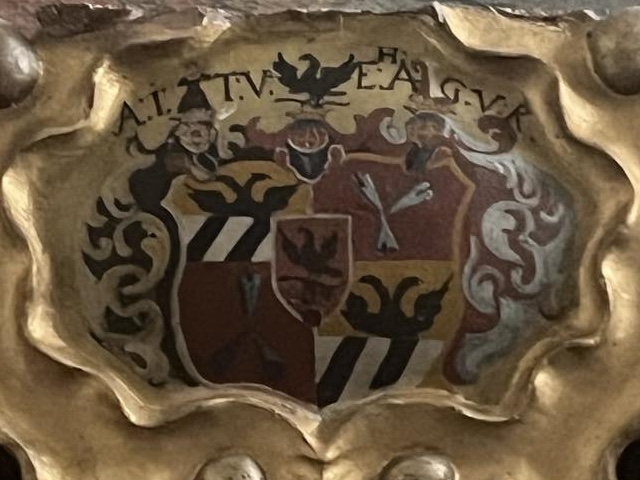
The Týřovský coat of arms on the cartouche from the altar of the Church of St. Peter in Chains in Milíčov from 1665.
Sources:
If you enjoyed this article, please consider making a small financial contribution. Writing articles is very time consuming and we do it in our free time.
IBAN: CZ39 2010 0000 0028 0346 2929
BIC/SWIFT: FIOBCZPPXXX